The Belmont Report in Practice: Applying Ethical Principles and Informed Consent in Modern Clinical Research
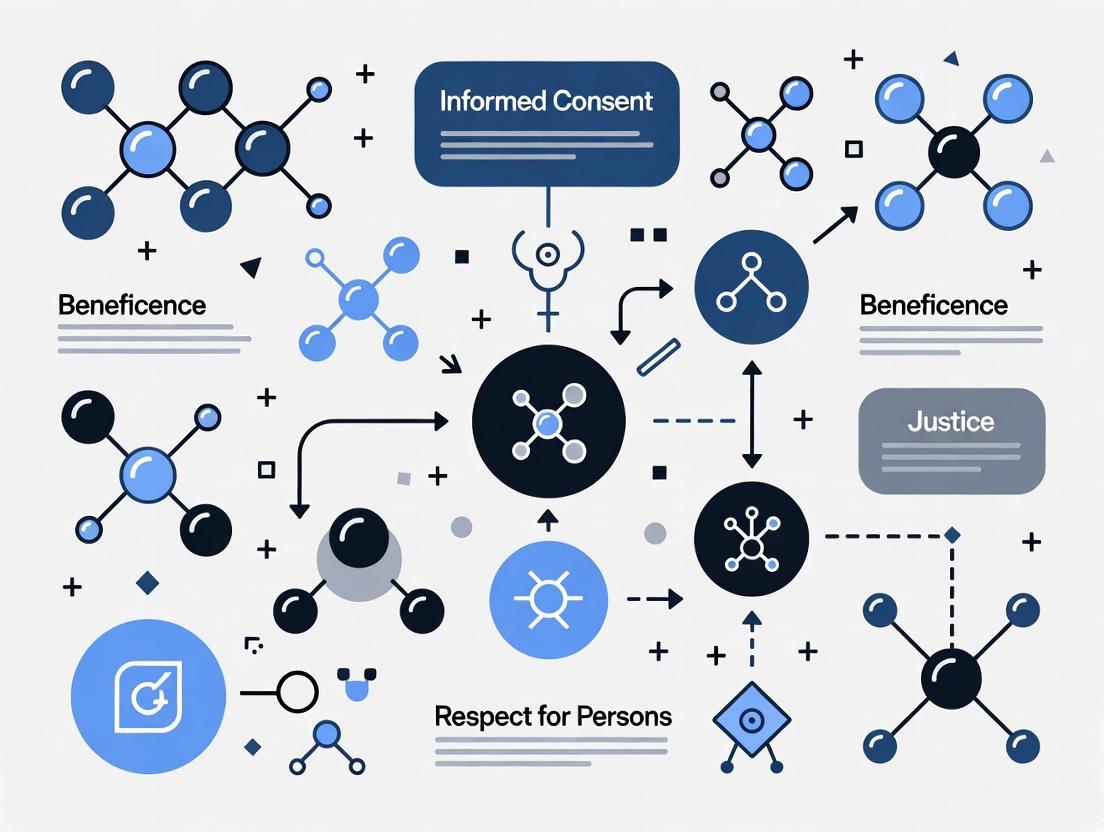
This article provides a comprehensive guide to the Belmont Report's ethical principles—Respect for Persons, Beneficence, and Justice—and their critical application in contemporary biomedical research.
The Belmont Report in Practice: Applying Ethical Principles and Informed Consent in Modern Clinical Research
Abstract
This article provides a comprehensive guide to the Belmont Report's ethical principles—Respect for Persons, Beneficence, and Justice—and their critical application in contemporary biomedical research. Tailored for researchers, scientists, and drug development professionals, it bridges the gap between foundational ethics and practical implementation. The content explores the historical context that necessitated the report, details methodological steps for effective informed consent, addresses common challenges with vulnerable populations, and validates the framework through comparison with other guidelines and the essential role of Institutional Review Boards (IRBs). The goal is to equip practitioners with the knowledge to conduct ethically sound and compliant research.
The Bedrock of Research Ethics: Understanding the Belmont Report's History and Core Principles
This whitepaper examines the Tuskegee Syphilis Study as the catalytic scandal that precipitated modern research ethics governance in the United States. We trace the direct legislative and ethical response pathway from the study's public exposure in 1972 to the National Research Act of 1974 and subsequently to the Belmont Report's ethical framework. For contemporary researchers and drug development professionals, this analysis provides critical historical context for current regulatory structures, emphasizing how ethical failures systematically translated into protective policies that now govern human subjects research.
The Tuskegee Syphilis Study: A Paradigm of Ethical Failure
The "Tuskegee Study of Untreated Syphilis in the Negro Male" (1932-1972) represents one of the most egregious violations of research ethics in U.S. history. Conducted by the U.S. Public Health Service (PHS), the study enrolled 600 African American sharecroppers from Macon County, Alabama—399 with latent syphilis and 201 without the disease serving as controls [1] [2].
Experimental Protocol and Methodology
The study employed a longitudinal observational design with deliberate intervention to prevent participants from receiving treatment:
- Deceptive Enrollment: Participants were recruited under the guise of receiving "special free treatment" for "bad blood," a colloquial term encompassing various conditions including syphilis, anemia, and fatigue [3] [2].
- Withheld Diagnosis: Researchers never informed subjects of their syphilis diagnosis, despite known risks of transmission and severe health consequences [1] [2].
- Active Prevention of Treatment: When penicillin became the standard treatment for syphilis in 1947, researchers systematically prevented participants from accessing therapy through military induction centers and later through rapid treatment centers established to eradicate the disease [3] [2].
- Deceptive Procedures: Lumbar punctures were misrepresented as "special treatment" rather than diagnostic procedures [1].
- Retention Strategies: The study employed a nurse to transport participants, provide meals, and offer burial insurance to secure autopsy consent—strategies particularly effective during the Great Depression [3].
Table 1: Tuskegee Study Experimental Parameters
| Parameter | Study Implementation | Ethical Violation |
|---|---|---|
| Informed Consent | None obtained; deliberate deception about study purpose | Violation of personal autonomy and right to self-determination |
| Treatment Access | Actively withheld effective treatment (penicillin) after 1947 | Violation of beneficence; direct harm to participants |
| Diagnostic Disclosure | Never informed of syphilis diagnosis | Prevented pursuit of independent treatment; increased public health risk |
| Study Duration | Extended from 6 months to 40 years (1932-1972) | Exploitation of vulnerable population over generations |
| Benefit-Risk Ratio | No direct benefit to participants; known severe risks | Complete imbalance favoring scientific knowledge over participant welfare |
Human Toll and Lasting Impact
The consequences of this ethical failure were devastating:
- Direct Mortality: By the study's conclusion in 1972, 28 participants had died directly from syphilis, 100 from related complications, with only 74 of the original subjects still alive [2].
- Secondary Transmission: Forty wives had been infected, and 19 children were born with congenital syphilis [3] [2].
- Societal Impact: The study profoundly damaged trust in medical research, particularly within African American communities, with effects persisting for generations [3].
The Path to Reform: Legislative and Ethical Response
The Tuskegee Study's exposure in 1972 created immediate public outrage that demanded systemic reform of human subjects research protections.
The National Research Act of 1974
In direct response to Tuskegee, Congress passed the National Research Act (Public Law 93-348) on July 12, 1974, creating the first comprehensive federal framework for research oversight [4] [5]. The legislation established:
- The National Commission for the Protection of Human Subjects of Biomedical and Behavioral Research: This expert body was tasked with identifying basic ethical principles and developing guidelines for human subjects research [4].
- Institutional Review Board (IRB) Requirements: Mandated review of all Department of Health, Education, and Welfare (DHEW)-supported research by local IRBs [4].
- Voluntary Informed Consent: Required researchers to obtain voluntary informed consent from all persons participating in DHEW-conducted or funded studies [4].
Table 2: Key Provisions of the National Research Act of 1974
| Provision | Legislative Requirement | Significance |
|---|---|---|
| National Commission | Established 11-member expert commission | First federal body dedicated specifically to research ethics |
| IRB System | Formalized and required local institutional review | Created decentralized oversight structure with local accountability |
| Informed Consent | Mandated voluntary informed consent for federally-funded research | Established autonomy and respect for persons as foundational principles |
| Specific Populations | Directed study of protections for vulnerable groups (children, prisoners) | Recognized need for special protections beyond general principles |
The Belmont Report: Ethical Framework for Research
The National Commission's most enduring contribution was the Belmont Report, published in 1979, which established three fundamental ethical principles for research involving human subjects [6]:
Diagram 1: Historical progression from scandal to ethical framework
Ethical Principles and Applications
The Belmont Report established three core principles with specific applications for research practice:
- Respect for Persons: Acknowledges personal autonomy and requires protection for individuals with diminished autonomy. This principle is operationalized through informed consent processes requiring comprehensive information disclosure, comprehension, and voluntary participation [6].
- Beneficence: Extends beyond non-maleficence to an obligation to maximize possible benefits and minimize possible harms. This is applied through systematic assessment of risks and benefits in research design and review [6].
- Justice: Addresses the fair distribution of research burdens and benefits, requiring equitable selection of subjects to avoid exploitation of vulnerable populations. This directly responded to Tuskegee's exploitation of African American men [6] [7].
Diagram 2: Belmont Report principles to applications mapping
Implementation Framework: From Principles to Practice
The Belmont principles directly informed federal regulations codified in 45 CFR 46 (the "Common Rule"), establishing uniform protections across federal departments and agencies [5] [6].
Institutional Review Board System
The National Research Act formalized the IRB system, creating local oversight committees with specific composition requirements and authority [5]:
- Minimum five members with diverse backgrounds
- Scientific and nonscientific representation
- Conflict of interest management
- Protocol approval authority based on ethical standards
As of 2023, approximately 2,300 IRBs operate in the United States, primarily affiliated with universities and healthcare institutions, with a growing number of independent, for-profit IRBs [5].
Regulatory Evolution and Current Challenges
The regulatory framework established in response to Tuskegee continues to evolve, addressing emerging challenges:
- 1991 Common Rule Adoption: 16 federal departments adopted the Federal Policy for the Protection of Human Subjects, creating uniform requirements [4].
- Single IRB Review: Recent requirements for multisite research to use single IRB review aim to eliminate duplicative reviews while maintaining oversight [5].
- Ongoing Substantive Limitations: Current regulations exclude deidentified information and biospecimens from protection and prohibit IRBs from considering long-range societal implications of research—significant limitations in the era of AI and big data research [5].
Table 3: Research Ethics Framework Evolution Post-Tuskegee
| Timeline | Regulatory Development | Impact on Research Practice |
|---|---|---|
| 1974 | National Research Act | Established IRB system and National Commission |
| 1979 | Belmont Report | Defined three foundational ethical principles |
| 1991 | Federal Policy (Common Rule) | Standardized protections across federal agencies |
| 2017 | Revised Common Rule | Updated requirements for contemporary research contexts |
| 2020 | Single IRB Mandate | Required single IRB review for multisite studies |
Contemporary Implications for Research Professionals
For today's researchers and drug development professionals, understanding this historical context is essential for several reasons:
Ethical Design Imperatives
The Tuskegee-Belmont narrative underscores non-negotiable design requirements:
- Informed Consent as Process: Consent must be ongoing, comprehensive, and comprehensible to participants, not merely a signed form [6].
- Vulnerability Assessment: Research protocols must explicitly address potential vulnerabilities in participant populations, including situational vulnerabilities like power differentials in student recruitment [8].
- Equitable Subject Selection: Justice requirements demand scrutiny of whether disadvantaged populations bear disproportionate research burdens [6].
Research Ethics Toolkit: Essential Components
Table 4: Essential Research Ethics Framework Components
| Component | Function | Regulatory Basis |
|---|---|---|
| IRB Review System | Independent ethical review of research protocols | National Research Act (1974) |
| Informed Consent Documents | Ensure comprehensive participant understanding | Belmont Report - Respect for Persons |
| Risk-Benefit Assessment Framework | Systematically evaluate and minimize risks | Belmont Report - Beneficence |
| Participant Recruitment Materials | Ensure equitable selection and avoid coercion | Belmont Report - Justice |
| Data Safety Monitoring Plans | Ongoing risk assessment during study conduct | FDA Regulations (21 CFR 50) |
| Vulnerable Population Protections | Additional safeguards for specific groups | Common Rule Subparts B-D |
The trajectory from Tuskegee to the National Research Act to the Belmont Report represents a transformative evolution in research ethics. For today's researchers, this history provides essential context for current regulatory requirements and underscores the ethical foundations underlying protocol development and review processes. The systematic ethical failures of Tuskegee—the disregard for autonomy, the absence of beneficence, and the profound injustice—directly shaped the protective structures that now govern human subjects research. Understanding this historical context is not merely an academic exercise but a professional imperative for maintaining public trust and conducting ethically sound research that honors the dignity and rights of all participants.
The Belmont Report, formally titled "Ethical Principles and Guidelines for the Protection of Human Subjects of Research," was published in 1979 by the National Commission for the Protection of Human Subjects of Biomedical and Behavioral Research [7]. This landmark document was a direct response to historical abuses in research, most notably the Tuskegee Syphilis Study, where treatment was withheld from 400 African American men without their consent so scientists could study the disease's progression [9] [10]. The report established a foundational ethical framework to ensure that research involving human subjects is conducted responsibly and morally. The three core principles—Respect for Persons, Beneficence, and Justice—serve as the ethical bedrock for federal regulations in the United States, including the Common Rule (45 CFR 46), and guide Institutional Review Boards (IRBs) in their oversight of research protocols [11] [6] [12]. This whitepaper provides an in-depth technical analysis of these three pillars and their critical application within modern clinical research and drug development.
The Principle of Respect for Persons
The principle of Respect for Persons incorporates two distinct ethical convictions: first, that individuals should be treated as autonomous agents, and second, that persons with diminished autonomy are entitled to protection [11] [13]. This dual conviction requires researchers to acknowledge human subjects' capacity for self-determination and to provide additional safeguards for those whose autonomy is limited.
Operationalization through Informed Consent
For autonomous individuals, Respect for Persons is primarily operationalized through the process of informed consent [11] [13]. This is not merely the act of signing a form but a continuous process of communication and understanding that begins before enrollment and continues throughout study participation. The Belmont Report specifies that this process must contain three fundamental elements:
- Information: Researchers must disclose all relevant information to prospective subjects, including the research procedure, its purposes, risks and anticipated benefits, alternative procedures (where therapy is involved), and a statement offering the subject the opportunity to ask questions and to withdraw from the research at any time without penalty [9] [11].
- Comprehension: The information must be presented in a manner that is understandable to the subject. Researchers have an obligation to ensure that the subject has adequately understood the information provided, which may require adapting the presentation to the subject's capacity or using a neutral, knowledgeable third party to explain complex concepts [13].
- Voluntariness: The agreement to participate must be made without coercion or undue influence. Researchers must ensure that subjects' decisions are free from controlling interference by others and that they are in a situation that allows for a voluntary choice [12].
Protection of Subjects with Diminished Autonomy
The second moral requirement under this principle involves protecting individuals with diminished autonomy. This group includes children, adults with severe cognitive impairments, unconscious patients, and those with limited mental capacity [9]. The extent of protection should be commensurate with the risk of harm and the likelihood of benefit. For these populations, Respect for Persons usually entails empowering a proxy decision-maker to decide about participation, ideally based on what the subject would have decided if capable (substituted judgment) or, barring that knowledge, in the subject's best interests [9]. The judgment that an individual lacks autonomy should be periodically re-evaluated, as it may vary in different situations [11].
The Principle of Beneficence
The principle of Beneficence extends beyond simply "doing no harm" to encompass an affirmative obligation to secure the well-being of research subjects [11] [13]. This principle is expressed through two complementary rules: (1) do not harm (non-maleficence), and (2) maximize possible benefits and minimize possible harms [11] [12]. In the context of research, Beneficence requires a systematic analysis of the risk-benefit profile to ensure that the potential gains for the individual subject and/or society are proportionate to the risks assumed by the participants.
Systematic Assessment of Risks and Benefits
The assessment of risks and benefits is a critical, formal process that requires gathering systematic and comprehensive information about the proposed research [13]. This assessment serves multiple functions: for the investigator, it is a means to examine whether the research is properly designed; for the IRB, it is a method for determining whether the risks to subjects are justified; and for prospective subjects, it provides essential information for their decision to participate [13]. The Belmont Report emphasizes that this assessment must consider all types of possible harm:
- Physical (e.g., death, disability, infection)
- Psychological (e.g., depression, anxiety)
- Economic (e.g., job loss)
- Social (e.g., discrimination or stigma) [9]
Table 1: Framework for Risk-Benefit Assessment in Clinical Research
| Assessment Component | Key Considerations | Documentation Requirements |
|---|---|---|
| Nature & Scope of Risks | Identify all foreseeable physical, psychological, social, and economic harms; characterize their probability and severity. | Protocol must detail all potential risks and the basis for probability estimates (e.g., prior preclinical/clinical data). |
| Nature & Scope of Benefits | Distinguish between direct therapeutic benefits to subjects and societal benefits (e.g., gained knowledge); avoid overstating direct benefits. | Protocol must clearly separate and define direct benefits from societal benefits; all promotional materials must be consistent. |
| Risk-Benefit Relationship | Determine if the risks are justified by the benefits to the subject and/or the importance of the knowledge; explore alternative ways to obtain benefits. | Investigator and IRB must provide a rationale that the potential benefits outweigh the risks, or that the knowledge is sufficiently valuable. |
The Principle of Justice
The principle of Justice in human subjects research addresses the ethical obligation to ensure the fair distribution of the burdens and benefits of research [11] [6]. This principle requires scrutiny of the selection of research subjects to determine whether some classes of people are being systematically selected for reasons of easy availability, compromised position, or manipulability, rather than for reasons directly related to the problem being studied [11] [13].
Historical Context and Vulnerable Populations
The importance of this principle is rooted in a history of ethical abuses where socially vulnerable groups were disproportionately burdened with the risks of research. The Tuskegee Syphilis Study is a prime example, in which economically disadvantaged African American men were exploited for research from which they could not possibly benefit [9] [10]. Other populations historically vulnerable to unjust selection include welfare patients, particular racial and ethnic minorities, and persons confined to institutions [13]. The Belmont Report establishes that groups and individuals who accept the risks and burdens of research should be in a position to enjoy its benefits, and those who may benefit should share in some of the risks and burdens [9].
Equitable Selection of Subjects in Modern Research
In contemporary practice, the principle of Justice translates into requirements for the equitable selection of research participants [12]. This involves ensuring that the primary basis for recruiting and enrolling groups and individuals is the scientific goals of the study—not vulnerability, privilege, or other unrelated factors [9]. Investigators must base inclusion and exclusion criteria on those factors that most effectively and soundly address the research problem [11]. Furthermore, Justice requires researchers to proactively consider whether populations that stand to benefit from a therapy or intervention are appropriately included in the trials that test them. For instance, drug development professionals must ensure that clinical trials include representative samples of the populations likely to use the drug once approved, unless there is a sound scientific reason for exclusion [9] [6].
Application of the Ethical Principles in Regulatory Practice
The three ethical principles are translated into concrete regulatory requirements through specific applications. The Belmont Report itself delineates how these abstract principles inform practice, particularly in the areas of informed consent, risk-benefit assessment, and subject selection [13].
From Principles to Practice
The following diagram illustrates the logical relationship between the foundational ethical principles defined in the Belmont Report and their practical applications in research oversight, which are then implemented through specific regulatory requirements.
For researchers, scientists, and drug development professionals, navigating the ethical and regulatory landscape requires familiarity with key resources and reagents. The following table details essential components of the ethical research toolkit.
Table 2: Research Reagent Solutions for Ethical Protocol Implementation
| Tool/Resource | Function & Purpose | Application in Research |
|---|---|---|
| Informed Consent Forms (ICFs) | Documents the consent process; ensures participants receive and acknowledge understanding of all required study information. | Must include purpose, procedures, risks, benefits, alternatives, confidentiality terms, and contact information; requires ongoing updates as new information emerges [9] [6]. |
| Institutional Review Board (IRB) | Independent review panel that initially approves and periodically monitors research to protect the rights and welfare of human subjects. | Reviews research protocols, consent forms, and recruitment materials to ensure ethical and regulatory compliance before and during study conduct [9] [12]. |
| Data and Safety Monitoring Board (DSMB) | Independent committee of experts that monitors patient safety and treatment efficacy data while a clinical trial is ongoing. | Particularly critical in multi-site, randomized, double-blind studies of potentially risky interventions; can recommend trial modification or termination based on interim data [9]. |
| Protocol & Statistical Analysis Plan | Detailed research plan and pre-specified statistical methods that define the study's scientific objective and validity. | Ensures the study is designed to get a reliable answer to a valuable question, minimizing risk and maximizing the value of knowledge gained; invalid research is inherently unethical [9]. |
| The Common Rule (45 CFR 46) | Core set of U.S. federal regulations for protecting human research subjects. | Provides the regulatory basis for IRB operations, informed consent requirements, and assurances of compliance for all federally funded research [7] [6] [12]. |
The three pillars of the Belmont Report—Respect for Persons, Beneficence, and Justice—provide a robust and enduring framework for the ethical conduct of research involving human subjects. For researchers, scientists, and drug development professionals, these principles are not abstract concepts but practical guides that are operationalized through informed consent, systematic risk-benefit analysis, and equitable subject selection. These applications are, in turn, enforced by regulatory bodies and IRBs to ensure compliance. As clinical research grows increasingly complex and global, a deep understanding of these ethical foundations remains paramount. It ensures that the pursuit of scientific knowledge and therapeutic innovation never comes at the cost of sacrificing human dignity, well-being, or fairness. Upholding these principles is both a professional obligation and a moral imperative for the entire research community.
The Belmont Report, published in 1979, established the three foundational ethical principles—Respect for Persons, Beneficence, and Justice—for conducting research with human subjects [6]. This seminal document was created by the National Commission for the Protection of Human Subjects of Biomedical and Behavioral Research in response to the National Research Act of 1974, which was itself a legislative reaction to historical ethical abuses in research [7]. The Report's primary function was to identify basic ethical principles and develop guidelines that should assist in resolving the ethical problems that surround the conduct of research with human subjects. However, these ethical principles required a regulatory framework to ensure their consistent application across the diverse landscape of scientific inquiry.
This technical guide explores the critical transition of these ethical principles from concept to codification through the Common Rule (45 CFR 46), the federal policy that provides the core procedures for protecting human research subjects [14]. For researchers, scientists, and drug development professionals, understanding this bridge from principles to practice is essential for designing and conducting ethically sound research that complies with regulatory requirements. The journey from the Belmont Report's ethical framework to the implementable regulations of the Common Rule represents a pivotal development in the protection of human subjects, establishing standards that have shaped the conduct of research for decades.
The Belmont Report's Ethical Framework
The Belmont Report established three fundamental ethical principles that form the moral foundation for human subjects research regulations. These principles provide the systematic framework for analyzing the ethical considerations inherent in research involving human participants.
The Three Core Ethical Principles
Respect for Persons: This principle incorporates at least two fundamental ethical convictions: first, that individuals should be treated as autonomous agents, and second, that persons with diminished autonomy are entitled to protection [6]. The application of this principle requires that participation in research be voluntary and informed, leading to the requirement of informed consent. Respect for persons acknowledges the personal dignity and autonomy of individuals, providing the philosophical basis for obtaining voluntary, informed consent prior to conducting research involving human subjects [14].
Beneficence: This principle goes beyond merely refraining from harm, encompassing an obligation to protect individuals from harm and to maximize possible benefits while minimizing potential risks [6]. In the research context, beneficence requires a careful systematic analysis of the risks and benefits of proposed research. This principle provides the foundation for the rigorous risk/benefit assessment that must be part of the review of any research protocol [14]. Beneficence demands that researchers not only protect participants from harm but also act in ways that secure their well-being.
Justice: The principle of justice addresses the fair distribution of the benefits and burdens of research [6]. This principle requires that the selection of research subjects be scrutinized to determine whether some classes of participants (such as welfare recipients, racial minorities, or persons confined to institutions) are being systematically selected simply because of their easy availability or manipulability, rather than for reasons directly related to the research problem. Justice promotes equitable representation in research by ensuring that the risks and benefits of research are fairly distributed among potential beneficiary groups [14] [6].
Application of the Principles
The Belmont Report further specified how these ethical principles should be applied in the conduct of research through three primary applications:
Informed Consent: Stemming primarily from Respect for Persons, informed consent requires that subjects enter into research voluntarily and with adequate information [6]. The consent process must contain three elements: information, comprehension, and voluntariness. Researchers must provide sufficient information in understandable language, ensure the subject's understanding of the information, and ensure that the agreement to participate is free from coercion or undue influence.
Assessment of Risks and Benefits: Arising from the principle of Beneficence, this application requires a careful assessment of the risks and benefits associated with the research [6]. The systematic assessment of risks and benefits poses a critical step in the ethical conduct of research, requiring that possible harms and benefits be identified and evaluated, and that the potential benefits justify the risks.
Selection of Subjects: Derived from the principle of Justice, this application addresses how participants are chosen for research studies [6]. It demands that the selection process be fair and not disproportionately target specific groups based on convenience, manipulability, or compromised position without regard to the distribution of benefits.
The Common Rule: Operationalizing Ethical Principles
The Common Rule (45 CFR 46) serves as the primary federal policy for the protection of human research subjects in the United States, providing the regulatory framework that translates the Belmont Report's ethical principles into enforceable requirements [14]. Initially adopted by 17 federal agencies in 1991, including the Department of Justice and the Department of Health and Human Services, the Common Rule establishes uniform procedures for human research subject protections, with informed consent and Institutional Review Board (IRB) oversight as its cornerstones [14]. The policy was significantly updated in 2019 with revisions aimed at enhancing transparency and updating protocols for contemporary research challenges [15].
Mapping Belmont Principles to Common Rule Provisions
Table: Bridging Belmont Ethical Principles to Common Rule Requirements
| Belmont Ethical Principle | Common Rule Regulatory Requirement | Practical Application for Researchers |
|---|---|---|
| Respect for Persons | Informed consent requirements (§46.116) [16] | Obtain legally effective informed consent under conditions that minimize possibility of coercion; provide information in understandable language |
| Beneficence | IRB review and approval (§46.109) [14] | Submit research protocol for IRB review of risks and benefits; ensure risks are minimized and reasonable in relation to anticipated benefits |
| Justice | Equitable selection of subjects [6] | Ensure participant selection is equitable; avoid selectively targeting vulnerable populations or excluding eligible groups without scientific justification |
| Respect for Persons | Documentation of informed consent (§46.117) [16] | Obtain signed consent form unless waived by IRB; provide copy to participant; maintain documentation |
| Beneficence | Continuing review of research (§46.109) [14] | Submit progress reports for IRB continuing review; report adverse events; obtain approval for modifications |
Informed Consent Requirements Under the Common Rule
The Common Rule provides detailed specifications for informed consent that directly operationalize the Belmont principle of Respect for Persons. These requirements ensure that potential subjects are provided with the information necessary to make a truly informed and voluntary decision about research participation.
Basic Elements of Informed Consent
According to §46.116(b) of the Common Rule, informed consent must include several key elements [16]:
- A statement that the study involves research, an explanation of the purposes of the research, the expected duration of participation, a description of procedures, and identification of experimental procedures
- A description of reasonably foreseeable risks or discomforts
- A description of potential benefits to subjects or others
- Disclosure of appropriate alternative procedures or courses of treatment
- A statement describing the extent of confidentiality of records
- For research involving more than minimal risk, explanation of compensation and medical treatments available for injury
- Contact information for answers to questions about research and research rights
- A statement that participation is voluntary with no penalty or loss of benefits for refusal
Additional Elements of Informed Consent
When appropriate, the Common Rule requires one or more additional elements, including [16]:
- Statements about unforeseeable risks to subjects or embryos/fetuses
- Circumstances under which participation may be terminated
- Additional costs to subjects resulting from participation
- Consequences of subject withdrawal from research
- Statement that significant new findings will be provided to subjects
- Approximate number of subjects involved in study
The 2019 revisions to the Common Rule introduced new requirements for informed consent, including a "Key Information" section that must appear at the beginning of consent forms, presenting concise information most likely to assist a prospective subject in understanding the reasons why one might or might not want to participate [16] [15]. This "beginning with a concise and focused presentation of the key information" represents a significant shift aimed at enhancing participant comprehension of the most critical elements of the study [16].
Quantitative Evidence Informing Consent Practices
Empirical research has provided critical insights into how different approaches to informed consent affect participant comprehension and willingness to enroll in studies. This quantitative evidence helps researchers design more effective consent processes that truly respect participant autonomy.
Key Experimental Studies on Consent Formats
Table: Quantitative Evidence on Informed Consent Formats
| Study Design | Intervention Groups | Sample Size | Key Findings | Statistical Significance |
|---|---|---|---|---|
| Randomized controlled trial comparing quantitative informed consent formats [17] [18] | Consent A: New medication "may work twice as fast as usual treatment" | n = 52 | Consent rate: 67% | p < 0.01 |
| Consent B: New medication "may work half as fast as usual treatment" | n = 48 | Consent rate: 42% | ||
| Subgroup analysis of patients citing quantitative information [17] [18] | Patients who recognized and cited quantitative information | Not specified | Consent rate: 95% vs 36% | p < 0.001 |
| Analysis by symptom severity [17] | Patients with minimal or severe symptoms vs. mid-range symptoms | Not specified | Lower consent rates for extreme symptom scores | χ²(2) = 8.35, p = 0.015 |
Experimental Protocol: Simel et al. Randomized Controlled Trial
The seminal study by Simel et al. provides a methodological framework for investigating informed consent formats:
- Study Design: Sham randomized controlled trial
- Participant Population: Adult ambulatory patients
- Randomization: Patients randomly allocated to one of two consent forms
- Intervention Groups:
- Consent A: Described a randomized trial of usual treatment versus a new medication that "may work twice as fast as the usual treatment"
- Consent B: Described a randomized trial of a new medication that "may work half as fast as the usual treatment"
- Primary Outcome: Consent rate comparison between groups
- Subgroup Analysis: Examination of patients who cited quantitative information versus those who did not
- Statistical Analysis: Chi-square tests for categorical comparisons
This experimental protocol demonstrates how quantitative research methodologies can be applied to investigate and optimize the informed consent process, providing evidence-based guidance for researchers developing consent procedures.
The Researcher's Toolkit: Implementing Ethical Research Practices
Essential Research Reagent Solutions for Ethical Research
Table: Essential Tools for Implementing Ethical Research Protocols
| Tool/Resource | Function | Regulatory Basis |
|---|---|---|
| IRB Protocol Template | Standardized format for submitting research plans for ethical review | Common Rule §46.109 [14] |
| Informed Consent Document Template | Pre-formatted structure ensuring all required consent elements are included | Common Rule §46.116 [16] [15] |
| Key Information Guidance | Assistance in creating the concise, focused initial consent presentation | Revised Common Rule requirement [15] |
| Health Literacy Assessment Tools | Evaluation of participant comprehension and understanding | Based on principle of Respect for Persons [19] |
| Broad Consent Templates | Documentation for storage and secondary research use of identifiable data/biospecimens | Common Rule §46.116(d) [16] |
Regulatory Workflow Implementation
Contemporary Applications and Challenges
Emerging Considerations in Human Subjects Research
The implementation of the Belmont Principles through the Common Rule continues to evolve in response to new research paradigms and technological advancements. Several areas present particular challenges and opportunities for researchers and drug development professionals:
Broad Consent for Biospecimens: The Revised Common Rule introduced provisions for "broad consent" as an alternative for the storage, maintenance, and secondary research use of identifiable private information or identifiable biospecimens [16]. This approach allows subjects to consent to future, unspecified research uses of their biospecimens and data, balancing respect for autonomy with research efficiency. Researchers must understand the specific requirements for broad consent documentation and the limitations on its use, particularly when subjects decline to provide such consent.
Centralized IRB Review: A substantial change in the Revised Common Rule is the requirement for a centralized Institutional Review Board (IRB) to review cooperative research conducted at multiple sites [20]. This shift addresses concerns about burdensome requirements and negative effects on timeliness that previously occurred when each location conducted its own IRB review. For researchers conducting multi-site trials, understanding the implementation timelines and requirements for centralized review is essential for protocol planning and regulatory compliance.
Exclusion and Exemption Determinations: The Revised Common Rule attempts to streamline IRB review by making the level of review proportional to the risk level of the research [20] [15]. Some activities that were previously considered exempt are now excluded from the Common Rule entirely, while other research that previously required IRB review may now qualify for exemption. Researchers should utilize the decision tools provided by their institutions to properly categorize their studies and ensure appropriate levels of review.
Special Considerations for Vulnerable Populations
The Belmont Principle of Justice requires special attention to the selection of subjects to ensure equitable distribution of both the burdens and benefits of research. This necessitates additional protections for vulnerable populations:
Children: Research involving children requires parental permission and, when appropriate, child assent. The Belmont Principles may conflict when a child does not want to enroll but their parent/guardian wants them to participate [6]. Generally, a child's dissent should be respected (Respect for Persons), though there are circumstances where Beneficence and Justice may outweigh this principle, such as when the research offers direct therapeutic benefit [6].
Prisoners: Incarcerated individuals represent a particularly vulnerable population requiring special consideration due to the limitations on their autonomy and choices [19]. Ensuring informed consent in this group demands meticulous attention to detail to uphold their autonomy and rights during treatment decisions, with additional safeguards to ensure participation is truly voluntary.
Individuals with Diminished Capacity: For subjects with cognitive impairments or other conditions affecting decision-making capacity, the principle of Respect for Persons requires additional protections. This may involve obtaining consent from legally authorized representatives while still respecting whatever decision-making capacity the individual retains.
The bridge from the Belmont Report's ethical principles to the practical regulations of the Common Rule represents a remarkable achievement in the protection of human research subjects. For today's researchers, scientists, and drug development professionals, understanding this foundation is not merely a regulatory requirement but a fundamental aspect of conducting scientifically valid and ethically sound research. The quantitative evidence on consent formats demonstrates that how information is presented significantly impacts participant decision-making, reinforcing the importance of the Common Rule's detailed consent requirements.
As research methodologies continue to evolve with technological advancements, the enduring ethical framework provided by the Belmont Report ensures that research practices remain grounded in respect for personhood, beneficence, and justice. By integrating these ethical principles with regulatory requirements throughout the research process—from initial design through implementation and monitoring—researchers contribute to a culture of ethical scientific inquiry that maintains public trust and advances knowledge while protecting the rights and welfare of those who make research possible.
The principle of Respect for Persons stands as one of the three foundational ethical pillars outlined in the Belmont Report, alongside Beneficence and Justice [11]. This principle acknowledges two distinct ethical convictions: first, that individuals should be treated as autonomous agents, and second, that persons with diminished autonomy are entitled to protection [11]. For researchers and drug development professionals, this dual obligation creates a complex landscape where the commitment to honor autonomous decision-making must be balanced with the responsibility to protect those with compromised self-determination capabilities.
This inherent tension is particularly acute when working with vulnerable populations, where the risk of exploitation or harm is elevated. The Belmont Report specifically addresses this challenge by noting that "the extent of protection afforded should depend upon the risk of harm and the likelihood of benefit" and that "the judgment that any individual lacks autonomy should be periodically reevaluated and will vary in different situations" [11]. In contemporary research practice, this principle is operationalized primarily through the informed consent process, which serves as the primary mechanism for respecting autonomy while implementing safeguards for those with diminished capacity [21].
The challenge for today's researchers lies in effectively identifying vulnerable populations, assessing the nature and degree of their vulnerability, and implementing appropriately calibrated protections that guard against exploitation without resorting to excessive paternalism that might unjustly exclude these populations from research participation and its potential benefits.
Defining and Categorizing Vulnerability in Research
Conceptual Framework of Vulnerability
Vulnerability in research ethics refers to circumstances where individuals or groups have a diminished capacity to protect their own interests, often due to limitations in decision-making capacity, situational constraints, or structural inequities [21]. According to Kipnis's influential taxonomy, vulnerability arises from various sources including cognitive, juridic, deferential, medical, allocational, and infrastructural factors [21]. The Declaration of Helsinki further elaborates that "some individuals, groups, and communities are in a situation of more vulnerability as research participants due to factors that may be fixed or contextual and dynamic, and thus are at greater risk of being wronged or incurring harm" [22].
A critical distinction exists between populations that are inherently vulnerable (those with permanent, severe limitations that cannot be remedied) and those with situational vulnerability (where barriers are contingent and potentially addressable through appropriate adaptations to the research process) [21]. This distinction has profound implications for regulatory approaches, as inherently vulnerable populations may require additional regulatory protections, while situationally vulnerable populations may be adequately protected through more rigorous implementation of existing safeguards.
Typology of Vulnerable Populations
Table 1: Categories of Vulnerability in Research Settings
| Vulnerability Category | Key Characteristics | Common Examples | Primary Ethical Concerns |
|---|---|---|---|
| Cognitive Vulnerability | Lacks capacity to deliberate about and decide whether to participate in research [21] | Individuals with dementia, severe mental illness, intellectual disabilities, temporary impairment [21] | Inability to provide genuine informed consent; potential for exploitation [21] |
| Economic Vulnerability | Seriously lacking in important social goods that will be provided as a consequence of research participation [21] | Economically disadvantaged persons; those lacking access to basic healthcare [21] | Potential for undue inducement; exploitation due to limited alternatives [21] |
| Medical Vulnerability | Compromised health status that affects decision-making or increases risk | Patients with life-threatening conditions; those with rare diseases [23] | Therapeutic misconception; desperation for potential treatments |
| Situational Vulnerability | Vulnerability arising from contextual or dynamic factors | Students, employees, military personnel [22] | Coercion through perceived power differentials; hierarchical pressures |
| Social/Structural Vulnerability | Marginalization due to social, political, or economic structures | Racial/ethnic minorities; refugees; incarcerated persons [7] | Systemic inequities; historical exploitation; distributive injustice |
The Regulatory and Ethical Framework
Historical Foundations: From Belmont to Contemporary Regulations
The Belmont Report, published in 1979, emerged as a direct response to ethical abuses in research, most notably the Tuskegee Syphilis Study [24]. It established Respect for Persons as a fundamental principle that requires researchers to acknowledge autonomy and protect those with diminished autonomy [11]. This principle was subsequently incorporated into the Federal Policy for the Protection of Human Subjects (the Common Rule) and continues to inform national and international research ethics guidelines [24] [11].
The Common Rule operationalizes the principle of Respect for Persons primarily through informed consent requirements, specifying elements of information that must be disclosed to prospective subjects and mandating that consent be voluntarily given by individuals with adequate capacity [11]. The Belmont Report further clarifies that respecting persons extends beyond mere consent to include honoring privacy and maintaining confidentiality throughout the research process [11].
International Harmonization: ICH and Declaration of Helsinki
Globally, the principles articulated in the Belmont Report have influenced international guidelines, including the International Council for Harmonisation's Guideline for Good Clinical Practice E6(R3) and the WMA Declaration of Helsinki [24] [22]. The Declaration of Helsinki specifically addresses vulnerability, stating that "medical research with individuals, groups, or communities in situations of particular vulnerability is only justified if it is responsive to their health needs and priorities and the individual, group, or community stands to benefit from the resulting knowledge, practices, or interventions" [22].
Recent FDA guidance on multiregional clinical trials further emphasizes the importance of ensuring that research populations are representative and that data generated from global trials is applicable to the intended use population, particularly highlighting concerns about representativeness of enrolled participants with respect to the U.S. population expected to be treated with the investigational product post-approval [25].
Assessment Methodologies for Vulnerability and Capacity
Capacity Assessment Protocol
Systematic assessment of decision-making capacity is essential for implementing the principle of Respect for Persons. The following protocol provides a structured approach to evaluating capacity in potential research participants:
Objective: To determine an individual's capacity to provide independent informed consent for research participation. Materials: Assessment guide, consent document, communication aids (if needed), documentation forms. Procedure:
- Pre-assessment Preparation: Ensure the consent information is presented in a manner, language, and level comprehensible to the potential subject [21]. Arrange for interpreters or communication specialists as needed.
- Information Disclosure Phase: Present key elements of the research study, including purpose, procedures, risks, benefits, alternatives, and voluntary nature of participation.
- Understanding Assessment: Evaluate the potential subject's understanding through open-ended questions:
- "Can you tell me in your own words what this study is about?"
- "What might be the benefits to you from participating?"
- "What are the risks or discomforts you might experience?"
- "What would happen if you decided to stop participating?"
- Appreciation Assessment: Assess the ability to apply the information to one's own situation:
- "How might being in this study affect your daily life?"
- "Why do you think this research might be helpful or not helpful for you?"
- Reasoning Assessment: Evaluate the process of comparing alternatives and consequences:
- "What factors are important to you in deciding whether to participate?"
- "How did you weigh the good and bad things about this study?"
- Choice Expression Assessment: Confirm the ability to make and communicate a clear, stable choice.
- Documentation: Record the assessment process, findings, and determination regarding capacity.
Interpretation: Individuals demonstrating understanding, appreciation, reasoning, and expression of choice regarding the research decision are considered to have adequate capacity for autonomous consent. Those with significant impairments may require additional protections, including surrogate decision-makers or independent participant advocates.
Vulnerability Assessment Matrix
Table 2: Vulnerability Assessment Criteria and Mitigation Strategies
| Vulnerability Dimension | Assessment Indicators | Assessment Tools | Recommended Mitigation Strategies |
|---|---|---|---|
| Cognitive Capacity | Understanding of consent information; appreciation of consequences; logical reasoning ability [21] | MacArthur Competence Assessment Tool for Clinical Research (MacCAT-CR); UBACC | Enhanced consent process; repeated assessments; surrogate decision-makers; independent participant advocates [21] |
| Economic Vulnerability | Income level; access to healthcare; employment status; housing stability | Socioeconomic status questionnaires; assessment of indirect benefits | Avoid undue inducement; ensure fair compensation; provide independent consent monitors; justify inclusion [21] |
| Social/Structural Vulnerability | Minority status; language barriers; educational attainment; immigration status | Demographic questionnaires; assessment of social determinants of health | Community engagement; cultural liaisons; translated materials; literacy-appropriate consent forms [22] |
| Situational Vulnerability | Power differentials; institutional context; dependency relationships | Assessment of organizational hierarchies; evaluation of voluntary choice | Independent consent facilitators; confidentiality assurances; non-retaliation guarantees [22] |
| Therapeutic Vulnerability | Disease severity; treatment options; prognosis | Medical record review; assessment of therapeutic misconception | Clear distinction between research and treatment; realistic benefit disclosure; cooling-off periods |
Implementing the Respect for Persons Principle: Practical Applications
The Informed Consent Process: Beyond Documentation
For the principle of Respect for Persons to be meaningfully implemented, the informed consent process must be understood as an ongoing ethical dialogue rather than a single documentation event. This is particularly critical when working with vulnerable populations. Effective implementation includes:
Process Adaptations: For individuals with cognitive vulnerabilities, researchers should implement enhanced consent processes that may include simplified language, pictorial aids, repeated information sessions, teach-back methods, and involvement of trusted intermediaries [21]. The consent process should be tailored to the specific needs and capacities of the individual, recognizing that cognitive vulnerability exists on a spectrum and may be temporary, fluctuating, or partial.
Cultural and Linguistic Considerations: For populations vulnerable due to language or cultural barriers, researchers must provide competent translation services and culturally adapted materials that go beyond literal translation to address conceptual understanding and health literacy [21]. This includes engaging cultural liaisons and community representatives in the consent process development.
Assessment of Voluntariness: Particularly for those in dependent relationships or institutional settings, researchers must implement specific safeguards to ensure participation is truly voluntary. These may include independent consent monitors, private settings for consent discussions, and clear assurances that non-participation will not affect routine care or standing within the institution [22].
Ethical Decision-Making Framework
The following diagram illustrates the systematic approach to balancing autonomy and protection when including vulnerable populations in research:
Regulatory Considerations for Specific Populations
Regulatory frameworks provide specific additional protections for certain vulnerable populations recognized as having particularly diminished autonomy. However, scholars have noted the importance of distinguishing between "research vulnerabilities in general and research vulnerabilities that require additional regulatory protections" [21]. Current U.S. regulations provide additional safeguards for:
Prisoners: Additional protections include limitations on the types of research permitted, requirements that the research presents minimal risk, and provisions for equitable selection to prevent exploitation of this captive population.
Children: Regulations categorize research into four levels of approval based on risk and potential benefit, requiring both parental permission and child assent when appropriate.
Pregnant Women and Fetuses: Specific requirements address potential impacts on both the woman and developing fetus, including provisions for paternal consent in some circumstances.
For other vulnerable groups, such as the economically disadvantaged, the regulatory approach should focus on "implementing existing regulations more appropriately and rigorously" rather than creating additional regulatory categories [21]. This distinction is crucial for avoiding "mission creep" in research oversight that might unnecessarily burden research with vulnerable populations while failing to address the actual sources of vulnerability [21].
Special Considerations in Drug Development Research
Rare Disease and Pediatric Populations
Drug development for rare diseases and pediatric populations presents unique challenges for implementing the Respect for Persons principle. FDA guidance emphasizes the importance of natural history studies and early engagement with patient communities to ensure that research designs are responsive to patient needs and priorities [23]. When working with these populations, researchers should:
- Develop age-appropriate assent processes for children that complement parental permission, with the child's involvement commensurate with their developing capacity.
- Implement adaptive consent processes for progressive neurological diseases where capacity may diminish over the course of the study.
- Engage patient advocacy groups and community representatives in study design and consent process development to ensure appropriateness and cultural sensitivity.
Multiregional Clinical Trials
Recent FDA draft guidance on multiregional clinical development programs for oncology highlights concerns about whether "outcomes reported from an MRTC may be considered applicable to the intended use population of cancer patients in the U.S., and whether the results are interpretable in the context of U.S. medical practice" [25]. This has implications for the Respect for Persons principle, as it raises questions about the representativeness of research populations and the applicability of findings to vulnerable subgroups within the target population.
When conducting multiregional trials, sponsors should:
- Ensure adequate representation of U.S. participants, including vulnerable subgroups, to support regulatory decisions.
- Evaluate differences in standard of care at foreign sites compared to the U.S. and consider how these differences might affect the voluntariness of participation and the risk-benefit assessment for participants.
- Select foreign sites with readiness for FDA inspection and compliance with Good Clinical Practice regulations to ensure uniform protection of all participants [25].
Table 3: Research Reagent Solutions for Ethical Vulnerability Assessment and Protection
| Tool/Resource | Function/Purpose | Application Context | Implementation Considerations |
|---|---|---|---|
| MacCAT-CR | Structured assessment of decision-making capacity for research consent | Cognitive vulnerability assessment | Requires trained administrator; should be used as part of comprehensive evaluation |
| UBACC | Brief screening tool for understanding consent information | Initial capacity screening in clinical populations | Efficient for rapid assessment; may need supplementation for complex studies |
| Cultural Liaison Framework | Engagement of cultural experts to adapt consent processes | Linguistic and cultural vulnerability | Early involvement in study design; community-based participatory approaches |
| Independent Consent Monitor | Neutral observer to ensure voluntariness of consent | Situational vulnerability (hierarchical relationships) | Must be truly independent from research team and institution |
| Enhanced Consent Documents | Simplified language, pictorial aids, multimedia presentations | Cognitive, educational, or linguistic vulnerability | Requires testing with target populations; iterative refinement process |
| Vulnerability Assessment Checklist | Systematic evaluation of potential vulnerability sources | Protocol development and IRB submission | Should be study-specific; informed by literature on specific populations |
The principle of Respect for Persons demands that researchers maintain a delicate balance between honoring autonomous choice and providing appropriate protection for those with diminished autonomy. This balance requires careful assessment of the nature and degree of vulnerability, implementation of appropriately tailored safeguards, and ongoing monitoring of protection effectiveness. For researchers and drug development professionals, successfully navigating this ethical landscape necessitates moving beyond regulatory compliance to embrace a more profoud commitment to ethical engagement with vulnerable populations. Through thoughtful application of the frameworks and methodologies outlined in this guide, researchers can advance scientific knowledge while fulfilling their fundamental ethical obligation to respect all persons involved in the research enterprise.
The Principle of Beneficence stands as a foundational pillar in research ethics, establishing a dual obligation for researchers: to maximize potential benefits while minimizing possible harms. This principle is formally enshrined in the Belmont Report, a seminal document published in 1979 that continues to provide the ethical framework for protecting human subjects in research [24] [7]. For today's researchers, scientists, and drug development professionals, beneficence is not a passive concept but an active and continuous process of evaluation and oversight that permeates every stage of research, from initial design to post-trial monitoring.
The Belmont Report emerged from a critical historical context, created by the National Commission for the Protection of Human Subjects of Biomedical and Behavioral Research partly in response to ethical abuses in research, most notably the Tuskegee Syphilis Study [24] [7]. While the Nuremberg Code had emphasized voluntary consent and the Declaration of Helsinki focused on beneficence, the Belmont Report synthesized and expanded these concepts into three comprehensive principles: Respect for Persons, Beneficence, and Justice [7]. Within this triad, beneficence functions as the operational safeguard that protects subjects from harm, demanding systematic assessment of risks and benefits to ensure that the research justifies involving human subjects at all [6].
In contemporary practice, beneficence requires more than good intentions; it necessitates methodical evaluation and sound judgment. As the National Institutes of Health clarifies, "Uncertainty about the degree of risks and benefits associated with a clinical research study is inherent," and therefore "everything should be done to minimize the risks and inconvenience to research participants to maximize the potential benefits, and to determine that the potential benefits are proportionate to, or outweigh, the risks" [26]. This whitepaper provides a comprehensive technical guide to implementing this crucial ethical principle within the framework of the Belmont Report, offering practical methodologies and tools for today's research professionals.
Theoretical Foundation: The Belmont Report Framework
Historical Context and Ethical Significance
The Belmont Report was crafted during a transformative period for research ethics, finished in 1978 and formally published in the Federal Register in 1979 [24]. Its creation was mandated by the National Research Act of 1974, which established the National Commission specifically to identify comprehensive ethical principles for human subject protection [7] [6]. This was a direct legislative response to growing public and political concern over ethical lapses in research, including the infamous Tuskegee Syphilis Study, where untreated syphilis was studied in African American men without their informed consent [24].
The report's enduring significance lies in its synthesis of ethical principles into a practical framework that has informed decades of federal regulation. The Belmont Report's principles were ultimately incorporated into the Federal Policy for Protection of Human Subjects (the "Common Rule") found in 45 CFR part 46, which outlines the duties of institutional review boards (IRBs) and research institutions [24]. As noted by ethicist James Riddle, despite being created decades ago, the Belmont Report "has stood the test of time" and continues to guide decision-making in response to contemporary challenges in research [24].
The Triad of Ethical Principles
The Belmont Report establishes three fundamental ethical principles that govern research involving human subjects:
Respect for Persons: This principle acknowledges the autonomy of individuals and requires that subjects enter research voluntarily and with adequate information. It expresses the ethical conviction that "the autonomy of individuals should be respected and that persons with diminished autonomy are entitled to equal protection" [6]. This principle is operationalized through the informed consent process.
Beneficence: This principle extends beyond simple kindness to establish an affirmative obligation to protect subjects from harm. The report describes beneficence as an obligation to "maximize possible benefits and minimize possible harms" [6]. This requires a systematic analysis of risks and benefits.
Justice: This principle addresses the fair distribution of both the burdens and benefits of research. It promotes "equitable representation in research in terms of fairly distributing the risks and benefits of research" [6], ensuring that vulnerable populations are not disproportionately targeted for risky research while being excluded from the benefits.
These principles are interdependent and must be balanced throughout the research process. The Belmont Report notes that these principles can sometimes conflict, requiring researchers and IRBs to carefully consider the particulars of each study and subject population to identify the appropriate balance [6].
Operationalizing Beneficence: A Methodological Framework
Systematic Risk-Benefit Assessment Methodology
Implementing the principle of beneficence requires a structured, systematic approach to identifying, evaluating, and mitigating risks while maximizing benefits. The following methodological framework provides a comprehensive protocol for fulfilling this ethical obligation:
Phase 1: Risk Identification and Characterization
- Conduct a thorough literature review of similar interventions and study designs
- Catalog potential risks across multiple dimensions: physical, psychological, social, and economic [26]
- Characterize risks by probability, magnitude, and duration (transient versus long-term) [26]
- Identify any potential risks to third parties or vulnerable groups not directly participating in the research
- Consult with subject matter experts, including clinicians, ethicists, and community representatives
Phase 2: Benefit Analysis and Maximization
- Identify and categorize potential benefits: direct benefits to participants, benefits to society through knowledge generation, and benefits to scientific understanding [26]
- Distinguish between proven benefits from standard care and potential benefits from experimental interventions
- Design the study to maximize valid results through scientific validity, which is itself an ethical requirement because "invalid research is unethical because it is a waste of resources and exposes people to risk for no purpose" [26]
- Ensure the research question has social and clinical value significant enough to justify asking people to accept risk or inconvenience [26]
Phase 3: Risk-Benefit Integration and Justification
- Determine whether the potential benefits to participants and/or society are proportionate to, or outweigh, the identified risks [26]
- Implement all feasible measures to minimize risks without compromising scientific validity
- Establish safety monitoring protocols, including stopping rules for when the study should be terminated due to emerging risk profiles
- Document the rationale for risk-benefit determinations transparently for IRB review
Phase 4: Independent Review and Ongoing Monitoring
- Submit the research proposal to an independent review panel or IRB to ensure the study is ethically acceptable before it starts [26]
- Establish a Data and Safety Monitoring Board (DSMB) for higher-risk studies
- Implement procedures for "monitoring [subjects'] welfare and, if they experience adverse reactions, unexpected effects, or changes in clinical status, ensuring appropriate treatment and, when necessary, removal from the study" [26]
- Plan for communicating significant new information to participants that might change their assessment of risks and benefits [26]
This systematic approach ensures that beneficence is not merely an abstract principle but is embedded throughout the research design and execution. The methodology acknowledges the inherent uncertainty in research while establishing robust safeguards to protect participants.
Risk-Benefit Assessment Workflow
The following diagram illustrates the systematic process for evaluating risks and benefits throughout the research lifecycle, ensuring continuous adherence to the principle of beneficence:
Systematic Risk-Benefit Assessment Workflow - This diagram outlines the continuous process for evaluating and monitoring risks and benefits throughout the research lifecycle, from initial design to study conclusion.
Quantitative Frameworks for Risk-Benefit Analysis
Risk Categorization and Mitigation Matrix
A systematic approach to risk assessment requires categorization and strategic mitigation planning. The following table provides a structured framework for identifying, classifying, and addressing potential research risks:
Table 1: Research Risk Categorization and Mitigation Framework
| Risk Category | Probability Assessment | Severity Level | Mitigation Strategies | Monitoring Protocols |
|---|---|---|---|---|
| Physical Risks | Varies by intervention; assess based on preclinical data and prior studies | Mild to severe (transient to permanent) | Dose escalation protocols; safety monitoring; stopping rules | Regular physical assessments; laboratory monitoring; adverse event reporting |
| Psychological Risks | Common in sensitive research; assess through pilot testing | Mild (transient distress) to severe (trauma) | Pre-screening for vulnerability; counseling resources; debriefing protocols | Structured psychological assessments; open communication channels |
| Social Risks | Higher in stigmatized conditions or small communities | Reputation damage; discrimination; relationship strain | Certificates of confidentiality; data protection plans; community consultation | Monitoring unintended consequences; confidentiality audits |
| Economic Risks | Direct costs, lost wages, insurance implications | Financial burden; insurability concerns | Compensation for time; coverage of research-related injuries; transparent cost disclosure | Tracking participant expenses; assessing financial impacts |
This framework enables researchers to move beyond vague concerns to specific, actionable risk management. By categorizing risks and corresponding mitigation strategies, researchers can demonstrate to IRBs and participants that they have thoroughly considered participant welfare.
Benefit Maximization Strategy Matrix
Just as risks must be minimized, benefits must be actively maximized throughout the research process. The following table outlines strategies for enhancing and communicating potential benefits:
Table 2: Benefit Maximization Strategy Framework
| Benefit Type | Maximization Strategies | Ethical Considerations | Communication Protocols |
|---|---|---|---|
| Direct Benefits to Participants | Access to potentially beneficial interventions; additional monitoring and care; financial compensation | Avoid therapeutic misconception; clearly distinguish research from clinical care | Transparent discussion of potential benefits without exaggeration; clear probability estimates |
| Knowledge Benefits to Society | Rigorous methodology to ensure valid results; publication regardless of outcome; data sharing | Ensure social value of research question; avoid duplication of previous research | Explanation of how research addresses significant health problem; dissemination plans |
| Benefits to Scientific Understanding | Methodological innovations; contribution to future research; training opportunities | Appropriate recognition of contributors; responsible authorship practices | Placement within broader research context; potential long-term impacts |
This structured approach ensures that potential benefits are not merely theoretical but are actively pursued through deliberate research design and implementation strategies.
Research Ethics and Compliance Tools
Successful implementation of the beneficence principle requires both conceptual understanding and practical tools. The following toolkit provides essential resources for researchers committed to ethical practice:
Table 3: Essential Research Ethics Tools and Resources
| Tool/Resource | Primary Function | Application in Ethical Practice |
|---|---|---|
| Institutional Review Board (IRB) | Independent ethical review of research protocols | Provides oversight to ensure risks are minimized and benefits maximized; required for most human subjects research [26] |
| Informed Consent Documents | Comprehensive disclosure of study information, risks, and benefits | Ensures participants make voluntary decisions based on understanding of relevant aspects of the trial [27] |
| Data Safety Monitoring Board (DSMB) | Independent monitoring of study data for safety concerns | Particularly crucial for higher-risk studies; can recommend study modification or termination based on emerging data |
| Adverse Event Reporting System | Standardized documentation and reporting of research-related harms | Enables continuous risk assessment and prompt response to safety concerns [28] |
| Protocol Violation Tracking | Systematic documentation of deviations from approved research plan | Identifies potential ethical or safety issues requiring corrective action |
| Community Advisory Boards | Engagement with patient/community perspectives on research design and implementation | Helps ensure research addresses community needs and respects cultural values |
These institutional resources provide the structural support necessary for researchers to fulfill their ethical obligations. Their proper utilization demonstrates institutional commitment to beneficence and provides additional safeguards for research participants.
Beyond institutional structures, specific methodological approaches enhance researchers' ability to assess and manage risks and benefits:
Table 4: Methodological Approaches to Risk-Benefit Analysis
| Methodological Approach | Ethical Application | Implementation Guidelines |
|---|---|---|
| Systematic Literature Review | Comprehensive identification of known risks and benefits from previous studies | Follow PRISMA guidelines; document search strategy; assess quality of included studies |
| Pilot Testing | Assessment of feasibility, acceptability, and preliminary safety | Small-scale implementation; rigorous monitoring; qualitative and quantitative assessment |
| Stopping Rules | Predefined criteria for modifying or terminating a study based on emerging data | Statistical thresholds for efficacy or harm; clear implementation protocols |
| Risk Prediction Models | Quantitative assessment of individual participant risk profiles | Validation in appropriate populations; acknowledgment of limitations; integration with clinical judgment |
| Sensitivity Analysis | Assessment of robustness of risk-benefit conclusions under different assumptions | Varying key parameters; testing different statistical models; transparent reporting |
These methodological tools enable researchers to move beyond intuitive risk-benefit assessments to evidence-based, systematic evaluations that can withstand ethical scrutiny.
Special Considerations in Research Implementation
Beneficence in Vulnerable Populations
The principle of beneficence requires special vigilance when research involves vulnerable populations. The Belmont Report notes that persons with "diminished autonomy are entitled to equal protection" [6], which may require additional safeguards rather than exclusion from research. A vulnerable population is defined as "a disadvantaged community subgroup unable to make informed choices, protect themselves from inherent or intended risks, or keep their own interests safeguarded" [27]. This includes physical vulnerability (e.g., children, pregnant women, terminally ill), psychological vulnerability (cognitively impaired individuals), and social vulnerability (those who are homeless, immigrants, or prisoners) [27].
When involving vulnerable populations, researchers must implement enhanced protections:
- Additional consent safeguards: For children, this includes parental permission and the child's assent when developmentally appropriate [6]. For cognitively impaired adults, this may involve surrogate decision-makers.
- Equitable risk-benefit profile: Ensure that vulnerable populations are not disproportionately exposed to risks without corresponding potential benefits.
- Community consultation: Engage representatives of vulnerable populations in research design and implementation to identify potential concerns and appropriate protections.
- Enhanced monitoring: Implement more frequent safety monitoring and additional oversight mechanisms.
The balance of Belmont principles becomes particularly nuanced with vulnerable populations. As the University of Washington's Human Subjects Division notes, "The Belmont Principles can conflict with each other with respect to research consent," and this is especially evident in pediatric research where a child's dissent (Respect for Persons) may conflict with potential therapeutic benefit (Beneficence) or the value of the research for other children with the same condition (Justice) [6].
Beneficence in Emerging Research Contexts
Contemporary research environments present new challenges for implementing beneficence:
Cluster Randomized Trials In cluster randomized studies where interventions involve entire communities (e.g., studies on infectious disease prevention), obtaining individual consent may be impracticable [27]. In such cases, researchers must justify any alteration of consent requirements and implement alternative community engagement and information dissemination strategies.
Emergency Research Emergency clinical studies involving critically ill subjects represent an exception to the requirement of prospective informed consent when "the investigated life-saving therapy and the medical intervention may be required immediately, not permitting the researchers to wait and respect all procedures of obtaining informed consent" [27]. Such research must still satisfy stringent ethical criteria, including potential for direct benefit, impracticality of obtaining consent, and provisions for later consent from surrogates [27].
Electronic Informed Consent (e-Consent) Digital consent platforms using "secure online portals, mobile applications, [and] interactive multimedia presentations" offer new opportunities for enhancing understanding through "audio-visual explanations [and] comprehension quizzes" [29]. These platforms can potentially improve participant comprehension while creating documentation and accessibility benefits, though they also raise challenges regarding "data security and privacy" and the "digital divide" [29].
The principle of beneficence, with its dual imperative to maximize possible benefits and minimize possible harms, remains a vital ethical foundation for research involving human subjects. While articulated nearly five decades ago in the Belmont Report, this principle continues to provide essential guidance for navigating contemporary research challenges, from innovative clinical trial designs to emerging technologies. For today's researchers and drug development professionals, beneficence represents not a constraint on scientific progress but a necessary condition for ethically sound research that maintains public trust.
Successful implementation of beneficence requires moving beyond compliance to cultivate what qualitative research with scientists has described as "transparent relationships" between researchers and participants [30]. When these relationships are robust, "researchers felt that they were better able to ensure participants made better, more informed decisions" [30]. This relational approach complements the systematic methodologies outlined in this whitepaper, recognizing that ethical research requires both procedural rigor and ethical commitment.
As the research landscape continues to evolve with advances in digital health technologies, artificial intelligence, and complex biological therapies, the fundamental obligation of beneficence remains constant. By embedding systematic risk-benefit assessment throughout the research lifecycle, maintaining meaningful independent oversight, and prioritizing participant welfare, researchers can honor this crucial ethical principle while advancing scientific knowledge for the benefit of all.
The principle of justice stands as one of three foundational ethical pillars established by the Belmont Report, creating a crucial framework for the ethical conduct of research involving human subjects [6]. This principle addresses the ethical imperative of fair distribution in both the benefits and burdens of research, demanding that the selection of research subjects be scrutinized to avoid systematically recruiting individuals or groups based on their ease of availability, compromised position, or manipulability [31]. In practical terms, justice requires that the vulnerable populations—including those who are disadvantaged, marginalized, or politically powerless—are not exclusively targeted for risky research, while simultaneously ensuring that potentially beneficial research does not solely enroll only the most advantaged groups [6].
The Belmont Report's articulation of justice emerged from a historical context where exploitative practices were unfortunately common, such as the notorious Tuskegee syphilis study. The report establishes that the voluntary consent of human subjects is paramount, and this consent process must occur within a system that equitably selects subjects [6]. For researchers, scientists, and drug development professionals, operationalizing justice involves implementing deliberate recruitment strategies, ensuring inclusive eligibility criteria, and continuously monitoring enrollment patterns. This technical guide provides a detailed framework for applying these principles throughout the research lifecycle, from initial protocol design to the dissemination of results, ensuring that the ethical mandate of justice is fulfilled in both spirit and practice.
Ethical Foundations and Regulatory Framework
The Belmont Report's Tripartite Ethical Principles
The Belmont Report, published in 1979, provides the ethical foundation for human subjects research regulations in the United States. It outlines three fundamental principles: Respect for Persons, Beneficence, and Justice [6].
Respect for Persons acknowledges the autonomy of individuals and mandates that persons with diminished autonomy are entitled to protection. This principle manifests in the requirement for informed consent, where subjects must be provided with all relevant information about a study that a reasonable person would need to make a voluntary decision [6].
Beneficence imposes an obligation on researchers to maximize possible benefits and minimize possible harms to subjects. This encompasses the systematic assessment of risks and benefits, ensuring that the research design is sound and that the welfare of subjects is protected throughout their participation [6].
Justice requires the fair distribution of the benefits and burdens of research. This principle demands that the selection of subjects be scrutinized to ensure that vulnerable populations are not systematically selected for risky research while more advantageous studies are reserved for privileged groups [6].
These principles can sometimes conflict. For instance, in research involving children, the principle of Respect for Persons (honoring a child's dissent) may conflict with Beneficence (when a parent or guardian believes participation offers direct therapeutic benefit) or Justice (when the research aims to generate knowledge that will benefit other children with the same condition). Institutional Review Boards (IRBs) must carefully balance these competing ethical demands when reviewing research protocols [6].
International Guidelines: CIOMS and Equitable Distribution
The Council for International Organizations of Medical Sciences (CIOMS), in collaboration with the World Health Organization (WHO), provides international guidelines that further elaborate on the principle of justice. Guideline 3 specifically addresses the "Equitable Distribution of Benefits and Burdens in the Selection of Individuals and Groups of Participants in Research" [31].
According to CIOMS, equitable distribution requires that:
- Sponsors, researchers, and governmental authorities must ensure that the benefits and burdens of research are equitably distributed across society.
- Selection based on compromise is prohibited; groups must not be selected for research because of their compromised social or economic position or their ease of manipulation.
- Exclusion consequences must be considered; the categorical exclusion of groups in need of special protection can result in or exacerbate health disparities.
- Benefit-burden alignment is crucial; groups that are unlikely to benefit from any knowledge gained from the research should not bear a disproportionate share of the risks and burdens [31].
The guidelines further clarify that a fair distribution of research benefits requires that research does not disproportionately focus on the health needs of a limited class of people but instead aims to address diverse health needs across different groups. Historically, the exclusion of vulnerable groups (e.g., children, women) from research has resulted in a serious injustice by limiting information about the diagnosis, prevention, and treatment of diseases that afflict them [31].
Similarly, a fair distribution of research burdens requires special care to ensure that disadvantaged or marginalized populations are not over-represented in research. This is morally problematic because it concentrates risks on those already disadvantaged, who are also least likely to access the benefits of research, and may make it easier to expose participants to unreasonable risks [31].
Table 1: Core Ethical Guidelines Governing the Principle of Justice
| Guideline Source | Key Ethical Mandate | Practical Application |
|---|---|---|
| The Belmont Report [6] | Fair distribution of research risks and benefits. | Scrutiny of subject selection to prevent systematic recruitment of vulnerable populations. |
| CIOMS/WHO Guidelines [31] | Equitable distribution of benefits and burdens in participant selection. | Justification for inclusion/exclusion criteria based on scientific, not convenience, reasons. |
| Common Rule (45 CFR 46) [6] | Equitable selection of subjects. | IRB review of research protocols to ensure equitable representation. |
A Conceptual Model for Assessing Benefits and Burdens
Defining Benefits and Burdens in Clinical Research
For research participants, the benefits and burdens of research participation are multi-dimensional and highly personal. Understanding this subjective experience is fundamental to ensuring that the consent process is truly informed and that the research is ethically conducted.
A qualitative study of cancer clinical trial participants defined respondent burden as "a subjective phenomenon that describes the perception by the subject of the psychological, physical, and/or economic hardships associated with participation in the research process" [32]. Similarly, benefits are not limited to direct medical benefit but encompass a broader range of positive perceptions.
Based on interviews with patients enrolled in cancer clinical trials, researchers have identified a range of benefits and burdens that can be categorized into five key dimensions: physical, psychological, economic, familial, and social [32]. This framework helps in systematically evaluating the participant's experience.
Table 2: Dimensions of Benefit and Burden in Clinical Research Participation
| Dimension | Reported Benefits | Reported Burdens |
|---|---|---|
| Physical | - Potential for remission or cure [32] | - Potential for side effects [32] |
| Psychological | - Ability to take control of their lives [32] | - Worry and fear of the unknown [32] |
| Economic | - Access to needed medications otherwise unaffordable [32] | - Financial concerns, loss of job support [32] |
| Familial | - Opportunity to help family members in the future [32] | - Strain on family relationships and roles |
| Social | - Contribution to science and helping others [32] | - Social stigma or isolation due to illness/participation |
The Benefit-Burden Decision Workflow
The decision to participate in research is a complex process where potential subjects weigh the various benefits and burdens across the dimensions outlined in Table 2. The following diagram illustrates the conceptual workflow and key factors influencing a participant's assessment of a clinical trial.
This assessment is inherently subjective and can be influenced by the urgency of medical need, personal values, and socioeconomic circumstances. For example, a patient with limited financial resources and no health insurance might weigh the benefit of receiving no-cost medical care more heavily against the burdens than a well-insured patient would [32]. Researchers must recognize this subjectivity and ensure the consent process allows for a personalized understanding of how benefits and burdens might apply to each individual.
Quantitative and Qualitative Methodologies for Assessment
Methodological Framework for Evaluating Participant Experiences
To systematically understand how participants perceive benefits and burdens, researchers can employ a mixed-methods approach. A proven qualitative methodology involves in-depth interviews with current research participants, following a rigorous process to ensure the trustworthiness of the data [32].
A study investigating benefits and burdens in cancer trials utilized the following protocol:
- Sample Design: A purposive, maximum variation sampling method is used to recruit a heterogeneous sample of participants currently enrolled in clinical trials. This ensures the inclusion of subjects with a wide range of perceptions [32].
- Data Collection: Semi-structured interviews are conducted with participants, either face-to-face in a private setting or by telephone. Interviews are audiotaped, and the interviewer takes detailed field notes. The interview tool consists of broad, open-ended questions (e.g., "What is it like for you to be a research participant in your cancer clinical trial?") [32].
- Data Saturation: The number of interviews is determined by the point of data saturation, which is reached when no new themes emerge from additional interviews [32].
- Data Analysis: Following Krueger's guidelines for qualitative analysis, interviews are transcribed verbatim and independently analyzed by multiple reviewers to identify emergent themes. The trustworthiness of the data is established through four criteria [32]:
- Credibility: Through verbatim transcription and independent analysis.
- Dependability: Through evaluation by a principal investigator for completeness.
- Confirmability: Through consensus meetings and member-checking with participants.
- Transferability: Through review by a multidisciplinary team with relevant expertise.
Quantitative Tools for Evidence Evaluation
On the quantitative side, innovative methodologies are being developed to objectively evaluate the strength of evidence regarding risk-outcome relationships, which can inform the risk-benefit assessment of new interventions. The Burden of Proof methodology is one such suite of meta-analyses designed to complement existing systems like GRADE and Cochrane Reviews [33].
This methodology involves:
- Data Synthesis: A standardized approach to search for and extract data from published studies on a specific risk-outcome relationship (e.g., smoking and lung cancer). This can result in hundreds of observations from various study types (e.g., cohort studies, case-control studies) [33].
- Risk Function Modeling: The development of a Burden of Proof Risk Function (BPRF), which estimates the level of risk closest to the null hypothesis that is consistent with the available data. This function accounts for issues like between-study heterogeneity and adjusts for known biases in existing studies [33].
- Star Rating System: The strength of evidence is translated into a simple star rating (one to five stars). For example, a risk-outcome pair with a five-star rating (like smoking and lung cancer) has a very strong conservative interpretation of the evidence, while a one-star rating suggests that, accounting for all uncertainty, there may be no association [33].
Table 3: Quantitative Evidence Assessment Using the Burden of Proof Framework
| Star Rating | Interpretation (Harmful Risks) | Excess Risk Increase (Relative to Minimal Risk) | Example Risk-Outcome Pairs |
|---|---|---|---|
| (One Star) | No association | 0% | 40 of 180 pairs assessed [33] |
| (Two Stars) | Weak evidence | 0% to 15% | 72 of 180 pairs assessed [33] |
| (Three Stars) | Moderate evidence | >15% to 50% | 46 of 180 pairs assessed [33] |
| (Four Stars) | Strong evidence | >50% to 85% | 14 of 180 pairs assessed [33] |
| (Five Stars) | Very strong evidence | >85% | 8 of 180 pairs assessed (e.g., Smoking & Lung Cancer) [33] |
Operationalizing Justice: A Toolkit for Researchers and IRBs
Procedural Framework for Equitable Selection
Translating the ethical principle of justice into daily practice requires a proactive, systematic approach throughout the research lifecycle. The following workflow outlines key procedural steps for researchers and IRBs to ensure equitable selection and fair distribution of benefits and burdens.
Essential Tools and Reagents for Ethical Research
To effectively implement the workflow described in Figure 2, research teams should utilize a standard set of procedural tools and documents. The following table details these essential components.
Table 4: Research Reagent Solutions for Implementing Ethical Practices
| Tool Category | Specific Tool or Document | Function in Promoting Justice |
|---|---|---|
| Protocol Development | Scientific Rationale Document | Justifies the chosen study population based on scientific goals, not convenience [31]. |
| Participant Screening | Eligibility Criteria Checklist | Ensures criteria do not arbitrarily exclude groups without a sound scientific or ethical reason [31]. |
| Recruitment | Multi-Pronged Recruitment Plan | Prevents over-reliance on a single, potentially vulnerable population segment [31]. |
| Informed Consent | IRB-Approved Consent Form | Provides clear, comprehensible information on potential benefits and burdens, enabling autonomous decision-making [32] [6]. |
| Data Monitoring | Participant Demographic Tracker | Allows for real-time monitoring of enrollment patterns to ensure equitable selection [31]. |
| Community Engagement | Community Advisory Board (CAB) | Provides input on the relevance of the research question and the acceptability of the risks and benefits to the community [31]. |
Upholding the principle of justice is an active and continuous responsibility for the research community. It requires moving beyond mere regulatory compliance to embrace a proactive commitment to equity at every stage of the research process—from the initial design of the protocol to the dissemination of its results. By implementing the structured frameworks, methodological approaches, and practical tools outlined in this guide, researchers, scientists, and drug development professionals can ensure that the benefits and burdens of research are distributed fairly. This not only fulfills an ethical imperative but also enhances the scientific validity and societal value of research, building a foundation of trust that is essential for the continued advancement of medicine and public health.
Operationalizing Ethics: A Step-by-Step Guide to Implementing Informed Consent
Within the framework of research ethics, the validity of informed consent serves as the primary safeguard for the principle of Respect for Persons, one of the three foundational ethical principles articulated in the Belmont Report [7] [6]. This technical guide provides an in-depth analysis of the three critical elements—Voluntarism, Information, and Capacity—that constitute valid consent. Aimed at researchers, scientists, and drug development professionals, this whitepaper synthesizes the regulatory and ethical foundations of these elements, provides structured assessment protocols, and discusses practical applications and contemporary challenges in human subjects research. By anchoring the consent process in these core components, the research community can ensure that its practices not only comply with federal regulations derived from the Belmont Report but also uphold the highest standards of ethical conduct [6] [34].
The Belmont Report, published in 1979, established a watershed moment for ethical research by delineating three core principles: Respect for Persons, Beneficence, and Justice [7] [6]. The application of the "Respect for Persons" principle manifests most concretely in the informed consent process [13] [34]. The report itself analyzes consent as containing three distinct elements: information, comprehension, and voluntariness [35]. For the purpose of operationalizing these concepts for research protocols, they can be framed as Voluntarism, Information, and Capacity [34] [35]. This framework ensures that individuals are treated as autonomous agents who can make informed, self-determined decisions about their participation in research [13] [34]. The following sections will deconstruct each element, providing detailed methodologies for their assessment and implementation.
Deconstructing the Core Elements
The validity of informed consent is contingent upon the satisfactory fulfillment of three preconditions. The relationship between these elements and the overarching ethical principle is visualized below.
Element 1: Voluntarism
Definition and Ethical Basis: Voluntarism requires that a potential subject's decision to participate in research is made freely, without coercion or undue influence [34] [35]. The Belmont Report emphasizes that respect for persons necessitates that subjects be given the opportunity to choose what shall or shall not happen to them, a condition satisfied only when their participation is voluntary [35].
Practical Threats and Safeguards: Coercion occurs when an overt threat of harm is presented to secure compliance. More subtle is undue influence, where an "offer one cannot refuse" is presented, such as excessive or inappropriate financial compensation or perceived pressure from individuals in positions of authority [35]. Researchers must implement robust safeguards to mitigate these threats, especially when working with vulnerable populations.
- Vulnerable Populations: Particular attention is required for prisoners, students, employees, and economically disadvantaged persons, who may be more susceptible to undue influence due to their contextual dependency [35] [36]. For example, a professor must administer a survey to their own students in a manner where participation is anonymous and non-participation carries no penalty [35].
- Cultural Considerations: In collectivistic cultures, decision-making may be group-oriented. While obtaining individual consent remains paramount, researchers should be sensitive to the fact that an individual's "voluntary" decision may involve consultation with family or community leaders [36]. Respecting this process is part of ensuring true voluntarism within a cultural context.
Element 2: Information
Definition and Scope: The information element requires the disclosure of all material facts that a reasonable person would need to make an informed decision about study participation [6] [34]. This is not merely a data dump but a deliberate process of providing relevant, understandable, and accessible information.
Essential Components of Disclosure: The following table summarizes the core information that must be conveyed to prospective subjects, aligning with federal regulations and ethical guidelines.
Table 1: Essential Elements of Information for Valid Consent
| Information Category | Description | Ethical Justification |
|---|---|---|
| Research Purpose & Procedures | Clear explanation that the activity is research, its duration, and all procedures involved [34]. | Distinguishes research from clinical care (Belmont's Practice-Research boundary) [34]. |
| Foreseeable Risks & Discomforts | Description of all physical, psychological, social, and economic risks. | Fulfills the Beneficence principle by enabling risk assessment [6] [13]. |
| Potential Benefits | Disclosure of any potential benefits to the subject or others. | Allows for a realistic appraisal of the risk-benefit profile [34]. |
| Alternative Procedures | Explanation of any alternative procedures or courses of treatment. | Respects autonomy by allowing a true choice [34]. |
| Confidentiality | Description of how records will be protected and the limits to confidentiality. | Addresses the risk of harm from privacy breaches [34]. |
| Compensation & Treatment | Information on whether compensation or medical treatment is available for injury. | Ensures transparency and manages expectations. |
| Voluntary Participation | Explicit statement that participation is voluntary and refusal involves no penalty [35]. | Directly supports the element of Voluntarism. |
Element 3: Capacity
Definition and Ethical Basis: Capacity refers to a prospective subject's ability to understand the information presented and to appreciate the consequences of their decision to participate in research [34] [36]. The principle of Respect for Persons demands that those with diminished autonomy are entitled to protection, which directly informs how capacity is assessed and managed [13] [36].
Assessment and Protections for Diminished Capacity: A subject's capacity is not a static trait but can be fluid and context-dependent.
- Assessment Techniques: Capacity is typically assessed through a conversational process where the researcher explains the study and then asks the subject to restate key elements in their own words (teach-back method). This checks for comprehension of the purpose, procedures, risks, benefits, and the voluntary nature of participation [35] [36].
- Populations with Diminished Capacity: Certain populations, such as children, individuals with cognitive impairments, or those with acute illness, may have reduced or fluctuating decision-making capacity [36]. In these cases, the consent process must be adapted.
- For children, a parent or guardian provides permission, while the child provides assent to the degree they are capable [6] [35]. The Belmont Principles may conflict here; for instance, a child's dissent (Respect for Persons) may be overridden by a guardian's permission in higher-risk research with potential for direct benefit (Beneficence) [6].
- For adults with impaired decision-making capacity, researchers must obtain consent from a legally authorized representative (proxy consent) while still seeking the subject's assent [34] [36]. Researchers should use keen observation and periodic check-ins to ensure the participant's continued willingness [36].
Experimental Protocols for Assessment
To ensure the consistent and ethical application of these elements, researchers should implement standardized assessment protocols.
Protocol for Assessing Voluntarism
Objective: To identify and mitigate potential sources of coercion and undue influence in the recruitment and consent process. Methodology:
- Environmental Scan: Review the recruitment setting (e.g., clinic, classroom, workplace) for inherent power imbalances. Document all recruitment materials and scripts to ensure they emphasize voluntariness and lack coercive language.
- Compensation Justification: Justify the level of financial compensation or other incentives by ensuring it is commensurate with the time and burden involved and is not so substantial as to unduly influence a potential subject's risk-benefit calculus.
- Process Documentation: Implement a "cooling-off" period between the initial presentation of information and the signing of the consent form, allowing potential subjects time to deliberate and consult with others. Document this process.
Protocol for Assessing Information & Comprehension
Objective: To verify that all required information has been disclosed and is understood by the prospective subject. Methodology:
- Structured Disclosure: Utilize a consent form that contains all elements listed in Table 1, written at an appropriate literacy level (typically 6th to 8th grade).
- Interactive Consent Process: The researcher should engage in a dialogue with the potential subject, explaining the study and its key components. This process should be tailored to the subject's needs, using culturally and linguistically appropriate materials [36].
- Comprehension Assessment: Employ a validated tool or a simple quiz using open-ended questions (e.g., "Can you tell me what might be the most bothersome part of being in this study?" or "What would you do if you wanted to stop being in the study?"). Document the subject's demonstrated understanding.
Protocol for Assessing Capacity
Objective: To determine a prospective subject's ability to understand information relevant to making an informed decision. Methodology:
- Initial Screening: During initial interactions, screen for obvious indicators of impaired capacity (e.g., confusion, inability to communicate a choice). For studies targeting populations where impairment is likely, pre-screen with a tool like the MacArthur Competence Assessment Tool for Clinical Research (MacCAT-CR).
- Functional Assessment: Assess the subject's ability to:
- Understand: Grasp the fundamental facts about the research.
- Appreciate: Apply those facts to their own situation.
- Reason: Weigh the options and their consequences.
- Express a Choice: Communicate a clear, stable decision.
- Documentation and Proxy Activation: Document the basis for the capacity determination. If capacity is found to be lacking, halt the consent process and initiate the protocol for obtaining proxy consent from a legally authorized representative.
The Researcher's Toolkit: Essential Materials for Ethical Consent
The following table details key resources and their functions in establishing a robust consent process.
Table 2: Essential Reagents and Resources for the Informed Consent Process
| Tool/Resource | Function in the Consent Process |
|---|---|
| IRB-Approved Consent Form | The legally effective document that structures the disclosure of information and serves as a record of consent. Must include all regulatory elements [35]. |
| Verbal Consent Script | A standardized script for obtaining verbal consent in low-risk studies or when a written signature is inappropriate (e.g., with undocumented populations) [36]. |
| Comprehension Quiz | A set of open-ended questions to assess the subject's understanding of key study concepts, risks, and rights. |
| Cultural Liaison or Translator | A professional who can bridge language and cultural gaps to ensure true comprehension and respect for cultural norms of decision-making [36]. |
| Decision-Aids (e.g., graphics, videos) | Visual aids to enhance comprehension of complex procedures or risk probabilities, particularly for educationally disadvantaged persons [36]. |
The three elements of Voluntarism, Information, and Capacity are the indispensable pillars of valid informed consent, directly deriving their authority from the Belmont Report's principle of Respect for Persons [13] [35]. For researchers and drug development professionals, a meticulous, process-oriented approach to consent is not a regulatory hurdle but an ethical imperative. By systematically implementing the assessment protocols and utilizing the tools outlined in this guide, the research community can navigate complex scenarios—from gene therapy trials to studies involving nuanced vulnerability—with confidence. This ensures that the pursuit of scientific knowledge never comes at the cost of individual autonomy and human dignity.
Informed consent is a cornerstone of ethical research, serving as a practical application of the Belmont Report's core principles. This process transforms the ethical concepts of Respect for Persons, Beneficence, and Justice into actionable protocols that protect participant autonomy and well-being [6]. For researchers and drug development professionals, crafting an effective consent process requires balancing regulatory requirements with the genuine comprehension of a "reasonable volunteer"—a prospective subject who possesses the information a reasonable person would want to make an informed decision [37]. This technical guide provides an in-depth examination of consent process design, supported by experimental data and structured methodologies to enhance understanding and voluntary participation in clinical research.
Ethical Principles and Regulatory Requirements
The Belmont Framework and Its Application to Consent
The Belmont Report establishes three fundamental ethical principles that must guide all human subjects research. Each principle directly informs specific requirements for the consent process [6]:
- Respect for Persons: This principle expresses the ethical conviction that individual autonomy should be respected and that persons with diminished autonomy are entitled to equal protection. It is satisfied through a meaningful consent process where subjects are provided with all relevant information and fully comprehend it, enabling voluntary decision-making [6].
- Beneficence: This principle describes an obligation to protect subjects from harm by maximizing possible benefits and minimizing possible harms. Researchers meet this requirement by disclosing anticipated risks and benefits to prospective subjects as part of the consent process [6].
- Justice: This principle promotes equitable representation in research by fairly distributing risks and benefits. It requires careful consideration of whether populations bearing research risks are also those most likely to benefit from the research [6].
These principles can sometimes conflict, particularly when involving vulnerable populations. For example, in pediatric research where a child's dissent may conflict with a guardian's permission, IRBs and researchers must carefully balance these principles, sometimes favoring Beneficence and Justice over Respect for Persons in specific, regulated circumstances [6].
General Regulatory Requirements for Consent
Research consent must adhere to general requirements laid out in the Common Rule (45 CFR 46) and, when applicable, FDA regulations (21 CFR 50). These foundational requirements cannot be waived by an IRB [37]:
Table: General Regulatory Requirements for Informed Consent
| Requirement | Regulatory Citation | Key Considerations |
|---|---|---|
| Legally Effective | 45 CFR 46.116(a)(1); 21 CFR 50.20 | Must comply with local laws regarding age of majority and consent capacity [37]. |
| Free from Coercion | 45 CFR 46.116(a)(2); 21 CFR 50.20 | Minimize undue influence; consider impact of significant payment [37]. |
| Sufficient Opportunity | 45 CFR 46.116(a)(2); 21 CFR 50.20 | Allow time for consideration and questions throughout participation [37]. |
| Key Information Presentation | 45 CFR 46.116(a)(5)(i) | Begin with concise, focused presentation of most relevant information [37]. |
| Reasonable Person Standard | 45 CFR 46.116(a)(4) | Provide information a reasonable person would want to decide [37]. |
| Comprehensible Organization | 45 CFR 46.116(a)(5)(ii) | Use logical sequence, readable formatting, and familiar language [37]. |
| No Exculpatory Language | 45 CFR 46.116(a)(6); 21 CFR 50.20 | Cannot waive legal rights or release from liability for negligence [37]. |
| Understandable Language | 45 CFR 46.116(a)(3); 21 CFR 50.20 | Use preferred language and appropriate reading level; ensure readability [37]. |
Designing Enhanced Consent Materials: Experimental Evidence
The Challenge of Complex Consent Scenarios
Traditional consent forms face significant challenges in high-complexity environments. Platform trials (adaptive or multi-arm, multistage designs), such as the REMAP-CAP trial for community-acquired pneumonia or COVID-19, introduce additional complexities by simultaneously evaluating multiple treatments and using response-adaptive randomization [38]. These complexities are compounded in high-stress environments like the Intensive Care Unit (ICU), where patients face life-threatening illnesses, treatments are time-sensitive, and consent discussions often occur with substitute decision makers (SDMs) within hours of admission [38].
Quantitative Assessment of Multimedia Consent Mediums
Recent research has explored the effectiveness of various consent mediums beyond plain text. A 2024 qualitative study compared attitudes toward five different consent formats in a health data sharing scenario [39]. The study identified distinct participant archetypes, including "Trust Seekers" who prioritized their own understanding and trust in organizations when making decisions [39].
Table: Comparative Performance of Consent Mediums in Enhancing Understanding
| Consent Medium | Ranking for Understanding | Preferred Engaging Elements | Appropriate Context |
|---|---|---|---|
| Infographic | 1st | Structure, step-by-step organization, readability | Serious health data sharing scenarios [39] |
| Video | Varies | Dual-channel approach (audio + visuals) | Low-effort consumption; not for skimming [39] |
| Comic | Varies | Narrative elements, enjoyment | Enhanced engagement and enjoyment [39] |
| Newsletter | Not Specified | Not Specified | Not Specified |
| Plain Text | Control | N/A | Baseline comparison; performs worst [39] |
The infographic format was particularly effective, ranking first for enhancing understanding, prioritizing information, and maintaining proper audience fit for serious consent in health data sharing scenarios [39]. Specific elements such as structure, step-by-step organization, and readability were identified as particularly engaging across mediums [39].
Methodological Protocol: Co-Designing a Consent Infographic
A mixed methods Study-Within-A-Trial (SWAT) embedded in the REMAP-CAP platform trial provides a replicable methodology for developing enhanced consent tools [38]. The study employed an exploratory sequential mixed methods design across two phases:
Phase 1: Qualitative Co-Design and Refinement
- Objective: Understand patient, SDM, and Research Coordinator (RC) perspectives on infographic prototypes [38].
- Methodology: Two two-hour focus groups with 5 participants each (10 total) including ICU survivors, substitute decision makers, and research coordinators [38].
- Data Analysis: Inductive content analysis to identify key design considerations (visual presentation, language) and critical content (study details, research participation information) [38].
- Outcome Integration: Results directly informed the development of a final consent infographic [38].
Phase 2: Quantitative Pilot Testing
- Objective: Determine feasibility of implementing the co-designed infographic in actual REMAP-CAP consent discussions [38].
- Implementation Metrics:
- Eligible Consent Encounters: Number of patients/SDMs eligible for SWAT versus approached for REMAP-CAP (33%; 21/63 patients) [38].
- Receipt of Infographic: Number of patients/SDMs who received the infographic versus eligible encounters (86%; 18/21) [38].
- Consent to SWAT Participation: Number of patients/SDMs who consented to the SWAT versus those approached (94%; 17/18) [38].
- Feedback Completion: Number of patients/SDMs who completed questionnaires versus those who received the infographic (88%; 15/17) [38].
- RC Engagement: Research coordinators completed case report forms for each consent encounter (100%; 18/18) [38].
The study concluded that despite fewer eligible consent encounters than anticipated, the approach demonstrated acceptable rates of infographic delivery, consent to SWAT participation, and questionnaire completion [38].
Technical Implementation and Accessibility Standards
Visualizing the Co-Design Process for Consent Tools
The following workflow diagrams illustrate the experimental protocols for developing and implementing enhanced consent materials, based on the methodologies successfully employed in recent studies [38] [39].
Multimedia Consent Selection Framework
Different consent situations warrant different multimedia approaches. The following decision diagram outlines a strategic framework for selecting appropriate consent mediums based on context and objectives [39].
Essential Toolkit for Consent Research and Design
Implementing effective consent processes requires specific methodological tools and approaches. The following table details key "research reagent solutions" for developing and testing enhanced consent materials.
Table: Research Reagent Solutions for Consent Process Design
| Tool or Method | Primary Function | Application Context |
|---|---|---|
| Study-Within-A-Trial (SWAT) | Embeds consent methodology research within parent clinical trials to test process improvements [38]. | REMAP-CAP platform trial; any complex clinical trial design [38]. |
| Co-Design Focus Groups | Engages individuals with lived experience (patients, families, coordinators) in tool development [38]. | Initial prototype refinement; identifying critical content and design elements [38]. |
| Inductive Content Analysis | Qualitative analysis method to identify themes and patterns from participant feedback without predefined categories [38]. | Analyzing focus group transcripts; extracting key design considerations [38]. |
| Feasibility Metrics Framework | Standardized implementation assessment: eligibility, receipt, consent, and feedback completion rates [38]. | Pilot testing of new consent tools; establishing feasibility before broader implementation [38]. |
| Multimedia Comparison Protocol | Systematic evaluation of different consent mediums (infographic, video, comic, text) for specific contexts [39]. | Determining appropriate medium for particular study populations and consent complexities [39]. |
Technical Specifications for Accessible Design
Creating accessible consent materials requires adherence to specific technical standards, particularly for color contrast, to ensure readability for all potential participants.
Table: WCAG 2.2 Level AA Contrast Requirements for Consent Materials
| Element Type | Minimum Contrast Ratio | Technical Specifications | Example Application |
|---|---|---|---|
| Standard Text | 4.5:1 | Applies to most text smaller than 18.66px or not bold [40]. | Body text in consent forms and infographics [41]. |
| Large Text | 3:1 | Text at least 18.66px or 14pt bold (approximately 14pt bold) [40]. | Headings and section titles in consent documents [41]. |
| User Interface Components | 3:1 | Visual information used to identify states and boundaries of UI components [40]. | Buttons, form fields, and interactive elements [40]. |
| Enhanced Contrast (Level AAA) | 7:1 | Standard text requires 7:1; large text requires 4.5:1 [41]. | High-stakes consent materials for maximum accessibility [41]. |
The following diagram illustrates the relationship between key ethical principles, their practical application in consent processes, and the resulting participant outcomes, creating a comprehensive map of the consent ecosystem.
Crafting an effective consent process for the reasonable volunteer requires methodical integration of ethical principles, regulatory requirements, and evidence-based design strategies. The Belmont Report's framework of Respect for Persons, Beneficence, and Justice provides the ethical foundation, while regulatory standards establish minimum requirements for consent content and process [37] [6]. Contemporary research demonstrates that enhanced consent tools, particularly co-designed infographics, can significantly improve understanding and engagement, especially in complex or high-stakes research environments [38] [39]. The experimental protocols and technical specifications detailed in this guide provide researchers and drug development professionals with a comprehensive toolkit for implementing consent processes that truly inform and protect research participants, thereby upholding both ethical standards and regulatory compliance while advancing scientific progress.
Within the ethical framework of research, the Belmont Report's principle of Respect for Persons mandates that individuals be treated as autonomous agents, capable of self-determination [7] [6]. This principle necessitates that participants provide informed consent, which is only valid if the individual possesses the decisional capacity to make a reasoned choice [42]. For researchers, scientists, and drug development professionals, assessing this capacity is not merely a procedural step but a fundamental ethical obligation. This guide provides an in-depth technical examination of the four core elements of decisional capacity—Understanding, Appreciation, Reasoning, and Choice—and their practical assessment within a clinical research context.
The Four Abilities Model of Decisional Capacity
The contemporary standard for assessing decision-making capacity is the Four Abilities Model, often referred to as the Appelbaum and Grisso criteria [43] [44] [45]. This model evaluates a potential subject's functional abilities related to a specific decision at a specific time.
Table 1: The Four Core Elements of Decisional Capacity
| Element | Definition | Key Assessment Question | Sample Probe for Researchers |
|---|---|---|---|
| Communicating a Choice | The ability to state a clear and consistent decision [43]. | Is the patient's decision stable over time? [45] | "We have discussed the study. Can you tell me what you have decided to do?" |
| Understanding | The ability to grasp the meaning of the relevant information provided [44]. | Can the patient summarize the diagnosis, proposed treatment, risks, benefits, and alternatives in their own words? [42] [45] | "Can you explain back to me, in your own words, what the purpose of this clinical trial is?" |
| Appreciation | The ability to acknowledge the medical situation and the likely consequences of the interventions for oneself [44]. | Does the patient believe the diagnosis and perceive that the risks and benefits apply to them personally? [43] [45] | "What do you believe will actually happen if you decide to participate in this study? What if you decide not to?" |
| Reasoning | The ability to rationally manipulate information by comparing options and consequences in light of personal values [44]. | Can the patient describe how they reached their decision, weighing the factors that are important to them? [42] [43] | "What factors were most important to you in making this decision? How did you balance the potential benefits and risks?" |
The following diagram illustrates the logical relationship and assessment flow of these four core elements:
The "Sliding Scale" of Capacity Assessment
A critical concept in capacity evaluation is the "sliding scale" [44] [45]. The stringency with which the four abilities are assessed should vary directly with the risk-benefit profile of the research intervention.
- Low-Risk Research: For a minimal-risk study, such as a survey or bio-sample collection, a lower threshold for demonstrating capacity may be sufficient. Basic understanding and a consistent choice might be adequate.
- High-Risk Research: For a Phase I drug trial with significant unknown risks and no direct therapeutic benefit, the threshold for capacity is much higher. The researcher must rigorously assess all four elements, ensuring the participant has a deep understanding and appreciation of the risks and can reason complexly about their decision.
This sliding scale ensures that the ethical principle of Beneficence—the obligation to protect subjects from harm—is balanced with Respect for Persons [6].
Prevalence and Triggers for Formal Assessment
Researchers should be aware of the contexts in which impaired capacity is more prevalent. Quantitative data can help gauge pre-test probability and inform vigilance.
Table 2: Prevalence of Incapacity in Various Populations
| Population | Prevalence of Incapacity | Key Risk Factors |
|---|---|---|
| Healthy Older Adults | 2.8% [42] | Advanced age (>85 years) [42] |
| Medical Inpatients | 26% [42] | Acute illness, delirium, metabolic derangements [42] [46] |
| Persons with Alzheimer Disease | 54% [42] | Dementia severity, chronic neurologic conditions [42] [46] |
| Persons with Learning Disabilities | 68% [42] | Cognitive developmental disorder, low education level [42] |
Formal capacity assessment should be triggered by specific red flags, including refusal of a clearly beneficial recommended treatment, an acute change in mental status, seemingly irrational decisions, or readily agreeing to a risky procedure without consideration [42] [45]. Conditions like dementia, psychosis, delirium, and intoxication also warrant a high index of suspicion [45] [46].
A Protocol for Structured Capacity Assessment
When a trigger is present, a structured, stepwise protocol should be followed. This methodology ensures a comprehensive and defensible evaluation.
Phase 1: Preparation and Reversible Causes
- Eliminate Communication Barriers: Ensure the participant can receive and process information. Use professional interpreters if needed, confirm hearing aids are working, and avoid medical jargon to prevent "pseudo-incapacity" [42] [45].
- Identify and Treat Reversible Causes: Before concluding a lack of capacity, assess for and address temporary factors such as infection, medication adverse effects, hypoxia, metabolic derangements, or delirium [42].
Phase 2: The Directed Clinical Interview
Engage the participant in a semi-structured interview focused on the specific research decision. Use open-ended questions to probe the four elements of capacity, as detailed in Table 1 [42]. Document the participant's verbatim responses to demonstrate the rationale behind the capacity determination.
Phase 3: Formal Assessment Tools & The Researcher's Toolkit
If uncertainty remains after the clinical interview, standardized tools can improve objectivity and accuracy [42]. The following table details key resources for structured assessment.
Table 3: Research Reagent Solutions for Capacity Assessment
| Tool Name | Primary Function | Key Features and Application |
|---|---|---|
| Aid to Capacity Evaluation (ACE) | Assesses capacity for a specific medical or research decision [42] [45]. | A structured, objective interview guide; freely available online; validated and shown to improve accuracy in determining capacity [42]. |
| MacArthur Competence Assessment Tool for Clinical Research (MacCAT-CR) | Evaluates capacity to consent to research protocols [42]. | Considered a gold standard; provides a semi-structured interview and scoring system; requires training to administer effectively [45]. |
| Hopkins Competency Assessment Test (HCAT) | Evaluates for generalized, rather than decision-specific, incapacity [42]. | A brief instrument useful for identifying patients who may need a surrogate decision-maker across multiple domains [42]. |
| Mini-Mental State Examination (MMSE) | Assesses global cognitive function [42]. | A cognitive screening tool; not a direct measure of capacity, but very low scores can suggest further assessment is needed [42]. |
Navigating Findings of Incapacity
If a potential subject is found to lack capacity for the research decision in question, the ethical principles of the Belmont Report guide the subsequent steps.
- Respect for Persons: This principle requires protecting persons with diminished autonomy. They may not be enrolled into research based on their own consent [6].
- Beneficence and Justice: The obligation to protect them from harm and ensure equitable selection of subjects comes to the fore. Enrollment may only proceed under strict regulatory conditions, such as obtaining permission from a legally authorized representative (LAR) and, where possible, seeking the assent (affirmative agreement) of the subject themselves [6]. The risks and benefits of the research must be appropriately balanced for this vulnerable population.
Rigorously assessing decisional capacity is a non-negotiable ethical skill for the clinical research professional. By systematically applying the four abilities model—Understanding, Appreciation, Reasoning, and Choice—within the guiding framework of the Belmont Report, researchers uphold the core principle of Respect for Persons. This process ensures that the autonomy of capable individuals is honored while extending protection to those with diminished capacity, thereby strengthening the integrity of the entire informed consent process.
Informed consent represents a cornerstone of ethical research involving human subjects, serving as a practical embodiment of the principles outlined in "The Belmont Report." This process ensures that research is conducted with respect for persons, beneficence, and justice. The informed consent form (ICF) is the critical document that facilitates this process, providing prospective subjects with the information necessary to make a voluntary and informed decision about their participation. For researchers, scientists, and drug development professionals, a well-constructed ICF is not merely a regulatory hurdle but a fundamental component of research integrity. It establishes a transparent relationship between investigators and participants, clearly articulating the research procedures, potential risks and benefits, and participants' rights. The process of obtaining informed consent is not a one-time event but rather an ongoing process that continues throughout the research study [47]. This technical guide provides a comprehensive framework for developing ethically sound and regulatory-compliant informed consent forms within the context of Belmont Report principles, ensuring that participant autonomy and welfare remain paramount in research conduct.
Theoretical Foundation: The Belmont Report Principles
The Belmont Report establishes three core ethical principles that must guide all research involving human subjects. These principles provide the foundational rationale for the informed consent process and the specific elements required in consent documentation.
Respect for Persons
This principle acknowledges the autonomy of individuals and requires that individuals with diminished autonomy are entitled to protection. It mandates that subjects enter research voluntarily and with adequate information. The ICF operationalizes this principle by ensuring participants receive complete disclosure of research procedures, comprehend the information presented, and make a voluntary decision without coercion or undue influence.
Beneficence
This principle extends beyond the injunction to "do no harm" to maximizing possible benefits and minimizing potential risks. The ICF fulfills this ethical mandate by providing a detailed enumeration of foreseeable risks and a clear statement of potential benefits, enabling subjects to make a risk-benefit assessment aligned with their personal values and circumstances.
Justice
The principle of justice requires the equitable distribution of both the burdens and benefits of research. The ICF supports this principle by ensuring the selection of subjects is equitable and the terms of participation are fairly explained, preventing the systematic recruitment of vulnerable populations for potentially risky research without adequate justification.
Table: Mapping Belmont Principles to ICF Elements
| Belmont Principle | Operational Requirement | Corresponding ICF Element |
|---|---|---|
| Respect for Persons | Voluntary participation & comprehensive information | Statement that participation is voluntary; Full disclosure of research procedures; Explanation of right to withdraw |
| Beneficence | Risk/benefit assessment & minimization of harm | Description of foreseeable risks & discomforts; Explanation of potential benefits |
| Justice | Equitable subject selection & fair terms | Equitable selection process; Clear explanation of participation requirements |
Core Elements of an Informed Consent Form
Based on federal regulations and the ethical principles of the Belmont Report, a comprehensive ICF must contain specific core elements to ensure participants are fully informed. The following elements are required unless a specific waiver is granted by an Institutional Review Board (IRB) [47].
- Statement of Research and Voluntariness: A clear declaration that the study involves research, an explanation of the purposes, and a statement that participation is voluntary [47].
- Study Procedures: A succinct description of the research, including its expected duration and a complete detailing of all procedures to be performed [47].
- Risks and Discomforts: Information on any reasonably foreseeable risks or discomforts to the participant, ranging from minimal (e.g., time burden) to more than minimal risk (e.g., side effects of an investigational drug) [47].
- Benefits: A description of any benefits to participants or others that can be reasonably expected. It is crucial to note that compensation is not considered a benefit [47].
- Alternatives: For clinical research, a listing of alternative procedures or courses of treatment that might be advantageous to the subject [47].
- Confidentiality: A statement describing the extent to which confidentiality of records identifying the subject will be maintained.
- Compensation and Treatment for Injury: For research involving more than minimal risk, an explanation regarding compensation and whether medical treatments are available if injury occurs.
- Contacts for Questions: Identification of appropriate contacts for participant questions about the research, their rights, and research-related injuries.
- Right to Discontinue Participation: A statement that participation is voluntary and the participant may discontinue at any time without penalty or loss of benefits.
The following diagram illustrates the logical workflow and key decision points in the informed consent process, from initial participant contact to ongoing participation.
Methodologies for Effective Consent Documentation
Creating an effective ICF requires meticulous attention to content, process, and presentation. The following experimental protocols and methodologies ensure that consent documentation meets both ethical and regulatory standards.
Protocol for ICF Development and Writing
The methodology for developing a comprehensible ICF involves structured drafting and review cycles. Reading level is a critical factor; consent documents should be written in plain language appropriate for the subject population, typically at an 8th-grade level or lower for general public studies [47]. Key writing strategies include:
- Use the second person ("you") to present study details directly to the participant, avoiding the first person ("I") which can create inconsistency [47].
- Format for ease of reading using graphics, bullet points, charts, adequate spacing, and appropriate font size to enhance comprehension [47].
- Avoid technical jargon and overly complex terms, instead using straightforward language that is easily understandable without sacrificing accuracy [47].
Protocol for the Consent Process
The process of obtaining consent is as crucial as the document itself. This ongoing methodology involves:
- Pre-session preparation: Provide the participant with the ICF in advance to allow time for review and question formulation.
- Interactive explanation: The investigator should discuss the research, using a teach-back method to verify understanding, and encourage questions.
- Assessment of comprehension: Utilize open-ended questions to assess the participant's grasp of key concepts like voluntary participation, risks, and primary procedures.
- Documentation: Obtain the participant's signature and date, providing them with a copy of the signed document.
- Reconsent (if applicable): For long-term studies, implement a process to reconfirm consent if significant new information emerges or at regular intervals.
Documentation and Formatting Standards
Proper documentation and formatting are essential for both regulatory compliance and participant comprehension. The ICF must be presented in a manner that facilitates understanding and confirms the voluntary nature of participation.
Types of Consent Documentation
The method for documenting consent must be appropriate for the study's risk level and design. The following table outlines the primary documentation types and their applications.
Table: Types of Informed Consent Documentation
| Documentation Type | Description | Common Applications | Key Considerations |
|---|---|---|---|
| Written Consent [47] | Participant signs a written consent form (including electronic signatures). | Face-to-face research; Research involving > minimal risk; Clinical trials. | Considered the gold standard; Provides tangible evidence of consent. |
| Waiver of Documentation [47] | Consent is obtained (verbally, online, or implied) but no signature is collected. | Minimal risk research (surveys, online, telephone); When signed consent is the primary confidentiality risk. | IRB approval required; Requires a script or information sheet. |
| Waiver or Alteration of Consent [47] | Consent is not obtained or contains altered information (rare). | Analysis of existing data; Deception research where full disclosure would compromise validity. | IRB approval required; Must meet specific regulatory criteria. |
Visual and Accessibility Standards
Adherence to visual accessibility standards ensures the ICF is perceivable by all potential participants, including those with visual disabilities. While WCAG guidelines are typically for web content, their principles represent best practices for document readability.
- Color Contrast: For any text or graphical information essential for understanding, ensure a minimum contrast ratio of 4.5:1 for standard text and 3:1 for large text (approximately 18 point or 14 point bold) against the background [48] [49]. This is vital for participants with low vision or color vision deficiencies.
- Color Independence: Never rely on color alone to convey critical information. For example, if required fields are indicated only by red text, this information is inaccessible to color-blind users and must be supplemented with an asterisk or text label.
- Formatting Clarity: Use adequate white space, clear headings, and a legible font size (typically 12 point or larger) to reduce reading fatigue and improve comprehension, particularly for individuals with cognitive or learning disabilities.
Essential Research Reagent Solutions for Consent Implementation
The following toolkit comprises essential materials and resources required for the effective implementation of the informed consent process in clinical and research settings.
Table: Research Reagent Solutions for the Informed Consent Process
| Tool/Resource | Function | Application in Consent Process |
|---|---|---|
| IRB-Approved Consent Form Template [47] | Standardized structure ensuring all required regulatory and ethical elements are included. | Serves as the master document for participant information; HRP-580 is an example of such a template. |
| Comprehension Assessment Tool | A set of open-ended questions or a teach-back script to verify participant understanding. | Used during the consent conversation to assess grasp of key concepts like voluntariness, risks, and procedures. |
| Accessibility Checker [49] | Software feature (e.g., in Microsoft Word) that identifies insufficient color contrast and other readability issues. | Applied to the consent document before finalization to ensure it meets visual accessibility standards. |
| Multi-Format Consent Materials | Providing consent information in various formats (e.g., print, digital, audio). | Accommodates diverse participant needs and preferences, ensuring equitable access to information. |
| Signature Documentation System | A secure method for capturing and storing consent signatures (paper or electronic). | Creates the auditable record of consent; Electronic systems must meet FDA 21 CFR Part 11 requirements if applicable. |
The informed consent form is the tangible manifestation of the ethical commitment researchers make to their participants, rooted in the foundational principles of the Belmont Report. Its development requires meticulous attention to regulatory requirements, linguistic clarity, and procedural integrity. A well-executed ICF is more than a signed document; it is the beginning of an ethical partnership based on transparency, respect, and shared commitment to the goals of research. By adhering to the best practices outlined in this guide—emphasizing plain language, robust process, and accessible design—researchers, scientists, and drug development professionals can ensure that the autonomy and welfare of participants remain central to the scientific pursuit, thereby upholding the highest standards of research ethics.
The Belmont Report: Ethical Principles and Guidelines for the Protection of Human Subjects of Research, published in 1979, established a foundational ethical framework for research involving human subjects [24]. This report was formulated by the National Commission for the Protection of Human Subjects of Biomedical and Behavioral Research in response to historical ethical abuses, most notably the Tuskegee Syphilis Study [24] [7]. The report elucidates three core ethical principles: Respect for Persons, Beneficence, and Justice [24] [7]. The principle of Respect for Persons forms the ethical basis for the requirement of informed consent and entails a specific obligation to protect individuals with diminished autonomy [7]. Such individuals, including children, adults with cognitive impairments, or prisoners, require special safeguards because their capacity for self-determination is either underdeveloped or impaired, making them vulnerable to coercion or undue influence [7]. This guide provides a strategic framework for researchers and drug development professionals to adapt consent processes and study protocols to ethically include these populations within the Belmont tradition.
Ethical Foundations and Regulatory Landscape
Historical Context and Core Principles
The ethical reasoning in the Belmont Report was shaped by earlier documents but sought to provide a more comprehensive framework. The Nuremberg Code, established in 1947, positioned voluntary consent as an absolute, essential condition, heavily emphasizing the principle of autonomy [7]. In contrast, the Declaration of Helsinki, first adopted in 1964, distinguished between therapeutic and non-therapeutic research and began to entrust research ethics committees with approval decisions, placing a greater emphasis on Beneficence [7]. The Belmont Report synthesized and expanded upon these ideas by formally articulating the three principles and their applications.
The following table summarizes the key principles and their specific applications as outlined in the Belmont Report:
Table 1: Ethical Principles and Applications from the Belmont Report
| Ethical Principle | Core Meaning | Application in Research |
|---|---|---|
| Respect for Persons | Recognition of the personal autonomy of individuals; protection of individuals with diminished autonomy [7]. | Informed Consent [24] [7]. |
| Beneficence | The obligation to do no harm and to maximize potential benefits while minimizing potential risks [24] [7]. | Assessment of Risks and Benefits [24] [7]. |
| Justice | The requirement for fairness in the distribution of the burdens and benefits of research [24] [7]. | Selection of Subjects [24] [7]. |
The Challenge of Diminished Autonomy
Diminished autonomy refers to a decreased capacity for self-determination, where an individual's ability to make independent, informed decisions about their participation in research is compromised [7]. This can be a permanent state, as in the case of severe intellectual disability, or a temporary one, such as during a medical emergency. The Belmont Report explicitly states that not every human being is capable of self-determination and that those with diminished autonomy are entitled to protection [7]. The ethical challenge for researchers is to respect the individual's residual capacity for choice while implementing robust safeguards to prevent exploitation. This often involves a shared decision-making approach, where the patient (to the extent of their ability) and their authorized representative work together with clinicians to make informed choices [50].
Quantitative Assessment of Decision-Making Capacity
A critical first step in adapting processes is the objective assessment of a potential subject's capacity to provide informed consent. The following table outlines key domains that should be evaluated, along with potential quantitative measures and thresholds that can be used in a research setting.
Table 2: Quantitative Metrics for Assessing Decision-Making Capacity
| Assessment Domain | What is Measured | Example Tool/Metric | Threshold Indicator of Impairment |
|---|---|---|---|
| Understanding | Ability to comprehend disclosed information about the research (e.g., purpose, procedures, risks/benefits) [50]. | Score on a standardized quiz (e.g., 0-10 point scale) about the study protocol. | Failure to achieve a pre-defined score (e.g., < 7/10) on the comprehension quiz. |
| Appreciation | Ability to recognize how the disclosed information applies to one's own personal situation and condition. | Clinical interview rated on a Likert scale (e.g., 1-5) for perceived relevance of the research. | Consistent inability to relate study procedures to personal health context during interview. |
| Reasoning | Ability to logically process information and compare alternatives (including the alternative of non-participation). | Quality of rationale for participation, scored by an independent rater using a structured rubric. | Inability to articulate any logical connection between decision and personal goals/values. |
| Expression of a Choice | Ability to communicate a clear and stable decision regarding participation. | Observation of consistency in choice across multiple time points (e.g., immediately after consent and 24 hours later). | Volatile, inconsistent decision-making without external cause. |
Strategic Methodologies for Consent and Assent
The Informed Consent Process for Legally Authorized Representatives
When a potential subject is found to lack decision-making capacity, informed consent must be sought from a Legally Authorized Representative (LAR). The process with an LAR must be even more rigorous and collaborative.
Key Methodological Steps:
- Identification and Verification of the LAR: Determine the individual authorized by state or local law to provide consent on behalf of the subject (e.g., court-appointed guardian, healthcare power of attorney, family member hierarchy). Document the legal basis for the LAR's authority.
- Structured Disclosure to the LAR: Provide the LAR with the full informed consent document. Conduct a dedicated meeting to discuss the study using simplified language and visual aids to ensure comprehension.
- Substituted Judgment Standard: Guide the LAR to make a decision based on their knowledge of the subject's previously expressed wishes, values, and preferences ("What would the subject choose if they were able?"), rather than the LAR's own personal beliefs [50].
- Ongoing Communication: Keep the LAR informed of any new information, changes to the study, or adverse events. Re-consent may be required if the study protocol undergoes significant modification.
Obtaining Assent from Subjects with Diminished Autonomy
Assent is the affirmative agreement to participate by an individual who is incapable of giving legally valid informed consent (e.g., a child or an adult with significant cognitive impairment). It is a crucial ethical safeguard that respects the individual's developing or residual autonomy.
Experimental Protocol for Assent:
- Participant: The prospective research subject who lacks legal capacity to consent.
- Materials: Age-appropriate or capacity-appropriate information sheets; pictorial aids; simplified forms.
- Procedure:
- A trained member of the research team explains the research to the subject in a manner commensurate with their understanding.
- The explanation covers what will happen, whether it might hurt, and that they can stop at any time.
- The subject's willingness to participate is solicited. Mere failure to object should not be construed as assent.
- The subject's verbal or behavioral expression of agreement is documented in the research record.
- Key Consideration: Even if an LAR has given permission, the subject's refusal to assent should be binding, except in rare circumstances where the research offers a direct therapeutic benefit unavailable outside the study and the intervention is necessary for the subject's well-being.
The following diagram illustrates the integrated workflow for assessing capacity and navigating the consent/assent process.
The Researcher's Toolkit: Essential Reagents and Materials
Successfully conducting research with vulnerable populations requires specialized tools and materials beyond standard laboratory supplies. The following table details key "reagents" for ethical research protocol implementation.
Table 3: Research Reagent Solutions for Ethical Protocol Implementation
| Item/Tool | Primary Function | Application in Research Context |
|---|---|---|
| Standardized Capacity Assessment Tool | To provide a validated, objective measure of a potential subject's understanding, appreciation, and reasoning related to the research study. | Used during screening to determine if a subject can provide direct informed consent or if an LAR is required. |
| Tiered Informed Consent Document | To present complex information in layered formats, from a simple summary to a detailed technical document. | Allows subjects with varying literacy and comprehension levels, as well as LARs, to understand the study's core elements. |
| Capacity-Adapted Assent Forms | To secure affirmative agreement from subjects who cannot give legal consent, using age-appropriate or cognitively-appropriate language and visuals. | Used with children and adults with cognitive impairments to respect their autonomy and document their willingness to participate. |
| Legally Authorized Representative (LAR) Verification Checklist | To ensure the individual providing consent on behalf of a subject has the legal authority to do so, as defined by local jurisdiction. | Mitigates legal and ethical risk by formally documenting the LAR's identity and basis of authority. |
| Data and Safety Monitoring Board (DSMB) | An independent committee of experts that monitors patient safety and treatment efficacy data while a clinical trial is ongoing. | Provides an additional layer of protection for all subjects, particularly vital for vulnerable populations who may be at higher or unknown risk. |
Special Circumstances and Crisis Protocols
Emergency and Public Health Research
In emergency situations, such as acute brain injury or cardiac arrest, patients often have impaired consciousness, and time for clinical decision-making is severely limited [50]. The emergent nature of the procedure can compromise the standard informed consent process [50]. Federal regulations (21 CFR 50.24) permit an exception from informed consent (EFIC) for emergency research under strict conditions, including community consultation and public disclosure. In public health crises, government administrators may implement measures that limit individual freedoms, such as mandatory testing or restrictions on movement, justified by the principle of harm prevention for the collective good [50].
Cultural and Familial Conflicts
Ethical challenges arise when family members, intending to protect their loved ones, ask clinicians not to disclose diagnoses or intervention options to the patient [50]. While clinicians must express respect for cultural norms, they are also ethically troubled by decisions that may negatively affect a patient's health outcomes or autonomy [50]. A strategy of "graduated disclosure," involving the family in the process while ultimately aiming to respect the patient's right to know, can often serve as a compromise.
The ethical landscape for navigating consent and cultural conflicts is summarized in the following decision-pathway diagram.
Informed consent serves as a cornerstone of ethical research, a principle firmly rooted in the Belmont Report's respect for persons. It necessitates that participants not only receive information but also comprehend it, allowing for autonomous decision-making. However, a significant gap often exists between obtaining a signature and ensuring genuine understanding. The Joint Commission reports that among patients who sign a consent form, 44% do not understand the nature of the procedure to be performed, and 60-70% did not read or understand the information contained in the form [51]. This gap represents a critical ethical and practical challenge in clinical research and drug development.
Traditional consent processes, often reliant on paper forms dense with legal and scientific jargon, frequently fail to achieve the comprehension they are designed to guarantee. This document explores how moving beyond a signature-based approach to embrace interactive dialogue and digital tools can bridge this gap, ensuring that the informed consent process truly upholds the ethical principles of the Belmont Report.
Quantitative Landscape of Consent Challenges and Digital Solutions
Recent studies quantify both the challenges in current consent processes and the efficacy of novel interventions. The following table summarizes key quantitative findings from recent research, providing a data-driven foundation for improvement.
Table 1: Quantitative Data on Informed Consent Challenges and Digital Interventions
| Aspect | Finding | Source/Study Context |
|---|---|---|
| General Comprehension Gap | 44% of signing patients do not understand the procedure's nature; 60-70% do not read or understand the form content [51]. | The Joint Commission Report [51]. |
| Public Willingness to Share Health Data | Pooled estimate of 77% (95% CI: 71–82%) of participants from predominantly high-income countries are willing to share their de-identified health data for secondary research purposes [52]. | Systematic Review & Meta-Analysis (65 studies) [52]. |
| Willingness to Share by Organization Type | 80.2% willing to share with research organizations; 25.4% willing to share with for-profit organizations for commercial purposes [52]. | Systematic Review & Meta-Analysis [52]. |
| Group eConsent Efficiency | 83.6% consent rate (434 participants enrolled out of 519 eligible) using a group eConsent method for a low-risk vaccination trial [53]. | SWITCH-ON Trial (Questionnaire, N=360) [53]. |
| Participant Evaluation of Group eConsent | 46% found group eConsent suitable for recruiting participants with diseases/conditions; 24% reported limitations [53]. The method allowed participants to hear others' questions, creating efficiency and a sense of togetherness [53]. | SWITCH-ON Trial (Questionnaire, N=360) [53]. |
Experimental Protocols for Enhancing Comprehension
Protocol: User-Centered Design (UCD) for a Multimedia Consent Tool
This methodology focuses on designing an informed consent tool with the patient's needs, wants, and limitations at the forefront [51].
- 1. Requirement Gathering & Analysis: Conduct front-end focus groups with key stakeholders, including patients, researchers, and IRB members. Sessions should use open-ended engagement and exploration questions (e.g., "What do you think is missing from the current process?" and "Would video, audio, and graphical presentation help?") to gather qualitative input [51].
- 2. Conceptual Design: Develop a theoretical framework based on Mayer's Cognitive Theory of Multimedia Learning. The goal is to create a model where a virtual coach explains the consent form in a patient-friendly style, presenting content briefly and offering a customized level of information [51].
- 3. Prototype Development & Mockups: Design and develop mockup screens and an interactive prototype of the tool (e.g., a tablet app) incorporating multimedia elements (graphics, video clips, animations) and features like text-to-speech and comprehension quizzes [51].
- 4. Usability Evaluation: Conduct a usability study to evaluate the prototype's effectiveness, efficiency, and user satisfaction. Use the data collected to iteratively refine and optimize the design before final development [51].
Protocol: Implementing and Evaluating Group eConsent
This protocol outlines the methods for implementing and evaluating informed consent conducted in a group setting via an online platform [53].
- 1. Participant Recruitment & Setup: Identify and invite eligible participants (e.g., healthcare workers for a low-risk vaccination trial). Send the participant information leaflet and an invitation to a group eConsent session via an online platform (e.g., Microsoft Teams), explicitly stating the session will include other participants. Always offer a one-to-one conversation as an alternative [53].
- 2. Group eConsent Session Execution: A researcher presents all essential study information to the group. Participants are encouraged to keep cameras on for identity verification. The session must be interactive, allowing time for questions from participants [53].
- 3. Post-Session Decision Point: At the session's end, participants are given three clear options: (Option 1) remain in the session to sign the consent form; (Option 2) leave the session if they do not wish to participate; or (Option 3) leave the session if they need more time to reflect or have private questions [53].
- 4. Evaluation & Data Collection: Several weeks post-consent, send participants a digital questionnaire with multiple-choice, numeric rating scale (0-10), and open-ended questions to grasp their experience. Analyze quantitative data descriptively and qualitative data using thematic analysis [53].
Visualizing the Interactive Consent Workflow
The following diagram illustrates a synthesized workflow for conducting informed consent that prioritizes patient comprehension, integrating elements from the experimental protocols above.
The Researcher's Toolkit: Essential Reagents for Modern Consent
Implementing a effective, comprehension-focused consent process requires a suite of methodological and technical "reagents."
Table 2: Essential Reagents for the Modern Informed Consent Process
| Tool / Reagent | Function in the Consent Process |
|---|---|
| User-Centered Design (UCD) Framework | An iterative multi-stage design approach that involves user input throughout development to ensure the final product meets their needs and capabilities [51]. |
| Virtual Multimedia Interactive Consent (VIC) Tool | A tablet-based application that uses virtual coaching, text-to-speech, and interactive multimedia (graphics, videos) to explain risks, benefits, and alternatives [51]. |
| Comprehension Assessment Quiz | An automated quiz integrated into a digital consent tool that helps patients assess their own understanding of the presented information [51]. |
| Teach-Back Method | A communication technique where patients are asked to explain the information back in their own words, allowing the clinician to verify understanding and correct misconceptions [19]. |
| Secure Online Meeting Platform | Platforms (e.g., Microsoft Teams) that enable the implementation of group eConsent sessions, expanding reach and improving efficiency for low-risk studies [53]. |
| Medical Interpreter Services | Professional interpreter services, including for American Sign Language (ASL), are crucial for ensuring clear and accurate communication with patients with limited proficiency or hearing impairment [19]. |
| Health Literacy Screening Tools | Brief tools used to identify patients with limited health literacy, allowing researchers to tailor the consent conversation and materials to an appropriate level [19]. |
Upholding the ethical mandate of the Belmont Report requires a consent process that is a dynamic, interactive dialogue rather than a static administrative task. By leveraging User-Centered Design, embracing multimedia tools, and implementing robust comprehension checks, researchers can close the gap between signature and understanding. The quantitative data and experimental protocols detailed herein provide a roadmap for transforming informed consent into a process that truly respects participant autonomy and ensures genuine comprehension.
Navigating Complexities: Troubleshooting Consent with Vulnerable Populations and in Challenging Scenarios
The ethical conduct of research involving children is anchored in a fundamental principle: while children are a vulnerable population requiring additional protections, they are also moral agents whose developing autonomy warrants respect. The process of obtaining informed permission from parents or guardians alongside assent from the child participant is the practical manifestation of this principle. This framework is deeply rooted in the Belmont Report's core ethical principles: Respect for Persons, Beneficence, and Justice [6]. Respect for Persons expresses the conviction that the autonomy of individuals should be respected and that persons with diminished autonomy are entitled to equal protection [6]. For children, this means recognizing their evolving capacity to understand and agree to research participation. The process of securing both parental permission and child assent ensures that the child's welfare is protected (Beneficence) and that the burdens and benefits of research are distributed fairly (Justice) [6] [54].
This guide provides a comprehensive overview of the guidelines and best practices for obtaining assent and permission, framing them within the ethical context established by the Belmont Report to ensure the respectful and equitable treatment of child participants in research.
The Belmont Report: The Ethical Bedrock
The Belmont Report, published in 1979, provides the ethical foundation for all U.S. federal regulations governing human subjects research [6]. Its three principles are paramount when designing and reviewing research involving children.
Respect for Persons: This principle is operationalized in pediatric research through the dual requirements of parental permission and child assent [6] [55]. Parental permission is required because children, due to their developmental stage, are considered to have diminished autonomy and thus are entitled to protection. Simultaneously, respect for the child as a developing individual mandates that we seek their affirmative agreement, or assent, to the extent of their capabilities [55]. This acknowledges that children possess a growing autonomy over their own bodies [55].
Beneficence: This principle translates to an obligation to maximize possible benefits and minimize possible harms [6]. In practice, researchers must carefully assess the risks and potential benefits of a study and disclose them transparently to both parents and children during the permission and assent processes [6] [54]. The Belmont Report notes that for research holding out the prospect of direct benefit to the child, considerations of Beneficence may, in some cases, outweigh a child's dissent, though every effort to obtain consensus is required [6].
Justice: This principle demands the fair distribution of the burdens and benefits of research [6]. It requires that children, as a group, should not be excluded from the potential benefits of research without good reason. Conversely, they should not be selectively burdened as a convenient population for research [54]. The principle of Justice promotes the equitable representation of children in research that may benefit their health and well-being [6].
Practical Guidelines for Obtaining Assent and Permission
Defining Consent, Permission, and Assent
In pediatric research, the terms "consent," "permission," and "assent" have distinct meanings:
- Informed Consent: A legally effective agreement provided by an adult with the capacity to understand and voluntarily decide whether to participate in research. Children, by law, cannot provide informed consent [56].
- Parental Permission: The agreement of a parent(s) or guardian(s) to a child's participation in research. This is the legal prerequisite for a child's enrollment [57] [58].
- Assent: A child's affirmative agreement to participate in research. Mere failure to object should not be construed as assent [58] [56]. It is an ethical requirement to seek assent from children capable of providing it, demonstrating respect for their developing autonomy [55].
Developmental Considerations for the Assent Process
A one-size-fits-all approach to assent is ineffective. The process and documentation must be tailored to the age, maturity, and psychological state of the child [58] [56]. The following table summarizes key considerations for different developmental stages.
Table: Developmentally Appropriate Assent Guidelines
| Age Group | Assent Process & Documentation | Key Information to Convey |
|---|---|---|
| Under 7 | Simple verbal explanation; verbal agreement documented in study records [56]. | A basic explanation of what the child will experience (e.g., "We're going to play a game with some pictures.") [58]. |
| Ages 7-12 | Simplified, brief written assent form (ideally one page); use of large type, simple schema, and pictures [56]. | Purpose of participation; brief description of tasks; assurance that participation is voluntary and they can stop at any time [58]. |
| Ages 13-17 | More detailed assent form written at an 8th-grade reading level, often mirroring an adult consent form [56]. | Full details of the study presented in straightforward language, including procedures, risks, benefits, and confidentiality [56]. |
Core Components of the Permission and Assent Processes
The workflow for obtaining permission and assent follows a logical sequence to ensure ethical integrity and regulatory compliance. The process begins with designing the study and ends with ongoing communication, with key decision points for assent and permission throughout.
Diagram: Ethical Workflow for Obtaining Permission and Assent in Pediatric Research
Parental Permission Requirements: Parental permission must be informed, voluntary, and documented [58]. The permission form must contain all the standard elements of an informed consent document, written in language understandable to the general population. Researchers must use active ("opt-in") consent procedures, as "passive" or "opt-out" consent is generally not approved for research involving children [58]. In certain cases, such as research involving greater than minimal risk with no direct benefit, permission from both parents may be required [6].
Key Elements of a Meaningful Assent Process: The assent process, as visualized in the workflow, is a dynamic interaction, not merely a form to be signed.
- Use Child-Friendly Language: Explain the study in a way the child can understand, avoiding complex jargon [57].
- Provide Visual Aids: Diagrams, videos, or interactive materials can greatly enhance a child's comprehension [57].
- Clarify Voluntary Participation: Children must know they can refuse to participate or withdraw at any time without any negative consequences [57] [58].
- Offer the Right to Say No: A child's dissent must be respected, except in rare circumstances where the research intervention holds out a prospect of direct benefit that is only available in the research context [6] [56].
- Ensure Ongoing Communication: The consent and assent process is continuous. Researchers should regularly check in with both parents and children throughout the study to reaffirm their willingness to participate [57].
Special Ethical Considerations and Challenges
Waivers and Adolescent Research
There are specific circumstances where the standard requirements for permission and assent may be modified.
- Waiver of Parental Permission: In some adolescent health research, particularly on sensitive topics, seeking parental permission may pose a risk to the participant (e.g., in studies on substance use or mental health in contexts where informing a parent could lead to conflict or harm). In such cases, an Institutional Review Board (IRB) may waive the requirement for parental permission if the research meets specific regulatory criteria, similar to how permission is waived for studies where children are wards of the state or unaccompanied minors [54].
- Waiver of Assent: The IRB may waive the requirement for child assent if the research intervention holds out a prospect of direct benefit that is important to the child's health or well-being and is available only in the context of the research [56]. In this scenario, a parent's permission could potentially override a child's dissent to secure a vital treatment [6].
Cultural and Contextual Sensitivity
Researchers must be aware that cultural values can significantly impact perceptions of parental authority and children's autonomy [57]. For instance, a study in the Middle East found that while students believed child assent was important, the majority would not participate in research if their parents refused [59]. This highlights the need for culturally sensitive practices that respect familial and community structures while still upholding the ethical principles of child assent to the greatest extent possible [54].
Research Reagent Solutions: The Scientist's Toolkit
Beyond ethical protocols, conducting research with children requires specific tools and materials to ensure the process is effective, engaging, and respectful. The following table details key resources for the developmental scientist.
Table: Essential Research Reagent Solutions for Pediatric Studies
| Tool/Reagent | Function & Application |
|---|---|
| Age-Appropriated Assent Forms | Simplified documents using child-friendly language and visuals to explain research procedures; tailored for different developmental stages (e.g., 7-12 vs. 13-17) [56]. |
| Visual Aids & Interactive Materials | Diagrams, pictures, or short videos used to enhance a child's comprehension of complex research concepts and procedures [57]. |
| Verbal Assent Scripts | Standardized, IRB-approved scripts for obtaining verbal assent from young children or those with limited literacy, ensuring a consistent and ethical approach [56]. |
| Participatory Visual Methods | Innovative techniques, such as using pictures to facilitate meaningful consent conversations, helping to bridge understanding with young participants [60]. |
| Youth Advisory Boards (YABs) | Structured groups of young people who co-produce research, providing input on study design, recruitment strategies, and ethical considerations from a youth perspective [60]. |
The processes of obtaining parental permission and child assent are fundamental to the ethical integrity of research involving children. These processes are not mere regulatory hurdles but are the practical application of the Belmont Report's principles: they demonstrate Respect for Persons by honoring the child's developing autonomy, fulfill Beneficence by ensuring a clear understanding of risks and benefits, and promote Justice by enabling the equitable inclusion of children in research that can improve their health and futures. By implementing thoughtful, developmentally appropriate, and culturally sensitive assent and permission procedures, researchers uphold the highest ethical standards, build trust with families and communities, and ensure that the rights and welfare of child participants are robustly protected.
The inclusion of cognitively impaired adults in clinical research presents a critical ethical challenge at the intersection of scientific progress and human subject protection. An estimated 2.4 to 5.5 million older Americans live with cognitive impairment, a number expected to increase significantly in the coming decades [61]. Historically, these individuals have been systematically excluded from research studies not directly targeting cognitive impairment, primarily due to concerns regarding informed consent [61]. This exclusion has created a dearth of evidence for this population, limiting the ability to improve healthcare experiences, costs, and outcomes [61]. This guide examines proxy and surrogate decision-making within the ethical framework established by the Belmont Report, providing researchers, scientists, and drug development professionals with methodologies to ethically include cognitively impaired adults in clinical investigations.
Ethical Framework: Applying the Belmont Report Principles
The Belmont Report's three core ethical principles—respect for persons, beneficence, and justice—provide essential guidance for research involving cognitively impaired adults.
Respect for Persons: This principle acknowledges the autonomy of individuals and requires protecting those with diminished autonomy. For cognitively impaired adults, respect for persons necessitates a dual approach: honoring the individual's residual capacity to the greatest extent possible while implementing robust protections through surrogate decision-makers when capacity is insufficient [61]. This involves assessing decisional capacity rather than making assumptions based on diagnosis and involving the individual in the consent process as much as possible.
Beneficence: This principle entails an obligation to maximize possible benefits and minimize possible harms. For researchers, this requires careful protocol design that incorporates appropriate safeguards, such as plain language explanations, corrective feedback, and ongoing monitoring of participant well-being and assent [61]. The beneficence calculus must balance the potential benefits of generating population-specific knowledge against the risks of including vulnerable participants.
Justice: The principle of justice requires the equitable distribution of both the burdens and benefits of research. The systematic exclusion of cognitively impaired adults from research constitutes a violation of this principle, as it denies them the potential benefits of participation and generates evidence that may not apply to their population [61]. Ethically sound research practices must promote fair inclusion while ensuring vulnerable populations are not targeted for convenience.
Assessment of Decisional Capacity
Defining and Evaluating Capacity
Decisional capacity is a functional assessment of an individual's ability to understand, appreciate, reason, and communicate a choice regarding research participation. It is task-specific and can fluctuate, meaning a person may have capacity for some decisions but not others, and their capacity may vary over time [61].
Table 1: Key Capacities for Informed Consent
| Capacity Component | Description | Assessment Method |
|---|---|---|
| Understanding | Ability to comprehend the purpose, procedures, risks, benefits, and alternatives to the research. | Teach-back method; plain language explanations; corrective feedback. |
| Appreciation | Ability to recognize how the research applies to one's own situation and condition. | Open-ended questions about perceived consequences and personal relevance. |
| Reasoning | Ability to compare options and logically evaluate the consequences of participation. | Questions that explore the participant's decision-making process. |
| Expression of Choice | Ability to communicate a stable decision consistently. | Observing the consistency of the participant's communication over time. |
Staged Capacity Assessment Protocol
A rigorous, ethical approach requires a structured assessment methodology.
- Initial Screening: Utilize brief cognitive screening tools (e.g., Mini-Cog, MMSE) as an initial trigger for further assessment, not as a definitive measure of capacity.
- Capacity-Specific Assessment: For those who screen positive for cognitive impairment, conduct a formal capacity assessment focusing on the four key capacities outlined in Table 1. The MacCAT-CR (MacArthur Competence Assessment Tool for Clinical Research) is a structured instrument designed for this purpose.
- Ongoing Monitoring: Re-assess capacity at regular intervals and during critical decision points throughout the study, as capacity can fluctuate [61].
- Documentation: Meticulously document the assessment process, findings, and justification for the determination of capacity or lack thereof.
Surrogate Decision-Making Models and Protocols
Types of Surrogate Authority
When an adult patient lacks capacity, an authorized surrogate must provide consent. Surrogates typically derive authority through one of three mechanisms, detailed below [62].
Table 2: Hierarchy and Authority of Surrogate Decision-Makers
| Surrogate Type | Source of Authority | Scope of Decision-Making Power |
|---|---|---|
| Court-Appointed Guardian/Conservator | Formal court order. | Authority is defined by the court order. The document must be consulted to determine the exact scope of health care decision-making power [62]. |
| Self-Appointed Agent (Healthcare Proxy/POA) | Patient-appointed via advance directive (e.g., Durable Power of Attorney for Health Care). | Broad discretion to make decisions within the scope granted by the document. Generally, the agent's current decision takes precedence over prior written instructions, unless the document specifies otherwise [62] [63]. |
| Default Surrogate (Next of Kin) | State law (statutory order of priority). | Typical order of priority: 1) Spouse/Domestic Partner, 2) Adult Child, 3) Parent, 4) Sibling. Must follow the patient's expressed wishes and act in their best interests, considering personal values [62]. |
Communication Privacy Management in Surrogate Roles
Surrogates often function as "proxy owners" of the patient's private health information, a role characterized by significant communicative challenges [64]. According to Communication Privacy Management (CPM) theory, surrogates are not merely co-owners but must act as full proxies, judging how the patient would want private information managed [64]. Researchers must recognize that surrogates frequently report obstacles in obtaining and sharing the patient's health information, and they require clear, consistent, and supportive communication from the research team to function effectively [64].
Surrogate Decision-Making Standards
Surrogates are ethically and legally obligated to make decisions based on a hierarchy of standards:
- Substituted Judgment: The surrogate decides based on the patient's known wishes, whether expressed verbally, in writing (e.g., a living will), or inferred from values and beliefs. This is the highest standard [62].
- Best Interests Standard: If the patient's wishes are unknown, the surrogate must decide based on an objective assessment of what would be in the patient's best medical interests, considering their personal values and goals of care to the extent known [62].
Practical Implementation for Researchers
Institutional Review Board (IRB) Protocols
Engaging with the IRB early is critical. Researchers should propose and seek approval for detailed protocols that include:
- Capacity Assessment Plans: The specific tools and procedures to be used.
- Surrogate Consent Procedures: How surrogates will be identified, verified, and engaged.
- Assent Procedures: How the continued willingness and preferences of participants with fluctuating or limited capacity will be respected, even with a surrogate in place [61].
- Documentation Templates: Consent forms tailored for surrogate signers and notes documenting the process.
The Researcher's Toolkit: Essential Materials and Reagents
Table 3: Research Reagent Solutions for Consent and Capacity Studies
| Tool / Material | Function in Research | Application and Rationale |
|---|---|---|
| MacCAT-CR | Structured capacity assessment. | Provides a validated, standardized method to evaluate the four key capacities for research consent. Essential for objective, defensible capacity determinations. |
| Plain Language Consent Forms | Enhance comprehension. | Using clear, simple language and visual aids improves understanding for participants with cognitive impairment and their surrogates [61] [65]. |
| Teach-Back & Corrective Feedback Protocol | Verify understanding. | A methodological process where researchers ask participants/surrogates to explain the study in their own words, allowing for immediate correction of misunderstandings [61]. |
| HIPAA-Compliant Communication Framework | Facilitate information sharing. | Establishes clear protocols for sharing patient information with authorized surrogates, overcoming clinician uncertainty about legal constraints [64]. |
Managing Disagreement and Disputes
Researchers must have a pre-established protocol for managing conflicts, such as dissent among multiple surrogate decision-makers of equal priority or disagreement between a surrogate and the research team. The protocol should include:
- Further Counseling: Additional meetings to discuss the study's goals, risks, and benefits.
- Ethics Consultation: Engaging the institution's ethics committee for guidance and mediation [62].
- Judicial Review: As a last resort, seeking court review to resolve intractable disputes about authority or the appropriateness of a decision [62].
The ethical inclusion of cognitively impaired adults in research is not an obstacle to be circumvented but an obligation to be met with rigorous methodology and profound respect for personhood. By integrating the principles of the Belmont Report with structured capacity assessments, a clear understanding of surrogate authority, and proactive communication strategies, researchers can generate robust evidence for a growing and critically underserved population. Moving beyond automatic exclusion toward ethically sound inclusion is essential for advancing justice and improving healthcare for all.
Therapeutic misconception (TM) represents a fundamental ethical challenge in clinical research, occurring when research subjects fail to appreciate the distinction between the imperatives of clinical research and those of ordinary treatment [66]. First identified in the 1980s, this phenomenon persists as a critical concern within the framework of the Belmont Report's ethical principles, particularly affecting the validity of informed consent [67]. When subjects manifest therapeutic misconception, they typically express incorrect beliefs about the degree to which their treatment will be individualized to meet their specific needs, hold unreasonable expectations of direct benefit from research participation, and misunderstand the primary scientific purpose of clinical trials [66]. This misunderstanding fundamentally undermines the ethical foundation of research participation, as subjects base their decisions on premises inconsistent with the actual nature of clinical research.
The significance of therapeutic misconception extends beyond theoretical ethics to practical implications for research integrity. Evidence indicates TM is remarkably widespread, found in approximately 62% of subjects across diverse clinical trials, with some studies of early-phase gene transfer trials reporting rates as high as 74% [66]. This prevalence is particularly concerning given that therapeutic misconception may distort subjects' beliefs about the nature and consequences of the research process, potentially compromising the autonomy of their decision-making [66] [67]. The Belmont Report's emphasis on respect for persons requires that subjects enter research with adequate understanding, making the identification and management of therapeutic misconception an essential competency for researchers and oversight bodies.
Theoretical Framework and Defining Therapeutic Misconception
Conceptual Foundations and Evolution
Therapeutic misconception was first systematically described by Paul Appelbaum and colleagues through observations that research subjects often "fail[ed] to appreciate the distinction between the imperatives of clinical research and of ordinary treatment" [66]. This initial conceptualization has evolved through decades of scholarly debate, with contemporary definitions emphasizing three core dimensions: (1) misunderstanding of individualization of care, (2) unreasonable expectations of personal benefit, and (3) failure to recognize that the primary purpose of research is to generate generalizable knowledge [66]. The concept has been further refined to distinguish it from related phenomena such as "therapeutic optimism" or "unrealistic optimism," which may not necessarily stem from a fundamental misunderstanding of the research context [66].
Current scholarly consensus suggests that therapeutic misconception exists when individuals do not understand that the defining purpose of clinical research is to produce generalizable knowledge, regardless of whether subjects enrolled in the trial may potentially benefit from the intervention under study [67]. This distinction is crucial because the primary goal of clinical care is to benefit the individual patient, while the primary goal of research is to test hypotheses and contribute to general knowledge. This theoretical framework provides the foundation for operationalizing TM in both assessment tools and intervention strategies.
Ethical Implications Within the Belmont Report Framework
The ethical concerns raised by therapeutic misconception directly engage the three core principles of the Belmont Report: respect for persons, beneficence, and justice. When subjects operate under therapeutic misconception, their capacity for self-determination and autonomous decision-making is compromised, violating the principle of respect for persons [66]. The informed consent process becomes ethically inadequate if subjects fundamentally misunderstand the nature of the enterprise to which they are consenting.
From the perspective of beneficence, therapeutic misconception may cause subjects to underestimate research risks or overestimate potential benefits, disrupting the careful risk-benefit analysis that ethical research requires [67]. The principle of justice is implicated when vulnerable populations, such as patients with serious illnesses and limited treatment options, are disproportionately affected by therapeutic misconception, potentially leading to exploitation [67]. Recognition of these ethical implications has driven the development of methodologies to identify and address TM throughout the research process.
Assessment Methodologies: Validated Tools and Protocols
The Therapeutic Misconception Scale
Significant advances in TM assessment have emerged through the development and validation of a theoretically grounded TM scale. This instrument was developed through rigorous psychometric testing with 220 participants recruited from clinical trials at four academic medical centers [66]. The scale operationalizes TM through three strongly correlated factors, each reflecting a core dimension of the phenomenon:
Table 1: Factor Structure of the Validated Therapeutic Misconception Scale
| Factor | Definition | Sample Assessment Items |
|---|---|---|
| Individualization | Belief that treatment will be personalized contrary to research protocol constraints | Assesses understanding of procedural standardization and limitations on individualized care |
| Therapeutic Benefit | Unreasonable expectations of direct personal benefit from research participation | Measures expectations of benefit based on misunderstanding of research methods |
| Research Purpose | Misunderstanding that primary purpose is generalizable knowledge rather than individual therapy | Evaluates understanding that research aims to benefit future patients |
The development process began with a 28-item Likert-type questionnaire that assessed these three theoretical dimensions at three different levels of application: research in general, the specific project, and the participant's own treatment [66]. Through factor analysis, this was refined to a 10-item scale with excellent internal consistency (Cronbach's alpha > 0.80) and stable factor solution across validation sets [66]. This scale represents a significant methodological advancement as it enables efficient quantification of TM tendencies that previously required resource-intensive qualitative methods.
Diagnostic Accuracy and Validation
The TM scale has been validated against the gold standard of semi-structured clinical interviews, with significantly higher scores among subjects coded as displaying evidence of TM through qualitative assessment [66]. The diagnostic accuracy of the instrument has been established through receiver operating characteristic (ROC) analysis, demonstrating an area under the curve (AUC) of .682 for detecting any evidence of TM [66].
Table 2: Diagnostic Accuracy Metrics of the TM Scale
| Metric | Value | Interpretation |
|---|---|---|
| Sensitivity | 0.72 | Proportion of actual TM cases correctly identified |
| Specificity | 0.61 | Proportion of non-TM cases correctly identified |
| Positive Predictive Value | 0.65 | Probability that positive score indicates true TM |
| Negative Predictive Value | 0.68 | Probability that negative score indicates true absence of TM |
| Positive Likelihood Ratio | 1.89 | How much a positive score increases probability of TM |
| Negative Likelihood Ratio | 0.47 | How much a negative score decreases probability of TM |
While the predictive value of the scale is modest compared to the interview gold standard, it is similar to other instruments based on self-report that assess states of mind rather than discrete symptoms [66]. This level of accuracy enables researchers to identify subjects at risk for distortions in their decision-making processes, though it does not allow definitive conclusion that TM is present in any given subject [66].
Semi-Structured Interview Protocol
The semi-structured TM interview remains the gold standard for assessing therapeutic misconception and was used as the validation criterion for the TM scale [66]. This qualitative approach involves open-ended questions designed to elicit subjects' perceptions of the nature of the research in which they are enrolled, with particular attention to their understanding of three key areas:
- The extent to which decisions about their treatment would be based on their individual needs
- Their expectations of benefit from the study and the reasons for these expectations
- Their understanding of the purpose of the study [66]
Interviewers are trained to probe adequately to allow subjects' responses to be scored on these three dimensions, providing rich qualitative data about the nature and extent of misconceptions [66]. This methodology, while time-consuming, offers the most definitive means of identifying TM and understanding its specific manifestations in different research contexts [66]. The protocol requires intensive training of interviewers to ensure consistent administration and scoring across different research settings.
Figure 1: Therapeutic Misconception Assessment Workflow illustrating the parallel pathways for efficient screening using the validated scale and comprehensive evaluation using the interview gold standard.
Quantitative Findings and Prevalence Data
Empirical research on therapeutic misconception has revealed consistently high prevalence rates across diverse research populations and settings. A comprehensive study of subjects in 44 clinical trials addressing diverse diagnoses found TM to be present to some degree in 62% of participants [66]. This widespread prevalence underscores the systemic nature of the problem and suggests that TM is not limited to specific therapeutic areas or research designs.
Table 3: TM Prevalence Across Different Research Contexts
| Research Context | Prevalence Rate | Sample Size | Key Findings |
|---|---|---|---|
| Mixed Clinical Trials | 62% | 225 participants | TM present across diverse diagnoses and trial designs [66] |
| Early Phase Gene Transfer | 74% | Not specified | Higher prevalence in novel intervention trials [66] |
| Psychiatric Research | 69% | Not specified | TM persists even in populations with potentially compromised decision-making capacity [66] |
| Phase I Oncology | 68% | 95 participants | High prevalence despite limited therapeutic intent in early phase trials [67] |
| Pediatric Oncology | >50% | 37 children | Children often unaware treatment was research [67] |
| International Settings | Varies | Multiple studies | TM identified in Egyptian (12/15) and French (70%) populations [66] |
More recent studies continue to demonstrate concerning prevalence rates. Research involving 547 U.S.-based oncologists revealed that a sizable proportion viewed clinical trials primarily as a way to ensure state-of-the-art treatments for their patients rather than to improve therapies for future patients, indicating that therapeutic misconception affects not only subjects but also investigator perspectives [67]. This finding is particularly significant as investigator attitudes and communication styles may directly influence subject understanding and expectations.
The consistent observation of therapeutic misconception across different populations, cultures, and research phases suggests this is a fundamental challenge in clinical research ethics rather than a problem limited to specific contexts or populations. This universality highlights the need for systematic approaches to address TM throughout the research process.
Intervention Strategies and Best Practices
Enhanced Informed Consent Processes
The informed consent process represents the primary opportunity to address and potentially mitigate therapeutic misconception. Evidence suggests several specific strategies can enhance understanding and reduce TM:
Explicit Discussion of Research-Treatment Distinction: Consent processes should directly address the differences between clinical research and ordinary treatment, explicitly stating that the primary purpose is generating generalizable knowledge rather than providing individual therapy [67]. This discussion should emphasize how research procedures may differ from personalized clinical care.
Clear Communication of Key Research Features: Investigators should explicitly discuss randomization, blinding, protocol-driven procedures, and the use of placebos when applicable [66]. These elements represent fundamental departures from ordinary clinical care that subjects often misunderstand.
Management of Benefit Expectations: The consent process should include realistic discussions of potential benefits, particularly in early-phase trials where direct therapeutic benefit is unlikely [67]. This includes acknowledging the hope for benefit while clearly stating the scientific purpose and limitations.
Structured Consent Materials: Organizing consent forms to highlight key distinctions between research and treatment can improve comprehension. This includes separate sections clearly explaining research procedures versus clinical care components.
Investigator and Staff Training
Addressing therapeutic misconception effectively requires awareness and skill from all research team members. Training programs should include:
Recognition of TM Manifestations: Research staff should be trained to identify common expressions of therapeutic misconception in subject questions and comments, enabling timely clarification [67].
Communication Skills Development: Staff need specific training in explaining research concepts in accessible language without oversimplifying complex ideas [66]. This includes techniques for discussing uncertainty and limitations of research.
Ongoing Assessment: Researchers should implement procedures for periodically assessing subject understanding throughout the research participation, not just at initial consent [67]. This allows for continuous correction of misconceptions.
Reflexivity Practices: Investigators should regularly examine their own potential therapeutic misconceptions, as evidence indicates that investigator attitudes significantly influence subject perceptions [67].
Figure 2: Comprehensive Intervention Framework for addressing therapeutic misconception throughout the research participation continuum.
Systemic and Institutional Approaches
Beyond individual research team practices, addressing therapeutic misconception effectively requires systemic and institutional approaches:
IRB Review Enhancements: Institutional Review Boards should specifically evaluate how research protocols and consent forms address potential therapeutic misconception [67]. This includes assessing whether materials adequately explain research-specific procedures and limitations.
Protocol Design Considerations: Researchers should consider therapeutic misconception when designing studies, particularly when considering complex procedures that may blur the distinction between research and treatment [67].
Documentation Standards: Research teams should document specific efforts to address therapeutic misconception in the consent process, including how key concepts were explained and how understanding was assessed [66].
Stakeholder Engagement: Including patient representatives in protocol and consent form development can help identify language that may contribute to misconceptions and suggest more accessible explanations [67].
Research Reagent Solutions for TM Assessment
Implementing an effective therapeutic misconception assessment program requires specific tools and methodologies. The following table outlines essential resources for researchers:
Table 4: Essential Research Resources for Therapeutic Misconception Assessment and Intervention
| Resource | Function | Application Context |
|---|---|---|
| Validated TM Scale | 10-item self-report measure assessing three TM dimensions | Efficient screening of TM prevalence in research populations [66] |
| Semi-Structured Interview Protocol | Qualitative assessment of subject understanding | Gold standard identification and in-depth analysis of TM manifestations [66] |
| TM Assessment Training Materials | Standardized training for interviewers and research staff | Ensuring consistent administration and scoring of TM assessments across sites [66] |
| Enhanced Consent Template | Structured consent language addressing key TM concepts | Standardizing communication of research-treatment distinction across studies [67] |
| Decision Support Tools | Visual aids and structured discussions about research participation | Facilitating subject understanding of research nature and purpose [67] |
These resources provide the methodological foundation for implementing evidence-based approaches to therapeutic misconception assessment and management. The availability of validated instruments like the TM scale represents a significant advance over earlier approaches that relied exclusively on custom qualitative assessments [66].
Implementation Protocol
Successful implementation of TM assessment and intervention strategies requires systematic planning and execution:
Assessment Selection: Choose appropriate assessment methods based on research context, resources, and objectives. The TM scale offers efficiency for larger studies, while interviews provide depth for smaller populations or developmental studies [66].
Staff Training: Implement comprehensive training programs for research staff responsible for consent processes and TM assessment. Training should include both theoretical understanding of TM and practical skills in assessment administration [66].
Integration Timeline: Incorporate TM assessment at appropriate timepoints throughout the research process, including after initial consent explanation, during the consent process, and at regular intervals during study participation [67].
Response Protocol: Develop clear procedures for addressing identified therapeutic misconception, including additional education, documentation requirements, and potential consultation with ethics committees for persistent cases [67].
The development of validated assessment tools and intervention frameworks provides researchers with practical means to address this persistent ethical challenge, potentially enhancing both the ethical conduct of research and the validity of informed consent [66]. As research methodologies continue to evolve, maintaining focus on the fundamental ethical principles articulated in the Belmont Report remains essential for ensuring that research participation reflects truly informed and autonomous choices.
The integrity of the physician-patient relationship rests upon a foundation of voluntary participation and autonomous decision-making. Within both clinical care and research settings, preserving this voluntarism requires vigilant protection against coercion and undue influence, which represent significant ethical threats. These concepts, formally articulated in the landmark Belmont Report of 1979, remain critically relevant as new challenges emerge from legislative interference and evolving healthcare structures [24]. The Belmont Report establishes three core ethical principles: Respect for Persons, which mandates protecting individual autonomy; Beneficence, which entails minimizing harm and maximizing benefits; and Justice, which requires the fair distribution of research burdens and benefits [24]. This technical guide examines the mechanisms of coercion and undue influence, analyzes contemporary threats, and provides a structured framework for researchers and drug development professionals to safeguard the ethical foundation of voluntary consent.
Defining Coercion and Undue Influence
Conceptual Foundations from the Belmont Report
The Belmont Report provides the foundational definitions that distinguish these two ethical violations [68] [24].
- Coercion occurs when "an overt threat of harm is intentionally presented by one person to another in order to obtain compliance" [68]. It involves the threat of a negative consequence for non-compliance, such as a penalty or deprivation of a right or entitlement.
- Undue Influence, by contrast, occurs "through an offer of an excessive, unwarranted, inappropriate, or improper reward or other overture to obtain compliance" [68]. It operates not through threats, but through inappropriate offers that can cloud judgment and compromise the voluntary nature of a decision.
The U.S. Office for Human Research Protections (OHRP) maintains these definitions, emphasizing that undue influence can be subtle and requires vigilance from investigators and Institutional Review Boards (IRBs) due to its relative nature and lack of clear-cut standards [69].
Practical Manifestations in Healthcare and Research
In contemporary practice, these ethical threats manifest in various ways:
- Coercive Threats: A physician-researcher threatening to withhold access to a limited medical treatment unless the patient agrees to participate in a research study [68]. Another example is a professor threatening academic penalties for students who decline to participate in research [68].
- Undue Inducements: Offers of excessive payment for research participation that could blind participants to risks [69] [68]. This also includes offering special "VIP" services or extraordinarily glowing recommendation letters in exchange for research enrollment [68].
Table 1: Distinguishing Coercion from Undue Influence
| Feature | Coercion | Undue Influence |
|---|---|---|
| Mechanism | Threat of harm or penalty | Offer of excessive/inappropriate reward |
| Compliance Driver | Fear of negative consequences | Attraction to inappropriate benefits |
| Participant Mindset | Avoidance of detriment | Pursuit of unwarranted gain |
| Common Contexts | Power-imbalanced relationships (e.g., instructor-student, physician-patient) | Payment structures, provision of special services |
Contemporary Threats to Voluntarism
Legislative and Governmental Interference
The American College of Obstetricians and Gynecologists (ACOG) highlights that legislative interference represents a significant and growing threat to patient-physician relationships [70]. Such interference occurs when laws and regulations "veer from [the proper] functions and unduly interfere with patient-physician relationships," potentially compromising medical judgment and honest communication [70]. Specific examples include:
- Laws that ban or criminalize evidence-based care in areas such as abortion, contraception, and gender-affirming care [70].
- Mandates that require physicians to give, or withhold, specific information when counseling patients, effectively distorting the informed consent process [70].
- Legislation that dictates which tests, procedures, or treatments physicians can perform or prescribe, bypassing their clinical judgment and patient preferences [70].
These intrusions can cause moral injury and burnout among physicians, threatening the future of the healthcare workforce [70]. From an ethical standpoint, they fundamentally undermine the Respect for Persons by restricting the information and options available to patients, thereby impairing their ability to make fully autonomous decisions.
Corporate Influence and the Corporate Practice of Medicine
The rise of Management Service Organizations (MSOs), particularly those backed by private equity firms and large corporations, creates new avenues for undue influence by prioritizing financial motives over patient care [71]. Originally designed for administrative support, many MSOs now functionally own or control medical practices through legal workarounds that bypass state Corporate Practice of Medicine (CPOM) laws [71]. These laws aim to "preserve the independent medical judgment of physicians and prevent undue corporate influence on patient care" [71]. The corporate-backed MSO model creates inherent conflicts of interest, where clinical decisions may be influenced by profit incentives, potentially leading to:
- Pressure to increase patient volume and throughput, limiting consultation time.
- Formulary restrictions or treatment pathways based on cost rather than efficacy.
- Incentives to use ancillary services owned by the corporate entity.
This corporate control can subtly steer both physician recommendations and patient choices, creating a form of structural undue influence that is difficult to identify and counter.
Methodologies for Identification and Mitigation
Institutional Review Boards (IRBs) and Ethical Oversight
IRBs play a critical role in protecting research subjects, but they often face challenges in consistently identifying and mitigating undue influence. A qualitative study of IRB leaders revealed that boards frequently wrestle with defining these concepts, often relying on "gut feelings" and seeking compromises, particularly regarding participant compensation [69]. The same study found a lack of consistent standards both between and within single IRBs, partly due to underlying tensions about whether subjects should be motivated by altruism versus compensation [69]. To strengthen IRB oversight, the following methodologies are recommended:
- Develop Standardized Assessment Tools: Create checklists for protocol review that explicitly address potential coercion and undue influence, including power dynamics, payment structures, and vulnerability of the population.
- Implement the Wage Payment Model: For participant compensation, adopt a standardized wage payment model rather than a market model, providing a low, standardised wage that could be raised for uncomfortable or onerous tasks [69]. This minimizes the risk of payment becoming an undue inducement.
- Enhance Comprehension Checks: To address the core concern of compromised informed consent, implement robust comprehension checks and mandate in-depth reviews of consent materials with participants, rather than imposing heavy-handed payment restrictions [68].
Safeguards Within the Clinical Practice
Protecting voluntarism in routine clinical care requires proactive strategies, especially in the face of external pressures.
- Transparent Communication: Physicians must commit to open, honest dialogue with patients about all treatment options, including those that may be restricted by institutional policy or state law, while carefully explaining the reasons for any limitations [70].
- Affirmation of Fiduciary Duty: Continuously reinforce that the physician's primary duty is to the patient's well-being. This is a powerful counterweight to corporate or legislative pressures that seek to prioritize other interests [70] [71].
- Structured Informed Consent Process: Implement a robust informed consent process that goes beyond a signature on a form. This process should verify patient understanding, ensure all questions are answered, and explicitly state the voluntary nature of the decision.
The following diagram illustrates a strategic framework for identifying and mitigating different forms of influence across the patient journey.
The Researcher's Toolkit: Essential Frameworks and Reagents
Successfully navigating the ethical landscape of voluntarism requires specific conceptual tools and frameworks. The following table outlines key resources for researchers and drug development professionals dedicated to implementing the ethical principles of the Belmont Report.
Table 2: Essential Frameworks for Protecting Voluntarism in Research
| Tool/Framework | Primary Function | Application Context |
|---|---|---|
| The Belmont Report Principles | Provides the foundational ethical framework of Respect for Persons, Beneficence, and Justice [24]. | All stages of research design, review, and conduct. |
| IRB Review Protocols | Formalizes ethical oversight, requiring justification of participant compensation, vulnerability safeguards, and consent processes [69]. | Protocol development and approval phase. |
| Wage Payment Model (for participant compensation) | Determines appropriate participant payment to minimize risk of undue inducement by providing a standard wage rather than high, risk-based payment [69]. | Study budget and protocol design. |
| Comprehension Checks | Assesses and ensures participant understanding of risks, benefits, and voluntary nature of research, protecting the integrity of consent [68]. | Informed consent process. |
| PRECIS-2 Tool | Helps visualize and design clinical trials along the explanatory-pragmatic continuum, ensuring alignment with real-world conditions and participant expectations [72]. | Clinical trial design. |
Protecting voluntarism in physician-patient relationships is an ongoing and multifaceted challenge. The ethical principles so clearly defined in the Belmont Report nearly five decades ago provide a durable compass for navigating modern threats, from legislative overreach to corporate influence [24]. For researchers, scientists, and drug development professionals, this responsibility requires more than passive compliance; it demands vigilant assessment of potential influences, proactive implementation of robust safeguards, and a steadfast commitment to the core tenet that all medical decisions must be free from coercion and undue influence. By employing the frameworks and methodologies outlined in this guide, the research community can uphold the highest standards of ethical conduct, ensuring that patient autonomy and voluntary consent remain inviolable.
Exception from Informed Consent (EFIC) represents a critical regulatory mechanism that allows clinical research to proceed in emergency settings where obtaining prospective informed consent is not feasible. Established in 1996 under FDA regulations 21 CFR 50.24, EFIC provides a structured exception to the fundamental principle of autonomy when investigating treatments for life-threatening conditions [73] [74]. This framework attempts to resolve the core ethical conflict between respecting participant autonomy and the urgent need to improve emergency care through rigorous scientific investigation [75]. When patients experience medical emergencies such as severe trauma, cardiac arrest, or life-threatening infections, the therapeutic window for intervention may be too narrow to obtain meaningful consent from either patients or their representatives [73] [76]. EFIC regulations acknowledge this reality while implementing robust safeguards to protect vulnerable populations, ensuring that emergency research can ethically advance medical knowledge and improve future patient outcomes.
Regulatory Foundation and Ethical Framework
Regulatory Basis of EFIC
The FDA's EFIC regulations establish specific criteria that must all be satisfied for research to proceed without prospective informed consent. These requirements create a narrow pathway for emergency research that balances scientific necessity with ethical protections [74]. The regulations apply to investigations of drugs, biological products, and devices where human subjects are in life-threatening situations that necessitate urgent intervention.
Table 1: FDA Criteria for Exception from Informed Consent (21 CFR 50.24)
| Criterion Number | Regulatory Requirement | Practical Application |
|---|---|---|
| 1 | Human subjects are in a life-threatening situation | Patients with conditions such as traumatic brain injury, cardiac arrest, or status epilepticus |
| 2 | Available treatments are unproven or unsatisfactory | Clinical equipoise exists regarding optimal treatment |
| 3 | Obtaining informed consent is not feasible | The intervention must be administered before consent could be obtained |
| 4 | Participation holds the prospect of direct benefit | The research intervention may help the enrolled patient |
| 5 | The clinical investigation could not practically be carried out without EFIC | No reasonable way to identify prospective participants |
Ethical Alignment with the Belmont Report
EFIC regulations operationalize the ethical principles outlined in the landmark Belmont Report in the context of emergency medicine research. The framework represents a carefully calibrated balance between the Report's core principles:
Respect for Persons: While EFIC temporarily suspends the autonomous authorization process, it respects persons through subsequent consent procedures, community consultation, and public disclosure [77] [75]. The regulations acknowledge that fully informed decision-making is impossible during life-threatening emergencies but preserve autonomy through the opportunity to decline continued participation once the emergency has stabilized [73].
Beneficence: EFIC requires that the research provide a prospect of direct benefit to enrolled subjects, aligning with the Belmont principle of beneficence which entails maximizing possible benefits and minimizing possible harms [74] [76]. The regulations specify that the investigated intervention must hold the potential to improve the patient's life-threatening condition beyond what standard care can offer.
Justice: The community consultation and public disclosure requirements ensure that the burdens and benefits of research are distributed fairly, addressing concerns about exploiting vulnerable populations [75] [78]. These safeguards help prevent the systematic enrollment of particular demographic groups without appropriate community awareness and input.
The ethical tension inherent in EFIC research persists because the regulations attempt to reconcile two compelling values: protecting individual autonomy while enabling research that can improve emergency care for future patients [75]. This conflict emerges practically when clinicians must make rapid enrollment decisions without direct consent, creating ongoing ethical controversy that requires careful management in trial design and implementation.
Implementing EFIC: Protocols and Safeguards
Determination Process and Workflow
The decision to employ EFIC follows a structured determination process that assesses both the clinical context and regulatory requirements. This workflow ensures that EFIC is applied only when strictly necessary and with appropriate oversight.
Community Consultation and Public Disclosure
EFIC regulations require investigators to engage in meaningful community consultation and public disclosure before initiating a trial. This process ensures that the potential subject communities are aware of the planned research and have opportunity to provide feedback [77] [78]. Community consultation typically involves presentations to community groups, stakeholder meetings, and focus groups to discuss the study's risks, benefits, and the use of EFIC.
A novel approach termed "personal public disclosure" has emerged in some inpatient EFIC trials, particularly in intensive care settings [77]. This method involves research team members directly notifying all potentially eligible patients or their families about the trial upon admission to the ICU. In one implementation, researchers successfully contacted 1,577 patients/families, of whom 30% opted out of future participation [77]. This approach supports autonomy by providing immediate opt-out opportunities while acknowledging the impracticality of obtaining full informed consent for unpredictable emergency events.
Table 2: EFIC Safeguards and Implementation Requirements
| Safeguard | Purpose | Implementation Methods |
|---|---|---|
| Community Consultation | Obtain feedback from community on study acceptability | Public meetings, focus groups, surveys, interviews |
| Public Disclosure | Inform communities about study plans | Press releases, website information, social media, flyers |
| Informed Consent When Possible | Respect autonomy when feasible | Obtain consent from patient/LAR if time permits |
| Deferred Consent | Provide information after enrollment | Notify family as soon as possible; seek consent for continued participation |
| IRB Oversight | Ensure ethical conduct | Specialized review of EFIC justification and safeguards |
The Enrollment Decision: Clinician Judgment in EFIC
A significant ethical consideration in EFIC implementation is the role of clinician judgment at the point of enrollment. Rather than applying EFIC as a blanket permission for all eligible patients, some ethicists argue for a "per patient" approach that empowers the enrolling clinician to determine whether exception from informed consent is appropriate for each individual [75]. This approach acknowledges that even within EFIC-approved trials, circumstances may vary significantly between patients.
The HEAT-PPCI trial controversy illustrates the ethical risks when EFIC is interpreted too broadly. Investigators in this UK trial employed a "delayed consent" model with the goal of enrolling "Every Patient, Every Time" to reduce selection bias [75]. This approach drew significant criticism, with expert panelists expressing concern about "experimenting on humans without their consent" and potential erosion of public trust [75]. This case underscores the importance of maintaining nuanced ethical judgment even when operating under EFIC regulations.
Experimental Evidence and Outcome Data
Recall Studies in Critical Care Research
Research on consent comprehension and recall in critically ill populations reveals significant challenges even outside EFIC contexts. A seminal study evaluating informed consent obtained from ICU patients found that although 80% of patients recalled their research participation 10-12 days after consent, only 32% could recall both the study purpose and associated risks [79]. This finding persisted despite a standardized 20-minute consent presentation and use of a one-page informational leaflet.
Table 3: Patient Recall After Informed Consent in ICU Setting
| Recall Category | Number of Patients (n=44) | Percentage | Factors Associated with Improved Recall |
|---|---|---|---|
| Recall Participation | 35 | 80% | Asking questions during consent process |
| Recall Purpose & Risks | 14 | 32% | Reading informational leaflet |
| No Recall of Participation | 9 | 20% | Higher severity of illness |
Patients with complete recall were significantly more likely to have asked questions during the consent process (93% vs. 60%, p=0.03) or read the informational leaflet [79]. These findings suggest that even under ideal conditions with conscious, non-ventilated ICU patients, comprehension and retention of research information remains challenging, providing important context for understanding the limitations of informed consent in critical care settings.
EFIC Trial Implementation Data
Recent studies of EFIC implementation reveal both the feasibility and limitations of various approaches. In the EPI Dose trial, which utilized personal public disclosure in a pediatric ICU setting, only 14% of eligible patients (9 of 64) were successfully enrolled over a 16-month period [77]. The majority of missed enrollments (69%) occurred because the emergency event happened before personal public disclosure could be completed, highlighting the logistical challenges of this approach.
Upon notification of enrollment, all nine families (100%) agreed to continue in the data collection phase of the study, suggesting that when families are adequately informed through pre-disclosure processes, they generally support participation [77]. However, the personal public disclosure approach required significant resources—employing two full-time research assistants covering 13 hours daily, six days per week—raising questions about cost-effectiveness for rare events [77].
Practical Application: The Researcher's Toolkit
Essential Research Reagents and Materials
Successful implementation of EFIC research requires specialized resources beyond typical clinical trial materials. These include both ethical framework tools and practical research materials.
Table 4: Essential Research Reagents and Materials for EFIC Studies
| Tool Category | Specific Items | Function in EFIC Research |
|---|---|---|
| Community Engagement Tools | Focus group guides, survey instruments, educational materials | Fulfill community consultation requirements and gather public feedback |
| Public Disclosure Materials | Press kits, website content, informational flyers, social media templates | Inform communities about study plans and EFIC use |
| Regulatory Documentation | EFIC justification documents, IRB submission templates, FDA correspondence templates | Demonstrate compliance with 21 CFR 50.24 requirements |
| Clinical Research Materials | Randomized treatment kits, data collection forms, biological sample collection supplies | Execute clinical trial protocol and gather research data |
| Family Communication Resources | Scripted notification guides, opt-out tracking systems, continued consent forms | Facilitate communication with families post-enrollment |
Implementation Considerations and Best Practices
Based on current evidence and regulatory guidance, researchers contemplating EFIC studies should consider several best practices:
Feasibility Assessment: Carefully evaluate whether the study truly meets all EFIC criteria, particularly whether the emergency intervention genuinely cannot be delivered within a time frame that would allow consent discussion [74] [76].
Community Engagement Strategy: Develop a comprehensive plan for community consultation and public disclosure that begins early in study planning and continues throughout the trial [77] [78].
Resource Allocation: Ensure adequate staffing and budget for the intensive community engagement and family notification processes required by EFIC regulations [77].
Clinician Training: Provide specialized training for enrolling clinicians on the ethical application of EFIC criteria and communication with families [75].
Data Monitoring: Implement rigorous tracking of enrollment patterns, withdrawal rates, and demographic data to identify potential disparities or ethical concerns [75].
Exception from Informed Consent research represents a carefully regulated balance between advancing emergency medical care and protecting patient autonomy. When implemented according to FDA regulations with proper community consultation, public disclosure, and post-enrollment consent procedures, EFIC enables vital research that would otherwise be impossible. The ongoing ethical controversy surrounding EFIC underscores the need for continued refinement of implementation approaches, particularly regarding the role of clinician judgment at the point of enrollment and the development of more effective community engagement strategies. As emergency medicine research evolves, maintaining public trust through transparent processes and ethical vigilance remains paramount to ensuring that EFIC research fulfills its dual mandate of advancing scientific knowledge while respecting the rights and welfare of vulnerable patient populations.
The Belmont Report, published in 1979, established a foundational ethical framework for research involving human subjects, built upon three core principles: Respect for Persons, Beneficence, and Justice [24]. The principle of Justice, in particular, demands an equitable distribution of the burdens and benefits of research. This inherently requires a consent process that is not only technically documented but is also truly understandable and accessible to participants from diverse cultural and linguistic backgrounds. A signature-based consent that fails to account for a participant's language, health literacy, or cultural norms risks becoming a mere formality, thereby undermining the ethical autonomy the Belmont Report seeks to protect [19]. This guide provides researchers and drug development professionals with a technical framework for operationalizing these ethical principles through culturally and linguistically competent consent processes.
Core Elements of an Equitable Informed Consent Process
An ethically sound and legally compliant informed consent process is the baseline. The following table summarizes the essential elements that must be communicated effectively, adapted from standard guidelines [80].
Table 1: Essential Elements of Informed Consent
| Element | Description & Technical Considerations |
|---|---|
| Study Title & Purpose | Describe the nature and general purpose of the study using lay language appropriate to the population [80]. |
| Procedures | Chronologically describe all study tasks, total participation time, and frequency. Disclose any audio/video recording and whether it is optional [80]. |
| Risks & Discomforts | Describe potential psychological, social, legal, or financial risks and their probabilities. Note that no human subject research is risk-free [80]. |
| Potential Benefits | Clearly state any expected benefits to the subject and/or to society/science. Explicitly state if the subject will not benefit directly [80]. |
| Alternatives | Outline reasonable alternative procedures or courses of treatment, including their risks and benefits [19]. |
| Confidentiality | Describe the procedures to safeguard data, who will have access, where it will be stored, and when it will be destroyed. Note the difference between anonymous and confidential data, and that confidentiality is limited by law [80]. |
| Voluntary Participation | State clearly that participation is voluntary and that the subject may refuse to answer any question or withdraw at any time without any penalty or loss of benefits [80] [19]. |
| Contact Information | Provide contact information for the principal investigator for study-related questions and an independent contact (e.g., an IRB or HRPP) for questions about rights as a research subject [80]. |
Quantitative Assessment of Comprehension and Barriers
Effective implementation of equitable consent requires measuring understanding and identifying barriers. The following quantitative data, derived from studies on health literacy and consent, highlights critical areas for intervention.
Table 2: Quantitative Data on Health Literacy and Consent Comprehension
| Metric | Finding | Implication for Equitable Consent |
|---|---|---|
| Adequate Personal Functional Health Literacy | Found to be inadequate among hospitalized patients in Chinese teaching hospitals, compromising consent [19]. | Highlights a widespread need for health literacy screening and materials designed for low-literacy populations. |
| Documentation of Consent Elements | Only 26.4% of consent forms were found to document all four required elements: nature, risks, benefits, and alternatives [19]. | Indicates a systemic failure in the consent process itself, beyond cultural or linguistic issues. |
| Intervention Effectiveness | Implementing health literacy-based consent forms improved patient-provider communication and increased patient comfort in asking questions [19]. | Provides evidence that targeted interventions can significantly improve the process and outcomes. |
Methodologies for Enhancing Comprehension and Engagement
Experimental Protocols for Validating Consent Materials
To ensure consent materials are effective, researchers should employ structured validation protocols. The following methodology outlines a robust approach.
Objective: To assess and ensure the readability, comprehensibility, and cultural relevance of informed consent documents for a target population with diverse literacy levels and cultural backgrounds.
Materials:
- Research Reagent Solutions: The draft Informed Consent Document (ICD), validated health literacy assessment tools (e.g., REALM-S, NVS), audio-recording device, qualitative data analysis software, and a secure environment for conducting interviews and focus groups.
Procedure:
- Readability Analysis: Calculate the readability score of the ICD using standardized formulas (e.g., Flesch-Kincaid Grade Level, SMOG Index). The target should be a 6th to 8th-grade reading level.
- Cognitive Interviewing: Recruit a small sample (n=10-15) of individuals representative of the target population. Conduct one-on-one interviews where participants are asked to "think aloud" as they read the ICD. Probe their understanding of key concepts like risks, benefits, voluntariness, and alternatives.
- Focus Group Discussions: Conduct focus groups (2-3 groups of 6-8 people) to explore collective understanding and cultural perceptions of the research procedures, potential risks, and the concept of research itself.
- Teach-Back Assessment: After explaining a section of the consent form, ask the participant to explain it back in their own words. Objectively score the accuracy of their understanding on a standardized rubric.
- Iterative Revision: Systematically revise the ICD and consent process based on the qualitative and quantitative data gathered in the previous steps.
- Validation Testing: Re-test the revised materials with a new, similar sample to confirm improved comprehension and acceptability.
Table 3: Essential Tools for Culturally and Linguistically Competent Consent
| Tool / Resource | Function & Application |
|---|---|
| Professional Medical Interpreter | Facilitates accurate, real-time translation during the consent discussion. Never use family members or untrained staff, especially for complex clinical research information [19]. |
| Validated Health Literacy Tool (e.g., NVS) | Quickly screens for individuals with limited health literacy, allowing the researcher to adapt their communication approach and pace accordingly [19]. |
| Teach-Back Method | An evidence-based technique to confirm patient understanding by asking them to explain the information back in their own words. This assesses comprehension, not the patient's intelligence [19]. |
| Culturally Adapted Visual Aids | Uses diagrams, flowcharts, and icons to convey complex procedures and risks. Must be pre-tested with the target culture to ensure symbols and concepts are correctly interpreted [81]. |
| Back-Translation | A quality control process for translating documents: the ICD is translated from Language A to B by one translator, then independently translated back to A by a second, to identify discrepancies and conceptual errors. |
Visualizing the Equitable Consent Process
The following workflow diagram maps the structured pathway for implementing a culturally and linguistically competent informed consent process, integrating the core principles and tools outlined in this guide.
The Belmont Report's enduring relevance lies in its powerful, principles-based approach to research ethics [24]. In a globalized research environment, the principles of Respect for Persons, Beneficence, and Justice cannot be upheld without a deep commitment to cultural and linguistic competence. Moving beyond a one-size-fits-all consent form to a dynamic, participant-centered process is not merely a regulatory hurdle; it is an ethical imperative. By integrating the methodologies, tools, and structured workflows outlined in this guide, researchers and drug development professionals can ensure that the informed consent process is a true reflection of equity, autonomy, and respect, thereby honoring the foundational spirit of the Belmont Report.
Ethics in Context: Validating the Belmont Report Through IRB Review and Comparative Guidelines
Institutional Review Boards (IRBs) serve as the cornerstone of ethical oversight in human subjects research, operating under a mandate to protect the rights, safety, and welfare of research participants. This mandate derives its authority and philosophical foundation from The Belmont Report: Ethical Principles and Guidelines for the Protection of Human Subjects of Research, published in 1979 by the National Commission for the Protection of Human Subjects of Biomedical and Behavioral Research [7]. The creation of this seminal document was precipitated by egregious ethical violations in historical research studies, most notably the Tuskegee Syphilis Study, in which Black men with syphilis were observed without treatment even after penicillin became available [82] [83]. This study, along with others like the Willowbrook State School hepatitis studies and the Brooklyn Jewish Chronic Disease Hospital cancer cell injections, revealed systemic failures in research ethics and prompted congressional action leading to the National Research Act of 1974 [84] [82]. The Belmont Report continues to provide the essential ethical framework that guides IRB review and decision-making processes, ensuring that modern research maintains the highest ethical standards while advancing scientific knowledge.
The Belmont Report's Ethical Principles
The Belmont Report establishes three core ethical principles that must guide all research involving human participants: Respect for Persons, Beneficence, and Justice. These principles form the conceptual foundation upon which specific IRB regulations and review criteria are built. Together, they create a comprehensive framework for evaluating the ethical acceptability of research protocols, balancing scientific advancement with robust participant protections. The principles translate into concrete applications throughout the research lifecycle, from initial design to participant selection and informed consent processes.
Table: The Three Core Ethical Principles of the Belmont Report
| Ethical Principle | Definition | Practical Application in Research |
|---|---|---|
| Respect for Persons | Recognition of the personal autonomy of individuals and protection for those with diminished autonomy [7] [84]. | Requirement of informed consent and additional safeguards for vulnerable populations (e.g., children, prisoners, adults with impaired decision-making capacity) [84] [83]. |
| Beneficence | Obligation to maximize potential benefits and minimize possible harms to research participants [7] [84]. | Systematic assessment of risks and benefits and ongoing monitoring to ensure risks are reasonable in relation to anticipated benefits [84] [83]. |
| Justice | Requirement for fair distribution of the burdens and benefits of research [7] [84]. | Equitable selection of subjects to avoid exploiting vulnerable populations and to ensure all groups have access to the benefits of research [85] [83]. |
Principle 1: Respect for Persons
The principle of Respect for Persons encompasses two fundamental ethical convictions: first, that individuals should be treated as autonomous agents capable of making informed decisions, and second, that persons with diminished autonomy are entitled to additional protections [7] [84]. In practical application, this principle requires that researchers obtain voluntary informed consent from all participants who are capable of providing it. The consent process must be more than just a signed form; it is an ongoing dialogue that provides sufficient information in language easily understood by participants (typically at an 8th-grade reading level), ensures comprehension, and emphasizes the voluntary nature of participation [86]. For prospective subjects with diminished autonomy, such as children or adults with impaired decision-making capacity, the principle mandates additional safeguards. This includes obtaining permission from legally authorized representatives and, when possible, seeking the assent of the participant themselves, which may be indicated through verbal agreement or non-verbal cues like a head nod [87]. The IRB evaluates the consent process meticulously to ensure it respects individual autonomy while protecting those with compromised decision-making capacity.
Principle 2: Beneficence
The principle of Beneficence obligates researchers to not only do no harm, but to maximize potential benefits and minimize possible risks [84]. This extends beyond the individual participant to encompass the broader benefit to society through the acquisition of knowledge. In practice, IRBs apply this principle by conducting a systematic risk-benefit assessment of proposed research [83]. The assessment requires that risks to participants are minimized using procedures that are consistent with sound research design and that do not unnecessarily expose participants to risk [82]. Furthermore, the IRB must determine that any remaining risks are reasonable in relation to the anticipated benefits to participants and the importance of the knowledge expected to result [82]. For research involving greater than minimal risk, IRBs often require independent monitoring boards and established procedures for halting trials if unforeseen risks emerge [83]. This rigorous application of the Beneficence principle ensures that the welfare of participants remains a central consideration throughout the research process.
Principle 3: Justice
The principle of Justice addresses the ethical distribution of the burdens and benefits of research [7] [84]. It demands that the selection of research subjects be equitable, ensuring that no particular group (e.g., economically disadvantaged, racial and ethnic minorities, prisoners) is systematically selected for research participation simply because of their availability, compromised position, or manipulability [85]. Historically, the burdens of research have often fallen disproportionately on vulnerable populations, while the benefits of improved therapies and medical interventions have flowed primarily to more advantaged groups. The Justice principle rectifies this inequity by requiring that the populations that bear the risks of research should also be among those likely to benefit from its outcomes [85] [83]. In application, IRBs scrutinize recruitment strategies and inclusion/exclusion criteria to prevent the systematic exclusion or over-representation of specific groups without a scientifically or ethically valid reason. This ensures equitable subject selection and promotes diversity in clinical research, which is critical for generating generalizable knowledge and addressing health disparities [85].
IRB Review Process: Operationalizing the Belmont Principles
The IRB review process represents the practical mechanism through which the abstract ethical principles of the Belmont Report are applied to real-world research protocols. This structured evaluation ensures that every aspect of a research study aligns with ethical requirements before approval is granted and throughout the study's duration. The level of scrutiny applied by the IRB varies according to the potential risk the research presents to participants, with more intensive review reserved for studies involving greater than minimal risk or vulnerable populations. The following diagram illustrates the key decision points and workflow in the IRB review process, demonstrating how the Belmont principles are integrated at each stage.
The IRB review process is categorized into three levels based on the potential risk to human subjects, with each level invoking different applications of the Belmont principles [82]:
Exempt Review: Applies to research involving no more than minimal risk and falling into specific categories defined by federal regulations. This often includes retrospective studies using de-identified data. While exempt from ongoing oversight, these studies still require initial IRB determination and must address confidentiality protections aligned with the principle of Beneficence [82].
Expedited Review: Pertains to research involving no more than minimal risk and prospective data collection. A designated IRB reviewer (rather than the full board) may conduct the review, which still requires a thorough evaluation of informed consent procedures (Respect for Persons), risk-benefit ratio (Beneficence), and subject selection (Justice) [82].
Full Board Review: Required for any research posing more than minimal risk to participants and studies involving vulnerable populations. This comprehensive review occurs at a convened meeting with a quorum of IRB members present and includes a systematic application of all three Belmont principles to ensure maximal protection for participants [82].
Table: IRB Review Categories and Belmont Principle Applications
| Review Level | Risk Level & Examples | Application of Belmont Principles |
|---|---|---|
| Exempt Review | No more than minimal risk [82].Examples: Anonymous surveys, retrospective chart reviews with de-identified data [82]. | Beneficence: Focus on data confidentiality protections [82].Justice: Ensure equitable data sourcing methods. |
| Expedited Review | No more than minimal risk with prospective data collection [82].Examples: Blood sample draws, non-invasive physiological monitoring [82]. | Respect for Persons: Informed consent required, though documentation may sometimes be waived [86] [82].Beneficence: Assessment of minimal risk procedures. |
| Full Board Review | More than minimal risk and/or vulnerable populations [82].Examples: Clinical trials with investigational drugs, research with children or cognitively impaired adults [87] [82]. | All Three Principles: Comprehensive review of consent processes/assent (Respect), detailed risk-benefit analysis (Beneficence), equitable recruitment strategies (Justice) [87] [82]. |
Special Considerations in Applying the Belmont Framework
Research Involving Vulnerable Populations
Certain populations require special ethical considerations and additional safeguards when participating in research due to their potentially diminished capacity for autonomy or increased vulnerability to coercion. The Belmont Report's principle of Respect for Persons explicitly acknowledges that persons with diminished autonomy are entitled to additional protections [7]. IRBs must pay particular attention to research involving children, prisoners, pregnant women, economically or educationally disadvantaged persons, and adults with impaired decision-making capacity [87] [85] [82].
Research with adults lacking capacity to consent presents unique ethical challenges. For this population, the IRB must determine that the research is ethically appropriate and scientifically necessary [87]. Key considerations include:
Scientific Necessity: The research must focus on a condition from which the potential participants suffer, and it must be impractical to conduct the research with individuals who have full decision-making capacity [87].
Risk-Benefit Profile: For minimal risk research, inclusion is generally acceptable. For greater than minimal risk research, the IRB evaluates whether there is potential for direct benefit to the participant. If there is no direct benefit, the research should present no more than a minor increase over minimal risk and must be likely to yield generalizable knowledge about the participant's condition [87].
Assent Process: Even when a legally authorized representative provides consent, investigators should seek assent from the adult participant to the extent of their capability. This process respects any remaining autonomy and may involve verbal agreement or non-verbal cues like a head nod [87].
Protocol Clarity: Eligibility criteria must clearly specify from whom informed consent will be obtained (participant or legally authorized representative) to avoid ambiguity in enrollment procedures [87].
Informed Consent as an Ethical Process
The informed consent process represents the primary practical application of the Respect for Persons principle. Federal regulations now require that informed consent begins with "a concise and focused presentation of key information" that will help prospective subjects understand why they might or might not want to participate [86]. The consent form must be organized to facilitate comprehension and written in language easily understood by the participants [86].
Key elements of ethically valid informed consent include [86]:
Complete Disclosure: Explanation of research purposes, procedures, risks, benefits, alternatives, and statement that the study involves research.
Comprehension: Information must be presented in language and at a level that participants can understand, typically at an 8th-grade reading level.
Voluntariness: Participants must be free from coercion or undue influence, with a clear statement that participation is voluntary and refusal or withdrawal will involve no penalty.
Ongoing Process: Consent is not a single event but a continuous process throughout the research, with participants receiving new information that may affect their willingness to continue.
For non-English speaking participants, the consent process and documents must be presented in a language understandable to them, typically through professional translation services or back-translation methods [86]. The research team bears responsibility for covering translation costs, ensuring participants are not burdened [86].
Current Regulatory Updates and Oversight
The regulatory landscape governing IRBs and human subjects research continues to evolve. Recent developments include:
Single IRB Mandate: For multicenter studies, there is a growing mandate to use a single IRB to streamline ethical review, reduce redundancy, and improve coordination among research sites [82].
Compliance Monitoring: Institutions are implementing enhanced compliance oversight programs. For example, the University of Iowa introduced a risk-based monitoring program for clinical trials that includes review of case report forms with data verification against source documents [88]. The monitoring intensity is tiered according to risk level, ranging from 10% of records reviewed for minimal risk studies to 100% for high-risk studies [88].
Oversight Challenges: A 2023 GAO report found that federal oversight of IRBs needs improvement, with relatively few IRBs inspected annually. The report recommended that HHS and FDA conduct annual risk assessments to determine if they are inspecting an adequate number of IRBs and convene stakeholders to examine approaches for measuring IRB effectiveness [89].
NIH Biospecimen Security Policy: Effective October 2025, the NIH established additional policies for ensuring the security of human biospecimens, including restrictions on distributing biospecimens to countries of concern with limited exceptions [88].
Table: Research Ethics and Compliance Tools
| Tool/Resource | Function/Purpose | Application in Research |
|---|---|---|
| IRB Consent Templates | Standardized formats ensuring all required consent elements are included [86]. | Provides comprehensive structure for informed consent documents, facilitating IRB review and ensuring regulatory compliance. |
| CITI Program Training | Widely used certification for human subjects research protections [82]. | Educates research team members on ethical principles, regulatory requirements, and best practices for human subjects protection. |
| Risk-Benefit Assessment Framework | Systematic approach to evaluating research risks and potential benefits [84] [83]. | Helps researchers design ethically sound studies and prepare for IRB review by documenting risk minimization strategies. |
| Compliance Monitoring Systems | Tools for ongoing oversight of approved research [88]. | EPIC, OnCore, and eReg systems help verify protocol compliance, monitor adverse events, and maintain data integrity throughout study conduct. |
| Material Transfer Agreements (MTAs) | Legal contracts governing transfer of tangible research materials [88]. | Ensures proper documentation and compliance when transferring human biospecimens or other materials between institutions. |
The Institutional Review Board's mandate, grounded in the ethical principles of the Belmont Report, remains essential for maintaining integrity in human subjects research. By systematically applying the principles of Respect for Persons, Beneficence, and Justice throughout the review process, IRBs fulfill their critical role in safeguarding participant welfare while enabling ethically sound scientific advancement. As the research landscape evolves with new technologies and methodologies, the enduring framework established by the Belmont Report continues to provide the ethical foundation necessary to maintain public trust and ensure that the rights and welfare of research participants remain paramount. For researchers, a thorough understanding of how IRBs operationalize these principles is indispensable for designing ethically defensible studies, navigating the review process efficiently, and ultimately conducting research that contributes valuable knowledge while upholding the highest standards of ethical conduct.
The ethical conduct of research involving human subjects is a cornerstone of modern medicine and scientific progress. This guide provides an in-depth technical comparison of the three foundational documents that form the bedrock of contemporary research ethics: the Nuremberg Code (1947), the Declaration of Helsinki (1964, most recently revised in 2024), and the Belmont Report (1979). These documents emerged from historical ethical failures and provide the essential principles and practical applications that researchers, scientists, and drug development professionals must adhere to. Understanding their distinct focuses, from the Nuremberg Code's direct response to atrocities to the Belmont Report's structured principles for U.S. regulations, is crucial for designing and implementing ethically sound research protocols [90] [91] [92].
Historical Context and Origins
The development of modern research ethics is a direct response to past abuses. The Nuremberg Code was established in 1947 as part of the Nuremberg Military Tribunal's decision in the case of United States v. Karl Brandt et al., which tried German physicians for war crimes and crimes against humanity for their brutal experiments on concentration camp prisoners [93] [90] [94]. It was the first major international document to delineate permissible medical experimentation [95].
The Declaration of Helsinki was developed by the World Medical Association (WMA) and first adopted in 1964. It was created as a statement of ethical principles for physicians conducting medical research involving human subjects, further building upon the foundation of the Nuremberg Code [22] [96] [92]. It has been revised multiple times (most recently in 2024) to address evolving ethical challenges [22] [96].
The Belmont Report was published in 1979 by the National Commission for the Protection of Human Subjects of Biomedical and Behavioral Research, which was created by the U.S. Congress in response to the infamous Tuskegee Syphilis Study (1932-1972), wherein African American men with syphilis were left untreated without their knowledge [90] [83] [97]. The report's principles form the ethical backbone of U.S. federal regulations, known as the "Common Rule" [90] [97].
Figure 1: Historical Development of Research Ethics Codes. The evolution of ethical guidelines was driven by historical abuses, with each document building upon its predecessors to form the basis of modern regulations.
Core Ethical Principles and Comparison
The three documents share common ethical foundations but emphasize different aspects and have distinct scopes. The Nuremberg Code is a concise set of 10 directives, with voluntary consent as its absolute first principle [93]. The Declaration of Helsinki is a comprehensive document detailing the obligations of physician-researchers to their participants, and the Belmont Report distills three fundamental principles that directly inform U.S. regulations [83] [97].
Table 1: Comparison of Core Ethical Documents in Human Subjects Research
| Feature | Nuremberg Code (1947) | Declaration of Helsinki (1964, 2024) | Belmont Report (1979) |
|---|---|---|---|
| Primary Focus | Permissible medical experimentation; response to Nazi war crimes [93] | Ethical principles for medical research involving human subjects; guidance for physicians [22] [96] | Ethical principles and guidelines for U.S. research; basis for federal regulations [90] [97] |
| Core Principles | 1. Voluntary consent is essential2. Fruitful results for society3. Based on prior knowledge4. Avoid unnecessary suffering [93] | - Safeguard patient health, well-being, and rights- Assess risks, burdens, and benefits- Protect privacy and confidentiality- Free and informed consent [22] | 1. Respect for Persons (autonomy, informed consent)2. Beneficence (maximize benefits, minimize harms)3. Justice (fair distribution of burdens/benefits) [90] [83] [97] |
| View on Informed Consent | Absolutely essential; "the person involved... should have sufficient knowledge and comprehension" [93] | An essential component of respect for individual autonomy; must be adequately informed and documented [22] | An application of Respect for Persons; must include information, comprehension, and voluntariness [90] [97] |
| Scope & Audience | All medical experimentation on human subjects [93] | Medical research involving human participants, including identifiable material/data; for physicians and all researchers [22] | Research involving human subjects; for U.S. researchers and institutions [90] [97] |
| Legal Status | Created by a military tribunal; influential but not formally legally binding [91] | A statement by the WMA; not legally binding but a global ethical benchmark [92] | Basis for U.S. federal regulations (Common Rule, FDA); legally binding for funded/resulated research [90] [97] |
Figure 2: Evolution of Core Ethical Concepts. The fundamental principles of research ethics evolved from specific rules in the Nuremberg Code to the broader, systematically applied principles of the Belmont Report.
Informed Consent: Detailed Methodologies and Protocols
Informed consent is a universal requirement across all three ethical frameworks, but its implementation has evolved in detail and emphasis. The following protocol outlines the key elements for obtaining valid informed consent in a clinical research setting, synthesizing requirements from these foundational documents.
Protocol for Obtaining Valid Informed Consent
Objective: To ensure that all participants in a research study provide their authorization in a voluntary, informed, and documented manner, upholding the ethical principle of respect for persons. Applicability: All research studies involving human participants. Materials: Informed Consent Form (ICF), plain language summary, contact information cards, access to an independent ombudsman.
Table 2: Essential Elements of an Informed Consent Form (ICF)
| Element | Description | Ethical Document Source |
|---|---|---|
| Statement of Research | Clear identification that the project is research, description of the purpose, duration, and procedures. [91] | Nuremberg Code, DoH, Belmont |
| Risks & Discomforts | Description of reasonably foreseeable risks, including physical, psychological, and social risks. | Nuremberg Code, DoH, Belmont [22] [93] [90] |
| Benefits | Description of any potential benefits to the participant or to others. | Nuremberg Code, DoH, Belmont [22] [93] [90] |
| Alternatives | Disclosure of any alternative procedures or courses of treatment that may be available. [91] | Belmont Report, Common Rule |
| Confidentiality | Explanation of how participant records and data will be kept confidential. [22] [91] | DoH, Belmont, Common Rule |
| Compensation & Treatment | Description of provisions for compensation and treatment in case of research-related injury. [22] | DoH |
| Voluntary Participation | Explicit statement that participation is voluntary and refusal or withdrawal will involve no penalty. [22] [93] [90] | Nuremberg Code, DoH, Belmont |
| Contact Information | Names and contact details of key researchers and the Institutional Review Board (IRB). [91] | Common Rule, ICH-GCP |
Procedure:
- Pre-Consent Preparation: The research protocol and ICF must be approved by an independent Research Ethics Committee (REC) or Institutional Review Board (IRB) before any participant contact [22] [90].
- Participant Environment: The consent discussion must occur in a private, quiet setting free from coercion or undue influence. The potential participant must have sufficient time to review the information and ask questions [93] [97].
- Information Disclosure: The researcher or a qualified delegate must explain the study to the potential participant using plain, understandable language. This conversation must cover all elements listed in Table 2. Special attention must be given to the participant's specific information and communication needs [22].
- Assessment of Comprehension: The researcher must assess the participant's understanding of the information. This can be done by asking open-ended questions (e.g., "Can you tell me in your own words what the study involves?" or "What would you do if you felt a side effect?") [90].
- Documentation of Consent: After ensuring comprehension and that participation is voluntary, the participant should sign and date the current version of the ICF. The person obtaining the consent should also sign. The participant receives a copy of the signed document [22]. For non-literate participants, an impartial witness should be present during the entire consent discussion, and the witness must sign the ICF [22].
- Ongoing Consent: Consent is not a single event. Participants must be informed of any new relevant information that arises during the study. Their continued willingness to participate should be verified at appropriate intervals [97].
Risk-Benefit Assessment: A Methodological Framework
The ethical principle of Beneficence requires a systematic assessment of risks and benefits to ensure that the potential for good outweighs the potential for harm [90] [97]. The Declaration of Helsinki mandates that medical research may only be conducted if "the importance of the objective outweighs the risks and burdens to the research participants." [22]
Protocol for Risk-Benefit Analysis
Objective: To perform a systematic, impartial assessment of all foreseeable risks and anticipated benefits associated with a research study. Methodology:
- Identification: List all potential risks (physical, psychological, social, economic) and benefits (direct to participant, indirect to society). This should be based on thorough literature review and pre-clinical data [22] [93].
- Assessment:
- Probability: Estimate the likelihood of each risk and benefit occurring (e.g., high, medium, low).
- Magnitude: Estimate the severity of each risk and the value of each benefit.
- Duration: Determine if effects are temporary or permanent.
- Minimization: Implement all feasible measures to minimize the identified risks. For example, use of data monitoring committees (DMC) to review accumulating data and recommend study modification or termination if risks become unacceptable [22].
- Justification: The researcher must justify that the risks are reasonable in relation to the potential benefits and the importance of the knowledge to be gained [22] [97].
Table 3: Framework for Assessing Research Risks and Benefits
| Category | Risks (Examples) | Benefits (Examples) |
|---|---|---|
| Physical | Pain, bruising from blood draw; drug side effects (nausea, rash); serious adverse events (organ failure) [97] | Direct therapeutic effect; improved diagnosis; receiving a general health check-up [97] |
| Psychological | Emotional distress from sensitive questions; anxiety from diagnostic procedures; feeling of guilt or stigma [97] | Gaining insight into one's condition; sense of altruism from helping others [97] |
| Social/Economic | Breach of confidentiality leading to social stigma or discrimination; loss of time; transportation costs [97] | Improved community health; advancement of scientific knowledge; development of new career skills for researchers |
Application and Implementation in Modern Research
The Researcher's Toolkit: Key Protections and Oversight Mechanisms
The principles outlined in the ethical codes are operationalized through specific tools and oversight bodies integrated into the research workflow.
Table 4: Essential Research Ethics Tools and Oversight Bodies
| Tool/Body | Function | Relevant Ethical Code/Principle |
|---|---|---|
| Institutional Review Board (IRB) / Research Ethics Committee (REC) | An independent committee that reviews, approves, and monitors research protocols to protect the rights and welfare of human subjects. Must be transparent, independent, and sufficiently resourced [22] [90]. | Declaration of Helsinki, Belmont Report, U.S. Common Rule |
| Informed Consent Form (ICF) | The documented process and form used to ensure a participant's consent is informed and voluntary. Serves as a permanent record of the consent transaction. [22] [91] | Nuremberg Code, Declaration of Helsinki, Belmont Report |
| Data and Safety Monitoring Board (DSMB) | An independent group of experts that monitors participant safety and treatment efficacy data while a clinical trial is ongoing. Can recommend stopping a trial early for safety or efficacy reasons. [22] | Declaration of Helsinki (Principle of Beneficence) |
| Protocol | The formal document detailing the background, design, methodology, and statistical considerations of a research study. It must include a statement of ethical considerations. [22] | Declaration of Helsinki, Good Clinical Practice |
| Vulnerable Population Safeguards | Additional protective procedures for participants with diminished autonomy (e.g., children, prisoners, individuals with cognitive impairments), such as requiring parental permission and child assent. [90] [97] | Belmont Report (Respect for Persons), Declaration of Helsinki |
Implementing Ethical Principles: From Theory to Practice
The three core principles of the Belmont Report provide a practical framework for implementing ethics in research design:
Respect for Persons: This is applied primarily through the informed consent process. It requires that individuals are treated as autonomous agents and that those with diminished autonomy (e.g., children, cognitively impaired persons) are entitled to additional protections [90] [97]. This addresses the ethical failures of studies like Tuskegee, where participants were not informed or allowed to choose.
Beneficence: This is applied through a systematic risk-benefit assessment. Researchers have an obligation to maximize possible benefits and minimize potential harms, ensuring that the risks are justified by the potential benefits of the knowledge gained [90] [97]. This echoes the Nuremberg Code's requirement to "avoid all unnecessary physical and mental suffering and injury." [93]
Justice: This is applied through the fair selection of subjects. It requires that the benefits and burdens of research be distributed fairly across society. Researchers must not systematically select vulnerable or disadvantaged populations for risky research while reserving the benefits for more privileged groups [90] [97]. The Tuskegee Study is a prime example of an injustice, as the burden of research was placed exclusively on impoverished African American men with no prospect of benefit.
The Nuremberg Code, Declaration of Helsinki, and Belmont Report collectively form an interdependent and evolving shield for human research participants. The Nuremberg Code established the non-negotiable primacy of voluntary consent. The Declaration of Helsinki provided detailed, living guidance for physician-researchers, emphasizing participant welfare and independent ethical review. The Belmont Report synthesized these ideas into a clear, principled framework that directly underpins U.S. regulations. For today's researchers and drug development professionals, a thorough understanding of these documents is not merely a regulatory requirement but a fundamental component of scientific integrity. It ensures that the pursuit of knowledge never overshadows the commitment to human dignity, safety, and rights.
The Institutional Review Board (IRB), also known as an Independent Ethics Committee (IEC), serves as a critical safeguard in the realm of clinical research. Its primary mission is to protect the rights, safety, and well-being of human research participants by ensuring that all studies involving human subjects are conducted ethically and scientifically [98]. The modern system of ethical oversight, including the establishment of IRBs, is a direct response to historical abuses in human subject research. Key tragedies, such as the Tuskegee Syphilis Study (1932-1972), where treatment was deceptively withheld from participants, exposed the urgent need for formal protections and led to the U.S. National Research Act of 1974 [99] [24]. This act mandated the creation of the National Commission for the Protection of Human Subjects of Biomedical and Behavioral Research, which subsequently produced the Belmont Report in 1979 [24] [7].
The Belmont Report is the foundational document that articulates the three core ethical principles governing research involving human subjects: Respect for Persons, Beneficence, and Justice [24] [7]. These principles are operationally embedded in federal regulations and provide the essential moral framework for IRB activities. "Respect for Persons" necessitates the recognition of participant autonomy and the requirement for informed consent. "Beneficence" obligates researchers to maximize potential benefits and minimize possible harms. "Justice" requires the fair distribution of the burdens and benefits of research [24]. The IRB is the practical embodiment of these principles, tasked with reviewing and monitoring research to ensure compliance with these ethical imperatives.
IRB Composition and Membership Requirements
The effectiveness of an IRB hinges on its independent oversight and diverse composition. Regulatory frameworks, such as the U.S. FDA regulations (21 CFR 56.107) and the HHS Common Rule (45 CFR 46.107), stipulate specific requirements for membership to ensure comprehensive and unbiased review of research protocols [100] [101].
An IRB must have at least five members with varying backgrounds to promote complete and competent review [100] [101]. The collective expertise of the IRB must be sufficient to ascertain the acceptability of proposed research in terms of institutional commitments, applicable laws, and professional standards of practice [100].
Table: Required Composition of an Institutional Review Board (IRB)
| Member Role/Expertise | Description | Regulatory Citation |
|---|---|---|
| Minimum Number | At least five members. | 21 CFR 56.107 [101] |
| Diversity | Members with varying backgrounds, gender, race, and cultural heritage. Sensitivity to community attitudes. | 45 CFR 46.107 [100] |
| Scientific Member | At least one member whose primary concerns are in scientific areas. | 21 CFR 56.107 [101] |
| Non-Scientific Member | At least one member whose primary concerns are in non-scientific areas (e.g., layperson). | 21 CFR 56.107 [101] |
| Unaffiliated Member | At least one member who is not otherwise affiliated with the institution. | 21 CFR 56.107 [101] |
| Professional Diversity | The board must not consist entirely of members of one profession. | 45 CFR 46.107 [100] |
Furthermore, when research involves vulnerable populations, such as children, pregnant women, or prisoners, the IRB must include one or more members who are knowledgeable about and experienced in working with these groups [100]. A key provision for maintaining independence is the management of conflicts of interest. Any IRB member with a conflicting interest in a specific study must recuse themselves from the discussion and vote on that protocol, except to provide information as requested by the board [100].
Core Functions and Operational Workflow
The central function of an IRB/IEC is to perform an independent, timely, and comprehensive review of all research activities involving human subjects before they commence and through periodic continuing review [98] [102]. This process is governed by written Standard Operating Procedures (SOPs) that the IRB must follow to ensure consistency and regulatory compliance [98] [102]. The IRB's operational workflow can be categorized into distinct types of review and a structured process for protocol submission and evaluation.
Types of IRB Review
The level of risk associated with a study determines the type of review required, which falls into three main categories [103]:
- Full Committee Review: This is required for all research involving more than minimal risk and for research involving vulnerable populations. The convened IRB committee reviews the protocol at a meeting, and approval requires a majority vote of the members present [98] [103].
- Expedited Review: Research activities that present no more than minimal risk and fall into specific categories may undergo an expedited review. This process is conducted by the IRB chair or by one or more experienced members designated by the chair [98]. Examples include minor changes to approved protocols or prospective collection of biological specimens [98].
- Exempt Review: Some research may be exempt from ongoing IRB review if it involves minimal-risk procedures, such as anonymous surveys or observations of public behavior [103]. The determination of exemption must be made by the IRB, not the investigator.
The following diagram illustrates the logical workflow of the IRB review process, from submission to final outcome.
Protocol Submission and Documentation
For a protocol to be reviewed, the investigator must submit comprehensive documentation to the IRB. The Chief Investigator is primarily responsible for this communication, though the sponsor may assist by providing necessary information [98]. The required documents typically include [98]:
- Detailed Study Protocol and Case Report Form (CRF)
- Informed Consent Form (ICF) and subject information sheets
- Investigator’s Brochure (IB) detailing the drug or intervention
- Subject recruitment procedures and materials
- Investigator’s curriculum vitae and documentation of available facilities
A critical, ongoing function of the IRB is post-approval monitoring. This includes continuing review of approved studies at intervals appropriate to the degree of risk, but not less than once per year [99]. The IRB also oversees the reporting of Serious Adverse Events (SAEs), which must typically be reported to the IRB within a specific timeframe, often 14 calendar days from occurrence [98].
Criteria for Protocol Approval and Ethical Scrutiny
The IRB's decision to approve a research protocol is not arbitrary; it is based on a systematic assessment against a set of well-defined ethical and regulatory criteria. These criteria directly translate the ethical principles of the Belmont Report into practical benchmarks for evaluating research [24]. A scientifically flawed study is inherently unethical because it exposes participants to risk without the potential for generating valuable knowledge [98].
Table: IRB Criteria for Protocol Approval
| Approval Criterion | Description | Belmont Principle |
|---|---|---|
| Risk-Benefit Ratio | Risks to subjects are minimized and are reasonable in relation to anticipated benefits. | Beneficence |
| Informed Consent | Informed consent will be sought from each prospective subject or their legally authorized representative. | Respect for Persons |
| Informed Consent Process | The consent process and documentation are adequate and appropriately comprehendible. | Respect for Persons |
| Equitable Subject Selection | The selection of subjects is equitable, considering the purposes of the research and the setting in which it will be conducted. | Justice |
| Data Safety and Confidentiality | There are adequate provisions to protect the privacy of subjects and to maintain the confidentiality of data. | Respect for Persons, Beneficence |
| Suitability of Investigator | The investigator is qualified and has adequate resources (support staff, facilities) to safely conduct the research. | Beneficence |
| Protocol Scientific Quality | The research design is sound, with clear objectives and scientific validity. | Beneficence |
The Informed Consent process is a paramount point of scrutiny, directly stemming from the Belmont principle of Respect for Persons [7]. The IRB reviews the consent document to ensure it includes all required elements, such as a clear description of risks and benefits, the voluntary nature of participation, and alternatives to participation. Furthermore, the IRB assesses the process for obtaining consent to ensure it affords sufficient opportunity for the subject to consider whether to participate [98] [99]. In the context of data management and sharing, the IRB also ensures that the protocol describes how participant confidentiality will be protected through de-identification and what information participants will be told about data preservation and sharing [104].
Essential Tools and Reagents for IRB Protocol Preparation
For researchers preparing a submission to the IRB, certain documents and tools are indispensable. While not "reagents" in the traditional sense, these items are essential for constructing a compliant and ethically sound research protocol. The following table details these key components.
Table: Essential Documentation for IRB Submissions
| Item | Function in the IRB Process |
|---|---|
| Study Protocol & CRF | The master plan for the research. The IRB reviews it for scientific validity, clarity, and ethical soundness [98]. The Case Report Form (CRF) is the tool for data collection and is reviewed for its ability to capture necessary data without collecting excessive private information. |
| Informed Consent Form (ICF) | The primary tool for implementing the principle of Respect for Persons. It must contain all required regulatory elements in language understandable to the subject, describing the study, risks, benefits, and rights [98] [99]. |
| Investigator’s Brochure (IB) | For drug or device trials, the IB provides the summary of clinical and non-clinical data on the investigational product. It is crucial for the IRB's assessment of the risk-benefit ratio [98]. |
| Recruitment Materials | All advertisements, scripts, and flyers used to recruit subjects must be reviewed by the IRB to ensure they are not coercive and do not make undue claims of benefit [98]. |
| Data De-Identification Plan | A detailed methodology for removing or coding direct and indirect identifiers from shared data to protect participant confidentiality, which is a key criterion for IRB approval [104]. |
The Institutional Review Board stands as a cornerstone of ethical research, operationalizing the principles of the Belmont Report through a structured process of review and oversight. Its mandated diverse composition ensures that research is examined from multiple perspectives—scientific, non-scientific, and community-based. The IRB's core functions, from initial risk-based review to ongoing monitoring, are designed to systematically safeguard participant welfare. Ultimately, approval is granted only when a protocol convincingly demonstrates a favorable risk-benefit ratio, a robust and ethical informed consent process, and an equitable selection of subjects. For the research community, a thorough understanding of the IRB's role, composition, and criteria is not merely a regulatory hurdle but a fundamental component of responsible and ethical scientific inquiry.
The Belmont Report, formally published in 1979, established the ethical foundation for the protection of human subjects in the United States [24] [105]. Its creation was a direct response to historical ethical breaches, most notably the Tuskegee Syphilis Study, which revealed the profound consequences of uninformed and coerced participation in research [24] [106]. The report's enduring power lies not in providing rigid, specific rules, but in articulating three fundamental ethical principles—Respect for Persons, Beneficence, and Justice—that must be applied to the conduct of research [107] [105] [6]. While these principles provide a universal framework, their application in behavioral and social science research (BSSR) presents unique challenges and considerations that extend far beyond the laboratory setting. This whitepaper provides an in-depth technical guide for researchers and drug development professionals on applying the Belmont principles within the complex, real-world contexts that characterize BSSR.
The Belmont Report's Ethical Principles and Their Direct Applications
The Belmont Report identifies three core principles and translates them into concrete applications for the research process. The following table summarizes this foundational relationship.
Table 1: Core Ethical Principles and Their Applications in the Belmont Report
| Ethical Principle | Core Meaning | Primary Application in Research |
|---|---|---|
| Respect for Persons | Recognition of the autonomy of individuals and the requirement to protect those with diminished autonomy [107] [6]. | Informed Consent [105] [6]. |
| Beneficence | The obligation to maximize possible benefits and minimize possible harms [107] [105]. | Assessment of Risks and Benefits [105]. |
| Justice | The requirement for fairness in the distribution of the burdens and benefits of research [107] [105]. | Selection of Subjects [105]. |
Principle 1: Respect for Persons and Informed Consent
The principle of Respect for Persons affirms that individuals should be treated as autonomous agents, whose opinions and choices are valued and respected [107]. This principle requires that individuals enter a research study voluntarily and with sufficient information, free from coercion or undue influence [107]. It also mandates additional protections for individuals with diminished autonomy, such as minors, prisoners, and persons with mental disabilities [107] [105].
In practice, this principle is operationalized through the process of informed consent. The Belmont Report specifies that informed consent is not merely a signature on a form, but an ongoing process that fulfills three critical components [105]:
- Information: Prospective subjects must be provided with all relevant information about the research in a language and manner they can understand. This includes the research purpose, procedures, risks, benefits, and alternatives [105].
- Comprehension: The researcher must take measures to ensure the information is truly understood by the subject. This may involve adjusting the presentation for the subject's comprehension levels or, in cases of diminished autonomy, seeking permission from a legally authorized representative [105].
- Voluntariness: The agreement to participate must be freely given, without the presence of coercion (e.g., threats) or undue influence (e.g., excessive financial rewards that could cloud judgment) [105].
Principle 2: Beneficence and Risk-Benefit Assessment
The principle of Beneficence imposes an obligation on researchers to not only "do no harm," but to actively maximize potential benefits while minimizing potential risks [107] [6]. This involves a systematic and comprehensive assessment of risks and benefits.
Researchers are required to consider a wide spectrum of potential harms, including psychological, physical, legal, social, and economic harms [107]. The assessment must be justified based on a favorable risk/benefit calculus, weighing the reasonableness of seeking certain benefits despite the risks involved [107]. This assessment is not a one-time event but an ongoing process throughout the research lifecycle.
Principle 3: Justice and Subject Selection
The principle of Justice requires equity in the selection of research subjects [105] [6]. It addresses the ethical concern that the burdens of research should not fall disproportionately on particular classes of individuals (e.g., welfare patients, racial minorities, or institutionalized persons) simply because they are easily accessible or manipulable [107] [105].
Conversely, the benefits of research should be distributed fairly. Publicly funded research that leads to new therapies should not provide advantages only to the more affluent, nor should it unduly involve persons from groups least likely to benefit from the developments [107] [105]. In BSSR, this principle demands careful consideration to avoid exploiting vulnerable populations who may be convenient to recruit.
Applying Belmont in Behavioral and Social Science Research: Methodologies and Protocols
Applying Belmont principles in BSSR requires tailored methodologies that address the field's specific ethical challenges, such as nuanced risks and the potential for deception.
Experimental Protocol for Ethical Informed Consent
The following protocol outlines a participant-centric approach to informed consent, aligning with both Belmont and modern regulatory proposals [108].
Table 2: Protocol for an Ethical Informed Consent Process
| Stage | Methodology | Belmont Principle & Rationale |
|---|---|---|
| 1. Preparation | Develop a Key Information Summary as the first section of the consent form. Use patient and public involvement (PPI) groups to identify what information is most critical for the decision-making process [108]. | Respect for Persons: Ensures information is relevant and accessible, facilitating true autonomy. |
| 2. Presentation | Use an interactive conversation supported by visual aids (e.g., schematics of study design, decision-making tables). Avoid reading the form verbatim. Check for understanding using teach-back methods [108]. | Respect for Persons & Beneficence: Promotes comprehension and ensures the participant's understanding of risks and benefits. |
| 3. Documentation | Provide the full consent form for the participant to keep. Use a Decision Aid that includes space for the participant to document their questions and concerns [108]. | Respect for Persons: Reinforces the ongoing nature of consent and provides a reference. |
| 4. Continuation | Revisit consent at major study milestones, especially if the study protocol changes or new risks emerge. Implement a dynamic consent process for longitudinal studies [109]. | Respect for Persons & Beneficence: Maintains autonomy over time and protects from newly identified harms. |
Workflow for Ethical Review and Implementation
The following diagram visualizes the integrated workflow for applying ethical principles throughout a research study, from design to execution.
The Researcher's Toolkit: Essential Reagents for Ethical BSSR
In BSSR, the "research reagents" are the tools and methodologies used to collect and analyze data ethically. The following table details key solutions for upholding Belmont principles.
Table 3: Essential Methodological Reagents for Ethical BSSR
| Research Reagent | Function | Ethical Principle Application |
|---|---|---|
| Validated Psychometric Scales | Pre-tested questionnaires and instruments to reliably measure psychological constructs (e.g., stress, depression, attitudes). | Beneficence: Using validated tools minimizes measurement error and the risk of misinforming participants or drawing incorrect conclusions. |
| Deception Debriefing Protocol | A structured script and process for fully explaining any deception used in the study after data collection, including the scientific rationale. | Respect for Persons: Mitigates potential harm from deception and restores the participant's autonomy through full disclosure. |
| Data Anonymization Framework | A technical process for removing all personally identifiable information (PII) from datasets, often using pseudonymization codes. | Beneficence & Respect for Persons: Protects participants from privacy breaches and social/economic harms related to data exposure. |
| Vulnerable Population Safeguards | Specific protocols, such as independent participant advocates or enhanced comprehension checks, for studies involving children, cognitively impaired individuals, etc. | Respect for Persons & Justice: Provides the additional protections owed to those with diminished autonomy and prevents their exploitation. |
| Cultural and Linguistic Adaptation Protocols | Procedures for translating and culturally adapting consent forms and study materials to ensure relevance and understanding for diverse populations. | Justice & Respect for Persons: Promotes equitable access to research and ensures true informed consent across different communities. |
Contemporary Challenges and Evolving Frameworks
The foundational principles of the Belmont Report remain timeless, but their application must evolve with new technological and methodological landscapes.
Informed Consent in the Age of Artificial Intelligence
The integration of Artificial Intelligence (AI) into research, particularly for data analysis, participant selection, and personalized interventions, poses a significant challenge to the traditional consent model [109]. The "black box" nature of some complex AI algorithms can undermine the core components of informed consent:
- Understanding: Participants may not be informed that AI is involved, or may not comprehend how their data informs AI-driven decisions [109].
- Voluntariness: Without understanding AI's role, participation cannot be considered fully informed or voluntary [109].
- Risk Disclosure: Risks such as algorithmic bias, data drift, and model error are often unknown or poorly communicated [109].
To address this, an updated framework is proposed, centered on Transparency, Temporal Consent, and Systemic Reform [109]. This includes:
- Disclosure and Explanation: Clearly informing participants of AI's use, its role in the trial, and its known limitations [109].
- Dynamic (Temporal) Consent: Re-consenting participants at major milestones when algorithms are updated or new risks are identified, supported by digital consent platforms [109].
- IRB Reform: Requiring Model Cards (documentation of an AI model's logic and fairness metrics) and Causal Reasoning to make AI decisions interpretable [109].
Regulatory Modernization and Participant-Centricity
Recognizing that lengthy, legalistic consent forms can hinder understanding, regulatory bodies are promoting modernization. The U.S. Food and Drug Administration (FDA) has proposed guidance to harmonize with the Common Rule, requiring a concise "key information" summary at the beginning of consent forms [108] [110]. This summary is intended to be a focused presentation of the most important information a person needs to decide whether to participate, such as the primary purpose of the research, the expected duration, and the reasonably foreseeable risks and benefits [108] [110]. This initiative encourages the use of interactive techniques, visuals, and direct engagement to facilitate a true understanding, moving beyond the consent form as a mere document to the consent process as an ongoing, interactive conversation [108].
The Belmont Report's ethical principles of Respect for Persons, Beneficence, and Justice provide a robust and enduring framework for the ethical conduct of behavioral and social science research. Their effective application requires more than procedural compliance; it demands a deep, reflexive commitment to protecting the rights and welfare of human subjects. As this whitepaper has detailed, this involves implementing participant-centric informed consent processes, conducting rigorous and ongoing risk-benefit assessments, and ensuring the equitable selection of subjects. In the face of new challenges posed by AI and big data, the research community must reaffirm its commitment to these core principles while championing the modernized frameworks of transparency, dynamic consent, and systemic oversight. By doing so, researchers and drug development professionals can ensure that the pursuit of scientific knowledge remains firmly grounded in ethical integrity and public trust.
The Belmont Report: Ethical Principles and Guidelines for the Protection of Human Subjects of Research, issued in 1978, established a foundational ethical framework for research involving human subjects in the United States [7] [11]. Developed by the National Commission for the Protection of Human Subjects of Biomedical and Behavioral Research in response to ethical atrocities like the Tuskegee Syphilis Study, the report articulated three core ethical principles: Respect for Persons, Beneficence, and Justice [111] [112] [11]. As gene therapy has evolved from a theoretical concept to a clinical reality, the Belmont Report's principles have profoundly shaped its regulatory landscape, particularly in the complex realm of clinical trials. This case study examines how these principles provide the ethical underpinnings for the development and oversight of gene therapy trials, ensuring that scientific advancement does not come at the cost of human rights and dignity.
The Belmont Report's Ethical Framework and its Regulatory Incorporation
The Belmont Report established a triad of comprehensive principles to guide the ethical conduct of research. Table 1 summarizes these principles and their applications.
Table 1: Ethical Principles of the Belmont Report and Their Applications
| Ethical Principle | Core Meaning | Application in Research |
|---|---|---|
| Respect for Persons | Recognition of the autonomy of individuals and the requirement to protect those with diminished autonomy [11]. | Informed consent process; respect for privacy [11]. |
| Beneficence | The ethical obligation to secure the well-being of participants by maximizing benefits and minimizing harms [11]. | Systematic assessment of risks and benefits [11]. |
| Justice | The requirement for fairness in the distribution of the burdens and benefits of research [11]. | Fair selection of subjects to avoid exploiting vulnerable populations [11]. |
These principles were codified into U.S. federal regulations, primarily the Common Rule (45 CFR 46) and Food and Drug Administration (FDA) regulations (21 CFR 50, 56) [111] [7]. They serve as the direct ethical basis for Institutional Review Boards (IRBs), which are charged with reviewing and monitoring human subjects research [11]. The diagram below illustrates how these ethical principles are operationalized within the research oversight system.
Direct Influence on Gene Therapy Trial Regulations
Historical and Regulatory Context
Gene therapy clinical trials emerged as a direct test case for the Belmont framework. The National Commission's work, which culminated in the Belmont Report, was initiated by the National Research Act of 1974, partly in response to the Tuskegee Syphilis Study and other ethical violations [111] [112]. The report's principles are "clearly reflected" in the subsequent regulations governing gene therapy clinical trials, including policies for public review of ethically approved protocols [7]. This was particularly evident in the early oversight of gene therapy, where the Recombinant DNA Advisory Committee (RAC) at the National Institutes of Health (NIH) provided an additional layer of public scrutiny for novel protocols, embodying the Belmont principle of justice through transparent, accountable review [7].
Application of Belmont Principles in Trial Design and Oversight
The unique characteristics of gene therapies—often involving irreversible, one-time administration with uncertain long-term risks—make the Belmont principles not just relevant but essential [113] [114].
Respect for Persons and Informed Consent: The principle of Respect for Persons imposes a rigorous informed consent process, which is especially critical in gene therapy due to its complexity and novelty [115]. The American Society of Gene & Cell Therapy (ASGCT) emphasizes that informed consent is a continuous process, not a single signature, requiring ongoing dialogue between researchers and participants [115]. Key challenges include ensuring participant comprehension of complex concepts like vector integration, off-target effects, and the distinction between therapeutic intent and research [116] [113]. This is further complicated in trials involving children or cognitively impaired adults, where the principles of assent and proxy consent by a legally authorized representative must be implemented with extra care [115].
Beneficence and Risk-Benefit Assessment: The principle of Beneficence requires a careful, systematic analysis of risks and benefits [11]. For gene therapies, this assessment is particularly difficult. These are often "living drugs" with biological instability and unpredictable long-term behavior [113]. Risks can be significant, including serious immune reactions or unknown consequences of permanent genetic modification [113]. The potential benefits in early-phase trials are often uncertain and may be more societal (generalizable knowledge) than direct for the participant [116] [113]. IRBs must therefore weigh these factors, ensuring risks are minimized and justified by the potential to develop therapies for severe, often rare, genetic diseases [116] [11].
Justice and Subject Selection: The principle of Justice demands the equitable selection of subjects to prevent the systematic exploitation of vulnerable populations [11]. In gene therapy, this principle addresses two key issues. First, it guards against targeting desperate patients with no other options, who may be unduly influenced by the prospect of a cure (therapeutic misconception) [113]. Second, it promotes fair access to trials, ensuring that all populations, including those from diverse racial and ethnic backgrounds, can benefit from research advances [117]. Historical injustices, such as the exploitation of the Havasupai Tribe's DNA for research beyond the original consent, highlight the critical importance of this principle in genetics research [112].
Table 2: Challenges in Applying Belmont Principles to Gene Therapy Trials
| Belmont Principle | Challenges in Gene Therapy Context | Regulatory & Ethical Responses |
|---|---|---|
| Respect for Persons | Highly complex science hindering participant understanding; blurred lines between research and clinical care; involvement of vulnerable populations (e.g., pediatric patients) [116] [113] [115]. | Requirement for ongoing consent process; use of plain-language; assessment of participant understanding; assent procedures for children [115] [11]. |
| Beneficence | Difficulty predicting long-term safety and efficacy; "one-time" irreversible intervention; high uncertainty in early-phase trials; unknown risks of novel technologies like CRISPR [113] [114]. | Mandatory long-term safety follow-up (5-15 years); systematic, non-arbitrary risk-benefit assessment by IRBs; heightened preclinical evidence requirements [113] [114]. |
| Justice | High cost of therapies raising access issues; ensuring equitable recruitment across racial/ethnic groups; avoiding exploitation of patients with no other treatment options [117] [113]. | Fair inclusion/exclusion criteria; ethical review of recruitment strategies; policies to broaden access to diverse populations [117] [11]. |
Experimental Protocols and Methodologies in Gene Therapy Development
Preclinical Evidence Generation for First-in-Human Trials
The transition from laboratory research to first-in-human (FIH) gene therapy trials is governed by the principle of Beneficence, which demands robust preclinical evidence to justify the risks to human subjects [113]. The Nuremberg Code and the Declaration of Helsinki both stipulate that clinical research must be based on a thorough knowledge of the disease and prior animal experimentation [113]. The following workflow outlines the key methodological steps and decision points in this critical translational phase.
The Scientist's Toolkit: Key Reagents for Gene Therapy Research
The development of gene therapies relies on a specialized set of biological and chemical reagents. The table below details essential materials used in the featured experiments and their functions.
Table 3: Key Research Reagent Solutions in Gene Therapy Development
| Research Reagent | Function in Development |
|---|---|
| Viral Vectors (e.g., AAV, Lentivirus) | Genetically engineered viruses used as delivery vehicles (vectors) to transport therapeutic genetic material into a patient's target cells [114]. |
| Plasmid DNA | Circular DNA molecules used in the manufacturing process to produce viral vectors or as a non-viral gene therapy product themselves. |
| CRISPR-Cas Systems | A genome editing technology that allows researchers to precisely alter, disrupt, or correct a specific gene within the genome [113]. |
| Cell Culture Media & Supplements | Nutrient-rich solutions and growth factors designed to support the growth and maintenance of specific cell types ex vivo (outside the body) during genetic modification [117]. |
| Therapeutic Transgene Construct | The specific, functional DNA sequence (gene) that is designed to correct or compensate for the underlying genetic defect causing the disease. |
| Analytical Assays (e.g., qPCR, ELISA, NGS) | Tools used to characterize the final gene therapy product, measure its potency, and ensure its safety and quality (e.g., testing for vector concentration, purity, and absence of contaminants) [114]. |
Quantitative Data and Clinical Trial Trends
The regulatory and ethical framework influenced by the Belmont Report has developed alongside rapid growth in the gene therapy field. The volume and design of clinical trials provide quantitative insight into this evolution.
Table 4: Gene Therapy Clinical Trial Landscape and Key Characteristics
| Metric | Data and Impact |
|---|---|
| Global Clinical Trial Volume | Nearly 2600 gene therapy clinical trials have been "completed, are ongoing or have been approved worldwide" [113]. |
| Trial Design Hallmarks | Trials are often characterized by: single administration; small sample sizes (rare diseases); lack of placebo controls due to ethical concerns; and endpoints that are complex and disease-specific [114]. |
| Long-Term Follow-Up | Regulatory authorities (FDA, EMA) require long-term monitoring of patients for 5 to 15 years post-treatment to assess persistent efficacy and delayed adverse events [114]. |
The Belmont Report has exerted a profound and enduring influence on the regulation of gene therapy trials. Its three ethical principles—Respect for Persons, Beneficence, and Justice—are not historical artifacts but living guides that have been directly incorporated into federal regulations and IRB practices [7] [11]. They provide the critical framework for navigating the unique ethical challenges posed by gene therapy, from ensuring genuine informed consent for complex, irreversible interventions to guaranteeing equitable access and a rigorous risk-benefit analysis [113] [114]. As the field continues to advance with technologies like in vivo genome editing and individualized interventions for ultra-rare conditions, the Belmont Report's foundational principles remain essential for maintaining public trust and ensuring that the pursuit of scientific innovation is firmly grounded in the protection of human rights and dignity [116] [113].
The ethical conduct of human subjects research stands as a cornerstone of scientific integrity, bridging the gap between innovative discovery and fundamental human rights. This whitepaper explores the integrated ethical framework formed by combining the three foundational principles of the Belmont Report with the seven practical principles outlined by the National Institutes of Health (NIH). The Belmont Report, formally titled "Ethical Principles and Guidelines for the Protection of Human Subjects of Research," was created in 1978 by the National Commission for the Protection of Human Subjects of Biomedical and Behavioral Research [11]. This landmark document was developed in part to address ethics violations revealed by the Tuskegee Syphilis Study and provides the philosophical foundation for research ethics [24] [7]. The NIH's principles offer a more granular, operational framework that researchers can directly implement in trial design and execution. Together, these frameworks provide a comprehensive structure for ensuring that research meets the highest ethical standards while generating scientifically valid and valuable results [26] [11]. For drug development professionals and clinical researchers, understanding how these principles interrelate is crucial for designing trials that are both methodologically sound and ethically defensible.
The Ethical Bedrock: Understanding the Belmont Report
Historical Context and Lasting Relevance
The Belmont Report emerged from a necessary response to historical injustices in medical research. Its creation was prompted in part by the revelations of unethical research practices condoned by U.S. health officials across the decades-long Tuskegee Syphilis Study [24]. Before its publication, guidance on research ethics primarily consisted of the Nuremberg Code, which focused heavily on voluntary consent, and the Declaration of Helsinki, which emphasized the principle of beneficence [7]. However, these documents lacked comprehensive consideration for protecting socially vulnerable groups such as children or adults with diminished decision-making capacity [7]. The Belmont Report filled this critical gap by establishing three fundamental ethical principles that continue to shape research ethics today, having been incorporated into the Federal Policy for Protection of Human Subjects (the "Common Rule") found in 45 CFR part 46 [24] [11].
The Three Core Principles
The Belmont Report establishes three fundamental ethical principles for all human subject research [11]:
Respect for Persons: This principle incorporates at least two ethical convictions: first, individuals should be treated as autonomous agents, and second, persons with diminished autonomy are entitled to protection. It divides into two separate moral requirements: the requirement to acknowledge autonomy and the requirement to protect those with diminished autonomy [11]. In practice, this means researchers must ensure subjects enter research voluntarily with adequate information and comprehension, while providing additional protections for vulnerable populations.
Beneficence: This principle extends beyond simply "do no harm" to include making efforts to secure the well-being of research participants. The report formulates two complementary expressions of beneficent actions: (1) do not harm and (2) maximize possible benefits and minimize possible harms [11]. This requires a careful assessment of the risk-benefit ratio to ensure that any risks resulting from research participation are justified by potential benefits to the subject or to society.
Justice: The principle of justice addresses the fair distribution of both the burdens and benefits of research. It requires that subjects are selected fairly and that the risks and benefits of research are distributed equitably [11]. Investigators must avoid systematically selecting subjects simply because of their easy availability, compromised position, or due to racial, sexual, economic, or cultural biases in society.
Table 1: Core Principles of the Belmont Report and Their Applications
| Ethical Principle | Core Meaning | Practical Application |
|---|---|---|
| Respect for Persons | Recognizing autonomy and protecting those with diminished autonomy | Informed consent process; additional protections for vulnerable populations |
| Beneficence | Securing well-being by maximizing benefits and minimizing harms | Risk-benefit assessment; careful study design to avoid unnecessary risk |
| Justice | Fair distribution of research burdens and benefits | Equitable subject selection; avoidance of exploiting vulnerable populations |
The NIH's Seven Practical Principles for Ethical Research
The NIH's guiding principles translate the Belmont Report's ethical foundations into actionable guidelines for clinical research. These seven principles provide specific direction for researchers in designing, implementing, and concluding ethical studies [26].
Detailed Explanation of the Seven Principles
Social and Clinical Value: Every research study must be designed to answer a specific question that contributes meaningfully to scientific understanding or clinical practice. The potential value of the answer must justify asking people to accept risk or inconvenience. Research that cannot yield meaningful results wastes resources and unethically exposes participants to risk [26].
Scientific Validity: A study must be methodologically sound to yield reliable and interpretable results. This requires that the research question is answerable, the methods are valid and feasible, and the study is designed with accepted principles and reliable practices. Invalid research is inherently unethical because it cannot generate useful knowledge to justify participant risk [26].
Fair Subject Selection: The primary basis for participant recruitment should be the scientific goals of the study, not vulnerability, privilege, or other unrelated factors. Participants who accept research risks should be positioned to enjoy its benefits. Specific groups should not be excluded without a sound scientific reason or particular susceptibility to risk [26].
Favorable Risk-Benefit Ratio: Uncertainty about risks and benefits is inherent to research. Risks can be physical, psychological, economic, or social. Researchers must minimize risks and inconvenience while maximizing potential benefits, ensuring that potential benefits are proportionate to or outweigh the risks [26].
Independent Review: To minimize conflicts of interest and ensure ethical acceptability, an independent review panel must examine the research proposal before initiation and monitor the study throughout its conduct. This review asks critical questions about freedom from bias, participant protection, and study design [26].
Informed Consent: Potential participants must autonomously decide whether to participate through a comprehensive process. This requires they (1) receive accurate information about purpose, methods, risks, benefits, and alternatives; (2) understand this information in relation to their own situation; and (3) make a voluntary decision without coercion [26].
Respect for Potential and Enrolled Subjects: Individuals deserve respect throughout their research involvement, from initial approach through study conclusion. This includes respecting privacy and confidentiality, allowing withdrawal without penalty, informing participants of new relevant information, monitoring welfare, and sharing research findings [26].
Methodological Implementation in Clinical Trials
Implementing these principles requires careful methodological planning. For informed consent, researchers must develop a multi-step process including information disclosure, comprehension assessment, and documentation of voluntary agreement. For risk-benefit assessment, a systematic approach must identify, quantify, and minimize all potential harms while maximizing benefits. Independent review typically occurs through Institutional Review Boards (IRBs) that rigorously evaluate protocols against ethical standards. To ensure scientific validity, researchers must conduct power analyses, implement blinding where appropriate, and pre-define statistical analysis plans. Respect for participants is operationalized through data safety monitoring boards, confidentiality protections, and communication plans for disseminating results to participants.
Integration Framework: Connecting NIH Principles to Belmont Foundations
The NIH's seven principles operationalize and expand upon the three foundational principles established in the Belmont Report. This integration creates a comprehensive framework where philosophical foundations inform practical applications.
Conceptual Mapping
The relationship between these frameworks can be visualized as a hierarchical structure where the broad ethical concepts of Belmont inform specific NIH applications:
Operational Integration in Research Practice
This integration framework demonstrates how abstract ethical principles translate to actionable research requirements:
From Respect for Persons to Informed Consent and Respect for Subjects: The Belmont principle of respect for persons directly manifests in the NIH's requirements for informed consent and respect for enrolled subjects. This includes not just the initial consent process but ongoing respect throughout participation, including privacy protection, right to withdraw, and information about new findings [26] [11].
From Beneficence to Risk-Benefit Analysis and Scientific Validity: The Belmont principle of beneficence underpins multiple NIH principles including favorable risk-benefit ratio, scientific validity, social value, and independent review. A study cannot be beneficent if it is scientifically invalid, as it would expose participants to risk without potential benefit [26].
From Justice to Fair Subject Selection: The Belmont principle of justice finds direct expression in the NIH's fair subject selection requirement. This prevents exploitation of vulnerable populations while ensuring equitable access to research benefits [26] [11].
Table 2: Mapping NIH Principles to Belmont Ethical Foundations
| Belmont Principle | Corresponding NIH Principles | Integrated Implementation |
|---|---|---|
| Respect for Persons | Informed Consent; Respect for Subjects | Comprehensive consent process; ongoing communication; privacy protection; right to withdraw |
| Beneficence | Social/Clinical Value; Scientific Validity; Favorable Risk-Benefit Ratio; Independent Review | Rigorous study design; systematic risk assessment; IRB review; social value justification |
| Justice | Fair Subject Selection; Social/Clinical Value | Equitable recruitment; inclusion of underrepresented groups; fair distribution of research burdens/benefits |
Contemporary Ethical Challenges and Evolving Applications
Ethical Implications of Premature Trial Termination
Recent events demonstrate the ongoing relevance of these integrated principles. The termination of thousands of federal grants funding clinical trials raises significant ethical concerns, particularly regarding studies involving marginalized populations [118]. When trials are cut short for political or funding reasons rather than scientific or safety concerns, multiple ethical principles are violated. This represents a violation of trust between researchers and participants, challenges the notion of true informed consent (as participants weren't informed of this termination risk), and reduces the social value of contributions from participants who agreed to take part to advance public health [118]. Such terminations particularly affect vulnerable populations, including children and adolescents dealing with serious health challenges, contradicting the justice principle of fair subject selection and access to benefits [118].
Expanding Principles for Health Equity Research
Contemporary research with marginalized communities, particularly Black diasporic communities, requires broadening our interpretation of core ethics principles [119]. This includes extending respect for persons to include respect for entire communities throughout the research process, deepening beneficence through meaningful community involvement, and furthering justice through innovative outreach to ensure communities can participate in and benefit from research [119]. These expansions acknowledge historical harms like the Tuskegee syphilis study and Henrietta Lacks case while creating more equitable research practices [119].
Vulnerability in Research Ethics
The concept of vulnerability, first introduced in the Belmont Report, remains critically important in contemporary research ethics [120]. There is an ongoing tension between categorical approaches (identifying vulnerable groups) and analytical approaches (identifying sources of vulnerability) [120]. Current systematic reviews of policy documents show a tendency to define vulnerability in relation to informed consent capacity, with recent trends supporting careful inclusion of vulnerable subjects with appropriate protections rather than blanket exclusion [120].
The Researcher's Toolkit: Practical Applications
Ethical Assessment Framework
Researchers can apply the integrated Belmont-NIH framework using this systematic assessment approach:
Essential Documentation and Materials
Table 3: Essential Components for Ethical Research Implementation
| Component | Function | Ethical Principle Served |
|---|---|---|
| IRB Protocol | Detailed study description for ethical review | Independent Review; Beneficence |
| Informed Consent Documents | Comprehensive participant information | Respect for Persons; Informed Consent |
| Data Safety Monitoring Plan | Participant welfare oversight | Respect for Subjects; Beneficence |
| Recruitment Materials | Fair participant outreach | Justice; Fair Subject Selection |
| Community Advisory Board | Community perspective integration | Justice; Respect for Persons |
| Risk Mitigation Strategies | Procedures to minimize potential harms | Beneficence; Favorable Risk-Benefit Ratio |
The integration of the Belmont Report's three foundational principles with the NIH's seven practical guidelines creates a robust framework for navigating the complex ethical terrain of human subjects research. This integrated approach ensures that research maintains both scientific rigor and ethical integrity, protecting participant rights while advancing valuable knowledge. For drug development professionals and researchers, this framework provides practical guidance for designing, implementing, and concluding studies in an ethically sound manner. As research methodologies and societal expectations evolve, these principles continue to provide a stable foundation for ethical decision-making, demonstrating their enduring relevance to the research community. The continued application of this integrated framework ensures that scientific progress never comes at the expense of human dignity or rights.
Conclusion
The Belmont Report remains the foundational compass for ethical research, providing the durable principles of Respect for Persons, Beneficence, and Justice that underpin all federal regulations and institutional oversight. As this article has detailed, the true test of these principles lies in their meticulous application—from a robust and comprehensive informed consent process to the vigilant protection of vulnerable subjects through IRB review. For researchers and drug developers, mastering this ethical framework is not merely a regulatory hurdle but a core professional competency. As biomedical research evolves with new technologies like gene editing and artificial intelligence, the Belmont principles offer a stable ethical foundation upon which to evaluate novel challenges, ensuring that scientific progress never comes at the cost of human rights and dignity. The future of ethical research depends on continuing to translate these enduring principles into innovative and adaptive practices.
References
- 1. Fiftieth Anniversary of Uncovering the Tuskegee Syphilis Study [https://pmc.ncbi.nlm.nih.gov/articles/PMC9872801/]
- 2. Tuskegee Syphilis Study [https://en.wikipedia.org/wiki/Tuskegee_Syphilis_Study]
- 3. 40 Years of Human Experimentation in America [https://www.mcgill.ca/oss/article/history/40-years-human-experimentation-america-tuskegee-study]
- 4. Effects on Research | The U.S. Public Health Service ... [https://www.cdc.gov/tuskegee/about/effects-research.html]
- 5. National Research Act at 50: An Ethics Landmark in Need ... [https://www.thehastingscenter.org/national-research-act-at-50-it-launched-ethics-oversight-but-it-needs-an-update/]
- 6. The Belmont Report - Ethical Principles [https://www.washington.edu/research/hsd/guidance/ethical-principles/belmont/]
- 7. The creation of the Belmont Report and its effect on ethical ... [https://pmc.ncbi.nlm.nih.gov/articles/PMC9700634/]
- 8. The Ethics of College Students as Research Participants [https://link.springer.com/article/10.1007/s10805-025-09670-8]
- 9. Ethics in Clinical Research [https://www.cc.nih.gov/recruit/ethics]
- 10. The importance of ethical considerations in research and ... [https://lpsonline.sas.upenn.edu/features/importance-ethical-considerations-research-and-clinical-trials]
- 11. Belmont Report - Human Research Protection Program [https://irb.wisc.edu/regulatory-information/belmont-report/]
- 12. About Us | Research Support - Yale University [https://research-support.yale.edu/research-compliance-regulatory-affairs/human-research-protection-program/about-us]
- 13. Ethical Principles - Inside NKU - Northern Kentucky University [https://inside.nku.edu/rgc/research-compliance/irb/resources/ethical-principles.html]
- 14. The "Common Rule" | National Institute of Justice [https://nij.ojp.gov/funding/common-rule]
- 15. Revised Common Rule [https://www.hopkinsmedicine.org/institutional-review-board/revised-common-rule]
- 16. 45 CFR 46.116 -- General requirements for informed consent. [https://www.ecfr.gov/current/title-45/subtitle-A/subchapter-A/part-46/subpart-A/section-46.116]
- 17. A randomized controlled trial comparing quantitative ... [https://pubmed.ncbi.nlm.nih.gov/1941028/]
- 18. A randomized controlled trial comparing quantitative ... [https://www.sciencedirect.com/science/article/abs/pii/089543569190129W]
- 19. Informed Consent - StatPearls - NCBI Bookshelf - NIH [https://www.ncbi.nlm.nih.gov/books/NBK430827/]
- 20. Common Rule Research Alert: New Proposed "Federal ... [https://www.hinshawlaw.com/en/insights/healthcare-alert/common-rule-research-alert-new-proposed-federal-policy-for-the-protection-of-human-subjects]
- 21. Protecting and Respecting the Vulnerable: Existing ... [https://pmc.ncbi.nlm.nih.gov/articles/PMC3619959/]
- 22. WMA Declaration of Helsinki – Ethical Principles for ... [https://www.wma.net/policies-post/wma-declaration-of-helsinki/]
- 23. Guidance Documents for Rare Disease Drug Development [https://www.fda.gov/drugs/guidances-drugs/guidance-documents-rare-disease-drug-development]
- 24. Still Timely After All These Years: How the Belmont Report ... [https://acrpnet.org/2025/08/06/still-timely-after-all-these-years-how-the-belmont-report-continues-to-shape-research-ethics]
- 25. FDA Draft Guidance on Multiregional Clinical Development ... [https://www.wcgclinical.com/insights/fda-draft-guidance-on-multiregional-clinical-development-programs-for-oncology/]
- 26. Guiding Principles for Ethical Research [https://www.nih.gov/health-information/nih-clinical-research-trials-you/guiding-principles-ethical-research]
- 27. How to obtain informed consent for research - PMC [https://pmc.ncbi.nlm.nih.gov/articles/PMC5980471/]
- 28. Pharmaceutical Ethics, Legal Frameworks & Policy Reforms in ... [https://www.pharmaguide360.com/pharmaceutical-ethics-legal-frameworks-policy-reforms-in-2025/]
- 29. Types of Informed Consent in Research [https://www.infonetica.net/articles/types-of-informed-consent]
- 30. Researchers' views on, and experiences with, the requirement ... [https://bmcmedethics.biomedcentral.com/articles/10.1186/s12910-020-00538-7]
- 31. EQUITABLE DISTRIBUTION OF BENEFITS AND BURDENS ... [https://www.ncbi.nlm.nih.gov/books/NBK614405/]
- 32. Developing a Model of the Benefits and Burdens of Research ... [https://pmc.ncbi.nlm.nih.gov/articles/PMC3989990/]
- 33. The Burden of Proof studies: assessing the evidence of risk [https://www.nature.com/articles/s41591-022-01973-2]
- 34. Belmont Report - an overview [https://www.sciencedirect.com/topics/medicine-and-dentistry/belmont-report]
- 35. Informed Consent Is a Process - Institutional Review Board [https://irb.richmond.edu/submitting-proposals/consent-forms/index.html]
- 36. Fostering Ethical Research in Contexts with Nuanced ... [https://www.tc.columbia.edu/institutional-review-board/irb-blog/2022/fostering-ethical-research-in-contexts-with-nuanced-vulnerability/]
- 37. Designing the Consent Process - UW Research [https://www.washington.edu/research/hsd/guidance/consent/design/]
- 38. Co-designing and pilot-testing an infographic to support the ... [https://researchinvolvement.biomedcentral.com/articles/10.1186/s40900-025-00705-3]
- 39. Comparing Attitudes Toward Different Consent Mediums [https://humanfactors.jmir.org/2024/1/e53113/]
- 40. Contrast requirements for WCAG 2.2 Level AA [https://www.makethingsaccessible.com/guides/contrast-requirements-for-wcag-2-2-level-aa/]
- 41. Text has enhanced contrast | ACT Rule | WAI [https://www.w3.org/WAI/standards-guidelines/act/rules/09o5cg/]
- 42. Evaluating Medical Decision-Making Capacity in Practice [https://www.aafp.org/pubs/afp/issues/2018/0701/p40.html]
- 43. Evaluating capacity: Appelbaum's framework interpreted ... [https://pmc.ncbi.nlm.nih.gov/articles/PMC10922513/]
- 44. A pragmatist's guide to the assessment of decision-making ... [https://pmc.ncbi.nlm.nih.gov/articles/PMC6430137/]
- 45. What Does It Mean for My Patient to Have Decision-Making ... [https://www.emra.org/emresident/article/decision-making-capacity-assessment]
- 46. How Do I Determine if My Patient has Decision-Making ... [https://www.the-hospitalist.org/hospitalist/article/124731/how-do-i-determine-if-my-patient-has-decision-making-capacity/]
- 47. Informed Consent - Research Support - Penn State [https://researchsupport.psu.edu/orp/irb/irb-resources-training-and-events/informed-consent/]
- 48. Understanding WCAG 2 Contrast and Color Requirements [https://webaim.org/articles/contrast/]
- 49. Accessibility Bytes No. 2: Color Contrast [https://www.section508.gov/blog/accessibility-bytes/color-contrast/]
- 50. Understanding Health Care Ethics: The Principle of ... [https://aihcp.net/2024/10/07/understanding-health-care-ethics-the-principle-of-autonomy/]
- 51. Building an Informed Consent Tool Starting with the Patient [https://pmc.ncbi.nlm.nih.gov/articles/PMC5977640/]
- 52. Worldwide willingness to share health data high but ... [https://www.nature.com/articles/s41746-025-01868-9]
- 53. Evaluation of a group-based online informed consent ... - Trials [https://trialsjournal.biomedcentral.com/articles/10.1186/s13063-024-08367-4]
- 54. Ethical Principles and Standards for Developmental ... [https://www.srcd.org/about-us/ethical-principles-and-standards-developmental-scientists]
- 55. Assent: Not just for kids anymore! [http://www.brany.com/assent-not-just-for-kids-anymore/]
- 56. Obtaining Child Assent and Parent Consent in Research [https://research.tamu.edu/research-compliance/human-research-protection-program/obtaining-child-assent-and-parent-consent-in-research/]
- 57. Consent and Assent for Research on Children [https://embassy.science/wiki/Theme:6feb603b-78db-43b6-9722-a8833ef0d8c7]
- 58. Research Involving Children [https://www.kean.edu/offices/research-and-sponsored-programs/research-integrity-security-and-compliance-0/compliance-1-4]
- 59. Assent and consent in pediatric and adolescent research [https://pmc.ncbi.nlm.nih.gov/articles/PMC6375532/]
- 60. Child Ethics Library, Ethical Research Involving Children [https://childethics.com/child-ethics-library/]
- 61. Informed Consent to Research with Cognitively Impaired Adults [https://pmc.ncbi.nlm.nih.gov/articles/PMC5911394/]
- 62. Consent and Surrogate Decision Making - Special Subjects [https://www.merckmanuals.com/professional/special-subjects/medicolegal-issues/consent-and-surrogate-decision-making]
- 63. Choosing a Health Care Agent, Surrogate or Proxy [https://www.caringinfo.org/planning/advance-directives/choosing-a-healthcare-agent/]
- 64. Surrogate Decision Makers and Proxy Ownership [https://pmc.ncbi.nlm.nih.gov/articles/PMC5003017/]
- 65. Consent Requirements - Toolkit - NIH [https://toolkit.ncats.nih.gov/module/prepare-for-clinical-trials/giving-input-on-the-informed-consent-process/consent-requirements/]
- 66. Therapeutic Misconception in Research Subjects [https://pmc.ncbi.nlm.nih.gov/articles/PMC3690536/]
- 67. Therapeutic Misconception - an overview [https://www.sciencedirect.com/topics/medicine-and-dentistry/therapeutic-misconception]
- 68. The Many Faces of “Coercion” and “Undue Influence” [https://www.advarra.com/blog/the-many-faces-of-coercion-and-undue-influence/]
- 69. How IRBs view and make decisions about coercion and ... [https://pmc.ncbi.nlm.nih.gov/articles/PMC3604028/]
- 70. Legislative Interference with Patient Care, Medical ... [https://www.acog.org/clinical-information/policy-and-position-statements/statements-of-policy/2025/legislative-interference-with-patient-care-medical-decisions-and-the-patient-physician-relationship]
- 71. The Corporate Backdoor to Medicine: How MSOs Are ... [https://www.milbank.org/publications/the-corporate-backdoor-to-medicine-how-msos-are-reshaping-physician-practices/]
- 72. Experimental Designs and Randomization Schemes [https://rethinkingclinicaltrials.org/chapters/design/experimental-designs-and-randomization-schemes/experimental-designs-introduction/]
- 73. What is Exception from Informed Consent Research? (EFIC) [https://www.ohsu.edu/school-of-medicine/emergency/exception-informed-consent-research]
- 74. Exception from Informed Consent Requirements for ... [https://www.fda.gov/regulatory-information/search-fda-guidance-documents/exception-informed-consent-requirements-emergency-research]
- 75. The role of the enrolling clinician in emergency research ... [https://pmc.ncbi.nlm.nih.gov/articles/PMC12037652/]
- 76. PRoMPT BOLUS Trial | Exception from Informed Consent (EFIC) [https://research.childrenshospital.org/research-units/prompt-bolus-trial-research/exception-informed-consent]
- 77. Personal Public Disclosure: A New Paradigm for Meeting ... [https://pmc.ncbi.nlm.nih.gov/articles/PMC12499905/]
- 78. EFIC - Exception from Informed Consent [https://acrc.umn.edu/efic-exception-informed-consent]
- 79. Informed consent for research obtained during the intensive ... [https://ccforum.biomedcentral.com/articles/10.1186/cc5120]
- 80. Elements of Informed Consent [https://www.brandeis.edu/ora/hrpp/special-topics/consent/elements-informed-consent.html]
- 81. Top 6 Visualizations for Quantitative Data Analysis Methods [https://chartexpo.com/blog/quantitative-data-analysis-methods]
- 82. What Every Clinical Researcher Should Know About ... [https://acrpnet.org/2025/10/21/what-every-clinical-researcher-should-know-about-institutional-review-boards]
- 83. The Three Principles Of The Belmont Report: Respect For ... [https://coursepivot.com/blog/which-of-the-following-are-the-three-principles-discussed-in-the-belmont-report/]
- 84. Ethical Guidelines and the Institutional Review Board [https://pmc.ncbi.nlm.nih.gov/articles/PMC10885741/]
- 85. The Role of IRBs in Research Oversight: Information for ... [https://www.wcgclinical.com/insights/the-role-of-irbs-in-research-oversight-information-for-potential-participants-in-clinical-research/]
- 86. Informed Consent | Institutional Review Board [https://www.belmont.edu/irb/informed-consent.html]
- 87. Research with Adults Lacking Capacity to Consent [https://www.wcgclinical.com/insights/navigating-ethical-challenges-research-with-adults-lacking-capacity-to-consent/]
- 88. November 2025 IRB Connection Newsletter [https://hso.research.uiowa.edu/1125]
- 89. Institutional Review Boards: Actions Needed to Improve ... [https://www.gao.gov/products/gao-23-104721]
- 90. History of Research Ethics [https://www.unlv.edu/research/ORI-HSR/history-ethics]
- 91. A Summary of Important Documents in the Field of Research ... [https://pmc.ncbi.nlm.nih.gov/articles/PMC2632196/]
- 92. The Declaration of Helsinki at 60: Bridging Historical Ethics ... [https://wfneurology.org/activities/news-events/archived-news/2025-02-25-Declaration-of-Helsinki-at-60]
- 93. Nuremberg Code - UNC Research [https://research.unc.edu/human-research-ethics/resources/ccm3_019064/]
- 94. Research Ethics Timeline [https://www.niehs.nih.gov/research/resources/bioethics/timeline]
- 95. Reports, Declarations, Codes & Guidelines - Academics [https://academics.lmu.edu/irb/reportsdeclarationscodesguidelines/]
- 96. Declaration of Helsinki – WMA [https://www.wma.net/what-we-do/medical-ethics/declaration-of-helsinki/]
- 97. Research Ethics - StatPearls - NCBI Bookshelf - NIH [https://www.ncbi.nlm.nih.gov/books/NBK459281/]
- 98. Role and Function of an IRB /IEC [https://www.webofpharma.com/2025/11/role-and-function-of-irbiec.html]
- 99. What is an IRB? The Role of Ethics Committees in Research [https://intuitionlabs.ai/articles/role-irb-ethics-committee]
- 100. 1.6 IRB , L... | UNMC Guides Composition [https://guides.unmc.edu/books/hrpp-policies-and-procedures/page/16-irb-composition-leadership-qualifications-and-responsibilities]
- 101. eCFR :: 21 CFR Part 56 -- Institutional Review Boards [https://www.ecfr.gov/current/title-21/chapter-I/subchapter-A/part-56]
- 102. Institutional Review Board (IRB) Written Procedures [https://www.fda.gov/regulatory-information/search-fda-guidance-documents/institutional-review-board-irb-written-procedures]
- 103. Navigating IRBs in Bioethics [https://www.numberanalytics.com/blog/ultimate-guide-irbs-bioethics]
- 104. IRB considerations - Data management good practices [https://libguides.umn.edu/c.php?g=1164012&p=8497456]
- 105. - Wikipedia Belmont Report [https://en.wikipedia.org/wiki/Belmont_Report]
- 106. Ethics Research [https://pubmed.ncbi.nlm.nih.gov/29083578/]
- 107. - BELMONT .pptxegoldsghhdghhg | PPTX REPORT 2025 [https://www.slideshare.net/slideshow/belmont-report-2025-pptxegoldsghhdghhg/283529628]
- 108. The USA's Food and Drug Administration and informed ... [https://blogs.bmj.com/medical-ethics/2025/03/19/the-usas-food-and-drug-administration-and-informed-consent/]
- 109. How To Reclaim Informed In The Age Of AI Consent [https://www.forbes.com/councils/forbestechcouncil/2025/06/18/the-reclaiming-of-informed-consent-why-ai-calls-for-transparency-temporal-ethics-and-systemic-reform/]
- 110. New Informed Consent Expectations Should Aid ... [https://acrpnet.org/2024/11/21/new-informed-consent-expectations-should-aid-participants-understanding-may-catch-professionals-off-guard]
- 111. Informed Consent: Getting It Right In Clinical Trials [https://compliancearchitects.com/informed-consent/]
- 112. Genomics, Rights, and Justice: The Belmont Report [https://sites.lib.jmu.edu/elsi-biotech/genomics-justice/historical-context-and-economic-issues/]
- 113. A few ethical issues in translational research for gene and cell ... [https://translational-medicine.biomedcentral.com/articles/10.1186/s12967-019-02154-5]
- 114. Gene Therapy Trials and Tribulations [https://statsandstories.net/health1/gene-therapy-trials-and-tribulations]
- 115. Informed Consent | ASGCT [https://patienteducation.asgct.org/research-clinical-trials/community-quick-takes/informed-consent]
- 116. Individualized Interventions for Rare Genetic Conditions ... [https://pmc.ncbi.nlm.nih.gov/articles/PMC10258687/]
- 117. Regenerative Medicine: Case Study for Understanding and ... [https://nam.edu/regenerative-medicine-case-study-for-understanding-and-anticipating-emerging-science-and-technology/]
- 118. Researchers Highlight Ethical Concerns When Clinical ... [https://www.bu.edu/sph/news/articles/2025/researchers-highlight-ethical-concerns-when-clinical-trials-are-cut-short/]
- 119. Broadening Core Research Ethics Principles [https://pmc.ncbi.nlm.nih.gov/articles/PMC12476220/]
- 120. Vulnerability in research ethics: A systematic review of policy ... [https://pmc.ncbi.nlm.nih.gov/articles/PMC12212517/]