Beyond the Signature: Applying Belmont Report Informed Consent Principles in Modern Clinical Research
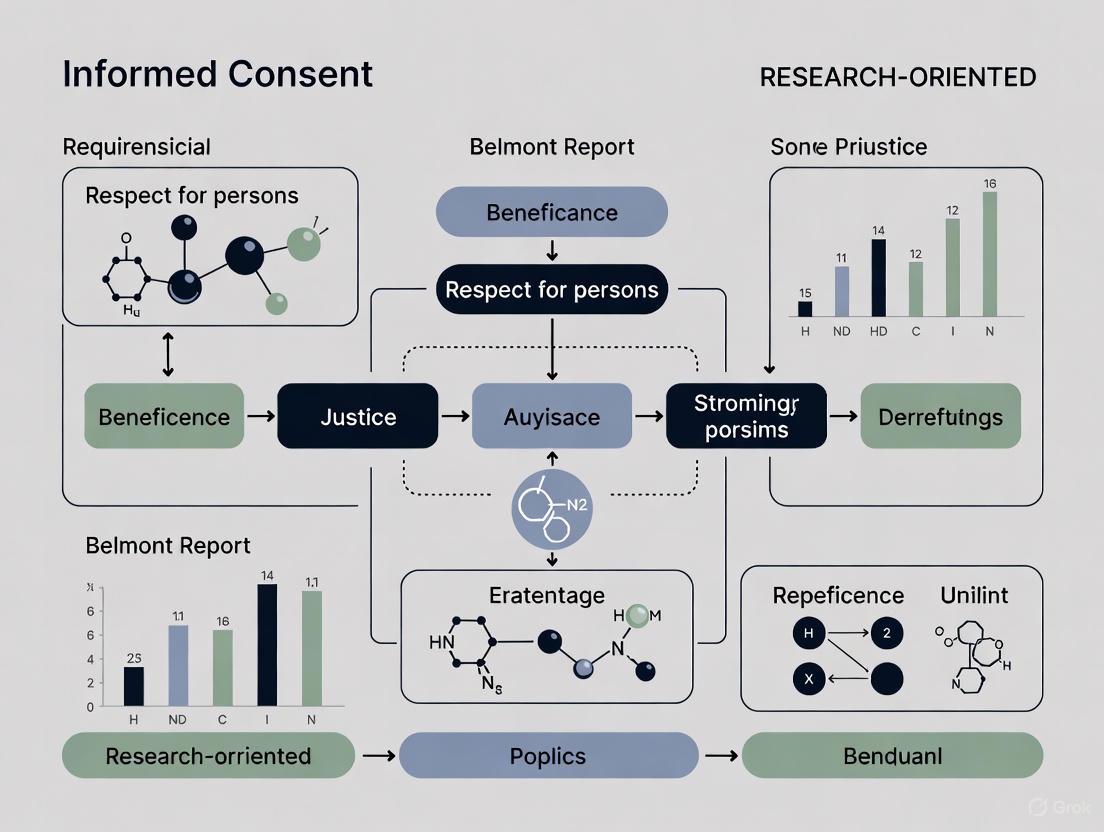
This article provides researchers, scientists, and drug development professionals with a comprehensive framework for understanding and implementing the informed consent requirements derived from the Belmont Report.
Beyond the Signature: Applying Belmont Report Informed Consent Principles in Modern Clinical Research
Abstract
This article provides researchers, scientists, and drug development professionals with a comprehensive framework for understanding and implementing the informed consent requirements derived from the Belmont Report. It explores the ethical foundations rooted in historical context, details practical methodologies for applying the principles of Respect for Persons, Beneficence, and Justice, offers solutions for contemporary challenges like digital consent and vulnerable populations, and validates these approaches through comparison with current international regulations and guidelines. The content synthesizes regulatory requirements with ethical imperatives to guide the conduct of ethically sound and compliant human subjects research.
The Bedrock of Bioethics: Understanding the Belmont Report's History and Core Principles
The Tuskegee Syphilis Study, conducted by the U.S. Public Health Service from 1932 to 1972, represents one of the most egregious violations of research ethics in modern history. The study aimed to document the natural progression of untreated syphilis in 400 African American men under the guise of providing free medical care [1]. Researchers systematically deceived participants, who were not informed of their diagnosis nor the study's true purpose, instead being told they were being treated for "bad blood" [1] [2]. Even after penicillin became the standard treatment for syphilis in the 1940s, researchers actively prevented participants from accessing it, continuing the study for 40 years until public exposure forced its termination in 1972 [1] [3]. This profound ethical failure directly catalyzed the development of modern research ethics frameworks, most notably the Belmont Report, which established the foundational principles governing human subjects research today [1] [4] [3].
The Path to the Belmont Report: Historical Catalysts
The exposure of the Tuskegee Study revealed systemic ethical deficiencies that demanded legislative and regulatory solutions. In direct response, Congress passed the National Research Act in 1974, which created the National Commission for the Protection of Human Subjects of Biomedical and Behavioral Research [1] [3]. This commission was charged with identifying comprehensive ethical principles to guide human subjects research. After nearly four years of deliberation, the commission produced the Belmont Report in 1979, named after the Belmont Conference Center where the final discussions were held [4] [5].
The Belmont Report established three fundamental ethical principles that would thereafter govern all federally conducted or supported research involving human subjects: Respect for Persons, Beneficence, and Justice [1] [4] [3]. These principles were operationalized through specific applications: Informed Consent, Risk/Benefit Assessment, and Selection of Subjects [1]. The report deliberately moved beyond earlier codes like the Nuremberg Code and Declaration of Helsinki by providing both ethical principles and actionable procedures for determining the legitimacy of research involving human participants [1] [4].
Table: Historical Timeline from Tuskegee to Federal Regulations
| Year | Event | Significance |
|---|---|---|
| 1932 | Tuskegee Syphilis Study begins | Initiation of unethical research observing untreated syphilis in Black men without informed consent [1] |
| 1947 | Nuremberg Code established | First international document outlining research ethics standards, emphasizing voluntary consent [6] |
| 1964 | Declaration of Helsinki adopted | Distinguished therapeutic from non-therapeutic research [4] |
| 1972 | Tuskegee Study publicly exposed | Press reports lead to termination of the study [1] |
| 1974 | National Research Act enacted | Created National Commission for human subject protection [1] [3] |
| 1979 | Belmont Report published | Established three core ethical principles for research [1] [4] |
| 1981 | Federal regulations codified | Belmont principles incorporated into federal law as "Protection of Human Subjects" [1] |
| 1991 | Federal Policy (Common Rule) adopted | 16 federal agencies adopt uniform human subjects protection rules [3] |
Analytical Framework: Core Ethical Principles of the Belmont Report
Respect for Persons
The principle of Respect for Persons acknowledges the autonomy of individuals and requires protecting those with diminished autonomy [1] [5]. This principle recognizes that all individuals should be treated as autonomous agents entitled to protection, with special safeguards necessary for vulnerable populations [5]. The Belmont Report applies this principle through the mechanism of Informed Consent, which requires three essential elements: information, comprehension, and voluntariness [5]. Potential subjects must be given sufficient information about the research procedures, purposes, risks, and benefits; must demonstrate understanding of this information; and must participate voluntarily without coercion or undue influence [1] [5].
Beneficence
The principle of Beneficence extends beyond the Hippocratic mandate to "do no harm" to an affirmative obligation to secure the well-being of research participants [1]. Researchers must not only avoid causing harm but also maximize potential benefits while minimizing possible risks [1] [5]. This principle is operationalized through systematic Risk/Benefit Assessment, wherein researchers and Institutional Review Boards (IRBs) carefully analyze whether the benefits of research justify the risks involved [1]. The assessment must consider the extent to which risks are minimized and benefits enhanced, ensuring that the research design does not unnecessarily expose participants to risk [1].
Justice
The principle of Justice requires the equitable distribution of both the burdens and benefits of research [1]. This principle addresses concerns that vulnerable populations should not be systematically selected for research simply because of their availability, compromised position, or manipulability [1]. The Tuskegee Study exemplified the violation of this principle, as researchers targeted a disadvantaged Black population for burdensome research that offered them no benefits [1]. Justice is applied through fair Selection of Subjects, requiring scrutiny of whether some classes of people are being selected simply for their ease of availability or manipulability rather than for reasons directly related to the problem being studied [1].
Belmont Report Principles and Applications
Experimental Protocols: Quantitative Assessment of Informed Consent Modalities
Methodology: Randomized Controlled Trial of Consent Formats
A landmark 1991 randomized controlled trial conducted by Simel et al. provides crucial empirical evidence on how consent form language affects participation rates [7] [8]. The study employed a sham research design in which adult ambulatory patients were randomly allocated to receive one of two consent forms for a hypothetical medication trial [7] [8]. Consent A (n=52) described a randomized trial of usual treatment versus a new medication that "may work twice as fast as the usual treatment," while Consent B (n=48) described the same trial but stated the new medication "may work half as fast as the usual treatment" [7] [8]. All other elements of the consent forms were identical. Patients were assessed for their decision to participate or decline, with specific attention to whether they cited the quantitative information in their decision-making process [7] [8].
Table: Quantitative Analysis of Consent Format Impact
| Consent Format | Total Patients (n) | Overall Consent Rate | Consent Rate Among Patients Citing Quantitative Information | Consent Rate Among Patients Not Citing Quantitative Information |
|---|---|---|---|---|
| Consent A ("twice as fast") | 52 | 67% (35/52) | 95% (21/22) | 47% (14/30) |
| Consent B ("half as fast") | 48 | 42% (20/48) | 36% (5/14) | 44% (15/34) |
| Statistical Significance | p < 0.01 | p < 0.001 | Not Significant |
Protocol Implementation: Key Procedural Steps
Participant Recruitment: Recruit adult ambulatory patients from clinical settings who possess capacity to provide informed consent [7] [8].
Randomization: Utilize computer-generated random number sequences to allocate participants to consent format groups, with allocation concealment maintained until group assignment [7] [8].
Consent Administration: Provide the assigned consent form in a standardized setting with consistent time allowances for review and consideration [7] [8].
Decision Assessment: Document participation decisions and conduct brief structured interviews to determine which elements of the consent form influenced the decision, with specific attention to quantitative information [7] [8].
Data Analysis: Compare consent rates between groups using appropriate statistical tests (chi-square for categorical data) and analyze effect modification through stratification [7] [8].
The trial demonstrated that patients who recognized and utilized quantitative information made fundamentally different decisions based on that data, with dramatically higher consent rates for the favorably framed intervention (95% vs. 36%, p<0.001) [7] [8]. This evidence underscores the critical importance of both the content and framing of information within the informed consent process.
The Scientist's Toolkit: Essential Research Reagent Solutions for Ethical Research Implementation
Table: Essential Resources for Ethical Research Conduct
| Research Reagent Solution | Function in Ethical Research Implementation | Regulatory/Ethical Framework |
|---|---|---|
| Institutional Review Board (IRB) | Independent review panel that evaluates research protocols to ensure ethical standards are met and participant welfare is protected [9] [3] | Required by DHEW (now HHS) for all supported human subjects research post-1974 [3] |
| Informed Consent Documentation | Comprehensive forms ensuring participants receive all necessary information about the study purpose, procedures, risks, benefits, and alternatives [1] [5] | Mandated by Belmont Report principles of Respect for Persons and applied through informed consent requirements [1] [5] |
| Risk-Benefit Assessment Framework | Systematic methodology for identifying, quantifying, and balancing potential risks and benefits of research participation [1] [9] | Required by Belmont Report principle of Beneficence and NIH ethical guidelines [1] [9] |
| Vulnerable Population Safeguards | Additional protections for participants with diminished autonomy or increased susceptibility to coercion [1] [9] | Mandated by Belmont Report principles of Respect for Persons and Justice [1] |
| Data Safety Monitoring Board (DSMB) | Independent expert committee that monitors participant safety and treatment efficacy data during clinical trials [9] | NIH ethical guideline implementation for ongoing risk-benefit evaluation [9] |
Ethical Research Implementation Workflow
Contemporary Applications and Persistent Challenges in Ethical Research
Modern Ethical Dilemmas in Clinical Research
While the Belmont Report established foundational ethical standards, contemporary research environments continue to present complex challenges. Early-phase clinical trials frequently raise ethical concerns regarding the therapeutic misconception, where participants may incorrectly believe that the primary goal of phase I trials is therapeutic benefit rather than safety assessment [2]. Studies demonstrate that even after detailed informed consent, a majority of phase I trial participants still believe the trial will benefit them personally, despite explicit explanations to the contrary [2]. This persistence of misunderstanding highlights the ongoing challenges in achieving truly informed consent.
Additionally, premature trial termination presents emerging ethical concerns, particularly when studies involving vulnerable populations are abruptly discontinued [10]. Recent analyses indicate that when clinical trials are terminated before completion, especially those involving children and adolescents with serious health conditions, significant ethical violations of Belmont principles may occur [10]. Such abrupt closures can break trust with participants, undermine the principle of beneficence by eliminating potential benefits, and violate justice by wasting contributions from vulnerable populations [10].
Protocol for Ethical Communication of Early-Phase Trial Information
Structured Consent Discussion: Implement multi-step consent processes that explicitly distinguish research from treatment, emphasizing the primary purpose of early-phase trials (safety assessment) rather than therapeutic benefit [2].
Comprehension Assessment: Incorporate validated assessment tools to evaluate participant understanding of key concepts, including the study's primary purpose, potential risks, and unproven nature of any potential benefits [2] [5].
Quantitative Information Framing: Present quantitative information about potential outcomes using both positive and negative framing to mitigate the impact of presentation bias on decision-making [7] [8].
Ongoing Consent Reinforcement: Implement periodic re-consenting processes throughout trial participation to reinforce understanding and maintain voluntary participation [9] [5].
Alternative Options Disclosure: Clearly describe appropriate alternative treatments or services available outside the research context, ensuring participants understand all available options [5].
The transformation from the ethical abrogations of the Tuskegee Study to the systematic protections of the Belmont Report represents one of the most significant evolutions in research practice. The three principles of Respect for Persons, Beneficence, and Justice provide a comprehensive framework for ethical research conduct that remains relevant decades after their formulation [1] [4] [3]. The operationalization of these principles through informed consent, risk/benefit assessment, and equitable subject selection creates actionable protocols for researcher implementation [1] [5].
Contemporary research continues to face ethical challenges, from therapeutic misconceptions in early-phase trials to the implications of premature trial termination [2] [10]. However, the foundational framework established in response to Tuskegee provides the ethical scaffolding to address these evolving concerns. By adhering to these principles and implementing the structured protocols outlined in this document, researchers can honor the legacy of those harmed by past ethical violations while advancing scientific knowledge through ethically sound research practices that prioritize participant welfare and autonomy.
The Belmont Report, formally titled "Ethical Principles and Guidelines for the Protection of Human Subjects of Research," was commissioned by the U.S. Congress in the aftermath of egregious ethical violations in research, most notably the Tuskegee Syphilis Study [5] [11]. Published in 1979 by the National Commission for the Protection of Human Subjects of Biomedical and Behavioral Research, this foundational document establishes three core ethical principles—Respect for Persons, Beneficence, and Justice—that form the moral framework for all federally regulated human subjects research in the United States [12] [13] [14]. These principles provide the ethical justification for the federal regulations known as the Common Rule (45 CFR 46) and directly inform the practice of informed consent, risk-benefit assessment, and subject selection [15] [16]. For researchers, scientists, and drug development professionals, understanding these pillars is not merely a regulatory requirement but a prerequisite for conducting ethically sound and socially responsible research.
Historical Context and Creation of the Belmont Report
The genesis of the Belmont Report lies in the National Research Act of 1974, a legislative response to public exposure of the Tuskegee Syphilis Study, in which African American men with syphilis were deliberately denied effective treatment and deceived about their condition for decades [5] [4]. This Act created the National Commission, which was charged with identifying the basic ethical principles that should underlie the conduct of biomedical and behavioral research involving human subjects [13]. The Commission, comprising eleven members from medicine, law, ethics, and public policy, engaged in nearly four years of deliberation, including an intensive four-day period in February 1976 at the Belmont Conference Center in Elkridge, Maryland, from which the report derives its name [13] [4].
The report was publicly released on September 30, 1978, and subsequently published in the Federal Register on April 18, 1979 [13]. It was designed to serve as a compass for ethical decision-making rather than a rigid checklist, providing an analytical framework for resolving the ethical problems that surround research with human subjects [17] [11]. The Belmont Report both consolidated earlier ethical codes like the Nuremberg Code and the Declaration of Helsinki and expanded upon them by providing a more comprehensive and principled approach to the protection of vulnerable populations and the equitable distribution of research burdens and benefits [4].
The First Pillar: Respect for Persons
Core Principle Definition
The principle of Respect for Persons incorporates two distinct ethical convictions: first, that individuals should be treated as autonomous agents, and second, that persons with diminished autonomy are entitled to protection [12] [13]. An autonomous person is an individual capable of deliberation about personal goals and acting under the direction of such deliberation [13]. Respecting autonomy means acknowledging these individuals' personal dignity and allowing them to choose their own path, free from controlling interference. The second conviction recognizes that not all individuals are capable of self-determination due to youth, illness, mental disability, or other circumstances that restrict liberty. These individuals require additional safeguards to protect their interests [12] [14].
Application to Informed Consent
In practice, Respect for Persons finds its primary application in the informed consent process [15] [14]. The Belmont Report specifies that informed consent is not merely the act of signing a form but a dynamic process of information exchange that must contain three fundamental elements: information, comprehension, and voluntariness [13] [5].
- Information: Researchers must provide prospective subjects with sufficient information about the research procedures, their purposes, potential risks and anticipated benefits, and alternative procedures (where therapy is involved) [5]. Subjects should also be given the opportunity to ask questions and be informed of their right to withdraw from the research at any time without penalty [17] [5].
- Comprehension: The manner and context in which information is conveyed are as important as the information itself [13] [5]. Investigators must present information in a language and manner understandable to the subject, often requiring materials to be written at an 8th-grade reading level or lower [17]. For populations with limited comprehension (e.g., children, adults with cognitive impairments), researchers must seek permission from legally authorized representatives and, where possible, obtain assent from the individuals themselves [17] [15].
- Voluntariness: Consent must be given voluntarily, free from coercion (such as threats of harm) or undue influence (such as excessive or inappropriate rewards) [13] [5]. This requires special vigilance when enrolling vulnerable individuals, such as prisoners, employees, or patients, who may be unduly influenced by real or perceived authority figures [5].
Table 1: Key Elements of Informed Consent as Required by Federal Regulations
| Element Category | Specific Requirement | Practical Application in Protocol |
|---|---|---|
| Basic Elements | Statement that study involves research, explanation of purposes [17] | Clearly label document as "Consent for Research"; state study objectives in plain language. |
| Expected duration of subject's participation [17] | Specify time commitment for participation, including follow-up periods. | |
| Description of procedures and identification of experimental aspects [17] | Detail all study procedures, distinguishing research from standard care. | |
| Risks & Benefits | Description of reasonably foreseeable risks/discomforts [17] | List physical, psychological, social, legal, and economic risks; quantify probability and severity where possible. |
| Description of reasonably expected benefits to subject/others [17] | Differentiate direct medical benefits from societal/knowledge benefits; avoid overstating potential benefits. | |
| Alternatives & Rights | Disclosure of appropriate alternative procedures [17] | Describe standard treatment options available outside the research context. |
| Statement that participation is voluntary [17] | Explicitly state that refusal involves no penalty or loss of benefits. | |
| Right to discontinue participation at any time [17] | Clarify procedures for withdrawal and any consequences of early termination. |
Experimental Protocol: Implementing the Informed Consent Process
Objective: To obtain valid informed consent from potential research participants in a manner that fully embodies the principle of Respect for Persons.
Materials:
- IRB-approved informed consent document (stamp-dated by IRB)
- Plain language information sheets (8th-grade reading level or lower)
- Comprehension assessment tool (e.g., teach-back questionnaire)
- Quiet, private space for consent discussions
- Certified translator or translated documents for non-English speakers [17]
Methodology:
- Pre-Encounter Preparation: Verify that the consent document has been approved and stamp-dated by the IRB. Confirm the document is in the prospective subject's primary language. For non-English speakers, utilize professionally translated documents or a certified medical interpreter—family members should not serve as interpreters for the consent process unless specifically approved by the IRB [17].
- Initial Discussion: Conduct the consent discussion in a private setting free from distractions or perceived coercion. Allow sufficient time for the potential subject to process the information; do not rush the encounter. Present information in lay terms, avoiding technical jargon. Cover all key elements outlined in Table 1, emphasizing the voluntary nature of participation and the right to withdraw [17] [5].
- Comprehension Verification: Utilize the "teach-back" method by asking the subject to explain the study's purpose, procedures, risks, benefits, and alternatives in their own words. For complex studies, consider administering a brief written comprehension questionnaire. Document the method used to verify understanding in the research record [5].
- Decision and Documentation: After ensuring comprehension and voluntariness, provide the subject with a copy of the signed consent form. The original signed form must be retained in the investigator's secured files for at least 3 years after study completion [17].
- Ongoing Consent Process: Reinforce the consent process throughout the study by reminding participants of their rights and providing any significant new findings that may affect their willingness to continue participation [17].
The Second Pillar: Beneficence
Core Principle Definition
The principle of Beneficence extends beyond the simple injunction to "do no harm" to encompass an obligation to maximize possible benefits and minimize possible harms [12] [14]. This principle imposes a dual duty on researchers: first, to not inflict harm intentionally, and second, to actively promote the well-being of research subjects by ensuring their participation is justified by potential beneficial outcomes [12] [13]. The principle recognizes that research inherently involves some degree of risk, but requires that these risks be reasonable in light of the expected benefits to the subject or to society [14].
Application to Risk-Benefit Assessment
The application of Beneficence requires a systematic assessment of the risks and benefits of the proposed research [13] [11]. This assessment must be thorough and evidence-based, considering the probability and magnitude of various types of harm—including physical, psychological, social, legal, and economic risks—and weighing them against the anticipated benefits, which may accrue to the individual subject or to society through the advancement of knowledge [14]. The IRB's role is to evaluate whether the risks have been minimized and are justified by the potential benefits, and that the selection of subjects is appropriate [12].
Table 2: Framework for Systematic Risk-Benefit Assessment
| Assessment Dimension | Key Considerations | Documentation in Protocol |
|---|---|---|
| Risk Identification & Minimization | Physical, psychological, social, legal, economic harms [14] | Categorize and describe all foreseeable risks; detail procedures to minimize each risk. |
| Procedures to reduce risks without compromising scientific integrity | Describe safety monitoring, data confidentiality measures, and inclusion/exclusion criteria. | |
| Benefit Analysis | Direct benefits to participants [17] | Clearly distinguish direct medical benefits from indirect or societal benefits; avoid overstatement. |
| Benefits to society or scientific knowledge [17] | Describe how results will contribute to generalizable knowledge and potential public health impact. | |
| Risk-Benefit Justification | Alternative ways to obtain the benefits [14] | Justify why the research design is necessary to answer the scientific question. |
| Reasonableness of seeking benefits despite risks [14] | Provide rationale for why risks are reasonable in relation to knowledge gained. |
Experimental Protocol: Conducting a Systematic Risk-Benefit Assessment
Objective: To perform a comprehensive analysis of research risks and benefits to ensure compliance with the principle of Beneficence.
Materials:
- Protocol document with detailed procedures section
- Previous literature on similar interventions/studies
- Safety monitoring plan template
- Data Safety Monitoring Board (DSMB) charter (for higher-risk studies)
Methodology:
- Risk Identification: Compile a comprehensive list of all foreseeable risks, categorized by type (physical, psychological, social, legal, economic), probability (remote, unlikely, probable, highly likely), and severity (minimal, minor, serious, catastrophic). Consult relevant literature on similar interventions and consider both immediate and long-term risks [14].
- Risk Minimization Strategies: For each identified risk, develop and document specific procedures to minimize that risk. This may include safety monitoring, data encryption for confidentiality, psychological support services, careful titration of interventions, or inclusion/exclusion criteria to protect vulnerable populations [14].
- Benefit Analysis: Clearly delineate and categorize potential benefits. Differentiate between direct benefits to participants (e.g., therapeutic effect) and collateral or societal benefits (e.g., contribution to scientific knowledge). Avoid overstating potential benefits, particularly in early-phase clinical trials where direct medical benefit is uncertain [17] [5].
- Risk-Benefit Comparison: Systematically compare the minimized risks against the anticipated benefits. Consider whether the knowledge gained could be obtained with lower risk to participants. Justify why the risks are reasonable in relation to the importance of the knowledge expected to result [14].
- Ongoing Monitoring: Implement a data and safety monitoring plan appropriate to the level of risk. For higher-risk studies, establish an independent Data Safety Monitoring Board (DSMB) to review accumulating data and make recommendations about trial continuation, modification, or termination [17].
The Third Pillar: Justice
Core Principle Definition
The principle of Justice requires the equitable distribution of both the burdens and the benefits of research [14] [11]. This principle addresses concerns about the fair selection of subjects, ensuring that specific populations are not systematically targeted for research burdens simply because of their availability, compromised position, or manipulability, while other populations enjoy the benefits of the research [12] [13]. The Belmont Report explicitly references the exploitation of "undesirable" persons in Nazi concentration camps and the selection of predominantly rural, African American men in the Tuskegee Syphilis Study as gross violations of this principle [13] [4].
Application to Subject Selection
In practice, Justice requires careful scrutiny of recruitment strategies and inclusion/exclusion criteria to ensure they are scientifically appropriate and non-exploitative [14]. Populations such as prisoners, institutionalized individuals, racial and ethnic minorities, and economically disadvantaged persons should not be systematically selected for high-risk research unless there is a compelling scientific reason for their inclusion related to the condition under study [13] [14]. Conversely, populations that may benefit from the research should not be arbitrarily excluded from participation, such as excluding women or children from studies of conditions that affect them [14].
Table 3: Evaluating Subject Selection for Compliance with Justice
| Justice Consideration | Ethical Concern | Protocol Compliance Check |
|---|---|---|
| Burden Distribution | Vulnerable populations bearing disproportionate risks [14] | Justify inclusion of vulnerable populations based on scientific necessity, not convenience. |
| Benefit Distribution | Advantaged populations reaping most research benefits [14] | Ensure potential beneficiary populations are included in recruitment when appropriate. |
| Selection Scrutiny | Selection based on ease of access or manipulability [14] | Document that subject selection relates directly to the scientific problem under study. |
| Social Vulnerability | Exploitation of welfare patients, minorities, institutionalized persons [14] | Implement additional safeguards for vulnerable groups to ensure voluntary participation. |
| Fair Access | Denying potentially beneficial research to eligible populations | Avoid arbitrary exclusions (e.g., by age, gender, race) unless scientifically justified. |
Experimental Protocol: Ensuring Equitable Subject Selection
Objective: To design and implement recruitment strategies and eligibility criteria that ensure the equitable selection of research subjects in accordance with the principle of Justice.
Materials:
- Study protocol with explicit inclusion/exclusion criteria
- Recruitment plan detailing all recruitment sources and methods
- Demographic data on the population affected by the condition under study
- IRB-approved recruitment materials
Methodology:
- Eligibility Criteria Justification: Develop inclusion and exclusion criteria based solely on factors that directly address the research question and ensure scientific validity. Avoid criteria that arbitrarily exclude groups without scientific justification (e.g., excluding women or minorities unless pharmacogenomic differences necessitate such exclusion) [14].
- Recruitment Plan Development: Design a recruitment strategy that targets appropriate participant populations based on the condition under study. If the research focuses on a condition that affects a specific demographic, ensure the recruitment plan adequately reaches that demographic. Conversely, if the research addresses a general health concern, develop a plan that recruits from diverse segments of the population [14].
- Vulnerability Assessment: Identify whether the research involves populations that may be vulnerable to coercion or undue influence (e.g., prisoners, students, employees, economically disadvantaged persons). For such populations, implement additional safeguards, such as requiring additional consent monitors, ensuring equitable compensation, or providing independent advocates [17] [14].
- Benefit-Burden Alignment: Ensure that the populations who bear the risks of research are those likely to benefit from its results, particularly for publicly funded research that leads to the development of therapeutic devices and procedures. Avoid situations where disadvantaged groups bear the risks for developments that will primarily benefit more affluent populations [14].
- Monitoring and Reporting: Track recruitment demographics throughout the study and report to the IRB regularly. If certain groups are underrepresented or overrepresented, adjust recruitment strategies accordingly to ensure equitable distribution of research burdens and benefits [14].
Integrated Application: Visualizing the Ethical Framework
The three ethical principles of the Belmont Report function as an integrated framework rather than as isolated concepts. The diagram below illustrates the relationship between these principles and their primary applications in the conduct of human subjects research.
Belmont Principles and Applications
This diagram illustrates how each ethical principle informs specific research applications, which are then operationalized through concrete procedures and considerations. The interconnected nature of these principles means that decisions in one area often involve balancing considerations from multiple principles.
Table 4: Essential Reagents and Resources for Implementing Belmont Principles
| Resource Category | Specific Tool/Reagent | Ethical Function & Application |
|---|---|---|
| Documentation Tools | IRB-approved consent forms (stamp-dated) [17] | Legal documentation of informed consent process; ensures regulatory compliance. |
| Parental permission/child assent forms [17] | Protects rights of minors; involves them in decision-making appropriate to their development. | |
| HIPAA authorization documents [17] | Ensures privacy and confidentiality of protected health information. | |
| Comprehension Aids | Plain language summaries (8th-grade level) [17] | Facilitates understanding for participants with varying literacy levels. |
| Teach-back questionnaires [5] | Verifies participant comprehension of key study elements. | |
| Visual aids/diagrams of procedures | Enhances understanding of complex study designs or procedures. | |
| Vulnerability Protections | Professional translation services [17] | Ensures non-English speakers receive information in understandable language. |
| Independent consent monitors | Prevents coercion in studies with potentially vulnerable populations (e.g., prisoners). | |
| Cultural liaison officers | Bridges cultural gaps in understanding and communication. | |
| Risk Management | Data Safety Monitoring Board (DSMB) | Independent oversight of accumulating safety data, particularly in high-risk trials. |
| Adverse event reporting system | Systematic documentation and response to research-related harms. | |
| Confidentiality safeguards (encryption, coding) | Protects participant data from unauthorized access or breaches. |
The Belmont Report's three pillars—Respect for Persons, Beneficence, and Justice—provide a durable and adaptable framework for navigating the complex ethical terrain of human subjects research [12] [11]. For researchers, scientists, and drug development professionals, these principles are not abstract concepts but practical guides that inform every stage of the research process, from study design and subject recruitment to data collection and dissemination of results [14]. The continuing relevance of the Belmont Report lies in its ability to balance the imperative for scientific progress with the fundamental moral obligation to protect the rights, welfare, and dignity of research participants [4] [16]. As research methodologies evolve with technological advancements, these ethical principles remain the critical foundation upon which public trust in science is built and maintained.
The Belmont Report's foundational principles did not emerge in a vacuum; they are the direct descendants of ethical codes established in the decades following World War II. The Nuremberg Code (1947) and the Declaration of Helsinki (1964, with major revisions through 2024) created the essential ethical architecture that the Belmont Report (1979) would later synthesize and refine for the U.S. context. These documents represent a concerted global effort to protect the autonomy, welfare, and rights of human research participants, moving from a researcher-centric to a participant-centric model. Understanding this historical progression is critical for contemporary researchers, scientists, and drug development professionals who must navigate the resulting ethical frameworks and regulatory requirements. The core of this evolution lies in the refinement of informed consent, the balancing of risks and benefits, and the fair selection of subjects—principles that remain the bedrock of ethical clinical research today [4] [18].
Historical Foundations: Nuremberg and Helsinki
The Nuremberg Code (1947)
The Nuremberg Code was established in 1947 in direct response to the atrocities committed by Nazi physicians during World War II. The judges at the "Doctors' Trial" drafted this set of ten principles to define the boundaries of permissible medical research on humans [18] [19]. Its first and most fundamental principle is that "The voluntary consent of the human subject is absolutely essential." [6]. This requirement of voluntary consent was groundbreaking, emphasizing that participants must be free from coercion and possess sufficient knowledge to make an understanding decision [18]. The Code also introduced other key principles, including the injunction that research should yield fruitful results for the good of society, that it should be based on prior animal experimentation, that physical and mental suffering should be avoided, and that the participant must be free to terminate the experiment at any time [19] [18]. Although the Nuremberg Code lacked the force of law, it stands as the first major international document to articulate a comprehensive set of principles for ethical human subjects research [18] [6].
The Declaration of Helsinki (1964-2024)
Adopted by the World Medical Association (WMA) in 1964, the Declaration of Helsinki was developed to provide more detailed guidance specifically for physicians engaged in clinical research [20] [21]. A living document, it has undergone multiple revisions—in 1975, 1983, 1989, 1996, 2000, 2008, 2013, and most recently in 2024—to address emerging ethical challenges [20] [22]. The Declaration made several critical advancements beyond the Nuremberg Code. It introduced a fundamental distinction between therapeutic research (combined with professional care) and non-therapeutic research, acknowledging that different ethical considerations might apply [21] [23]. A major conceptual shift was the introduction of independent committee review of research protocols (the forerunner of modern IRBs and RECs) in its 1975 revision, moving ethical oversight beyond the sole purview of the individual investigator [22]. Furthermore, it relaxed the Nuremberg Code's absolute requirement for consent, making it possible for research to proceed with the consent of a legally authorized representative when a potential subject is incapable of giving consent [22]. The Declaration firmly states that "the interests of the subject must always prevail over the interests of science and society," establishing a clear hierarchy of priorities [20] [22].
Comparative Analysis of Foundational Documents
Table 1: Comparative Ethical Principles Across Foundational Documents
| Ethical Principle | The Nuremberg Code (1947) | Declaration of Helsinki (1964-2024) | The Belmont Report (1979) |
|---|---|---|---|
| Informed Consent | "Voluntary consent is absolutely essential." Focus on competent individuals. | Consent must be obtained from the subject or a legally authorized representative if incompetent. Emphasis on information comprehensibility [20]. | Respect for Persons: Application is Informed Consent. Must include information, comprehension, and voluntariness [18]. |
| Risk/Benefit Assessment | Risk should be justified by humanitarian importance; no a priori reason to believe death/disabling injury will occur. | Research must be preceded by careful assessment of predictable risks and burdens; risks must be continuously monitored [20]. | Beneficence: Application is Assessment of Risks and Benefits. Research must maximize benefits and minimize harms [18]. |
| Subject Selection | Implied in the requirement that subjects can freely consent, thus protecting vulnerable populations who cannot. | Explicitly requires special protections for vulnerable individuals, groups, and communities [20]. | Justice: Application is Selection of Subjects. Fair procedures and outcomes in the selection of research subjects [18]. |
| Independent Review | Not explicitly mentioned. | Requires protocol review by a transparent, independent research ethics committee (REC) before research begins [20] [22]. | Underpins the modern IRB system, which is mandated by federal regulations derived from the Belmont Report [18]. |
| Legal Status | Part of a judicial ruling; no legal force but immense moral authority. | A professional code for physicians, globally influential in shaping national regulations [22]. | A federally commissioned report; its principles codified in U.S. regulations (45 CFR 46, 21 CFR 50/56) [4] [6]. |
Table 2: Evolution of Key Concepts in Informed Consent
| Concept | Nuremberg Code | Declaration of Helsinki | Belmont Report |
|---|---|---|---|
| Consent Capacity | Focus on the "legal capacity" to give consent. | Expands to include individuals who are incapable, via a legally authorized representative [20] [22]. | Systematizes the concept of respect for persons, requiring protection for those with diminished autonomy. |
| Comprehension | "Sufficient knowledge and comprehension of the elements...to enable an understanding decision." | Information must be presented in "plain language" with attention to the participant's specific information needs [20]. | Explicitly names Comprehension as one of three core elements of informed consent, alongside Information and Voluntariness. |
| Voluntariness | "Free power of choice, without...force, fraud, deceit, duress..." | Warns against consent in "dependent relationships" and requires independent individual to seek consent in such cases [20]. | Explicitly names Voluntariness as a core element, requiring an absence of coercion and undue influence. |
| Withdrawal | The subject should be "at liberty to bring the experiment to an end." | "The subject or his guardian should be free to withdraw permission for research to be continued at any time." [21] | An integral component of the consent process, ensuring the continuous exercise of participant autonomy. |
Visualizing the Historical and Conceptual Evolution
The following diagram illustrates the historical timeline and key conceptual transfers between the Nuremberg Code, the Declaration of Helsinki, and the Belmont Report.
The Pathway to the Belmont Report: Synthesis and Standardization
The Belmont Report was created by the National Commission for the Protection of Human Subjects of Biomedical and Behavioral Research in 1979, largely in response to ethical scandals in the United States, most infamously the Tuskegee Syphilis Study [18] [4]. The Tuskegee Study, which ran from 1932 to 1972, involved monitoring African American men with syphilis without informing them of their diagnosis and actively denying them treatment even after penicillin became a proven cure [18]. This egregious violation of ethical standards highlighted the inadequacy of existing protections and spurred Congress to pass the National Research Act of 1974, which ultimately led to the commissioning of the Belmont Report [18].
The Belmont Report's genius lies in its distillation of the complex rules from Nuremberg and Helsinki into three clear, comprehensive, and overarching ethical principles:
- Respect for Persons: This principle incorporates the Nuremberg Code's mandate of voluntary consent, acknowledging the autonomy of individuals and requiring protection for those with diminished autonomy [18] [4].
- Beneficence: This extends beyond the Hippocratic "do no harm" to a positive obligation to maximize possible benefits and minimize potential harms, reflecting the systematic risk-benefit analysis required by both previous documents [18] [4].
- Justice: This principle addresses the fair distribution of the burdens and benefits of research, a direct response to the injustices of Tuskegee and other studies that exploited vulnerable populations [18].
The Report then translates these principles into practical applications for research: Informed Consent (from Respect for Persons), Assessment of Risks and Benefits (from Beneficence), and Selection of Subjects (from Justice) [18]. This framework provides the ethical underpinnings for the U.S. Common Rule (45 CFR 46) and FDA regulations (21 CFR 50, 56), which legally enforce these principles through requirements for IRB review and informed consent procedures [6] [4].
Application Notes and Protocols for Modern Research
Protocol: Implementing a Historically-Informed Informed Consent Process
This protocol is designed to ensure the consent process meets the highest standards derived from the Nuremberg, Helsinki, and Belmont traditions.
1. Pre-Consent Preparation:
- REC/IRB Review: Submit the final study protocol, consent form, and all participant-facing materials to the independent Research Ethics Committee or Institutional Review Board for approval, as mandated by the Declaration of Helsinki and U.S. regulations [20] [6].
- Vulnerability Assessment: Identify if the study population includes individuals in situations of vulnerability (e.g., due to illness, lack of education, or dependent relationships). Plan for additional safeguards, such as using an independent individual to seek consent, as stipulated in the Declaration of Helsinki [20].
2. The Consent Interview:
- Information Disclosure: Explain the study using the IRB-approved consent form. Cover all elements required by 21 CFR 50.25, including the purpose, procedures, risks, benefits, alternatives, confidentiality, compensation, and the right to withdraw without penalty [6]. This fulfills the Information element from Belmont.
- Assessment of Comprehension: Use the "teach-back" method: ask the participant to explain the study's purpose, key procedures, and main risks in their own words. This directly implements the Comprehension requirement of the Belmont Report's Respect for Persons principle [18].
- Documentation of Voluntariness: Confirm the participant's decision is free from coercion or undue influence. Document the consent process. Consent must be formally documented on paper or electronically, per Declaration of Helsinki guidelines [20].
3. Post-Consent Continuation:
- Re-consent: If significant new information becomes available during the study that may affect a participant's willingness to continue, submit a protocol amendment to the IRB and obtain re-consent from participants.
- Ongoing Right to Withdraw: Remind participants at appropriate intervals of their right to withdraw from the study at any time without reprisal, a right firmly established in the Nuremberg Code and all subsequent documents [21] [18].
Table 3: Key Research Ethics Resources and Guidelines
| Resource Name | Issuing Body | Primary Function & Relevance |
|---|---|---|
| The Belmont Report | U.S. National Commission | Foundational ethical principles (Respect for Persons, Beneficence, Justice) underlying U.S. federal regulations for human subjects research [18] [6]. |
| Declaration of Helsinki | World Medical Association (WMA) | Global cornerstone of medical research ethics. Guides physicians on therapeutic/non-therapeutic research, consent, and REC review. Regularly updated [20] [22]. |
| 45 CFR Part 46 (The Common Rule) | U.S. Department of Health & Human Services (HHS) | The primary federal regulation for protecting human subjects in the U.S. Codifies the principles of the Belmont Report for most federally-funded research [6]. |
| 21 CFR Parts 50 & 56 | U.S. Food & Drug Administration (FDA) | FDA regulations governing informed consent and IRB operations for clinical investigations of drugs, devices, and biologics [6]. |
| ICH E6 (R2) Good Clinical Practice | International Council for Harmonisation (ICH) | An international ethical and scientific quality standard for designing, conducting, and reporting clinical trials. Ensures data integrity and participant rights [6]. |
| CIOMS International Ethical Guidelines | Council for International Organizations of Medical Sciences | Provides guidelines on applying the Declaration of Helsinki principles, especially in low-resource settings and with vulnerable populations [23] [6]. |
Protocol: Navigating International Ethical Review
The ethical approval process for international research can be heterogeneous. The following workflow, based on a recent global survey, outlines a strategic approach [24].
Key Steps:
- Early Engagement: Consult with in-country representatives early to understand local regulations, as processes vary significantly even within the same country (e.g., local vs. regional RECs in Italy and Germany) [24].
- Study Classification: Determine how the host country classifies the study (e.g., audit, observational, RCT), as this dictates the approval pathway. Some countries, like the UK and Vietnam, only require audit department registration for audits, while others require full REC review [24].
- Document Preparation: Assemble a core dossier including the study protocol, informed consent forms, conflict-of-interest statements, and data transfer agreements. Use a checklist to ensure consistency across all sites [24].
- Submission and Monitoring: Submit to the appropriate local, regional, or national REC. Be prepared for timelines ranging from 1-3 months to over 6 months, particularly for interventional studies in countries like Belgium and the UK [24].
- Additional Authorizations: In several countries (e.g., France, Portugal, Indonesia), securing ethical approval is only one step. Additional foreign research permits or other national-level authorizations may be required before the study can begin [24].
The National Research Act (NRA) of 1974 (Public Law 93-348) represents a watershed moment in the history of research ethics, establishing the first comprehensive federal framework for protecting human subjects in the United States. Enacted by the 93rd United States Congress and signed into law by President Richard Nixon on July 12, 1974, this legislation was a direct legislative response to public outcry over ethical breaches in human subjects research, most notably the infamous Tuskegee Syphilis Study [25] [26] [3]. The revelation of this study, in which treatment was deliberately withheld from African American men with syphilis for decades without their informed consent, exposed critical gaps in research oversight and created an urgent mandate for systemic reform [26] [3]. The Act emerged from a series of congressional hearings directed by Senator Edward Kennedy, which illuminated multiple research abuses and built bipartisan consensus for creating a structured oversight system [25] [26].
The NRA established a tripartite foundation for research ethics that continues to underpin modern regulatory frameworks: (1) the creation of a national commission to identify fundamental ethical principles, (2) the formalization of Institutional Review Boards (IRBs) for local research oversight, and (3) the development of federal regulations applicable to all federally-funded research [26]. This legislative intervention marked a decisive transition from professional self-regulation to a mandated, principled approach to human subject protection, fundamentally reshaping the conduct of biomedical and behavioral research in the United States and influencing global research ethics standards [25] [27].
Core Legislative Provisions and Architectural Framework
The National Research Act established three interconnected mechanisms to ensure ethical research conduct, creating a comprehensive system of guidance, review, and regulation that would evolve into the contemporary human research protections program.
Establishment of the National Commission
The Act created the National Commission for the Protection of Human Subjects of Biomedical and Behavioral Research, charging this independent body with a critical mandate: to "identify the basic ethical principles which should underlie the conduct of biomedical and behavioral research involving human subjects and to develop guidelines... to assure that it is conducted in accordance with such principles" [26]. The Commission's membership comprised eleven multidisciplinary experts who produced highly influential reports on contentious issues including fetal research, psychosurgery, and special protections for vulnerable populations such as children, prisoners, and institutionalized mentally ill persons [26]. Although the Commission was initially authorized for less than three years as a legislative compromise, its productivity and impact far exceeded its limited tenure [26].
Codification of Institutional Review Boards (IRBs)
The NRA formally mandated that all entities applying for federal grants or contracts involving human subjects research must establish Institutional Review Boards (IRBs) to review proposed research protocols and "protect the rights of the human subjects of such research" [25] [26]. While many research institutions already maintained local review committees by 1974, the Act systematized and expanded their authority, requiring that all federally conducted or funded research undergo ethical review [26]. This institutional model privileged local oversight based on the premise that local IRBs possessed superior knowledge of their research contexts, potential participant communities, institutional norms, and applicable state laws [26]. According to Government Accountability Office estimates, this framework has grown to encompass approximately 2,300 IRBs nationwide as of 2023, including both institution-affiliated boards and independent, for-profit IRBs [26].
Regulatory Foundation for the Common Rule
The Act directed the Secretary of the Department of Health, Education, and Welfare (DHEW, now the Department of Health and Human Services) to promulgate regulations governing human subjects research [26]. This directive eventually culminated in the Federal Policy for the Protection of Human Subjects (45 CFR 46), commonly known as the "Common Rule," which was formally adopted by 15 federal departments and agencies in 1991 and continues to serve as the cornerstone of human research protections in the United States [26] [28]. The regulations specified IRB composition, operations, and review criteria, formally incorporating the ethical principles articulated in the Belmont Report into regulatory requirements [26].
Table: Key Provisions of the National Research Act of 1974
| Legislative Component | Statutory Function | Regulatory Outcome |
|---|---|---|
| National Commission for Protection of Human Subjects | Identify basic ethical principles and develop implementation guidelines | Production of the Belmont Report (1979) and specialized reports on vulnerable populations |
| Institutional Review Board Mandate | Local review of research protocols to protect human subjects | Formal requirement for IRB review at all institutions receiving federal research funding |
| Regulatory Authority | Empower DHEW/HHS to create binding research regulations | Establishment of 45 CFR 46, eventually adopted as Federal Policy (Common Rule) by 15 agencies |
The Belmont Report: Ethical Principles and Regulatory Implementation
The National Commission's most enduring legacy emerged from its mandate to identify fundamental ethical principles, culminating in the Belmont Report: Ethical Principles and Guidelines for the Protection of Human Subjects of Research, published in 1979 [15]. This landmark document established three foundational principles that continue to guide ethical analysis in human subjects research nearly five decades later.
Ethical Foundations and Principles
The Belmont Report organized ethical requirements around three core principles:
Respect for Persons: This principle acknowledges the autonomy of individuals and requires that subjects with diminished autonomy (such as children or those with cognitive impairments) receive additional protections. It expresses the ethical conviction that individuals should be treated as autonomous agents capable of self-determination, and that those with diminished autonomy are entitled to equal protection [15]. This principle finds practical expression through the requirement for voluntary informed consent, wherein subjects must receive comprehensive information about the research and make a voluntary decision about participation without coercion or undue influence [15].
Beneficence: This principle extends beyond merely "do no harm" to establish a positive obligation to maximize potential benefits and minimize possible harms to research subjects [15]. It requires researchers to conduct a systematic assessment of risks and benefits, ensuring that the potential benefits to subjects or society justify the risks undertaken, and that these risks are minimized through sound research design and ongoing monitoring [28] [15].
Justice: This principle addresses the equitable distribution of research burdens and benefits across society [15]. It requires careful attention to the selection of research subjects to ensure that vulnerable populations are not systematically selected for high-risk research simply because of their availability or compromised position, nor excluded from research that might benefit them [26] [15]. The Tuskegee Syphilis Study represented a profound violation of this principle, as the burdens of research fell disproportionately on disadvantaged African American men while the benefits of treatment were deliberately withheld from them [3].
Application to Informed Consent Requirements
The Belmont Report's principle of Respect for Persons provides the ethical foundation for contemporary informed consent requirements, transforming consent from a mere signature on a form to an ongoing educational process between researcher and participant [17] [15]. The Belmont principles manifest in consent requirements through several key applications:
Information Comprehension: Consent processes must ensure prospective subjects adequately comprehend the research information, requiring presentation in language easily understood by participants (typically at an 8th-grade reading level) and, when necessary, translation into the participant's native language [17].
Voluntariness: Consent must be given without coercion or undue influence, with participants given sufficient time to consider their decision and clear understanding that refusal or withdrawal involves no penalty or loss of benefits [17] [15].
Ongoing Process: Informed consent constitutes an ongoing process throughout the research project, not a single event concluding with a signed form [17]. Researchers must provide participants with significant new findings that may affect their willingness to continue participation and reiterate their right to withdraw at any time [17].
The following diagram illustrates the relationship between the National Research Act, the resulting Belmont Report, and their application to informed consent processes:
Contemporary Applications and Protocol Implementation
Fifty years after its enactment, the framework established by the National Research Act continues to shape daily research practices through specific regulatory requirements and review processes.
Essential Elements of Informed Consent Documentation
Current regulations derived from the NRA and Belmont principles require that informed consent documents include specific elements to ensure comprehensive subject understanding. These requirements, codified in 45 CFR 46, provide the operational framework for translating ethical principles into practice [17].
Table: Essential Elements of Informed Consent as Required by 45 CFR 46
| Element Category | Specific Requirement | Belmont Principle Applied |
|---|---|---|
| Study Information | Statement that study involves research; explanation of purposes; expected duration of participation | Respect for Persons |
| Procedures | Description of procedures; identification of experimental procedures; description of foreseeable risks/discomforts | Beneficence, Respect for Persons |
| Benefits & Alternatives | Description of benefits to subject/others; disclosure of alternative procedures | Beneficence |
| Confidentiality | Statement on confidentiality of records; consequences of withdrawal | Respect for Persons, Beneficence |
| Compensation & Contacts | Explanation of compensation; contacts for questions/research rights; statement on injury treatment | Beneficence, Respect for Persons |
| Voluntary Participation | Clear statement that participation is voluntary with no penalty for refusal/withdrawal | Respect for Persons |
Protocol for Ethical Research Implementation
Researchers implementing studies requiring human subjects oversight should follow this standardized protocol derived from NRA-mandated requirements:
Step 1: IRB Submission Preparation - Prepare complete research protocol including study objectives, methodology, subject recruitment materials, data collection instruments, and informed consent documents. For greater than minimal risk studies, include detailed risk-benefit analysis and data safety monitoring plan.
Step 2: Informed Consent Document Development - Create consent document using the essential elements table above as a checklist. Ensure language complies with 8th-grade reading level requirements and is understandable to prospective subjects. For non-English speaking populations, arrange for professional translation services or back-translation verification [17].
Step 3: IRB Review and Approval - Submit complete application to institutional IRB for review according to category (exempt, expedited, or full board review). Address any IRB modifications or contingencies before initiating any research activities, including subject recruitment.
Step 4: Consent Process Implementation - Conduct the informed consent process as an interactive discussion, allowing sufficient time for subject questions and consideration. Provide subjects with copy of signed consent form and maintain original in secured research files for minimum 3 years as required by regulation [17].
Step 5: Ongoing Compliance and Reporting - Implement approved protocol exactly as reviewed. Report any adverse events or protocol deviations to IRB promptly. For long-term studies, obtain continuing review approval before initial approval period expires and provide subjects with significant new findings that may affect willingness to continue participation [17].
The following workflow diagram illustrates the ethical review and implementation process mandated by the National Research Act framework:
Special Circumstances: Waivers and Alterations
The regulatory framework allows for certain flexibility in informed consent requirements under specific circumstances, maintaining alignment with Belmont principles while accommodating practical research needs:
Waiver of Documentation: IRBs may waive the requirement for signed consent documentation when: (1) the consent document would be the only record linking subject to research and breach of confidentiality represents the principal risk; or (2) research presents no more than minimal risk and involves no procedures for which written consent is normally required outside research context [17].
Waiver or Alteration of Consent: IRBs may approve consent procedures that omit or alter required elements when: (1) research involves no more than minimal risk; (2) waiver will not adversely affect rights and welfare of subjects; (3) research could not practicably be carried out without waiver; and (4) whenever appropriate, subjects will be provided with additional pertinent information after participation [17].
The Scientist's Toolkit: Essential Research Compliance Materials
Successfully navigating the human research protections environment requires familiarity with key regulatory and ethical resources. The following toolkit provides essential materials for researchers implementing the NRA framework.
Table: Essential Research Compliance Resources and Materials
| Tool/Resource | Function/Purpose | Application Context |
|---|---|---|
| Belmont Report | Foundational ethical framework identifying Respect for Persons, Beneficence, and Justice as guiding principles | Ethical decision-making throughout research design, implementation, and review |
| 45 CFR Part 46 | Codified federal regulations for human subjects protection (Common Rule) | Regulatory compliance for all federally-funded research; basis for IRB review criteria |
| IRB Consent Templates | Institution-approved templates containing required regulatory elements and appropriate readability | Standardization of consent documentation; efficiency in protocol development |
| Back-Translation Protocols | Methodology for verifying accuracy of translated consent documents (forward/backward translation with independent verification) | Research involving non-English speaking participants; ensuring comprehension across languages |
| Vulnerable Population Supplements | Specialized consent/permission forms for children, prisoners, cognitively impaired individuals | Research involving populations with diminished autonomy requiring additional protections |
| HIPAA Authorization Templates | Documentation for authorization to use/disclose protected health information for research | Clinical research involving review of medical records or health information |
Fifty years after its enactment, the National Research Act of 1974 continues to provide the fundamental architecture for human subjects protection in the United States. Its threefold approach—establishing ethical principles through the Belmont Report, implementing local review via IRBs, and creating federal regulations through the Common Rule—has proven remarkably durable [26] [28]. However, contemporary research environments present challenges unanticipated in 1974, including digital data explosion, multisite multinational trials, artificial intelligence applications, and complex bioethical questions surrounding emerging technologies like gene therapy and brain-computer interfaces [26].
Recent updates to international guidelines, including the International Council for Harmonisation's Guideline for Good Clinical Practice E6(R3), continue to acknowledge the enduring relevance of the Belmont framework while adapting to modern research complexities [28]. Ongoing debates regarding the NRA's limitations—including its restriction on IRB consideration of long-range societal impacts, exclusion of de-identified information from protections, and voluntary application to non-federally funded research—suggest the need for continued evolution of this landmark legislation's framework [26]. Despite these challenges, the National Research Act's core achievement remains: establishing a principled, systematic approach to ensuring that respect for human dignity remains paramount in the pursuit of scientific knowledge.
The Belmont Report, formally published in 1979, established the three fundamental ethical principles that form the moral foundation for all federally regulated human subjects research in the United States: Respect for Persons, Beneficence, and Justice [11]. This framework was developed in response to egregious historical abuses of research subjects, such as the Tuskegee Syphilis Study, and was codified into law by the National Research Act of 1974 [29]. These principles are not merely theoretical concepts; they are intended as an analytical framework to guide the design, review, and conduct of research [11]. This document translates these ethical principles into concrete applications and detailed protocols, providing researchers, scientists, and drug development professionals with actionable guidance for implementing these mandates in practice, with a particular focus on the informed consent process.
The Belmont Report's Ethical Principles and Their Applications
The Belmont Report's three principles are directly linked to specific research applications, creating a bridge from theory to practice. The following table summarizes this critical relationship.
Table 1: Linking Belmont Report Principles to Research Applications
| Ethical Principle | Definition and Implications | Primary Research Application |
|---|---|---|
| Respect for Persons | Individuals are treated as autonomous agents; persons with diminished autonomy are entitled to protection [30] [11]. | Informed Consent: A process that ensures voluntary participation free from coercion, with complete and understandable information [30] [29]. |
| Beneficence | The obligation to maximize possible benefits and minimize possible harms [30] [11]. | Assessment of Risks and Benefits: A systematic analysis to ensure that the risks to subjects are justified by the potential benefits [30]. |
| Justice | The fair distribution of the burdens and benefits of research [30] [11]. | Selection of Subjects: Equitable selection to ensure no group is unfairly burdened or excluded without cause [30] [29]. |
The logical relationship between these principles and their corresponding applications in the research workflow can be visualized as a structured pathway. The following diagram maps this ethical framework from its foundational principles to its practical outcomes.
Application Notes & Protocols: Implementing Informed Consent
Informed consent is the primary practical application of the principle of Respect for Persons. It is not a single event but an ongoing process of information exchange between the researcher and the prospective subject [31]. The following section provides detailed protocols for its implementation.
Protocol: Key Information and Required Elements of Consent
Federal regulations provide a specific framework for the content of informed consent. The 2018 Revised Common Rule mandates that the consent document begin with a "concise and focused" presentation of key information to help potential participants understand why they might or might not want to participate [32]. The following table outlines the five suggested key information elements, followed by the full set of required basic elements.
Table 2: Key Information Elements for Informed Consent (2018 Common Rule)
| Element Number | Description of Key Information Element |
|---|---|
| 1 | A statement that the project is research and participation is voluntary. |
| 2 | A summary of the research (purpose, duration, procedures). |
| 3 | Reasonable, foreseeable risks or discomforts. |
| 4 | Reasonable, expected benefits. |
| 5 | Alternative procedures or course of treatment, if any (applies primarily to clinical research). |
Beyond this key information summary, the consent document must comprehensively address all required basic elements. The following protocol details these mandatory components.
Table 3: Required Elements of Informed Consent (45 CFR 46.116)
| Element | Protocol Requirement & Description |
|---|---|
| Research Statement | Clearly state the study involves research, explain the purposes, and provide the expected duration of the subject's participation [33]. |
| Procedures | Describe all procedures to be followed and identify any that are experimental [33]. Write in the second person "You" (e.g., "You will be asked to...") to enhance clarity [34]. |
| Risks | Describe any reasonably foreseeable risks or discomforts to the subject, including physical, psychological, legal, social, or economic harms [30] [34]. |
| Benefits | Describe any benefits to the subject or others that may reasonably be expected. Compensation is not considered a benefit [33] [31]. |
| Alternatives | Disclose appropriate alternative procedures or courses of treatment, if any, that might be advantageous [33]. |
| Confidentiality | Describe the extent to which confidentiality of records will be maintained [33]. Explain what will be done with the data upon study completion [34]. |
| Compensation | For research involving more than minimal risk, explain compensation and medical treatment availability for injuries [33]. |
| Contacts | Provide contact information for answers to questions about the research and research subjects' rights, and whom to contact for research-related injuries [33] [34]. |
| Voluntary Participation | Include a clear statement that participation is voluntary, refusal carries no penalty, and the subject may discontinue at any time [33] [34]. |
Protocol: Documenting the Consent Process
Obtaining and documenting consent must occur before initiating any study procedures [31]. The method of documentation should be appropriate to the level of risk and the nature of the research. The following workflow outlines the decision process for selecting and implementing the appropriate consent documentation procedure.
Signed Written Consent is the gold standard and is generally required for research, particularly that involving more than minimal risk [34] [31]. It involves presenting a written document containing all consent elements, which the participant reads and signs.
Waiver of Documentation may be approved by the IRB in specific circumstances, such as when the only record linking the subject and the research would be the consent document and the principal risk is a breach of confidentiality, or when the research presents no more than minimal risk and involves procedures for which written consent is not normally required outside of the research context [33] [31]. In these cases, participants may still be provided with an information sheet, and consent may be implied by the completion of a survey or task, or obtained verbally [34].
Protocol: Special Considerations & Vulnerable Populations
The Belmont Report's principle of Respect for Persons requires special protections for individuals with diminished autonomy [30] [11]. The application of informed consent protocols must be adapted for these vulnerable populations.
- Research with Children: For minors, parental permission must typically be obtained from a parent or guardian. Additionally, the child must provide their assent to participate, if they are mature enough to do so (generally age 7 and older) [34] [29]. The assent process should be appropriate to the child's age, maturity, and psychological state.
- Capacity and Competence: For adults who lack the capacity to make autonomous decisions due to developmental, mental, or physical disorders, consent must be obtained from a legally authorized representative (LAR) [35]. The determination of a patient's lack of decision-making capacity, assessed by health professionals, has the same practical consequences as a legal determination of incompetence [35].
- Cultural Considerations: In some distinct cultural groups or communities where signing forms is not the norm, and for minimal risk research, an IRB may waive the requirement for signed documentation and approve an alternative mechanism for documenting that informed consent was obtained [33].
The Scientist's Toolkit: Essential Materials for Ethical Research
This toolkit outlines the essential resources and materials required for the development, ethical review, and execution of human subjects research.
Table 4: Research Reagent Solutions for Ethical Research Compliance
| Tool or Resource | Function & Purpose |
|---|---|
| IRB-Approved Consent Template | A pre-formatted document (e.g., from a university HRPP office) that ensures all required regulatory and institutional language is included [32] [31]. |
| Plain Language Guide | A resource to aid in writing consent documents at an appropriate reading level (e.g., 8th grade level), avoiding technical jargon to ensure participant comprehension [32] [31]. |
| Institutional Review Board (IRB) Protocol Application | The formal application submitted for ethical review of the research project. It details the study's scientific rationale, methodology, risks, benefits, and consent procedures [29]. |
| Debriefing Statement Template | A script or document used to inform participants about any deception used in a study after their participation is complete, and to provide them the opportunity to withdraw their data [34]. |
| Vulnerable Population Guidelines | Institutional policies and federal regulations that outline specific additional protections required for research involving children, prisoners, individuals with impaired decision-making capacity, and other vulnerable groups [32] [29]. |
| Data Confidentiality Plan | A documented protocol for the handling, storage, and destruction of research data to protect participant privacy and confidentiality, as required by the principle of Beneficence [29]. |
The ethical framework established by the Belmont Report provides an indispensable and dynamic compass for the conduct of research with human subjects [11]. By translating the principles of Respect for Persons, Beneficence, and Justice into concrete applications—through a rigorous informed consent process, a systematic assessment of risks and benefits, and the equitable selection of subjects—researchers and drug development professionals uphold the highest standards of integrity. Adherence to these detailed application notes and protocols ensures that the pursuit of scientific knowledge never supersedes the commitment to protecting the rights, safety, and welfare of the individuals who make that research possible.
From Principle to Protocol: A Step-by-Step Guide to Implementing Belmont's Consent Requirements
The principle of Respect for Persons, as articulated in the Belmont Report, forms the ethical foundation for informed consent in human subjects research. This principle acknowledges the autonomy of individuals and requires that subjects with diminished autonomy are entitled to protection [36] [15]. In practice, Respect for Persons is operationalized through a meaningful consent process that ensures individuals voluntarily agree to participate in research with adequate understanding of what such participation entails [15]. The traditional paper-based consent model poses significant challenges, including low comprehensibility, lack of customization, and comprehension levels that frequently fall below ethical standards [37] [38]. Contemporary approaches to consent must address these shortcomings while adapting to new research paradigms, including digital health studies and the use of large-scale health data [39] [40]. This article provides application notes and protocols to guide researchers in crafting consent processes that genuinely fulfill the ethical imperative of Respect for Persons.
Quantitative Foundations: Evidence-Based Consent Design
Recent research provides quantitative insights into participant preferences and comprehension factors that should inform consent process design. The following tables summarize key evidence for developing effective consent protocols.
Table 1: Participant Preferences in Consent Communication - Findings from a Survey Study (N=79) [39]
| Factor | Finding | Statistical Significance |
|---|---|---|
| Text Length | Participants were less likely to prefer original text as character length increased. | P < 0.001 |
| Preference for Modified Text | Participants were 1.20 times more likely to prefer modified text when original was longer. | P = 0.04 |
| Risk Explanations | Significant preference for modified versions in text snippets explaining study risks. | P = 0.03 |
| Age Influence | Older participants were 1.95 times more likely to prefer original text compared to younger participants. | P = 0.004 |
Table 2: Willingness to Share Health Data for Secondary Purposes - Meta-Analysis of 65 Studies [41]
| Category | Pooled Proportion Willing to Share | 95% Confidence Interval | Key Influencing Factors |
|---|---|---|---|
| Overall Pooled Estimate | 77.2% | 71–82% | Privacy concerns, consent transparency, trust in institution |
| By Organization Type | |||
| • Research Organizations | 80.2% | 74–85% | Perception of societal benefit |
| • Government | Decreased willingness | Not reported | Trust in governing body |
| • For-Profit (Commercial) | 25.4% | 19–33% | Concerns about profit motivation |
| By Participant Type | |||
| • Patients with Cancer | 90.9% | 73–97% | Potential for personal/therapeutic benefit |
| • Patients (Other Settings) | 81.1% | 72–88% | Engagement with healthcare system |
| • General Public | 69.7% | 62–77% | Lower perceived direct benefit |
Application Notes: Implementing Ethical Consent Processes
Digital Consent Modalities
Digital tools present promising approaches to enhance the consent process, potentially improving understanding through interactive features and customization [37]. Research indicates that digitalizing the consent process can enhance recipients' understanding of clinical procedures, potential risks and benefits, and alternative treatments [37]. Recent scoping reviews have found that digital consent can be particularly effective when it incorporates multimedia elements and interactive comprehension checks [37]. However, evidence on patient satisfaction, convenience, and perceived stress remains mixed, indicating that digital solutions must be carefully implemented [37]. For AI-based consent technologies, professional oversight remains essential as these technologies are not yet reliably suitable for standalone use without medical supervision [37].
Participant-Centered Communication
Effective consent communication must account for diverse participant preferences and characteristics. Research demonstrates that shorter consent materials are generally preferred, particularly for communicating risks [39]. However, preferences vary significantly by demographic factors; for instance, older participants tend to prefer more traditional consent language [39]. These findings underscore the importance of human-centered approaches to consent design that consider the learning preferences and literacy needs of specific participant populations [39]. Researchers should pilot-test consent materials with representative samples of their target population to identify potential comprehension barriers and preferences before finalizing protocols.
Dynamic and Adaptive Consent Models
For research involving secondary data use, traditional one-time consent is often inadequate. Dynamic consent models enable ongoing communication between researchers and participants, allowing individuals to make decisions about future research uses as they arise [40]. This approach conceptualizes consent as a process rather than a single event, aligning with the Belmont Report's emphasis on continuous respect for persons [40]. Dynamic consent interfaces facilitate two-way communication, providing participants with information updates and opportunities to adjust their participation preferences over time [40]. This model is particularly relevant for big data research and biobanking, where future research uses may be unpredictable at the time of initial consent [40].
Experimental Protocols: Methodologies for Consent Research
Objective: To quantitatively assess participant comprehension and preferences for different consent communication approaches.
Methods:
- Participant Recruitment: Recruit eligible participants from target population (e.g., N=79 as in prior research) [39].
- Stimuli Development: Create paired consent "snippets" (short sections of consent forms) with original and modified versions differing in readability, length, and lexical diversity [39].
- Study Design: Present participants with 16 pairs of text snippets in random order [39].
- Data Collection: For each pair, ask participants to:
- Choose their preferred version (original or modified)
- Rate clarity and comprehensiveness on Likert scales
- Provide qualitative feedback on preferences
- Analysis:
- Use statistical tests (e.g., regression) to identify factors influencing preferences
- Analyze qualitative feedback for themes
- Examine demographic variables as potential moderators
Validation: This approach has successfully identified significant effects of text length, content type, and demographic factors on consent preferences [39].
Protocol 2: Implementing and Assessing Verbal Consent Processes
Objective: To implement ethically sound verbal consent processes for settings where written consent is impractical.
Methods:
- Script Development: Create a comprehensive verbal consent script containing all required consent elements [42].
- REB Approval: Submit the verbal consent script for review and approval by the Research Ethics Board [42].
- Participant Preparation: When possible, provide participants with a paper or digital copy of the script in advance of the consent conversation [42].
- Consent Process:
- Conduct the consent conversation via telephone, videoconference, or in-person
- Use open-ended questions to assess understanding
- Provide ample opportunity for questions
- Documentation:
- Audio-record the consent conversation (with permission) OR
- Create detailed notes documenting the conversation and confirmation of consent
- File documentation in the research record
- Follow-up: Provide participants with a written summary of the consent information after the conversation [42].
Applications: This protocol is particularly suitable for minimal-risk research, remote data collection, and studies involving vulnerable populations where written consent may present barriers to participation [42].
Visualization: Consent Process Workflows
Diagram 1: Adaptive Consent Process Workflow
Diagram 2: From Ethical Principle to Consent Applications
Table 3: Research Reagent Solutions for Consent Process Implementation
| Tool/Resource | Function/Purpose | Application Notes |
|---|---|---|
| Readability Analysis Software | Assesses and improves text comprehension level | Use to ensure consent forms meet 6th-8th grade reading level; provides metrics on character length, sentence complexity [39]. |
| Verbal Consent Script Template | Standardizes verbal consent process | Provides consistent information delivery; requires REB approval; should include all consent elements [42]. |
| Digital Consent Platform | Interactive multimedia consent delivery | Enhances understanding through videos, quizzes; allows customization; provides documentation [37]. |
| Dynamic Consent Interface | Manages ongoing consent for data reuse | Enables participant choice for future studies; facilitates re-contact; maintains communication channel [40]. |
| Comprehension Assessment Tool | Validates participant understanding | Open-ended questions preferred over simple recall; identifies areas needing clarification [39] [15]. |
| Multi-Format Consent Materials | Accommodates diverse participant preferences | Provides options (short/long form, audio, video); addresses age, literacy, and cultural differences [39]. |
The Belmont Report establishes justice as a fundamental ethical principle, requiring a fair distribution of the benefits and burdens of research. This principle demands that the selection of research participants must be scrutinized to avoid systematically recruiting individuals or groups based on their easy availability, compromised position, or manipulability, rather than for reasons directly related to the research problem [28].
Historically, vulnerable populations have been overburdened while others were unjustly excluded, limiting the generalizability of findings and perpetuating health disparities. This application note provides detailed protocols for operationalizing justice through equitable participant selection, ensuring research validity and ethical compliance within the framework of informed consent requirements established by the Belmont Report [28] [43].
Operationalizing Justice: A Strategic Framework
Core Concepts and Definitions
- Fair Participant Selection: An ethical and scientific necessity that ensures the participant pool reflects the population affected by the condition under study, avoiding the systematic selection of participants based on convenience or vulnerability [43].
- Equity in Recruitment: Proactive strategies to ensure inclusive enrollment, particularly of historically underrepresented communities, to produce research findings that are applicable to a broad population [43].
- Representativeness: A characteristic of a study sample that accurately mirrors the demographic and clinical diversity of the target population for whom the intervention is intended, crucial for the scientific validity and generalizability of the results [44].
Quantitative Assessment of Equity
A critical first step is to quantitatively assess current enrollment against population benchmarks. The Participant-Prevalence Ratio (PPR) is a key metric for this assessment [44].
Table 1: Participant-Prevalence Ratio (PPR) Calculation and Interpretation
| Metric | Calculation | Interpretation | Example from Literature |
|---|---|---|---|
| Participant-Prevalence Ratio (PPR) | (% of subpopulation in study) / (% of subpopulation with condition) |
A PPR of 1 indicates proportional representation. < 1 indicates underrepresentation. > 1 indicates overrepresentation. | An assessment of ECPR trials found a PPR for women of 0.48 and for Black individuals of 0.26, indicating significant underrepresentation relative to disease incidence [44]. |
The following protocol outlines the workflow for embedding equity considerations into the entire research lifecycle, from planning to analysis.
Application Notes and Experimental Protocols
Protocol 1: Defining Representative Enrollment Targets Using Real-World Data
Objective: To establish scientifically justified, equitable enrollment targets for key demographic groups based on the disease prevalence in the real-world population.
Methodology:
- Data Source Identification: Acquire real-world data (RWD) from public health databases, disease registries, or claims data that reflect the epidemiology of the condition under study in the geographic region of the trial [43].
- Prevalence Calculation: Calculate the proportion of the disease burden carried by specific demographic strata (e.g., by race, ethnicity, age, sex). For example:
Prevalence_GroupX = (Number of people with the condition in Group X) / (Total number of people with the condition). - Target Setting: Translate prevalence proportions into enrollment targets. If Group X bears 25% of the disease burden, the initial enrollment target for that group should be 25% of the total sample size, adjusted for scientific and practical constraints documented in the diversity plan [43].
Table 2: Example Enrollment Targets for a Hypothetical Diabetes Trial
| Demographic Characteristic | Subgroup | Disease Prevalence in Region | Minimum Enrollment Target | Aspirational Enrollment Goal |
|---|---|---|---|---|
| Race/Ethnicity | Black / African American | 18% | 15% | 20% |
| Race/Ethnicity | Hispanic / Latino | 25% | 20% | 28% |
| Age | 65 years and older | 45% | 40% | 50% |
| Socioeconomic Status | Medicaid Beneficiaries | 30% | 25% | 35% |
Protocol 2: Community Partnership for Equitable Recruitment
Objective: To build trust and improve recruitment and retention in historically underserved communities through authentic, sustained partnerships.
Methodology:
- Stakeholder Identification: Identify and map community stakeholders, including patient advocacy groups, community leaders, faith-based organizations, and healthcare providers trusted within the target community [43].
- Co-Development: Engage these partners in the design of the research, particularly in developing the informed consent process, recruitment materials, and intervention protocols to ensure they are culturally and linguistically appropriate [44].
- Trust-Building Communications: Implement communication strategies developed with community partners. This may include using culturally competent messaging, translated materials, and community-based recruitment events [43].
Protocol 3: Equity-Focused Data Collection and Analysis
Objective: To systematically collect, report, and analyze data related to participant demographics and outcomes across equity-relevant subgroups.
Methodology:
- Standardized Data Extraction: Develop a standardized data extraction form to systematically collect participant characteristics from all included studies or participants. This should go beyond age and sex to include factors such as race, ethnicity, socioeconomic status, education level, geographic location, and other social determinants of health relevant to the review [44].
- Summary Table Creation: Create a summary table in the results section to compare the characteristics of the populations included in the studies against the expected population characteristics based on the condition's prevalence. This table should be completed during the analysis phase to report on who is represented in the evidence [44].
- Subgroup Analysis: Plan and conduct subgroup analyses based on participant characteristics that may stratify the outcomes. For example, analyze outcomes separately for different age groups, sexes, ethnicities, or by country income level (high vs. low- and middle-income countries) to identify any differential effects of the intervention [44].
Table 3: Template for Reporting Population Characteristics in Results
| Characteristic | Inclusion Criteria of Review\n(People we expect to see) | Representation in Included Studies\n(People who took part) |
|---|---|---|
| Age | Adults aged 18+ | Mean ages ranged from 54 to 73 years. |
| Sex/Gender | All sexes and genders | Women made up between 20% and 52% of participants. |
| Location | Any country, urban or rural settings. | Studies were conducted in high- and middle-income countries; none in low-income countries. |
| Race/Ethnicity | Reflects disease demographics. | Reporting was inconsistent; where reported, Group Y was underrepresented. |
The Scientist's Toolkit: Essential Materials for Equity
Table 4: Key Research Reagent Solutions for Equitable Research
| Item / Tool | Function / Purpose |
|---|---|
| PRO-EDI Initiative Table | A standardized table to plan and report on the inclusion and representation of various population characteristics in a study, ensuring transparency [44]. |
| Participant-Prevalence Ratio (PPR) | A quantitative metric to assess and quantify the participation of specific populations in a study relative to their disease burden [44]. |
| Community Advisory Board (CAB) | A group of community stakeholders that provides ongoing guidance on research design, recruitment, consent processes, and dissemination to ensure cultural appropriateness and build trust [43]. |
| Real-World Data (RWD) Repositories | Databases (e.g., health claims, disease registries) used to establish baseline disease prevalence across demographic groups and set evidence-based, equitable enrollment targets [43]. |
| Cultural & Linguistic Adaptation Frameworks | Structured processes for translating and adapting informed consent forms and study materials to ensure comprehension and relevance for diverse populations [43]. |
Adhering to the Belmont principle of justice requires moving beyond mere compliance. It demands the proactive implementation of detailed, systematic protocols for participant selection. By defining representative targets through real-world data, building authentic community partnerships, and rigorously collecting and analyzing equity-focused data, researchers can ensure that their studies are both ethically sound and scientifically valid. This commitment to equitable participant selection is fundamental to producing research that truly serves all populations.
The ethical principle of respect for persons, as articulated in the Belmont Report, provides the foundational context for informed consent requirements in human subjects research [45] [31]. This principle acknowledges the autonomy of individuals and requires that subjects enter into research voluntarily and with adequate information [31]. The Federal Policy for the Protection of Human Subjects, known as the Common Rule (45 CFR § 46), operationalizes this ethical mandate into specific regulatory requirements [45]. The 2017 revisions to the Common Rule aimed to enhance participant protection while reducing unnecessary burdens, with significant changes focused on improving the consent process and documentation [45] [46]. These revisions acknowledge that informed consent constitutes an ongoing process rather than merely a signed document, requiring researchers to facilitate genuine understanding through thoughtful organization and presentation of information [45] [47] [31].
Key Changes in the Revised Common Rule Consent Requirements
The revised Common Rule introduced several critical modifications to the consent process designed to address the increasingly complex research environment. These changes shift the consent model beyond a simple disclosure checklist toward a more participant-centered approach that emphasizes comprehension and voluntary decision-making [45].
General Requirements for the Consent Process
The revised regulations established two new general requirements that fundamentally reshape how consent information must be structured and presented:
Reasonable Person Standard: Consent information must include "information that a reasonable person would want to know to make an informed decision about whether to participate" [46]. This standard obligates researchers to consider what information would be material to a prospective subject's decision-making process, moving beyond a minimal disclosure approach [45].
Key Information Presentation: Informed consent must begin with "a concise and focused presentation of the key information that is most likely to assist a prospective subject or legally authorized representative in understanding the reasons why one might or might not want to participate in the research" [45] [46]. This section must be organized to facilitate comprehension rather than presenting isolated facts [45].
The following workflow illustrates the revised consent development process incorporating these new requirements:
Comprehensive Common Rule Checklist for Informed Consent
Researchers must ensure their consent processes and documents incorporate all required elements specified in the Common Rule. The checklist below synthesizes both longstanding and new requirements.
Table 1: Required Elements of Informed Consent According to 45 CFR § 46.116
| Element Category | Specific Requirement | Revised Common Rule Changes |
|---|---|---|
| Basic Required Elements | 1. Statement that study involves research, explanation of purposes, expected duration, procedures, and identification of experimental procedures [47] [33] | No significant change |
| 2. Description of reasonably foreseeable risks or discomforts [47] [33] | No significant change | |
| 3. Description of benefits to subject or others [47] [33] | No significant change | |
| 4. Disclosure of appropriate alternative procedures [47] [33] | No significant change | |
| 5. Statement about confidentiality of records [47] [33] | No significant change | |
| 6. For research > minimal risk: explanation of compensation/medical treatments for injury [47] [33] | No significant change | |
| 7. Contact information for questions and research-related injuries [47] [33] | No significant change | |
| 8. Statement that participation is voluntary [47] [33] | No significant change | |
| 9. New Basic Element: Collection of identifiable private information/biospecimens - statement about whether identifiers might be removed and used for future research [47] [46] | NEW REQUIREMENT | |
| Additional Elements When Applicable | 10. Unforeseeable risks to subject/embryo/fetus [47] | No significant change |
| 11. Circumstances for investigator-terminated participation [47] | No significant change | |
| 12. Additional costs to subject [47] | No significant change | |
| 13. Consequences of withdrawal and procedures [47] | No significant change | |
| 14. Provision of significant new findings [47] | No significant change | |
| 15. Approximate number of subjects [47] | No significant change | |
| 16. New: Statement about commercial profit and whether subject will share [47] [46] | NEW REQUIREMENT | |
| 17. New: Disclosure about return of clinically relevant research results [47] [46] | NEW REQUIREMENT | |
| 18. New: For biospecimen research - statement about whole genome sequencing [47] [46] | NEW REQUIREMENT |
Key Information Section: Structure and Implementation Protocol
The key information section represents a fundamental shift in consent design. The following protocol provides methodology for developing this critical section:
Protocol 1: Development of the Key Information Section
Objective: Create a concise, focused presentation that facilitates prospective subjects' understanding of reasons for or against participation.
Materials: Study protocol document, previous consent forms (if applicable), readability assessment tools.
Procedure:
- Step 1: Extract core study elements including purpose, duration, primary procedures, and main risks/benefits.
- Step 2: Draft a summary statement (approximately 1-2 paragraphs) stating that participation is voluntary and explaining why someone might or might not want to participate.
- Step 3: Organize information using bullet points or short paragraphs rather than dense text blocks.
- Step 4: Write at an appropriate reading level (typically 8th grade or lower) using second person ("you") to address the subject directly [31].
- Step 5: Place this section at the beginning of the consent document, before detailed elements.
- Step 6: Test comprehensibility with colleagues or representative readers before IRB submission.
Quality Control: Ensure the section avoids technical jargon and presents information a "reasonable person" would need for decision-making [45] [46].
Implementation Protocols and Procedures
Comprehensive Consent Process Workflow
Successful implementation of Common Rule requirements involves multiple stages from initial design through ongoing participant engagement. The following diagram maps this complete workflow:
Protocol for Addressing New Consent Elements
The revised Common Rule introduced specific new elements that require particular attention in consent processes:
Protocol 2: Implementation of New Consent Elements for Biospecimens and Data
Objective: Ensure proper disclosure and documentation for biospecimen research, commercial applications, and return of research results.
Materials: IRB-approved consent template, institutional policies on data sharing and biospecimen use.
Procedure:
- Step 1: Determine if research involves collection of identifiable private information or identifiable biospecimens.
- Step 2: Select appropriate statement regarding future use:
- Step 3: If commercial profit is possible, include statement regarding whether subject will share in profits [47] [46].
- Step 4: Develop policy on return of research results and disclose in consent form whether clinically relevant results will be returned and under what conditions [47] [46].
- Step 5: For research involving biospecimens, state whether the research will or might include whole genome sequencing [47] [46].
Documentation: Ensure all applicable elements are included in consent document and discussed during consent process.
Table 2: Research Reagent Solutions for Consent Process Implementation
| Tool/Resource | Function/Purpose | Implementation Guidance |
|---|---|---|
| Consent Form Templates | Standardized structure ensuring inclusion of all required elements [31] | Use institution-specific templates that incorporate revised Common Rule requirements |
| Readability Assessment Tools | Evaluate consent document reading level [46] | Target 8th grade level or lower; use tools like Flesch-Kincaid |
| Key Information Section Framework | Facilitates comprehension of core study aspects [45] [46] | Create concise summary at beginning of consent document |
| Electronic Consent Systems | Document consent process and obtain signatures | Ensure 21 CFR Part 11 compliance for FDA-regulated research |
| Decision Capacity Assessment Tools | Evaluate subject understanding during consent process [47] | Use validated instruments for populations with potential impairment |
| Multi-Language Consent Documents | Accommodate non-English speaking participants [47] | Use certified translation services; IRB review of non-English documents |
Special Considerations and Exceptions
Waivers and Alterations of Consent
The Common Rule provides specific circumstances under which requirements for consent may be waived or altered:
Protocol 3: Implementing Waivers or Alterations of Consent
Objective: Properly apply regulatory criteria for waivers or alterations of consent requirements.
Background: IRBs may approve consent procedures that omit or alter some elements, or waive consent entirely under specific conditions [47] [33].
Criteria Assessment:
- Minimal Risk: Research must involve no more than minimal risk to subjects [47] [33].
- Practicability: Research could not practicably be carried out without waiver or alteration [47] [33].
- Identifiable Information: If using identifiable information, research could not be done without it in identifiable format [47].
- Rights and Welfare: Waiver or alteration will not adversely affect rights and welfare of subjects [47] [33].
- Post-Participation Information: Whenever appropriate, subjects will be provided with additional pertinent information after participation [47] [33].
Documentation: Justify request for waiver in IRB application, specifying which criteria are met and why [47].
Consent in Special Populations
The following diagram illustrates the decision process for obtaining consent with vulnerable populations or those with impaired decision-making capacity:
For research involving children, who cannot provide legal consent, investigators must obtain permission from parents or guardians and assent from the child participants when appropriate [47]. Similarly, for adults with impaired decision-making capacity, researchers should obtain permission from a legally authorized representative while still soliciting the prospective subject's assent to the extent possible [47]. Assessment of capacity should be individualized rather than based solely on medical diagnosis or status [47].
The revised Common Rule establishes enhanced requirements for informed consent that emphasize comprehension and voluntary decision-making. By implementing the comprehensive checklist and protocols outlined in this document, researchers can ensure regulatory compliance while truly honoring the ethical principle of respect for persons. The key information section, new required elements for biospecimen research, and focus on the "reasonable person" standard collectively represent a significant shift toward more meaningful informed consent processes that protect participant autonomy and welfare.
This application note provides a standardized protocol for creating informed consent documents and other critical research materials that adhere to plain language principles and achieve an 8th-grade reading level. Framed within the ethical requirements of the Belmont Report, these guidelines ensure that research participants can fully comprehend the information, risks, and benefits of a study, thereby upholding the principle of respect for persons. The protocols include quantitative readability assessment methods, structured revision workflows, and visualization tools to support researchers and drug development professionals in creating participant-centered documentation.
The Belmont Report establishes three fundamental ethical principles for research involving human subjects: respect for persons, beneficence, and justice [5]. The application of the respect for persons principle directly mandates that individuals should enter research voluntarily and with adequate information [4]. The report explicitly states that informed consent requires three elements: information, comprehension, and voluntariness [5].
Comprehension, as defined by the Belmont Report, necessitates that "the manner and context in which information is conveyed is as important as the information itself" [5]. This places an ethical obligation on researchers to present information in an understandable manner, considering the subject's "maturity, capacity for understanding, language and literacy" [5]. Using plain language at an 8th-grade reading level is not merely a stylistic choice but an ethical imperative to ensure true comprehension, thereby validating the consent process.
Plain Language Protocol for Informed Consent Documents
Protocol Metadata
- Title: Plain Language Revision for Informed Consent Documents
- Primary Author: [Researcher Name]
- Keywords: plain language, informed consent, readability, Belmont Report, participant comprehension
- Description: This protocol provides a step-by-step process for creating and revising informed consent documents to achieve an 8th-grade reading level, ensuring compliance with the comprehension requirement of the Belmont Report. Before execution, ensure access to readability assessment tools and secure stakeholder buy-in for plain language principles.
Protocol Steps
Step 1: Content Analysis and Audience Assessment
- Title: Assess Existing Content and Target Audience
- Description:
- Identify the core information points that must be communicated (procedures, risks, benefits, alternatives, rights).
- Determine the educational background and health literacy of the target participant population.
- Note complex scientific or legal terms that require simplification.
- Checklist:
- List all key information elements
- Identify participant demographics and likely literacy levels
- Flag technical jargon and complex terminology
Step 2: Initial Readability Assessment
- Title: Measure Baseline Readability Scores
- Description:
- Process the current informed consent document through a readability assessment tool such as Hemingway App or similar software [48].
- Record baseline readability metrics including Flesch-Kincaid Grade Level, sentence length, and adverb density.
- Identify specific sections with the poorest readability scores for prioritized revision.
- Tables: Table: Baseline Readability Assessment Worksheet
| Document Section | Word Count | Avg. Sentence Length | Readability Score | Problem Areas Flagged |
|---|---|---|---|---|
| Introduction | 245 | 28 words | 13.2 | 5 complex terms |
| Procedures | 387 | 32 words | 14.7 | 8 passive constructions |
| Risks | 156 | 25 words | 11.4 | 3 medical jargon |
| Benefits | 98 | 22 words | 10.1 | 2 conditional phrases |
Step 3: Document Restructuring
- Title: Reorganize Content for Logical Flow
- Description:
- Use clear, descriptive headings to identify sections [48].
- Group related information together under logical headings.
- Move critical information (key risks, voluntary participation) to prominent positions.
- Ensure the most important points appear early in the document.
- Checklist:
- Create descriptive headings for all sections
- Group related concepts together
- Position critical information prominently
- Ensure logical flow from general to specific information
Step 4: Sentence-Level Revision
- Title: Implement Plain Language Principles
- Description:
- Apply specific plain language techniques to reduce reading complexity.
- Break long sentences into shorter ones (aim for 15-20 words maximum) [48].
- Use active voice instead of passive voice [48].
- Replace complex words with simpler, more common alternatives.
- Remove unnecessary words that do not add meaning [48].
- Checklist:
- Reduce sentence length to ≤20 words
- Convert passive to active voice
- Replace complex terms with simple alternatives
- Eliminate redundant phrases and unnecessary words
Step 5: Terminology Management
- Title: Simplify and Define Technical Terms
- Description:
- Replace medical and technical jargon with common language where possible.
- For essential technical terms that cannot be replaced, provide clear definitions within the text.
- Consider creating a simple glossary for complex studies with multiple unavoidable technical terms [48].
- Use consistent terminology throughout the document.
- Tables: Table: Technical Terminology Simplification Guide
| Technical Term | Simplified Alternative | Contextual Definition |
|---|---|---|
| "Randomization" | "Chance, like a coin toss" | "You will be placed by chance, like flipping a coin, into one of the study groups" |
| "Placebo" | "Inactive substance" | "A pill that contains no medicine" |
| "Adverse event" | "Side effect" | "Any unwanted or unexpected effect that may happen during the study" |
| "Confidentiality" | "Privacy" | "We will protect your personal information" |
Step 6: Formatting Optimization
- Title: Enhance Visual Accessibility
- Description:
- Checklist:
- Convert complex sentences to bulleted lists
- Limit paragraph length to one main idea
- Verify font size is at least 12 point
- Confirm color contrast meets WCAG standards
Step 7: Validation and Testing
- Title: Validate Readability and Comprehension
- Description:
- Checklist:
- Confirm readability score of 8.0 or below
- Obtain colleague review and feedback
- Conduct participant comprehension testing (if feasible)
- Incorporate feedback into final version
Workflow Visualization
Quantitative Assessment Methods
Readability Metrics Protocol
Step 1: Text Preparation
- Title: Prepare Text for Analysis
- Description:
- Extract the full text of the informed consent document.
- Remove any proper names, identifiers, or institutional information that might skew results.
- Ensure the text represents the complete content participants will read.
- Checklist:
- Extract complete document text
- Remove proper names and identifiers
- Verify text represents final content
Step 2: Assessment Tool Configuration
- Title: Configure Readability Tools
- Description:
- Select and configure appropriate readability assessment tools.
- For sensitive information, ensure tools operate in a secure environment.
- Configure tools to report multiple readability metrics for comprehensive assessment.
- Checklist:
- Select appropriate assessment tools
- Configure security for sensitive documents
- Enable multiple metric reporting
Step 3: Data Collection and Analysis
- Title: Collect and Analyze Readability Data
- Description:
- Process text through assessment tools.
- Record multiple readability scores to ensure consistent measurement.
- Identify specific problem areas contributing to high reading level.
- Tables: Table: Readability Metrics Target Values
| Metric | Target Value | Belmont Rationale |
|---|---|---|
| Flesch-Kincaid Grade Level | ≤8.0 | Ensures comprehension across diverse educational backgrounds [48] |
| Average Sentence Length | 15-20 words | Reduces cognitive load for complex information [48] |
| Passive Sentences | <10% | Promotes clarity and direct responsibility [48] |
| Complex Words | <10% | Accommodates varying health literacy levels [5] |
Comparative Analysis of Document Versions
Step 1: Pre- and Post-Revision Comparison
- Title: Compare Document Versions
- Description:
- Apply the plain language protocol to existing informed consent documents.
- Measure readability metrics before and after revision.
- Quantify the improvement in accessibility and comprehension.
- Tables: Table: Pre- and Post-Revision Readability Comparison
| Metric | Pre-Revision | Post-Revision | % Improvement | Belmont Principle Addressed |
|---|---|---|---|---|
| Reading Grade Level | 13.7 | 7.4 | 46.0% | Respect for Persons - Comprehension [5] |
| Average Sentence Length | 28.3 words | 16.2 words | 42.8% | Respect for Persons - Clear Communication |
| Passive Voice Constructions | 24% | 7% | 70.8% | Beneficence - Clear Understanding of Risks |
| Participant Comprehension Score* | 62% | 89% | 43.5% | Justice - Equitable Access to Information |
*Comprehension scores based on standardized testing with representative participants
The Scientist's Toolkit: Research Reagent Solutions
Table: Essential Resources for Plain Language Implementation
| Tool/Resource | Function | Application in Consent Document Development |
|---|---|---|
| Readability Assessment Software (e.g., Hemingway App) | Quantifies reading level and identifies complex sentences [48] | Objective measurement of document accessibility; identifies specific areas needing simplification |
| Plain Language Thesaurus | Provides simplified alternatives to complex terms | Replacing technical jargon with common language while maintaining accuracy |
| Color Contrast Analyzer | Verifies visual accessibility of text [49] | Ensuring documents meet WCAG standards for participants with visual impairments |
| Participant Feedback Protocol | Structured method for collecting comprehension data | Validating that the target audience understands the consent information as intended |
| Document Template Library | Pre-formatted structures following plain language principles | Accelerating development of new consent documents with built-in accessibility features |
Ethical Framework Visualization
The ethical conduct of research involving children is fundamentally guided by the Belmont Report's core principles. The process of obtaining parental permission and child assent represents a direct application of the principle of Respect for Persons, which acknowledges the autonomy of individuals and requires additional protections for those with diminished autonomy, such as children [50]. This process also embodies Beneficence by maximizing benefits and minimizing harms, and Justice by ensuring the fair selection of research participants from this vulnerable population [51]. Because children are legally incapable of providing informed consent, a dual-layered process has been established: parental permission from the parent or guardian, and assent, which is the child's affirmative agreement to participate [52]. This protocol outlines the detailed application notes and procedures for navigating this critical ethical requirement.
Application Notes: Core Principles and Regulatory Framework
Defining the Process
Parental permission and child assent are two distinct but interconnected components of the informed consent process in pediatric research.
- Parental Permission: This is the consent provided by a child's parent(s) or legal guardian(s). It is the legal authorization for the child's participation in research and must include all the standard elements of informed consent, presented in language that is understandable to the parent [53].
- Child Assent: This is the child's affirmative agreement to participate in research. Mere failure to object should not be construed as assent. The ethical foundation for assent is the respect for the developing autonomy of the child and their right to have a say over what happens to their body [50]. The National Institutes of Health (NIH) expects assent to be sought from children as young as 6 years old [53].
Quantitative Guidelines for Assent by Age Group
The methods for obtaining and documenting assent must be tailored to the age, maturity, and psychological state of the child. The following table summarizes age-appropriate approaches, synthesizing recommendations from institutional review boards.
Table 1: Age-Stratified Guidelines for Obtaining and Documenting Child Assent
| Age Group | Description of Process | Documentation Method |
|---|---|---|
| Ages 6-7 | A simple oral description of the child's involvement in the research is provided. | Verbal assent is documented by the signature of a witness on the consent/assent form. A parent may not serve as this witness [53]. |
| Ages 8-13 | A more complete oral description of the research, using layman's terminology, is provided. | Verbal assent is documented by the signature of a witness on the consent/assent form [53]. |
| Ages 14+ | A written assent form, tailored to the child's reading level and maturity, is used. | Written signature from the child on an age-appropriate assent form [53]. |
It is critical to note that these age ranges are guidelines. Factors such as literacy, developmental status, and familiarity with medical procedures must be considered, and researchers should be prepared to use different approaches with different participants [53].
Regulatory Categories of Research
Federal regulations define children as persons who have not attained the legal age for consent to treatments or procedures involved in the research under the applicable law of the jurisdiction (typically under 18 years old) [53]. Research involving children is categorized based on the level of risk, which dictates the conditions under which it may be approved by an IRB. The following table outlines these categories and their requirements.
Table 2: Regulatory Categories of Pediatric Research and Permission/Assent Requirements
| Category of Research | Regulatory Citation | Permission & Assent Requirements |
|---|---|---|
| Research not involving greater than minimal risk | 45 CFR 46.404, 21 CFR 50.51 | The IRB must find that adequate provisions are made for soliciting assent of the children and permission of their parents or guardians [53]. |
| Research involving greater than minimal risk but presenting the prospect of direct benefit to the individual subject | 45 CFR 46.405, 21 CFR 50.52 | The IRB must find that the risk is justified by the anticipated benefit to the subjects and that the relation of the benefit to the risk is at least as favorable as that presented by available alternatives. Adequate provisions for assent and permission are required [53]. |
| Research involving greater than minimal risk and no prospect of direct benefit to the individual subject, but likely to yield generalizable knowledge about the subject's disorder or condition | 45 CFR 46.406, 21 CFR 50.53 | The IRB may approve this research only if it finds the risk represents a minor increase over minimal risk, the interventions are commensurate with the subject's actual experiences, and the research is likely to yield vital knowledge. Adequate provisions for assent and permission are required [53]. |
Experimental Protocols
Protocol 1: Comprehensive Workflow for Obtaining and Documenting Permission and Assent
This protocol provides a step-by-step methodology for the initial consent and assent process, from preparation through documentation.
Diagram 1: Permission and Assent Workflow
Procedure:
- Develop Process and Materials: Prior to participant contact, develop the parental permission and child assent processes. This includes creating assent forms for children aged seven and older, adapted to their reading level, and ensuring all materials and procedures are approved by the IRB [52].
- Prepare for the Study Visit: Schedule the visit considering the child's routine and needs. Prepare copies of all IRB-approved forms. If feasible, share these forms with the parent and child in advance of the discussion. Ensure the physical environment for the discussion is private and comfortable [52].
- Obtain Parental Permission: Conduct the parental permission discussion with the parent(s) or guardian(s). This discussion must cover all key elements of the study, including risks, benefits, procedures, and the voluntary nature of participation. The researcher must answer all questions to the parent's satisfaction [52].
- Document Parental Permission: Document that permission was obtained using the IRB-approved consent form. This typically involves the parent's signature. Note any special circumstances, such as situations involving only one parent with legal custody [52].
- Obtain Child Assent: Following parental permission, conduct the assent discussion with the child. This must be done using age-appropriate language and concepts. The child should be informed about what they will experience in the study and be told that their participation is voluntary and they can say "no" or withdraw at any time without negative consequences [52] [51].
- Document Child Assent: Document the child's affirmative agreement. For older children, this will be a signature on a written assent form. For younger children, this involves a witness signing to document the child's verbal assent [52] [53].
Protocol 2: Protocol for Ongoing Assent and Managing Dissent
The ethical obligation to ensure a child's continued willingness to participate does not end after initial enrollment. This protocol outlines the procedures for maintaining ongoing assent and respectfully responding to a child's dissent.
Diagram 2: Ongoing Assent and Dissent Protocol
Procedure:
- Ensure Ongoing Communication: Throughout the study, provide age-appropriate information to the child and updates to the parents. Verify the ongoing understanding of key study information, such as changes in procedures or new findings that might affect their willingness to participate [52].
- Monitor for Dissent: Researchers must be attuned to both verbal and non-verbal cues from the child that may indicate withdrawal of assent (dissent). This can be anything from explicitly stating they want to stop to showing consistent signs of distress or refusal related to the study procedures [52].
- Respond to Dissent: Any expression of dissent from the child must be respected immediately. The child's participation in the research must be paused or halted, even if parental permission remains in place. The child's decision must be honored without negative consequences [52].
- Documentation: The child's dissent must be formally documented in the research record [52].
- Age of Majority: If a child participant reaches the legal age of majority during the study, researchers must obtain legally effective informed consent directly from the now-adult participant for any ongoing research interactions [52].
The Scientist's Toolkit: Essential Reagents and Materials for Ethical Implementation
The following table details key materials and resources required for the effective and ethical implementation of parental permission and child assent procedures.
Table 3: Essential Research Reagent Solutions for Permission and Assent Protocols
| Item/Tool | Function & Application | Specifications & Ethical Justification |
|---|---|---|
| IRB-Approved Parental Permission Form | Serves as the formal document for obtaining and recording legal authorization from a parent/guardian. | Must be written at an appropriate reading level (e.g., 6th-8th grade) using short sentences and everyday language to ensure comprehensibility [53]. |
| Age-Specific Assent Forms & Scripts | Tools used to seek the child's affirmative agreement. | Includes written forms for adolescents and simplified scripts for verbal assent with younger children. Justified by the need for developmentally appropriate communication [52] [53]. |
| Child-Friendly Visual Aids | Supplementary materials to enhance a child's understanding of the research. | Includes diagrams, pictures, or videos that explain study procedures. Supports the ethical principle of Respect for Persons by promoting true understanding [51]. |
| Certificate of Confidentiality | A legal document that protects sensitive participant information from forced disclosure. | Critical for research collecting data on illegal or highly sensitive behaviors (e.g., substance use) to manage legal and psychosocial risks for the child and family [53]. |
| Cultural & Linguistic Adaptation Tools | Resources to ensure the consent/assent process is accessible to all participants. | Includes professionally translated forms and the use of qualified interpreters for families with Limited English Proficiency (LEP). Essential for ethical inclusivity and justice [52]. |
| Witness Signature Log | A system for documenting verbal assent procedures. | Used when a child provides verbal agreement instead of a written signature. A witness (who cannot be the parent) signs to attest to the process, ensuring procedural rigor [53]. |
The processes of obtaining parental permission and child assent are not mere regulatory hurdles but are the practical embodiment of the ethical principles enshrined in the Belmont Report. A rigorous, thoughtful, and compassionate approach to these processes, utilizing age-appropriate tools and maintaining a commitment to ongoing communication, is fundamental to the ethical conduct of pediatric research. By implementing the detailed application notes and protocols outlined in this document, researchers can ensure they uphold the highest standards of Respect for Persons, Beneficence, and Justice, thereby safeguarding the welfare and rights of child participants and their families.
Navigating Modern Complexities: Troubleshooting Consent in Digital, Diverse, and Vulnerable Populations
The integration of digital and remote consent (eConsent) into clinical research represents a significant evolution in the application of the ethical principles outlined in the Belmont Report. eConsent is defined as a technology-enabled participant engagement tool that uses multimedia to present study and consent information, facilitate communication, and obtain an electronic signature [54]. As research methodologies increasingly adopt decentralized and remote models, optimizing eConsent processes is paramount to upholding the core Belmont principles of Respect for Persons, Beneficence, and Justice [15] [55]. This document provides detailed application notes and protocols for researchers to implement eConsent processes that rigorously ensure participant comprehension and the voluntariness of their consent.
Application Notes: Core Components for Optimization
Operationalizing Ethical Principles in eConsent
The design of any eConsent process must be guided by a direct translation of ethical principles into practical features.
Table 1: Translating Ethical Principles into eConsent Practices
| Belmont Principle | Core Ethical Requirement | eConsent Application & Features |
|---|---|---|
| Respect for Persons | Autonomy; Voluntary choice free from coercion; Protection for those with diminished autonomy [15]. | - Self-Paced Review: Participants can review materials privately and return to them later [54].- Multimedia Content: Videos, animations, and audio explain complex concepts catering to different learning styles [56] [54].- Explicit Affirmation: Design that moves beyond simple "click-through" agreements, incorporating "cognitive friction" like knowledge checks to prompt reflection [55]. |
| Beneficence | Maximize benefits and minimize potential harms [15]. | - Enhanced Comprehension: Interactive quizzes and hover-to-define glossary terms ensure understanding of risks and benefits [57] [58].- Tiered Information: Presentation of key information first, with optional deeper layers for those who want more detail [55].- Clear Risk Communication: Use of icons, visuals, and plain language to articulate study risks clearly [59]. |
| Justice | Equitable distribution of the burdens and benefits of research [15]. | - Multilingual Support: Platforms offering content in multiple languages to serve diverse populations [59] [58].- Accessibility Features: Compatibility with screen readers, adjustable text sizes, and offline functionality for areas with poor connectivity [57] [59].- Paper-Based Option: Offering a paper-based alternative based on participant preference or digital literacy [57]. |
Quantitative Evidence for eConsent Efficacy
A growing body of evidence supports the implementation of eConsent. The following table summarizes key performance metrics from the literature.
Table 2: Documented Impacts of eConsent Implementation
| Outcome Metric | Documented Impact | Context & Source |
|---|---|---|
| Participant Comprehension | Increase of up to 40% [56] | Consistent reports of improved understanding of study objectives, procedures, and risks [57] [59]. |
| Documentation Errors | Eliminated in a Malawi pilot (0% vs. 43% error rate with paper) [59] | Reduction in missing or erroneous data due to structured data entry and automated validation [59]. |
| Participant Retention | 20-30% increase [56] [58] | Linked to higher engagement and clearer understanding of study expectations [56]. |
| Administrative Efficiency | 56% decrease in site/admin costs; 68% decrease in time to consent [58] | Streamlined workflows, reduced paperwork, and faster document approval times [57] [58]. |
| Global Willingness to Share Data | Pooled estimate of 77% (95% CI: 71–82%) [41] | Willingness is highest when data is used for research purposes and shared with academic/non-profit institutions [41]. |
Experimental Protocols for Validation
To ensure that an eConsent platform meets ethical and regulatory standards, its effectiveness should be validated through rigorous testing. The following protocols provide a framework for this validation.
Protocol for Assessing Participant Comprehension
Aim: To quantitatively and qualitatively measure the effectiveness of the eConsent tool in conveying key study information compared to a traditional paper-based method.
Methodology:
- Design: Randomized Controlled Trial (RCT) or a pre-post intervention study [59].
- Participants: Recruit a cohort representative of the target study population, including individuals with varying levels of health and digital literacy.
- Intervention: The intervention group completes the informed consent process using the proposed eConsent platform. The control group uses a standard paper consent form.
- Assessment Tool: Develop a standardized quiz focusing on core concepts critical to informed decision-making. This should include questions on:
- Data Collection: Administer the quiz immediately after the consent process and, for a subset of participants, after a delay (e.g., 24-48 hours) to assess knowledge retention.
- Supplementary Data: Collect qualitative feedback through structured interviews or surveys to gauge user experience, perceived understanding, and comfort with the technology.
Validation Criteria: A successful implementation will show a statistically significant improvement in quiz scores and/or higher satisfaction rates in the eConsent group compared to the control group.
Protocol for Evaluating the Voluntariness and User Experience
Aim: To ensure the eConsent process supports voluntary, uncoerced decision-making and is accessible and acceptable to users.
Methodology:
- Mixed-Methods Approach: Combine quantitative metrics with qualitative analysis [57] [55].
- Quantitative Metrics:
- Time Tracking: Measure the time participants spend reviewing each section of the eConsent document. Abnormally short times may indicate "click-through" behavior.
- Interaction Logs: Analyze data on which sections participants revisit, what glossary terms they hover over, and how they use embedded Q&A features [54].
- Drop-off Rates: Monitor at which points participants pause or exit the process before completion.
- Qualitative Assessment:
- Conduct focus groups or semi-structured interviews with participants who have used the platform.
- Use thematic analysis to identify perceptions of pressure, ease of asking questions, clarity of information, and overall comfort with the digital process.
- Vulnerable Populations: Deliberately include and oversample individuals from potentially vulnerable groups (e.g., low digital literacy, elderly, low-income) to assess accessibility and the "digital divide" [55].
Validation Criteria: The platform should demonstrate patterns of engaged use (e.g., sufficient review time, use of interactive features). Qualitative data must reflect that participants felt no undue pressure and had ample opportunity to ask questions and make an autonomous choice.
The Scientist's Toolkit: Essential Research Reagent Solutions
Table 3: Key Components for an eConsent Implementation Framework
| Tool Category | Examples | Function & Importance |
|---|---|---|
| Platform Software | REDCap [57], ResearchKit [57], Sitero's Mentor eConsent [58], Medable [60] | Provides the core infrastructure for building, delivering, and managing digital consent forms. Essential for version control, audit trails, and integration with other clinical systems. |
| Multimedia Authoring Tools | Video animation software, interactive graphic tools, audio recording suites. | Creates non-textual content (videos, animations, audio narrations) to explain complex procedures and risks, improving comprehension across literacy levels [59] [54]. |
| Comprehension Assessment Modules | Embedded quizzes, knowledge checks, interactive FAQs. | Functions as a "reagent" to test participant understanding in real-time, allowing researchers to identify and clarify misconceptions before consent is finalized [57] [58]. |
| Electronic Signature Solutions | Compliant eSignature systems integrated into the platform. | Provides a secure and legally recognized method for documenting consent, adhering to FDA 21 CFR Part 11 and EMA regulations [56] [60]. |
| Interoperability Standards | HL7 FHIR APIs, CDISC standards [60]. | Acts as the "binding agent" allowing the eConsent platform to securely exchange data with Electronic Health Records (EHRs), EDC systems, and CTMS, creating a seamless data flow. |
Workflow and System Diagrams
High-Level eConsent Workflow
This diagram illustrates the participant's journey through a comprehensive eConsent process, highlighting key stages that support comprehension and voluntariness.
System Architecture for eConsent
This diagram outlines the logical structure and data flows of a secure and integrated eConsent system within a clinical trial ecosystem.
The Belmont Report, a cornerstone of ethical research, establishes three fundamental principles: Respect for Persons, Beneficence, and Justice. The application of the principle of Respect for Persons requires that individuals enter into research voluntarily and with adequate information, which is operationalized through the process of informed consent. However, certain populations are considered vulnerable because their autonomy is limited, or they may be susceptible to coercion or undue influence. Federal regulations stipulate that when subjects are likely to be vulnerable, additional safeguards must be included in the study to protect their rights and welfare [61]. This document provides application notes and detailed protocols for researchers working with such populations, framing these additional protections within the broader ethical context established by the Belmont Report.
Vulnerability can arise from inherent limitations in the ability to provide autonomous consent (e.g., children, cognitively impaired adults) or from situational or positional power dynamics (e.g., students, prisoners, economically disadvantaged persons) [61] [62]. For researchers, this necessitates a heightened commitment to ethical rigor, ensuring that the voluntary nature of consent is not compromised and that the risks of participation are both minimized and justified.
Categorical Protocols and Additional Safeguards
Research Involving Children
Definition and Regulatory Context: A child is defined as a person who has not attained the legal age for consent to treatments or procedures involved in the research, under the applicable law of the jurisdiction in which the research will be conducted [61]. Research involving children must be specifically approved by an IRB and must fall into one of three federal approval categories based on risk and potential for direct benefit [61].
Essential Safeguards and Protocols: The primary additional protections for children involve a two-tiered consent process: parental permission and child assent.
- Parental Permission: Generally, the permission of one parent is sufficient for minimal-risk research or greater-than-minimal-risk research with the prospect of direct benefit. For greater-than-minimal-risk research with no prospect of direct benefit, the permission of both parents is typically required, unless one parent is deceased, unknown, incompetent, or not reasonably available [61].
- Child Assent: Assent is a child's affirmative agreement to participate in research. It should be obtained from all children capable of providing it, generally based on the age, maturity, and psychological state of the child. The IRB does not generally require a separate assent document; assent is often documented in a children's signature block within the consent form [61]. The protocol must clearly describe the process for obtaining assent in an age-appropriate manner.
Table 1: Protocol Summary for Research Involving Children
| Protocol Element | Requirement Description | Belmont Principle Alignment |
|---|---|---|
| IRB Approval Category | Research must be approved as: (1) Minimal Risk; (2) Greater than Minimal Risk with prospect of direct benefit; or (3) Greater than Minimal Risk with no prospect of direct benefit but likely to yield generalizable knowledge [61]. | Beneficence, Justice |
| Parental Permission | Required unless waived by the IRB. Number of parents required depends on the risk category [61]. | Respect for Persons |
| Child Assent | Must be obtained from all children capable of providing it. Justification is required if assent will not be obtained [61]. | Respect for Persons |
| Risk-Benefit Assessment | Risks must be minimized and justified by the anticipated benefits. For higher-risk studies with no direct benefit, additional stringent criteria apply [61]. | Beneficence |
Research Involving Prisoners
Definition and Regulatory Context: A prisoner is defined as any individual involuntarily confined or detained in a penal institution [61]. The restrictions on research involving prisoners are extensive. For example, the state of California does not allow state prisoners to be enrolled in clinical trials or other biomedical studies [61].
Essential Safeguards and Protocols: An IRB reviewing research involving prisoners must make seven additional findings beyond the standard criteria. These ensure that the prison environment does not unduly influence a prisoner's decision to participate [61].
- Minimizing Undue Influence: Any advantages associated with participation must not be of such a magnitude that they impair a prisoner's ability to weigh the risks of the research against the value of those advantages in the limited-choice prison environment [61].
- Parole Considerations: The research must not present information that could be taken into account by a parole board, and adequate assurances must be in place to prevent this [61].
- Fair Subject Selection: The selection of subjects within the prison must be fair to all prisoners, avoiding any arbitrary or discriminatory practices [61].
Research Involving Adults with Impaired Decision-Making Capacity
Definition and Regulatory Context: A cognitively impaired adult is a person who has reached the legal age of consent but may lack the decision-making capacity to comprehend the consent process and voluntarily choose to participate in research [61]. A Legally Authorized Representative (LAR) is an individual or judicial body authorized under applicable law to consent on behalf of the prospective subject [61].
Essential Safeguards and Protocols: Adults who lack capacity may only be enrolled in research under specific conditions, primarily relating to their condition (e.g., cognitive impairment, serious life-threatening disease), and when the necessary study cannot be conducted using subjects who are not cognitively impaired [61].
- Capacity Assessment: The research protocol must describe a clear and justified process for determining whether an adult has the capacity to consent. This may involve standardized assessment tools or clinical evaluation [61].
- Assent and Re-consent: Even when an LAR provides consent, the researcher should seek assent from the participant to the extent they are capable. Furthermore, if a research subject regains capacity during the study, the researcher must obtain the subject's own consent for any continued participation [61].
- LAR Authorization: The LAR's authority to consent must be in accordance with state and local laws, and their decision should be based on what they believe the subject would have decided or, if unknown, in the subject's best interest.
Table 2: Protocol Summary for Cognitively Impaired Adults & Students
| Vulnerable Population | Primary Vulnerability | Key Additional Safeguards | Informed Consent Process Modifications |
|---|---|---|---|
| Cognitively Impaired Adults [61] | Lack of capacity to provide informed consent | - Use of a Legally Authorized Representative (LAR)- Process for assessing decision-making capacity- Plan for obtaining assent and re-consent | LAR provides permission, analogous to informed consent. Participant's wishes and assent are sought and respected. |
| Students or Direct Reports of PI [62] | Power dynamic, potential for coercion or undue influence | - Recruitment via broad announcements, not personal solicitation- Offering comparable non-research alternatives- Protecting confidentiality from teachers/peers | Standard consent process, but with explicit statements that participation is voluntary and refusal will not impact grades, recommendations, or relationships. |
Research Involving Students or Direct Reports
Definition and Context: This category includes students at the same institution as the researcher, particularly those who are in the Principal Investigator's (PI's) classes or are their direct reports in an employment context [62]. Because of the power relationship, students may feel pressured to participate, fearing negative consequences for refusal.
Essential Safeguards and Protocols: Investigators should avoid using students from their own classes as a convenience sample. Whenever possible, research should recruit participants who are not subject to this power dynamic [62].
- Minimizing Coercion in Recruitment: Recruitment should be designed to minimize the possibility of coercion. Strategies include using general announcements, posted sign-up sheets, or other methods that require the student to initiate contact with the researcher, rather than the researcher personally soliciting specific students [62].
- Alternative Activities: If research participation is related to a course, students must be offered a non-research alternative of comparable effort and value to fulfill course requirements [62].
- Confidentiality Protections: The research design must include robust protections for confidentiality, particularly given the classroom or workplace setting. This may involve conducting research off-site or outside of regular hours to minimize risks from peer pressure or inadvertent disclosure [62].
- Compliance with FERPA and PPRA: When research involves educational records or surveys in schools receiving federal funding, researchers must comply with the Family Educational Rights and Privacy Act (FERPA) and the Protection of Pupil Rights Amendment (PPRA), which govern the disclosure of student data and require parental consent for certain types of student surveys [62].
The Researcher's Toolkit: Materials and Reagents for Ethical Research
Beyond scientific reagents, ethical research with vulnerable populations requires a "toolkit" of procedural and documentation materials.
Table 3: Research Reagent Solutions for Ethical Safeguarding
| Item / Solution | Function in the Research Protocol |
|---|---|
| Informed Consent Forms (ICF) | The primary document for ensuring Respect for Persons. Must be written in language understandable to the participant or their LAR [61]. |
| Assent Scripts / Forms | Age-appropriate or capacity-appropriate materials used to secure affirmative agreement from individuals (e.g., children, some cognitively impaired adults) who cannot provide legally valid consent but can express their willingness to participate [61]. |
| Capacity Assessment Tool | A standardized instrument or structured interview guide used by the research team to objectively evaluate a potential participant's decision-making capacity [61]. |
| LAR Documentation | Legal documentation establishing an individual's authority to serve as a Legally Authorized Representative for a prospective subject. |
| IRB Approval Documentation | Official documentation of IRB review and approval, including the specific approval category for research involving vulnerable populations like children or prisoners [61]. |
| FERPA/PPRA Written Agreement | For school-based research, the written agreement with the educational institution that specifies the purpose, scope, and data handling procedures for accessing student records, as required by law [62]. |
| Certificate of Confidentiality | A document issued by certain federal agencies to protect the privacy of research subjects by protecting investigators from being compelled to disclose identifying information in legal proceedings. |
Visualizing Ethical Review and Safeguard Implementation
The following workflow diagram outlines the key decision points and safeguard implementation when designing a research study.
Upholding the principles of the Belmont Report in research involving vulnerable populations is a fundamental responsibility for the scientific community. It requires a proactive and deliberate approach to study design, recruitment, and consent processes. By implementing the categorical protocols, additional safeguards, and practical tools outlined in these application notes, researchers and drug development professionals can ensure that their work not only generates valuable data but also rigorously protects the rights and welfare of all research participants, especially those most susceptible to harm.
The ethical conduct of research, as mandated by the Belmont Report, requires the protection of human subjects through the core principles of Respect for Persons, Beneficence, and Justice [28]. For multi-lingual and cross-cultural research, fulfilling these principles necessitates rigorous translation and back-translation protocols. Respect for Persons requires that informed consent is truly informed and comprehended, which is only possible when study materials are linguistically accurate and culturally appropriate. Beneficence obliges researchers to maximize benefits and minimize harms, which includes preventing misunderstandings that could lead to adverse outcomes. Justice demands a fair distribution of the benefits and burdens of research, ensuring that participants are not excluded due to language barriers and that materials are accessible to diverse populations [28]. These protocols are not merely linguistic exercises but are fundamental to ethical research practice, ensuring the validity of data collected across different cultures and languages.
Core Concepts and Equivalence in Cross-Cultural Adaptation
Cross-cultural adaptation extends beyond simple translation to ensure a measurement instrument is conceptually equivalent and functionally appropriate in the target culture [63]. Achieving this requires understanding specific types of equivalence, as outlined in the table below.
Table 1: Types of Equivalence in Cross-Cultural Validation
| Equivalence Type | Description | Objective |
|---|---|---|
| Conceptual Equivalence | Verifies that the domains of the concept being measured are relevant and have the same meaning in the target culture [63]. | Ensure the construct being studied is the same across cultures. |
| Semantic/Linguistic Equivalence | Ensures the translated items have the same meaning and emotional impact as the original items [63]. | Maintain the intended meaning and nuance of each question or statement. |
| Item Equivalence | Critically examines whether individual items (questions) are appropriate and relevant in the target culture [63]. | Confirm that each item is culturally suitable and not offensive or confusing. |
| Operational Equivalence | Assesses whether the method of administration (e.g., self-report, digital) is appropriate in the target culture [63]. | Ensure the mode of delivery does not bias responses. |
| Measurement Equivalence | Verifies that the psychometric properties (reliability, validity) of the instrument are maintained in the target version [63]. | Confirm the instrument measures the construct consistently and accurately in the new culture. |
Failure to achieve these equivalences introduces cultural bias, which can threaten the validity of research findings. The primary biases include construct bias (the construct is not the same across cultures), method bias (issues with administration or response styles), and item bias (specific items working differently) [63]. For example, response styles like acquiescence (the tendency to agree) can vary by culture and are a source of method bias [63].
Application Notes: An Eight-Step Protocol for Translation, Adaptation, and Validation
The following protocol synthesizes established guidelines into a comprehensive, actionable eight-step process for researchers [63].
Step 1: Forward Translation
- Objective: Translate the original instrument from the source language to the target language.
- Protocol: Employ at least two independent translators whose native language is the target language. These translators should be fluent in the source language and aware of the research context. One translator should be knowledgeable about the concepts being measured, while the other should be a naive translator to capture natural language use. The translators should provide a conceptual, rather than strictly literal, translation and note any ambiguous or difficult-to-translate terms [63] [64].
Step 2: Synthesis of Translations
- Objective: Create a single, reconciled forward translation.
- Protocol: The two forward translators and the research team lead review the two versions together. They discuss discrepancies, resolve conflicts, and merge the translations into a single version (T-1) that best reflects the original's meaning in culturally appropriate language [63].
Step 3: Back Translation
- Objective: Verify the accuracy of the synthesized translation (T-1) by translating it back into the source language.
- Protocol: This step requires one or two new translators who are native speakers of the source language and fluent in the target language. They should be blinded to the original instrument to avoid bias. The back translators work independently to translate T-1 back into the source language, producing a back-translated version (BT-1). The goal is a conceptual, not word-for-word, back-translation [63] [64].
Step 4: Harmonization
- Objective: Compare the back-translated version (BT-1) with the original instrument to identify and resolve conceptual errors.
- Protocol: An expert committee—including the forward and back translators, a methodologist, and a language professional—reviews the original instrument, T-1, and BT-1. They identify any inconsistencies, conceptual errors, or culturally inappropriate content. The committee then harmonizes the versions to produce a pre-final version of the target instrument, ensuring all types of equivalence are addressed [63].
Step 5: Pre-Testing and Cognitive Debriefing
- Objective: Assess the comprehensibility and cultural relevance of the pre-final instrument with individuals from the target population.
- Protocol: Administer the instrument to a small sample (e.g., 15-30 individuals) representative of the target population. Follow this with cognitive interviews where participants are asked to explain the meaning of each item in their own words, describe their thought process for answering, and identify any wording that is confusing, awkward, or offensive. This step is critical for validating the instrument before field testing [63].
Step 6: Field Testing
- Objective: Administer the adapted instrument to a larger sample to gather data for psychometric analysis.
- Protocol: Conduct a full-scale study using the pre-final instrument on a sample large enough for statistical analysis of its properties. The mode of administration should match the intended final use [63].
Step 7: Psychometric Validation
- Objective: Statistically evaluate the measurement properties of the adapted instrument.
- Protocol: Analyze the field test data to assess key psychometric properties, including:
- Reliability: The instrument's consistency (e.g., using internal consistency like Cronbach's alpha, test-retest reliability).
- Validity: The instrument's accuracy in measuring the intended construct (e.g., using factor analysis to test structural validity, correlations with other measures for criterion validity) [63].
Step 8: Analysis of Psychometric Properties and Finalization
- Objective: Interpret the validation results and produce the final adapted instrument.
- Protocol: The research team reviews all quantitative and qualitative evidence from the previous steps. Based on this analysis, they make final revisions to the instrument and document the entire process. The final product is a culturally adapted, validated instrument ready for use in research [63].
The workflow for this comprehensive process is as follows:
The Scientist's Toolkit: Research Reagent Solutions
Successful implementation of these protocols requires specific resources. The following table details essential "research reagents" for cross-cultural research.
Table 2: Essential Research Reagents for Cross-Cultural Validation
| Research Reagent | Function / Purpose | Key Considerations |
|---|---|---|
| Native-Speaking Translators | To perform forward and back translation, ensuring linguistic and cultural fluency [63] [64]. | Must be fluent in both source and target languages; understand cultural nuances; ideally, one content expert and one layperson for forward translation. |
| Expert Review Committee | To harmonize translations and review for conceptual equivalence [63]. | Should include translators, methodologists, content experts, and language professionals from both cultures. |
| Pre-Test Sample Population | To participate in cognitive debriefing and pre-testing of the adapted instrument [63]. | Must be representative of the final target population in terms of demographics, literacy, and cultural background. |
| Statistical Software Package | To conduct psychometric analysis on field test data (e.g., reliability analysis, factor analysis) [63]. | Software like R, SPSS, or Stata is essential for quantifying the validity and reliability of the adapted instrument. |
| Back-Translation Protocol Template | To provide standardized instructions and ensure blinding and consistency during back-translation [64]. | A template ensures all translators work from the same instructions, improving the rigor and reproducibility of the process. |
| Project Management Platform | To manage the workflow, documents, and communication between a potentially dispersed team of translators and researchers [64]. | Platforms like Transifex or other TMS can streamline collaboration, maintain version control, and store translation memories. |
Back-Translation: A Detailed Method Breakdown
Back-translation is a critical quality assurance step where the translated text is independently re-translated back into the original language by a blinded translator [64]. This process is indispensable for verifying accuracy in highly regulated industries like drug development, where mistranslation in informed consent forms or patient-reported outcomes could violate ethical principles and regulatory standards [64].
Detailed Protocol for Back-Translation
- Translator Selection: Use a new translator who is a native speaker of the source language (e.g., English) and fluent in the target language. This translator must be blinded to the original source text to prevent bias [64].
- Instruction and Context: Provide the back-translator with the translated text (T-1) and clear instructions. While they should strive for conceptual accuracy, they should not see the original text. However, providing context about the instrument's purpose and key concepts can improve the quality of the back-translation [64].
- Back-Translation Production: The translator produces a new document in the original language (BT-1).
- Comparison and Review: An expert committee compares the back-translation (BT-1) with the original instrument. The goal is not a word-for-word match, but rather to identify conceptual discrepancies, omissions, or additions that indicate a problem with the forward translation [63] [64].
- Resolution: Any identified discrepancies are reviewed, and the forward translation (T-1) is revised accordingly. This cycle may be repeated until satisfactory conceptual alignment is achieved.
When to Use and Circumvent Back-Translation
- Use Back-Translation For: Clinical trial documents (informed consent, case report forms), patient-reported outcome measures (PROMs), regulatory documents, and content where precision is critical [64].
- Circumvent Back-Translation For: Highly creative content (e.g., poetry, marketing slogans) where a literal back-translation may lose the intended effect, or when project resources are severely constrained and the cost of a mistranslation is low [64].
The relationship between forward and back translation, and its role in quality assurance, is shown in the following workflow:
Data Presentation and Visualization of Psychometric Properties
Following field testing, quantitative data on the instrument's performance must be analyzed and summarized clearly. The following table provides a template for presenting key psychometric properties, which is essential for demonstrating the validity of the adapted instrument to regulatory bodies and the scientific community.
Table 3: Summary of Psychometric Properties for Validated Instrument
| Psychometric Property | Target Threshold | Result for Adapted Instrument | Interpretation & Notes |
|---|---|---|---|
| Internal Consistency (Cronbach's Alpha) | α ≥ 0.70 [63] | e.g., α = 0.85 | Indicates the extent to which items in the scale measure the same construct. Result shows good internal consistency. |
| Test-Retest Reliability (ICC) | ICC ≥ 0.70 | e.g., ICC = 0.78 | Measures stability over time in a stable population. Result indicates acceptable temporal stability. |
| Construct Validity (CFI/TLI in CFA) | CFI/TLI ≥ 0.90 | e.g., CFI = 0.92, TLI = 0.91 | Confirmatory Factor Analysis (CFA) fit indices. Results suggest the original factor structure is well-replicated. |
| Construct Validity (Correlation with other measure) | Significant correlation hypothesized | e.g., r = 0.65 with [Established Scale] | Correlation with a measure of a similar construct. Strong positive correlation supports convergent validity. |
When and How to Use a Waiver of Consent or Documentation
Informed consent serves as a cornerstone of ethical research involving human subjects, rooted directly in the Belmont Report's principle of Respect for Persons. This principle affirms that individuals should be treated as autonomous agents and that persons with diminished autonomy are entitled to protection [15] [5]. The consent process typically involves two distinct regulatory requirements: first, that specific elements of consent must be included in the consent process; and second, that this process must be documented with a signed consent form unless specific criteria are met [65].
There are legitimate research scenarios where strict adherence to standard consent procedures may be inappropriate or impracticable. In such cases, regulatory frameworks provide mechanisms for waiver of consent (dispensing with some or all consent elements) or waiver of documentation (dispensing with signed consent forms while maintaining some consent process). Understanding when and how to utilize these waivers is essential for researchers conducting studies where traditional consent would compromise scientific validity or is not feasible, while still upholding the ethical foundations established by the Belmont Report [15].
Ethical Foundation in the Belmont Report
The Belmont Report, developed in response to ethical violations in research such as the notorious Tuskegee Syphilis Study, established three fundamental ethical principles that guide human subjects research: Respect for Persons, Beneficence, and Justice [5]. These principles provide the ethical framework for understanding informed consent and its exceptions.
Respect for Persons: This principle expresses the ethical conviction that individual autonomy should be respected and that persons with diminished autonomy are entitled to equal protection. It requires that subjects, to the degree they are capable, be given the opportunity to choose what shall or shall not happen to them [15] [5]. The report specifies that informed consent requires three elements: information, comprehension, and voluntariness [5].
Beneficence: This principle describes an obligation to protect subjects from harm by maximizing possible benefits and minimizing possible harms [15]. In the consent context, this requires honest communication about risks and benefits, and ensuring subjects are not exposed to unnecessary risk [15] [5].
Justice: This principle promotes equitable representation in research by fairly distributing the risks and benefits of research [15]. The selection of research subjects should be scrutinized so that no one is systematically selected on the basis of race, ethnicity, class, or other factors [5].
The Belmont Principles can conflict with each other in research consent situations. Considerations of Beneficence must be balanced against obligations to subject autonomy (Respect for Persons) and promoting equitable representation (Justice). Institutional Review Boards (IRBs) and researchers must consider the particulars of each study and subject population to identify the appropriate balance between these principles [15].
Regulatory Framework and Criteria
Types of Waivers and Regulatory Authority
Regulatory frameworks distinguish between two distinct types of waivers, each with different applications and criteria:
Waiver of Consent: This waiver applies when researchers seek to not include a specific element of consent or not obtain consent at all. It requires formal approval from the Institutional Review Board (IRB) and must meet specific regulatory criteria [65].
Waiver of Documentation of Consent: This applies when researchers will conduct some type of consent process but will not ask participants to sign a consent form. This is sometimes referred to as "verbal consent" or "implied consent" in certain research contexts [65].
Recent regulatory developments have expanded waiver possibilities. The FDA's 2023 Final Rule now permits IRB waiver or alteration of informed consent for certain FDA-regulated minimal-risk clinical investigations, harmonizing FDA regulations more closely with the Common Rule criteria [66]. This rule, effective January 22, 2024, represents a significant expansion of informed consent exceptions for minimal-risk investigations regulated by the FDA [66].
Regulatory Criteria for Waivers
For both waivers of consent and alterations of consent elements, the IRB must find and document that specific criteria are met. These criteria are consistent across the Revised Common Rule and the new FDA Final Rule for minimal-risk investigations [66] [67] [68]:
Table: Regulatory Criteria for Waiver or Alteration of Informed Consent
| Criterion Number | Regulatory Requirement | Practical Application |
|---|---|---|
| 1 | The research involves no more than minimal risk to subjects [66] [67] [68] | Subjects will experience no more discomfort or distress than in daily life [68] |
| 2 | The research could not practicably be carried out without the requested waiver or alteration [66] [67] [68] | Not merely inconvenient; research would be impossible or scientifically invalid with consent [67] |
| 3 | If using identifiable private information or biospecimens, research could not practicably be carried out without using them in identifiable format [66] [67] | Justification needed for collecting/retaining identifiers [67] [68] |
| 4 | The waiver or alteration will not adversely affect rights and welfare of subjects [66] [67] [68] | Separate consideration beyond minimal risk assessment [68] |
| 5 | Whenever appropriate, subjects will be provided with additional pertinent information after participation [66] [67] [68] | Debriefing plan, especially for deception research [67] [68] |
Practical Application and Protocol
Decision Framework for Consent Waivers
The following diagram illustrates the decision pathway researchers should follow when considering whether to seek a waiver of consent or documentation of consent:
Experimental Protocol for Implementing Waivers
Protocol: Implementing Waiver of Consent for Retrospective Research
Purpose: To utilize existing data or biospecimens for research without obtaining individual consent when obtaining consent is not practicable.
Applications:
- Retrospective chart reviews of medical records
- Analysis of existing biospecimens collected for clinical purposes
- Analysis of existing datasets where recontacting subjects is not feasible
Methodology:
Determine Data Status: Establish that records or biospecimens are existing (already available as of the date of IRB submission) rather than prospective [67].
Assess Minimal Risk: Implement safeguards to protect confidentiality through de-identification or secure data management. In social and behavioral sciences, the greatest risk is usually a breach of confidentiality [68].
Demonstrate Impracticability: Provide justification addressing why the research could not practicably be carried out without the waiver [67]. Valid justifications include:
- Scientific validity would be compromised if consent was required (e.g., large sample size requirements where consent would introduce bias) [67]
- Subjects are no longer accessible (deceased, relocated, lost to follow-up) [67]
- Contact would create ethical concerns (psychological harm, privacy threats from re-identification) [67]
Document IRB Justification: Explicitly address all regulatory criteria in waiver request [67].
Protocol: Implementing Waiver of Documentation for Prospective Research
Purpose: To conduct a consent process without obtaining signed consent forms when documentation would be the only record linking subject to research.
Applications:
- Anonymous surveys where signed consent would be the only identifying document
- Research where signed consent would increase risk to subjects (sensitive topics, illegal behaviors)
- Cultural research where formal signed documents would undermine trust
Methodology:
Design Information Script: Develop a standardized verbal consent script containing all required consent elements [65].
Implement Consent Process: Conduct the consent conversation, allowing subjects to ask questions and providing time for consideration [5].
Document Consent Alternative: Implement procedures to document that consent occurred without creating identifying records (e.g., researcher notes of consent process) [65].
Provide Subject Information: Give subjects an information sheet containing all consent elements, without requiring signature [65].
Research Reagents and Materials
Table: Essential Protocol Components for Consent Waiver Implementation
| Component | Function | Application Examples |
|---|---|---|
| IRB Waiver Request Form | Documents justification for waiver using regulatory criteria | Emory University's Waiver of Consent form (PDF) [67] |
| HIPAA Authorization Waiver | Authorizes use of protected health information when consent is waived | Required for research involving existing medical records [67] |
| Debriefing Script/Template | Provides pertinent information to subjects after participation | Required when withholding information affects consent [67] [68] |
| Data Security Protocol | Protects confidentiality through data management safeguards | De-identification procedures, secure data storage [68] |
| Verbal Consent Script | Standardizes information presentation when documentation is waived | Ensures all consent elements are communicated [65] |
Special Considerations and Limitations
Understanding "Practicability"
The criterion that "the research could not practicably be carried out without the waiver" requires careful interpretation. The commonly accepted definitions of "practicable" are: (a) feasible; (b) capable of being effected, done or put into practice; and (c) that may be practiced or performed; capable of being done or accomplished with available means or resources [67].
Crucially, practicability should not be determined solely by considerations of convenience, cost, or speed [67]. The emphasis is that it is impracticable to perform the research, not just impracticable to obtain consent [67]. Valid demonstrations of impracticability include:
- Scientific validity would be compromised if consent was required [67]
- The disclosure of study purpose would bias subjects so that results would not be meaningful [67]
- Ethical concerns would be raised if consent were required (e.g., creating privacy threats by re-identifying data to contact individuals) [67]
FDA-Regulated Research
For FDA-regulated research, special considerations apply. The FDA's IRB regulations traditionally did not permit waiver of consent with the narrow exception of emergency research [67]. However, recent regulatory changes have created new possibilities.
The FDA's 2023 Final Rule now permits an IRB to waive or alter informed consent for certain minimal-risk clinical investigations regulated by the FDA, using criteria consistent with the Common Rule [66]. This represents a significant expansion of waiver possibilities for FDA-regulated studies, provided the investigation poses no more than minimal risk and includes appropriate safeguards [66].
Successive Waivers and Prospective Data
The IRB may grant a successive waiver to extend the enrollment period, but careful distinction must be made between retrospective and prospective data [67]. If the request to extend the enrollment period goes beyond the original date of submission to the IRB, that portion of the data is considered "prospective," requiring a new waiver justification explaining why it would have been impracticable to obtain consent from these prospective subjects [67].
The Belmont Report establishes the ethical principle of Respect for Persons, which in practice requires a robust process for obtaining informed consent. This process is not a single event but a dynamic, ongoing dialogue between the researcher and the participant. Maintaining this process through continuous communication and formal re-consenting is critical to affirming the autonomy of research participants throughout their involvement in a study. This document provides detailed application notes and protocols to guide researchers, scientists, and drug development professionals in implementing and documenting this essential, continuous process.
The Re-consenting Imperative: Triggers and Requirements
Re-consenting is the formal process of re-confirming a participant's willingness to continue in a study after significant changes occur. It is a fundamental mechanism for upholding the ethical commitment to ongoing informed consent.
Triggers for the Re-consenting Process
The decision to re-consent a participant is not arbitrary; it is triggered by specific study developments that could influence a participant's decision to continue. The following table summarizes the primary categories of such triggers.
Table 1: Common Triggers Requiring the Re-consenting Process
| Trigger Category | Description | Examples |
|---|---|---|
| Safety & Risk Updates | Emergence of new risks or changes in the severity of known risks [69]. | New adverse events (AEs); Increased severity or frequency of known AEs [69]. |
| Procedural Changes | Modifications to the study procedures that affect the participant's experience [69]. | Addition of new procedures (e.g., extra imaging); Changes in visit frequency or duration [69]. |
| Administrative Changes | Changes in study leadership or contact information [69] [70]. | Change in Principal Investigator (PI); Update of site contact details [69] [70]. |
| Regulatory or Sponsor Mandates | Requirements issued by the study sponsor, Institutional Review Board (IRB), or other regulatory bodies [69]. | Directive from the IRB of Record (e.g., CIRB for NCTN studies); Sponsor-issued broadcast message [69]. |
Determining and Applying Re-consenting Requirements
The requirement to re-consent can be determined by several entities, including the study sponsor, the IRB of Record, the local site IRB, or institutional policy [69]. It is crucial to identify which entity has the authority for a given study. Furthermore, re-consent may be required for all actively consented patients or only for specific subsets, such as patients currently receiving a specific treatment, those randomized to a particular study arm, or those who discontinued treatment shortly before a new amendment was activated [69].
Experimental Protocol: Implementing the Re-consenting Process
This protocol provides a step-by-step methodology for executing the re-consenting process in compliance with ethical guidelines and regulatory standards.
Materials and Reagents
Table 2: Research Reagent Solutions for the Re-consenting Process
| Item | Function | Critical Specifications |
|---|---|---|
| Approved Revised Consent Form | The primary document for formal re-consent. | Must be the current, IRB-approved version; includes all new information and updated signatures lines [69]. |
| Verbal Notification Script | A standardized tool for initial communication of new information. | Ensures consistent, clear, and accurate initial disclosure of changes to all participants [69]. |
| Documentation Tools | Systems for recording the re-consenting process. | Includes the participant's source record (medical chart) and regulatory binders for storing the signed document [69]. |
Procedure
The re-consenting procedure must be conducted systematically to ensure completeness and regulatory compliance.
- Identification and Preparation: Identify all participants requiring re-consent based on the amendment and IRB determination. Obtain the latest IRB-approved consent form and prepare a quiet, private setting for the discussion [69].
- Initial Communication (if applicable): For significant new risk information, the site may be required to notify the participant verbally first. This allows the participant to acknowledge the new information before the formal re-consent visit [69].
- The Re-consenting Discussion: Conduct a structured discussion with the participant and/or their Legally Authorized Representative (LAR). The process must include [69]:
- A clear explanation that the purpose is to discuss new information and reconfirm their willingness to continue.
- A review of all sections of the new consent form, highlighting the changes or new information.
- A discussion of the participant's/LAR's wishes regarding continued participation.
- An opportunity for the participant/LAR to ask questions, with all questions answered satisfactorily.
- Execution of Documentation: Provide the participant/LAR with the revised consent form. Ensure the participant/LAR and the individual obtaining consent accurately sign and date the form. Confirm that every mandatory yes/no question on the consent form has been answered [69].
- Post-Consenting Protocol: Provide a copy of all signed consent pages to the participant/LAR. File the original signed consent form in the participant's study record and/or regulatory binder as per institutional policy [69].
Data Analysis and Documentation
Thorough documentation is critical. The expression, "if it’s not documented, then it’s not done," directly applies [69]. The following elements should be clearly documented in the participant's chart [69]:
- That the Bill of Rights (if required locally) was reviewed.
- The specific consent changes that were discussed.
- That all sections of the new consent form were reviewed.
- That the participant's/LAR's questions were answered.
- The participant's/LAR's decision regarding continued participation.
- That a copy of the signed consent form was provided.
Validation of Protocol
This protocol is validated by its alignment with established guidelines from major research organizations and institutional review boards, which mandate ongoing communication and formal re-consenting for significant study changes [69] [70]. The procedural steps ensure adherence to the ethical principles of the Belmont Report by continuously affirming participant autonomy.
General Notes and Troubleshooting
- Mode of Re-consent: Re-consent can be conducted in-person or remotely (eConsent), provided the process for remote mechanisms is supported by a local policy approved by the IRB [69].
- Timeline: Re-consent must occur within the IRB-required timeline, which may be "as soon as possible" or "at the next study visit" [69].
- Failure to Re-consent: If re-consenting is missed, the site must consent the patient immediately with the current consent form and notify the IRB. Local policy should be followed for internal reporting and documentation [69].
- Cognitively Impaired Participants: For subjects initially consented by an LAR who regain the cognitive ability to consent, the PI must re-consent the subject using standard procedures. If an LAR of higher priority comes forward, the investigator must defer to that LAR's decisions [70].
Workflow and Data Presentation
Re-consenting Process Workflow
The following diagram illustrates the logical sequence of the re-consenting process, from trigger to documentation.
The implementation of re-consenting involves specific parameters to ensure timely and effective execution. The table below summarizes key quantitative and categorical data related to this process.
Table 3: Re-consenting Implementation Parameters
| Parameter | Categories / Values | Applicable Context |
|---|---|---|
| Required Timeline | As soon as possible; At next study visit; By a specific deadline [69]. | Mandated by the IRB or sponsor directive. |
| Modes of Execution | In-person; Remote / eConsent [69]. | Remote methods require local IRB-approved policy [69]. |
| Communication Methods | Verbal and written; Verbal first, then written [69]. | Depends on the nature and urgency of the new information [69]. |
| Contrast Ratio (for eConsent) | At least 4.5:1 (small text); At least 3:1 (large text) [71]. | Critical for ensuring accessibility of electronic documents [71]. |
Benchmarking for Compliance: How Belmont Consent Stacks Up Against FDA, ICH-GCP, and Global Standards
Cross-Referencing with FDA Regulations (21 CFR 50, 56) for Clinical Investigations
The informed consent process stands as a fundamental ethical and regulatory requirement in clinical investigations, serving as a critical bridge between the foundational principles outlined in the Belmont Report and their practical application in human subjects research. This process operationalizes the ethical principle of Respect for Persons by ensuring that individuals exercise autonomy through voluntary choice and are provided adequate information for decision-making [72]. The Food and Drug Administration (FDA) codifies these protections primarily in 21 CFR Part 50 (Protection of Human Subjects) and 21 CFR Part 56 (Institutional Review Boards), which collectively establish the requirements for informed consent and IRB oversight for clinical investigations involving FDA-regulated products [73] [74] [75]. These regulations apply to clinical investigations of drugs, biological products, medical devices, and other FDA-regulated articles that must meet requirements for prior submission to the FDA or where results are intended for submission to the agency [74]. For researchers and drug development professionals, a precise understanding of these regulations is not merely about compliance but represents a core ethical commitment to participant rights, safety, and welfare.
Regulatory Framework and Scope
Key Definitions and Applicability
FDA regulations establish specific definitions that determine the scope and application of human subject protection requirements. Understanding these precise definitions is essential for proper protocol development and compliance.
Table 1: Scope and Definitions Under 21 CFR 50 and 21 CFR 56
| Term | Regulatory Definition | Significance for Clinical Investigations |
|---|---|---|
| Clinical Investigation | "Any experiment that involves a test article and one or more human subjects..." and that is either subject to prior submission requirements or where results are intended for submission to the FDA as part of a marketing application [74] [75]. | Broadly encompasses most research involving FDA-regulated products and defines the boundaries of what activities require IRB review and informed consent. |
| Human Subject | "An individual who is or becomes a participant in research, either as a recipient of the test article or as a control" [74] [75]. | Focuses on intervention with the test article, differing slightly from the HHS definition which also covers interaction to obtain private information [76] [77]. |
| Minimal Risk | "The probability and magnitude of harm or discomfort anticipated in the research are not greater in and of themselves than those ordinarily encountered in daily life or during the performance of routine physical or psychological examinations or tests" [74] [75]. | Critical determinant for eligibility for expedited IRB review and, as of recent regulatory changes, potential waiver or alteration of informed consent [78]. |
| Legally Authorized Representative | "An individual or judicial or other body authorized under applicable law to consent on behalf of a prospective subject to the subject's participation in the procedure(s) involved in the research" [74]. | Essential for enrolling subjects with impaired decision-making capacity, with authorization dependent on state laws. |
Comparison of FDA and HHS (Common Rule) Regulations
While often aligned, significant differences exist between FDA and HHS human subject protection regulations that investigators must recognize when studies fall under both jurisdictions or are funded by HHS but involve FDA-regulated products.
Table 2: Significant Differences Between FDA and HHS (Common Rule) Regulations
| Regulatory Aspect | FDA Regulations (21 CFR 50, 56) | HHS Regulations (45 CFR 46) |
|---|---|---|
| Scope | Applies to clinical investigations of FDA-regulated products (drugs, devices, biologics, etc.) [76] [74]. | Applies to all research involving human subjects conducted or supported by HHS [76]. |
| Documentation of Consent | Explicitly requires that informed consent be documented by a signed written consent form [77] [79]. | Permits IRB to waive documentation requirement under specific conditions (e.g., when principal risk is breach of confidentiality) [76] [77]. |
| Waiver of Consent | Traditionally limited to life-threatening situations and emergency research [79]; now expanded to include minimal risk investigations with specific criteria [78]. | Allows waiver of consent under 45 CFR 46.116(d) for minimal risk research when specific criteria are met [77] [79]. |
| Waiver of Parental Permission | Not allowed for FDA-regulated research involving children [77]. | Permitted for minimal risk research in certain circumstances (e.g., neglected or abused children) [77]. |
| Exemptions | Limited exemptions, primarily for emergency use and taste/food quality studies [75]. | Broader categories of exemption for educational, survey, and interview research, among others [76]. |
| FDA Inspection Notice | Requires that consent documents include a statement that the FDA may inspect study records [77] [79]. | No comparable requirement. |
The Informed Consent Process: Protocols and Procedures
Core Elements of Informed Consent
FDA regulations at 21 CFR 50.25 delineate the required elements that must be provided to research subjects or their legally authorized representatives. The following protocol outlines the methodology for implementing these elements effectively in clinical investigations.
Experimental Protocol 1: Implementation of Core Informed Consent Elements
Objective: To ensure legally effective informed consent is obtained and properly documented in accordance with 21 CFR 50.25, respecting the ethical principle of Respect for Persons from the Belmont Report.
Materials:
- IRB-approved informed consent document
- Consent form tracking system
- Educational materials (e.g., diagrams, videos) to enhance comprehension
- Quiet, private space for consent discussions
Procedure:
- Pre-Consent Preparation: Verify IRB approval of the current consent document version and ensure all study staff involved in consent process are trained on protocol specifics and communication techniques.
- Initial Discussion: Conduct a structured discussion with potential subject or legally authorized representative in a setting conducive to understanding, using plain language appropriate to the subject's comprehension level.
- Element Disclosure: Systematically present all required elements per 21 CFR 50.25(a), including:
- Statement that study involves research
- Explanation of purpose and expected duration
- Description of reasonably foreseeable risks
- Description of benefits to subject or others
- Disclosure of alternative procedures
- Statement regarding confidentiality of records
- For more than minimal risk, explanation of compensation/treatment
- Contact information for questions
- Statement that participation is voluntary [74] [79]
- FDA-Specific Disclosures: Include mandatory statements about possible FDA inspection of records and for applicable clinical trials, the requirement for registration on ClinicalTrials.gov [79].
- Comprehension Assessment: Use open-ended questions to verify understanding of key study elements (e.g., "Can you tell me in your own words what the main purpose of this study is?" and "What are the potential risks that concern you most?").
- Documentation: Obtain signature and date from subject or legally authorized representative and from the individual conducting the consent interview. Provide a copy to the subject.
- Ongoing Process: Reinforce consent throughout study participation, particularly when new information becomes available, and document any reaffirmation of consent.
Waiver or Alteration of Informed Consent for Minimal Risk Research
A significant regulatory development occurred in 2024 when the FDA issued a final rule implementing a provision of the 21st Century Cures Act, permitting an exception from informed consent requirements for certain minimal risk clinical investigations [78].
Experimental Protocol 2: Implementing IRB Waiver or Alteration of Informed Consent for Minimal Risk Clinical Investigations
Objective: To establish procedures for seeking and implementing IRB waiver or alteration of informed consent for minimal risk clinical investigations in accordance with the 2024 final rule.
Materials:
- Study protocol documenting minimal risk nature
- Justification for waiver/alteration request
- Plan for subject debriefing (where appropriate)
Procedure:
- Study Evaluation: Determine that the clinical investigation involves no more than minimal risk to subjects as defined in 21 CFR 50.3(k).
- Waiver Justification: Document how the investigation meets all five required criteria [78]:
- Clinical investigation involves no more than minimal risk
- Waiver or alteration will not adversely affect subjects' rights and welfare
- Clinical investigation could not practicably be carried out without waiver/alteration
- Whenever appropriate, subjects will be provided with additional pertinent information after participation
- The investigation is not a subject of an investigational new drug application or investigational device exemption (unless subject to abbreviated requirements)
- IRB Submission: Submit detailed justification to IRB addressing each criterion, including explanation of why obtaining consent is not practicable.
- IRB Review: IRB must find and document that all five criteria are met for approval.
- Subject Communication (when appropriate): Develop plan for providing subjects with additional pertinent information after participation, if the IRB determines such disclosure is appropriate.
- Documentation: Maintain all records of IRB review, approval, and rationale for waiver in study files.
Emergency Use and Exception from Informed Consent
FDA regulations provide specific, limited exceptions from informed consent requirements for emergency situations where immediate action is necessary.
Table 3: FDA Exceptions from Informed Consent Requirements (21 CFR 50.23)
| Situation | Conditions | Documentation & Reporting |
|---|---|---|
| Emergency Use (50.23a) | - Life-threatening situation- Unable to obtain consent from subject or LAR- No time to obtain consent from LAR- No alternative therapy available | - Prior written determination by investigator and independent physician- Report to IRB within 5 working days [79] |
| Subsequent Emergency Use (50.23b) | - Immediate use required to preserve life- Insufficient time for independent physician determination | - Clinical investigator makes determination- Review by independent physician within 5 working days post-use- Report to IRB within 5 working days [79] |
| Planned Emergency Research (50.24) | - Specific, rigorous criteria met- IRB approval with community consultation- Public disclosure | - Comprehensive IRB review and documentation- Required FDA and sponsor oversight |
The Scientist's Toolkit: Essential Materials for Compliance
Table 4: Research Reagent Solutions for Informed Consent Compliance
| Item | Function | Application Notes |
|---|---|---|
| IRB-Approved Consent Template | Provides standardized structure ensuring inclusion of all required regulatory elements [74] [79]. | Must be version-controlled and customized for specific protocol while maintaining required elements. |
| Comprehension Assessment Tool | Validates subject understanding of key study elements through structured questions. | Use open-ended questions tailored to study complexity; document assessment in source documents. |
| Multi-Language Consent Materials | Ensures meaningful consent for non-English speaking populations. | Use professionally validated translations; consider cultural appropriateness beyond literal translation. |
| Electronic Consent (eConsent) Platform | Facilitates consent process in decentralized trials with embedded comprehension checks. | Must comply with 21 CFR Part 11 for electronic records; provide at least as much information as paper alternative [72]. |
| Legally Authorized Representative (LAR) Identification Guide | Aids in determining who can provide consent for cognitively impaired subjects. | Reference applicable state laws; document authority to consent for the subject. |
| Consent Monitoring Checklist | Ensures consistent implementation of consent process across all study sites. | Use for internal quality control and during site initiation visits; verify process not just documentation. |
Visualization of Regulatory Workflows
Informed Consent Decision Pathway
The following diagram illustrates the key decision points in selecting the appropriate informed consent pathway for a clinical investigation, integrating both standard and exceptional circumstances under FDA regulations.
The FDA's regulatory framework for human subject protection in 21 CFR 50 and 56 represents the practical implementation of the ethical principles first articulated in the Belmont Report. For researchers and drug development professionals, mastery of these regulations requires understanding not only the standard requirements for informed consent but also the specific exceptions and recent modifications, particularly the 2024 final rule enabling waiver or alteration for minimal risk investigations. As clinical research methodologies evolve with increasing decentralized elements and global participation, the informed consent process remains the bedrock of ethical research, requiring both regulatory compliance and genuine commitment to participant autonomy and welfare. Through careful application of these protocols and procedures, researchers can ensure that their work advances scientific knowledge while fully protecting the rights and welfare of human subjects who make this progress possible.
The Belmont Report, published in 1978, established three foundational ethical principles—Respect for Persons, Beneficence, and Justice—for protecting human subjects in research [12]. These principles provide the moral framework that underpins regulations and guidelines for clinical research. The International Council for Harmonisation (ICH) E6 Good Clinical Practice (GCP) guidelines serve as the detailed, international standard for the ethical and quality-driven design, conduct, and reporting of clinical trials involving human subjects. The recent finalization of ICH E6(R3) in 2025 marks a significant modernization of these standards, incorporating flexible, risk-based approaches and embracing innovations in trial design and technology [80]. This document provides Application Notes and Protocols to assist researchers, scientists, and drug development professionals in aligning their informed consent processes with the updated ICH E6(R3) requirements, viewed through the enduring ethical lens of the Belmont Report.
Core Ethical Principles and Their Modern Application
The following table maps the core ethical principles from the Belmont Report to their practical application and enhancements within the ICH E6(R3) guideline.
Table 1: Bridging Belmont Report Principles to ICH E6(R3) Applications
| Belmont Report Ethical Principle | Core Ethical Conviction | Application in ICH E6(R3) |
|---|---|---|
| Respect for Persons | Recognition of personal autonomy; protection for those with diminished autonomy [12]. | - Informed Consent Transparency: Requires disclosing data handling upon withdrawal, results communication, and data safeguards [81].- Linguistic Shift: Use of "trial participant" instead of "subject" to emphasize partnership and autonomy [81].- eConsent & Identity: Confirmation that electronic methods can be used for consent and participant identity verification [82]. |
| Beneficence | Obligation to maximize benefits and minimize potential harms [12]. | - Quality by Design (QbD): Proactively building quality into trials to prevent errors impacting participant safety and data reliability [82].- Proportionality: Applying a risk-based, "fit-for-purpose" approach to trial conduct to avoid unnecessary burden on participants and investigators [82].- Risk-Based Safety Reporting: Removal of the requirement for all SUSARs to be expedited, promoting aggregated safety review [82]. |
| Justice | Fair distribution of the burdens and benefits of research [12]. | - Participant Selection: Promotion of representative participant selection and a requirement for sponsors to clearly describe the rationale for exclusion criteria [82].- Participant Reimbursement: Explicit confirmation that reasonable reimbursement for expenses is not considered coercive [82]. |
Figure 1: Logical relationship between the foundational Belmont Report principles and their operational applications in the modern ICH E6(R3) guideline.
Application Notes: Implementing Enhanced Informed Consent under ICH E6(R3)
Informed consent is the practical embodiment of the Belmont principle of Respect for Persons. ICH E6(R3) expands upon this foundation to address the complexities of modern clinical research [81] [82].
Key Enhancements and Rationale
- Transparency in Data Governance: Annex 1 of ICH E6(R3) mandates that consent processes inform participants about data handling after withdrawal, data storage duration, communication of results, and safeguards for data secondary use [81]. This aligns with Respect for Persons by empowering participants with a comprehensive understanding of their ongoing relationship with the research.
- Proportionality in Consent: The guideline encourages consent forms and processes that are "clear and concise" and tailored to the study's risk profile [82] [83]. This is an application of Beneficence, as it minimizes the burden on participants (a potential "harm") while securing meaningful consent.
- Leveraging Technology: ICH E6(R3) explicitly confirms the use of electronic methods (eConsent) for obtaining informed consent, which supports accessibility and comprehension through multimedia tools [82].
Protocol: Validating a Comprehensive Informed Consent Process
Objective: To establish and validate a consent process that meets ICH E6(R3) transparency requirements and upholds the ethical principles of the Belmont Report.
Materials: The "Research Reagent Solutions" table below details essential materials for this protocol.
Table 2: Research Reagent Solutions for Consent Validation
| Item/Category | Function in Protocol |
|---|---|
| Multi-Format Consent Documentation | To present information in text, visual, and interactive video formats, catering to varied literacy levels and supporting the "clear and concise" requirement [83]. |
| Electronic Consent (eConsent) Platform | To facilitate remote consent, employ identity verification tools, and provide embedded comprehension assessments and multimedia explanations [82] [84]. |
| Comprehension Assessment Tool | A standardized questionnaire to objectively measure participant understanding of key study elements, such as purpose, risks, and data usage, validating the effectiveness of the consent process. |
| Data Security & Privacy Synopsis | A document for ethics committee review that outlines technical and organizational measures protecting participant data, addressing ICH E6(R3)'s emphasis on data governance [81]. |
Methodology:
- Design Phase:
- Draft the consent document incorporating all required and additional elements per 21 CFR 50.25 and ICH E6(R3) §3.15.3/2.8.10, with special attention to new details on data use after withdrawal and result communication [81] [82].
- Develop a companion Comprehension Assessment Tool with 5-10 key questions targeting the study's primary risks, procedures, and rights as a participant.
- Prepare a Data Security Synopsis detailing encryption methods, access controls, and data retention policies for IRB review [81].
Pilot Testing & Validation:
- Recruit a small cohort of individuals representative of the target study population but not enrolled in the trial.
- Administer the consent process (using the drafted materials and platform) followed by the Comprehension Assessment Tool.
- Define a pre-specified success threshold (e.g., >85% of participants correctly answering all critical questions).
- Iteratively refine the consent materials based on pilot feedback until the success threshold is met.
Implementation and Oversight:
- Submit the finalized consent documents, validation report from the pilot, and Data Security Synopsis to the IRB/Ethics Committee for approval.
- Implement the validated process for the actual clinical trial.
- Document any participant questions and consent withdrawals as part of ongoing monitoring to ensure continuous respect for participant autonomy.
Figure 2: Experimental workflow for developing and validating an ICH E6(R3)-aligned informed consent process.
Discussion: Integrating a Risk-Based Approach into the Informed Consent Lifecycle
The modernization of GCP through ICH E6(R3) moves clinical trials toward a system that is more flexible, efficient, and participant-centric. The guideline's emphasis on proportionality and risk-based approaches necessitates a shift in how researchers conceptualize and implement all trial processes, especially informed consent [80] [82]. For example, a low-risk observational study might warrant a simplified consent form and process, while a first-in-human gene therapy trial would necessitate a more extensive and rigorous consent protocol. This tailored approach directly serves the Belmont principle of Justice by ensuring the burden of information comprehension is not overly onerous relative to the research risks, and Beneficence by focusing protective efforts where they are most needed. Adopting these principles ensures that the ethical conduct of research keeps pace with scientific and technological innovation, solidifying a foundation of trust with participants.
The Role of Institutional Review Boards (IRBs) in Validating Consent Procedures
The validation of informed consent procedures represents a core function of Institutional Review Boards (IRBs) in safeguarding human research subjects. This process is fundamentally rooted in the ethical principles established by the Belmont Report: Respect for Persons, Beneficence, and Justice [85]. These principles translate into specific regulatory requirements that IRBs must enforce across all research involving human participants [85] [86]. The IRB's role extends beyond mere regulatory compliance to serving as an independent ethical arbiter, ensuring that consent is not merely a signed document but a comprehensible, voluntary, and ongoing process [87] [88]. This protocol outlines the systematic approach IRBs employ to validate consent procedures, providing researchers with a clear framework for developing and implementing ethically sound consent processes that meet regulatory standards and uphold participant dignity and autonomy.
The modern system of ethical oversight, including the IRB's mandate to validate consent, evolved from historical abuses in human subjects research. Key historical documents, including the Nuremberg Code (1947) and the Declaration of Helsinki (1964), established the foundational requirement for voluntary informed consent [85]. In the United States, the Belmont Report (1979) explicitly recommended that institutions conducting human research establish review bodies to implement ethical principles, directly leading to the formalization of IRB authority over consent procedures [85]. Today, this authority is codified in federal regulations including the Common Rule (45 CFR 46) and FDA regulations (21 CFR 50, 56), which legally empower IRBs to approve, require modifications to, or disapprove research based on the adequacy of informed consent [85] [86].
IRB Evaluation Framework for Consent Procedures
Core Validation Criteria
IRBs employ a structured evaluation framework to assess consent procedures against eight core validation criteria derived from federal regulations and ethical principles. The following table summarizes these key criteria and their regulatory bases.
Table 1: Core IRB Validation Criteria for Consent Procedures
| Validation Criterion | Regulatory/Ethical Basis | IRB Assessment Focus |
|---|---|---|
| Comprehensibility | Common Rule 45 CFR 46.116(a)(3); Belmont: Respect for Persons [88] | Language level, technical jargon avoidance, cultural appropriateness, readability |
| Key Information Presentation | Common Rule 45 CFR 46.116(a)(5) [87] [88] | Initial concise presentation of most important reasons for/against participation |
| Voluntariness | Common Rule 45 CFR 46.116(a)(2); Belmont: Respect for Persons [88] [89] | Absence of coercion/undue influence, right to withdraw without penalty |
| Complete Information Disclosure | Common Rule 45 CFR 46.116(b); FDA 21 CFR 50.25 [88] [89] | Inclusion of all required elements (risks, benefits, alternatives, etc.) |
| Process Adequacy | Common Rule 45 CFR 46.116(a)(2) [88] | Opportunity for questions, time for consideration, ongoing consent dialogue |
| Documentation | Common Rule 45 CFR 46.117; FDA 21 CFR 50.27 [89] | Proper signature requirements, copy provision to participant |
| Vulnerable Population Safeguards | Belmont: Justice [90] | Additional protections for students, prisoners, cognitively impaired |
| Legal Effectiveness | Common Rule 45 CFR 46.116(a)(1) [88] | Compliance with state/local laws, age of majority requirements |
Quantitative Review Metrics
IRB evaluation incorporates both qualitative assessment and quantitative metrics to ensure consistent review standards. The following data, synthesized from institutional reporting and empirical studies of IRB operations, illustrates typical benchmarks for consent document quality and review outcomes [85].
Table 2: Quantitative Metrics for Consent Document Quality and IRB Review Outcomes
| Metric Category | Benchmark/Standard | Typical Range/Outcome |
|---|---|---|
| Readability | 6th-8th grade reading level [87] [91] | Often exceeds (12th+ grade) without intervention |
| Word Count (Full Document) | ≤2,000 words recommended [88] | 1,500-3,000+ words without key information section |
| Key Information Section | ~500 words, beginning of document [87] [88] | Presents purpose, risks, benefits, alternatives |
| IRB Review Outcome Distribution | Approval on first review: 45-60% [85] | Modifications required: 30-45%; Disapproval: <5% [85] |
| Common Modification Requests | Consent process (25%), Risk description (20%), Key information (15%) [85] | Privacy/confidentiality (12%), Compensation (10%) [85] |
Detailed Methodologies and Experimental Protocols
Protocol for Key Information Section Development
Objective: To create a concise, focused presentation of key information that assists prospective subjects in understanding reasons for or against participation, as required by 45 CFR 46.116(a)(5) [87] [88].
Materials:
- Draft research protocol
- Regulatory requirements checklist
- Participant population profile
- Plain language guidelines [91]
Procedure:
- Content Identification: Convene a multidisciplinary team to identify potential key information using the SACHRP question framework [87]:
- What are the main reasons a subject will want to join this study?
- What are the main reasons a subject will not want to join this study?
- What aspects of participation are likely to be unfamiliar or require special attention?
- How will participation impact the subject outside of the research?
Stakeholder Consultation: Present identified content to 5-10 individuals representing the target participant population for feedback on comprehension, relevance, and missing elements [87].
Content Organization: Structure the key information section using the following mandatory elements [87] [88]:
- Statement that consent is for research and participation is voluntary
- Purpose, duration, and procedures of the study
- Reasonably foreseeable risks or discomforts
- Any alternatives to participation that might be advantageous
- Potential benefits to participants or others
Readability Assessment: Apply readability formulas (Flesch-Kincaid, SMOG) to ensure the section does not exceed an 8th-grade reading level [91].
Usability Testing: Conduct cognitive interviews with 3-5 additional representative individuals, using the "teach-back" method to confirm comprehension of all key concepts [87].
Validation Metrics:
- Successful teach-back demonstration for all critical elements
- Readability score at or below 8th-grade level
- Participant-reported confidence in decision-making
Protocol for Assessing Vulnerability and Coercion
Objective: To systematically evaluate and mitigate potential coercion or undue influence in participant recruitment and consent processes, with special attention to vulnerable populations [90] [88].
Materials:
- Recruitment materials and scripts
- Compensation structure documentation
- Power differential assessment tool
- Vulnerability screening checklist
Procedure:
- Power Differential Mapping: Identify all potential power relationships between researchers and prospective participants (e.g., instructor-student, physician-patient) [90].
Compensation Analysis: Evaluate whether payment constitutes undue influence by assessing:
- Proportion relative to standard wages
- Timing and structure of payment (complete vs. pro-rated)
- Alternatives to participation for equivalent compensation
Recruitment Context Assessment: Review where and how participants will be recruited, identifying environmental pressures that might compromise voluntariness [90] [89].
Vulnerability Screening: Apply institutional criteria for identifying vulnerable populations and implement additional safeguards [90]:
- For student participants: alternative non-research activities for equivalent credit
- For medically vulnerable: independent consent monitors
- For cognitively impaired: assessment of decision-making capacity
Voluntariness Validation: Incorporate explicit statements in consent dialogue emphasizing:
- Right to refuse without penalty
- No effect on regular benefits or relationships
- Ability to withdraw at any time
Validation Metrics:
- Documentation of alternative activities for credit-based participation
- Compensation structure approval by ethics committee
- Absence of exculpatory language waiving rights [88]
Protocol for Readability and Comprehensibility Testing
Objective: To ensure consent information is understandable to the prospective subject, meeting regulatory requirements for language and presentation [88] [91].
Materials:
- Draft consent document
- Readability assessment software
- Formatting guidelines checklist [91]
- Participant feedback forms
Procedure:
- Readability Assessment:
- Calculate Flesch-Kincaid Grade Level and Flesch Reading Ease scores
- Target 6th-8th grade reading level for general populations
- Adjust technical terminology to match population literacy level
Document Design Optimization [91]:
- Apply 12-14 point font size for body text
- Utilize ample white space (1-1.5 line spacing)
- Implement clear headings and subheadings
- Use bulleted lists for complex information
- Employ bold for emphasis rather than underlining
- Ensure high contrast between text and background
Content Structure Validation:
- Organize information in logical sequence
- Place key information at beginning
- Use active voice and personal pronouns
- Define technical terms in simple language
- Incorporate visual aids where appropriate
Comprehension Testing:
- Recruit 5-8 individuals from target population
- Administer comprehension assessment (10-15 items)
- Conduct debriefing interviews to identify confusing elements
- Revise document based on feedback
Validation Metrics:
- Readability score at target grade level
- Minimum 85% correct on comprehension assessment
- Participant-reported clarity rating of ≥4/5
The Researcher's Toolkit: Essential Reagent Solutions
Table 3: Essential Research Reagents for Consent Procedure Development and Validation
| Tool/Reagent | Function/Application | Implementation Example |
|---|---|---|
| Regulatory Checklists | Ensures inclusion of all required consent elements per 45 CFR 46.116 and 21 CFR 50.25 [88] [89] | UW IRB Consent Requirements Worksheet; UC Davis Elements of Consent Checklist [88] [89] |
| Readability Software | Quantifies reading level and identifies complex language needing simplification [91] | Flesch-Kincaid Grade Level analysis in word processors; online readability calculators |
| Plain Language Guidelines | Provides evidence-based recommendations for clear communication with lay audiences [87] [91] | MRCT Center Health Literacy Guidelines; Expert Consensus Conference Recommendations [87] [91] |
| Vulnerability Assessment Framework | Identifies populations requiring additional protections and appropriate safeguards [90] | IRB vulnerability screening checklist; power differential evaluation tool [90] |
| Teach-Back Method Protocol | Validates participant comprehension through demonstration of understanding [87] | Structured script for research staff; documentation template for comprehension confirmation |
| Multilingual Translation Services | Ensures non-English speaking participants receive information in understandable language [88] [89] | Certified translation of consent documents; interpreter-assisted consent processes |
| Formatting Templates | Standardizes consent document structure and optimizes visual presentation [88] [91] | UW and UC Davis IRB consent templates; accessibility-compliant formatting guides [88] [89] |
| Comprehension Assessment Tools | Measures participant understanding of key consent concepts [91] [89] | Validated questionnaires; qualitative interview guides; QuALMRI framework adaptation |
Special Considerations and Implementation Protocols
Electronic Consent (e-Consent) Validation
Objective: To adapt traditional consent validation principles to digital platforms while maintaining all regulatory requirements and ethical standards.
Implementation Protocol:
- Platform Assessment: Verify that the electronic system provides all required consent information and documents the consent process appropriately [89].
- Accessibility Validation: Ensure the platform meets Section 508 standards for accessibility, including screen reader compatibility and keyboard navigation [91].
- Comprehension Aids: Incorporate interactive elements such as hover-to-define terminology, embedded educational videos, and self-assessment quizzes [87].
- Technical Proficiency Screening: Assess participant comfort with technology and provide alternative consent methods for those with limited digital literacy [88].
- Security Verification: Implement and document appropriate cybersecurity measures to protect participant data and consent documentation [89].
Waiver of Consent Documentation Procedures
Objective: To establish criteria and procedures for implementing waivers of consent documentation when appropriate under 45 CFR 46.117 and 21 CFR 56.109 [89].
Implementation Protocol:
- Eligibility Assessment: Confirm the research meets regulatory criteria for documentation waiver [89]:
- The only record linking subject and research is the consent document AND the principal risk would be potential harm resulting from breach of confidentiality OR
- The research presents no more than minimal risk AND involves no procedures for which written consent is normally required outside research context
Alternative Documentation: Implement information sheet or oral presentation of consent information that includes all required elements [89].
IRB Approval: Obtain formal IRB waiver approval before initiating research activities [89].
Participant Acknowledgement: Provide participants with a written statement regarding the research, even when signature is waived [89].
Continuing Review and Process Monitoring
Objective: To implement ongoing validation of consent procedures throughout the research lifecycle, not just at initial review [85] [86].
Implementation Protocol:
- Periodic Audit: Conduct random sampling of consent documents for completeness and proper execution [86].
- Participant Feedback: Implement structured mechanisms for collecting participant feedback on the consent process [87].
- Investigator Reporting: Require reporting of any consent process deviations or participant complaints regarding comprehension [86].
- Protocol Modification Review: Re-validate consent procedures whenever research protocols undergo significant modification [85].
- Adverse Event Integration: Incorporate consent-related issues into the adverse event reporting system [86].
Through systematic implementation of these protocols, researchers can ensure their consent procedures meet the rigorous validation standards applied by IRBs, thereby fulfilling both regulatory requirements and the ethical principles underlying human subjects protection.
Application Note: Implementing Ethical Frameworks in Gene Therapy Trials
Gene therapy represents a transformative approach to treating genetic disorders by enabling modifications in the human genome to repair expression of altered genes responsible for underlying diseases [92]. The clinical development of this therapeutic class necessitates robust ethical oversight due to its permanent or long-acting nature and the novel risks it presents to human research participants. Dozens of gene therapies have received regulatory approval, with hundreds more in various research phases, amplifying the importance of characterizing and addressing the associated ethical, legal, and social implications (ELSI) [93] [94]. This application note situates these considerations within the foundational principles of the Belmont Report—respect for persons, beneficence, and justice—providing a structured framework for researchers, scientists, and drug development professionals to navigate the complex ethical landscape of gene therapy clinical trials.
Core Ethical Challenges in Gene Therapy Clinical Research
Recent scoping reviews have identified five high-level thematic areas of ethical concern in human somatic gene therapy clinical research, which directly correlate with Belmont Report principles [93] [94]:
- Risk-Benefit Assessment Challenges: The assessment of risks and benefits of gene therapies is scientifically and ethically complex, requiring careful consideration of unknown long-term risks against potential therapeutic benefits, aligning with the Belmont principle of beneficence.
- Communication and Engagement Imperatives: Effective communication and engagement with patient communities is crucial for fulfilling the Belmont principle of respect for persons, particularly in obtaining truly informed consent.
- Justice and Access Issues: Access and justice issues are heightened in gene therapy due to high costs and manufacturing complexities, directly relating to the Belmont principle of justice in the fair distribution of research benefits and burdens.
- Ethical Trial Design Complexities: Ethical gene therapy trial design requires thoughtful consideration of inclusion criteria, control groups, and endpoint selection, impacting all three Belmont principles.
- Financial and Regulatory Influences: Strategic decision-making about gene therapy research has ethical implications and is significantly impacted by financial considerations and the regulatory context.
Table 1: Mapping Gene Therapy ELSI to Belmont Report Principles
| Belmont Principle | Associated Ethical Challenges in Gene Therapy | Practical Manifestations in Clinical Trials |
|---|---|---|
| Respect for Persons | Informed consent failures, Community engagement | Inadequate risk disclosure, Financial conflict of interest non-disclosure, Therapeutic misconception [95] [93] |
| Beneficence | Risk-benefit assessment, Long-term safety uncertainties | Delayed adverse events, Insertional mutagenesis risks, Persistence of therapy [96] [93] |
| Justice | Access and cost issues, Participant selection | High therapy costs limiting availability, Equity in recruitment, Fair selection of vulnerable populations [93] [94] |
Protocol: Ethical Review Framework for Gene Therapy Trials
Pre-Review Assessment and Risk Categorization
Prior to institutional review board (IRB) submission, research teams must conduct a comprehensive risk assessment. This pre-review evaluation should categorize the gene therapy product based on key risk factors that influence the ethical review intensity and informed consent requirements [96]:
- Vector Type and Delivery Method: Determine whether the therapy uses viral (e.g., lentivirus, adenovirus, adeno-associated virus) or non-viral vectors, and whether administration is in vivo (directly into the patient) or ex vivo (cells modified outside the body) [92] [97].
- Genomic Modification Potential: Assess the product's potential for genomic integration (e.g., retroviral vectors), genome editing activity (e.g., CRISPR-Cas9 systems), and persistence in the body [96] [92].
- Target Population Vulnerability: Evaluate the vulnerability of the participant population, considering disease severity, available alternatives, age, and cognitive capacity, with special protections for pediatric populations [95].
Table 2: Gene Therapy Product Risk Matrix for Ethical Review
| Risk Factor | Lower Risk Category | Higher Risk Category | Ethical Review Implications |
|---|---|---|---|
| Vector System | Non-integrating vectors (e.g., Adenovirus), Non-viral methods | Integrating vectors (e.g., Retrovirus, Lentivirus) | Enhanced safety monitoring, Extended follow-up requirements [92] [96] |
| Delivery Approach | Ex vivo modification | Direct in vivo administration | Additional manufacturing quality controls, Different safety profile assessment [92] |
| Genetic Modification | Gene addition/silencing | Gene editing (e.g., CRISPR-Cas9), Gene replacement | Increased scrutiny of off-target effects, Long-term germline protection assessment [92] [96] |
| Target Population | Adult populations with treatment-refractory disease | Pediatric populations, Patients with non-life-threatening conditions | Heightened vulnerability protections, Additional consent safeguards [95] |
Informed Consent Protocol Specific to Gene Therapy
The informed consent process for gene therapy trials must extend beyond standard requirements to address the unique characteristics and uncertainties of genetic interventions, thereby fully implementing the Belmont principle of respect for persons:
- Comprehensive Risk Disclosure: Clearly communicate theoretical risks including insertional mutagenesis, oncogenesis, immune reactions, and germline transmission possibilities, even when considered remote [92] [97]. The consent form must specify the potential for unknown long-term risks that cannot be fully characterized at the trial inception.
- Financial Conflicts of Interest: Disclose all investigator and institutional financial interests in the gene therapy product or related technologies, as failure to do so represents a significant ethical violation that undermines informed consent [95].
- Long-Term Commitments: Explicitly outline requirements for long-term follow-up (LTFU), which may extend 5-15 years post-administration, including procedures, time commitments, and data sharing arrangements [96]. Participants must understand that withdrawal from the study does not necessarily terminate all data collection if required by regulators.
- Alternative Treatments: Discuss all available alternative treatments, including standard therapies and palliative care options, ensuring participants understand the comparative landscape of available interventions.
- Non-Guarantee of Benefit: Emphasize the investigational nature of the therapy and that personal benefit cannot be guaranteed, directly addressing therapeutic misconception common in early-phase trials.
The following workflow diagram outlines the comprehensive ethical review protocol for gene therapy clinical trials:
Long-Term Follow-Up (LTFU) Assessment Protocol
Long-term follow-up is an integral ethical requirement for most gene therapy trials, implementing the Belmont principle of beneficence through continued protection of participant welfare and contributing to societal knowledge about long-term risks [96]:
- LTFU Determination: Conduct a systematic risk assessment to determine the necessity and duration of LTFU based on product-specific characteristics (integration potential, genome editing activity, persistence), target cells/tissues, and patient population factors [96].
- LTFU Protocol Elements: The LTFU protocol should include:
- Detailed record of exposures to mutagenic agents and other medicinal products
- Surveillance for emergence of new clinical conditions (malignancies, neurologic disorders, autoimmune disorders, hematologic disorders)
- Regular assessments including history, physical examination, and laboratory testing appropriate to the study population
- Documentation of any delayed adverse events, including unexpected hospitalizations [96]
- LTFU Implementation: LTFU observations are typically conducted under a separate protocol or main protocol extension, beginning after the subject completes the last visit of the main study. Strategies to minimize attrition should be implemented, including participant reimbursement, flexible visit scheduling, and robust tracking mechanisms [96].
Experimental Protocols and Methodologies
Case Study Analysis: Historical Ethical Violations and Remedial Strategies
Analysis of historical ethical violations provides critical learning opportunities for improving current gene therapy trial oversight. The following case represents a seminal example of ethical failures in the field:
- Case: Jesse Gelsinger Gene Therapy Trial (1999) [95]
- Ethical Violation: Inadequate informed consent and failure to disclose conflicts of interest. Jesse Gelsinger was not fully apprised of all known risks to participants, and conflicts of interest on the part of the university and a study co-investigator were not properly disclosed.
- Belmont Principle Violated: Respect for persons through failure of informed consent; Beneficence through inadequate risk assessment.
- Remedial Protocol Implementation:
- Enhanced Consent Monitoring: Implement direct observation of consent processes by research coordinators independent of the investigative team.
- Conflict of Interest Transparency: Establish mandatory public disclosure of all financial interests for investigators and institutions involved in gene therapy trials.
- Real-Time Adverse Event Reporting: Implement systems for immediate reporting of serious adverse events to all trial sites, IRBs, and regulatory agencies.
Technical Protocol: Vector Delivery and Safety Assessment
Gene therapy delivery methods present unique technical and ethical challenges that must be addressed through rigorous experimental protocols:
- Vector Selection: Based on target cell type, gene size, and desired expression duration. Common viral vectors include:
- Adeno-Associated Viruses (AAV): For in vivo delivery to non-dividing cells (e.g., retinal cells in Leber congenital amaurosis) [92]
- Lentiviruses: For ex vivo modification of dividing cells (e.g., T-cells in CAR-T therapy) and stable integration [92] [97]
- Adenoviruses: For high-level transient gene expression in various tissues [97]
- Transduction Procedure:
- Vector Propagation: Produce replication-inadequate viral vectors in appropriate cell lines under Good Manufacturing Practice (GMP) conditions.
- Titration Determination: Establish appropriate vector titer through preclinical models to balance efficacy and toxicity.
- Administration: Deliver via route appropriate to target tissue (e.g., intravenous, intrathecal, intramuscular, intravitreal).
- Transduction Confirmation: Verify gene delivery and expression through PCR, Western blot, or functional assays.
The following diagram illustrates the primary gene therapy delivery approaches and their cellular mechanisms:
- Off-Target Analysis:
- In Silico Prediction: Use computational tools to identify potential off-target sites with sequence similarity to the guide RNA.
- Cell-Based Assays: Implement GUIDE-seq or CIRCLE-seq to empirically identify off-target cleavage sites in relevant cell types.
- Whole Genome Sequencing: Perform limited WGS on edited clones to detect unexpected genomic rearrangements or insertions.
- On-Target Efficiency Quantification:
- Next-Generation Sequencing: Deep sequencing of the target locus to precisely measure editing efficiency and identify insertion-deletion patterns.
- Functional Validation: Assess protein expression and functional recovery in edited cells through Western blot, immunohistochemistry, or physiological assays.
The Scientist's Toolkit: Essential Reagents and Materials
Table 3: Essential Research Reagents for Gene Therapy Development
| Reagent/Material | Function | Application Examples |
|---|---|---|
| Viral Vector Systems (Lentivirus, AAV, Adenovirus) | Delivery of therapeutic genes to target cells | Lentivirus: ex vivo cell modification (CAR-T); AAV: in vivo gene delivery (retinal disorders) [92] [97] |
| CRISPR-Cas9 Components (Cas nuclease, gRNA) | Precise genome editing through targeted DNA cleavage | Correction of mutations in monogenic disorders (sickle cell anemia, muscular dystrophy) [92] |
| Cell Culture Media & Supplements | Maintenance and expansion of target cells | Ex vivo modification of T-cells, hematopoietic stem cells (HSCs) [92] |
| Transfection Reagents (Lipids, Polymers) | Non-viral delivery of genetic material | Plasmid DNA delivery in vitro and in vivo [92] |
| Selection Antibiotics | Enrichment of successfully modified cells | Stable cell line development after genetic modification [97] |
| PCR & Sequencing Reagents | Verification of genetic modifications | Off-target analysis, on-target efficiency quantification, vector copy number determination [92] |
| Flow Cytometry Antibodies | Characterization of cell surface and intracellular markers | Immune phenotyping of modified cells (e.g., CAR expression on T-cells) [92] |
Conclusion
The Belmont Report remains the indispensable ethical compass for informed consent in clinical research, its principles of Respect for Persons, Beneficence, and Justice providing a robust framework that has adapted to decades of scientific advancement. Successfully navigating the modern research landscape requires a deep understanding of this foundation, coupled with the methodological skill to apply it through a transparent, ongoing consent process. As research grows more global, digital, and complex, the commitment to these core ethical principles is not just a regulatory obligation but the cornerstone of maintaining public trust and upholding the dignity and rights of every research participant. Future directions will demand continued vigilance in applying these timeless principles to emerging fields like advanced therapeutics, AI-driven research, and global health studies, ensuring that ethical integrity keeps pace with scientific innovation.
References
- 1. How Did the Tuskegee Study Influence Modern Research ... [https://encoredocs.com/2024/05/24/how-did-the-tuskegee-study-influence-modern-research-ethics/]
- 2. Challenges in the evaluation, consent, ethics and history of ... [https://pmc.ncbi.nlm.nih.gov/articles/PMC2864135/]
- 3. Effects on Research | The U.S. Public Health Service ... [https://www.cdc.gov/tuskegee/about/effects-research.html]
- 4. The creation of the Belmont Report and its effect on ethical ... [https://pmc.ncbi.nlm.nih.gov/articles/PMC9700634/]
- 5. How the Belmont Report clarified informed consent [https://www.massdevice.com/how-the-belmont-report-clarified-informed-consent/]
- 6. Ethical Guidelines, Federal Regulations and State Statutes [https://rci.ucmerced.edu/irb/resources/ethical-guidelines-regulations-and-statutes]
- 7. A randomized controlled trial comparing quantitative ... [https://pubmed.ncbi.nlm.nih.gov/1941028/]
- 8. A randomized controlled trial comparing quantitative ... [https://www.sciencedirect.com/science/article/abs/pii/089543569190129W]
- 9. Guiding Principles for Ethical Research [https://www.nih.gov/health-information/nih-clinical-research-trials-you/guiding-principles-ethical-research]
- 10. Researchers Highlight Ethical Concerns When Clinical Trials ... [https://nursing.iu.edu/news-events/vital-signs/2025/2025-10-researchers-highlight-ethical-concerns-when-clinical-trials-are-cut-short.html]
- 11. The Belmont Report - Human Subjects Office [https://hso.research.uiowa.edu/about-human-subjects-office/regulations-and-policies/belmont-report]
- 12. Belmont Report - Human Research Protection Program [https://irb.wisc.edu/regulatory-information/belmont-report/]
- 13. Belmont Report - Wikipedia [https://en.wikipedia.org/wiki/Belmont_Report]
- 14. 50. Ethical Foundation: The Belmont Report | Research Integrity & Security | University of Nevada, Reno [https://www.unr.edu/research-integrity/program-areas/human-research/human-research-protection-policy-manual/50-ethical-foundation-the-belmont-report]
- 15. The Belmont Report - Ethical Principles [https://www.washington.edu/research/hsd/guidance/ethical-principles/belmont/]
- 16. Resources - Office of Research Compliance [https://www.boisestate.edu/research-compliance/irb/resources/]
- 17. Informed Consent | Institutional Review Board | Belmont University [https://www.belmont.edu/irb/informed-consent.html]
- 18. History of Research Ethics - IRB [https://ori.umkc.edu/facilities-compliance-and-commercialization/compliance/irb/history-of-research-ethics.html]
- 19. The Nuremberg Code–A critique - PMC [https://pmc.ncbi.nlm.nih.gov/articles/PMC3121268/]
- 20. WMA Declaration of Helsinki – Ethical Principles for ... [https://www.wma.net/policies-post/wma-declaration-of-helsinki/]
- 21. Declaration of Helsinki 1964 [https://www.wma.net/what-we-do/medical-ethics/declaration-of-helsinki/doh-jun1964/]
- 22. Declaration of Helsinki [https://en.wikipedia.org/wiki/Declaration_of_Helsinki]
- 23. Reports, Declarations, Codes & Guidelines - Academics [https://academics.lmu.edu/irb/reportsdeclarationscodesguidelines/]
- 24. Global comparison of research ethical review protocols [https://pmc.ncbi.nlm.nih.gov/articles/PMC11975204/]
- 25. National Research Act [https://en.wikipedia.org/wiki/National_Research_Act]
- 26. National Research Act at 50: An Ethics Landmark in Need ... [https://www.thehastingscenter.org/national-research-act-at-50-it-launched-ethics-oversight-but-it-needs-an-update/]
- 27. The historical, ethical, and legal background of human ... [https://pubmed.ncbi.nlm.nih.gov/18811995/]
- 28. Still Timely After All These Years: How the Belmont Report ... [https://acrpnet.org/2025/08/06/still-timely-after-all-these-years-how-the-belmont-report-continues-to-shape-research-ethics]
- 29. Research Ethics and Informed Consent [https://researchbasics.education.uconn.edu/ethics-and-informed-consent/]
- 30. Ethical and Regulatory Mandates to Protect Human Research ... [https://www.hrpo.pitt.edu/policies-and-procedures/chapter-1-ethical-and-regulatory-mandates-protect-human-research]
- 31. Informed Consent - Research Support - Penn State [https://researchsupport.psu.edu/orp/irb/irb-resources-training-and-events/informed-consent/]
- 32. Informed Consent Guidelines & Templates [https://hrpp.umich.edu/irb-health-sciences-and-behavioral-sciences-hsbs/informed-consent-guidelines-templates/]
- 33. Informed Consent - Institutional Review Board [https://www.macalester.edu/irb/guide/informed-consent/]
- 34. IRB Informed Consent - Cornell Research Services [https://researchservices.cornell.edu/resources/irb-informed-consent]
- 35. Principles of Clinical Ethics and Their Application to Practice [https://pmc.ncbi.nlm.nih.gov/articles/PMC7923912/]
- 36. Belmont Report - an overview [https://www.sciencedirect.com/topics/medicine-and-dentistry/belmont-report]
- 37. Digitalizing informed consent in healthcare: a scoping review [https://pmc.ncbi.nlm.nih.gov/articles/PMC12225439/]
- 38. Informed Consent Forms: A Guide to Ethics & Regulation [https://intuitionlabs.ai/articles/informed-consent-clinical-trial-ethics]
- 39. Factors Influencing Informed Consent Preferences in ... [https://www.jmir.org/2025/1/e63349/]
- 40. Big Health Care Data Research and Consent [https://nursology.net/2025/10/29/big-healthcare-data-research-and-consent/]
- 41. Worldwide willingness to share health data high but ... [https://www.nature.com/articles/s41746-025-01868-9]
- 42. Verbal consent in biomedical research: moving toward a ... [https://www.frontiersin.org/journals/genetics/articles/10.3389/fgene.2025.1472655/full]
- 43. Cliical Trials: Equity in Recruitment & Fair Participant Selection [https://www.clinicaltrials101.com/ethics-equity-informed-consent/equity-in-recruitment-fair-participant-selection/]
- 44. Health Equity in Systematic Reviews: A Tutorial—Part 2 ... [https://pmc.ncbi.nlm.nih.gov/articles/PMC12522172/]
- 45. Informed Consent and the Revised Common Rule [https://bioethics.hms.harvard.edu/journal/consent-common-rule]
- 46. Revised Common Rule Changes to the Consent Process ... [https://pmc.ncbi.nlm.nih.gov/articles/PMC7122264/]
- 47. Informed Consent, Assent, and Parental Permission [https://www.ohio.edu/research/compliance/informed-consent]
- 48. Plain language checklist - Province of British Columbia [https://www2.gov.bc.ca/gov/content/governments/services-for-government/service-experience-digital-delivery/web-content-development-guides/web-style-guide/writing-guide/plain-language]
- 49. Color contrast - Accessibility - MDN Web Docs - Mozilla [https://developer.mozilla.org/en-US/docs/Web/Accessibility/Guides/Understanding_WCAG/Perceivable/Color_contrast]
- 50. Assent: Not just for kids anymore! [http://www.brany.com/assent-not-just-for-kids-anymore/]
- 51. Consent and Assent for Research on Children [https://embassy.science/wiki/Theme:6feb603b-78db-43b6-9722-a8833ef0d8c7]
- 52. Obtaining Parental Permission & Child Assent [https://clinicalresearch.unc.edu/playbooks/my-study-lifecycle/study-conduct/obtaining-parental-permission-and-child-assent/]
- 53. IRB Guideline I - Parental Consent and Child Assent [https://researchsupport.psu.edu/orp/irb/irb-resources-training-and-events/irb-guidelines/irb-guideline-i-parental-consent-and-child-assent/]
- 54. Comprehensive Guide to Successfully Adopt eConsent [https://sitero.com/how-multimedia-in-econsent-enhances-participant-engagement/]
- 55. Towards an understanding of the ethics of electronic consent ... [https://trialsjournal.biomedcentral.com/articles/10.1186/s13063-024-08330-3]
- 56. Benefits of eConsent in Clinical Trials [https://ccrps.org/clinical-research-blog/benefits-of-econsent-in-clinical-trials]
- 57. Electronic consenting for conducting research remotely [https://pmc.ncbi.nlm.nih.gov/articles/PMC7487205/]
- 58. Mentor eConsent: Modern Consent for Clinical Trials [https://sitero.com/technology/clinical-trials/mentor-econsent/]
- 59. A Systematic Review of Digital Consent Tools to Enhance ... [https://pmc.ncbi.nlm.nih.gov/articles/PMC12596901/]
- 60. Automation in Clinical Trials: AI, eConsent, and Digital ... [https://www.quanticate.com/blog/automation-in-clinical-trials]
- 61. Vulnerable Populations - IRB - UC Davis [https://irb.ucdavis.edu/project-guidance/vulnerable-pops/]
- 62. SOP 013: Research Involving Vulnerable Populations [https://human.research.wvu.edu/sop-013-research-involving-vulnerable-populations]
- 63. Translation, Cross-Cultural Adaptation, and Validation of ... [https://pmc.ncbi.nlm.nih.gov/articles/PMC11151507/]
- 64. What is Back Translation? Complete Method Breakdown ... [https://www.transifex.com/blog/2023/what-is-back-translation]
- 65. What is the difference between a "waiver of consent" and a ... [https://www.orc.msstate.edu/faq/what-difference-between-waiver-consent-and-waiver-documentation-consent]
- 66. FDA Final Rule: IRB Waiver of Informed Consent for ... [https://www.jonesday.com/en/insights/2024/01/fda-final-rule-irb-waiver-of-informed-consent-for-minimalrisk-investigations]
- 67. Waiver of Consent | Emory University | Atlanta GA [https://irb.emory.edu/forms/waivers/consent.html]
- 68. Waiver or Alteration of Elements of Informed Consent [https://research.duke.edu/resource/waiver-or-alteration-elements-informed-consent/]
- 69. Guidance on the Re-consenting Process [https://www.nrgoncology.org/Home/News/Post/guidance-on-the-re-consenting-process/]
- 70. Re-Consenting Requirements | Human Research Protection ... [https://hrpp.research.virginia.edu/teams/irb-hsr/researcher-guide-irb-hsr/re-consenting-requirements]
- 71. Elements must meet minimum color contrast ratio thresholds [https://dequeuniversity.com/rules/axe/4.8/color-contrast]
- 72. Informed Consent: Getting It Right In Clinical Trials [https://compliancearchitects.com/informed-consent/]
- 73. Regulations: Good Clinical Practice and Clinical Trials [https://www.fda.gov/science-research/clinical-trials-and-human-subject-protection/regulations-good-clinical-practice-and-clinical-trials]
- 74. 21 CFR Part 50 -- Protection of Human Subjects [https://www.ecfr.gov/current/title-21/chapter-I/subchapter-A/part-50]
- 75. 21 CFR Part 56 -- Institutional Review Boards [https://www.ecfr.gov/current/title-21/chapter-I/subchapter-A/part-56]
- 76. Comparison of FDA and HHS Human Subject Protection ... [https://www.fda.gov/science-research/good-clinical-practice-educational-materials/comparison-fda-and-hhs-human-subject-protection-regulations]
- 77. Significant Differences in FDA and DHHS Regulations [https://www.hopkinsmedicine.org/institutional-review-board/guidelines-policies/guidelines/fda-ohrp]
- 78. Institutional Review Board Waiver or Alteration of Informed ... [https://www.federalregister.gov/documents/2023/12/21/2023-27935/institutional-review-board-waiver-or-alteration-of-informed-consent-for-minimal-risk-clinical]
- 79. 101. FDA Regulations for the Protection of Human ... [https://www.unr.edu/research-integrity/program-areas/human-research/human-research-protection-policy-manual/101-fda-regulations-for-the-protection-of-human-research-participants]
- 80. E6(R3) Good Clinical Practice (GCP) September 2025 [https://www.fda.gov/regulatory-information/search-fda-guidance-documents/e6r3-good-clinical-practice-gcp]
- 81. The Impact of ICH E6(R3) on U.S. and Canadian IRBs [https://www.advarra.com/blog/the-impact-of-ich-e6r3-on-u-s-and-canadian-irbs/]
- 82. Summary of Key Changes in the ICH E6 (R3) Guidelines [https://www.ct-toolkit.ac.uk/news/summary-key-changes-ich-e6-r3-guidelines]
- 83. Are you prepared for ICH E6 (R3)? [https://www.advarra.com/blog/are-you-prepared-for-ich-e6-r3/]
- 84. ICH Releases final Version of E6(R3) GCP Guidelines [https://about.citiprogram.org/blog/ich-releases-final-version-of-e6r3-good-clinical-practice-guideline/]
- 85. What is an IRB? The Role of Ethics Committees in Research [https://intuitionlabs.ai/articles/role-irb-ethics-committee]
- 86. Institutional Review Boards Frequently Asked Questions [https://www.fda.gov/regulatory-information/search-fda-guidance-documents/institutional-review-boards-frequently-asked-questions]
- 87. Consent Guide - Health Literacy in Clinical Research [https://mrctcenter.org/health-literacy/tools/overview/consent-guide/]
- 88. Designing the Consent Process - UW Research [https://www.washington.edu/research/hsd/guidance/consent/design/]
- 89. Consent Process - IRB - UC Davis [https://irb.ucdavis.edu/project-guidance/consent-process/]
- 90. The Ethics of College Students as Research Participants [https://link.springer.com/article/10.1007/s10805-025-09670-8]
- 91. a set of guidelines from an expert consensus conference [https://researchinvolvement.biomedcentral.com/articles/10.1186/s40900-021-00265-2]
- 92. Exploring gene therapy: Types, methods and applications [https://www.abcam.com/en-us/knowledge-center/dna-and-rna/gene-therapy]
- 93. Ethical, Legal, and Social Issues (ELSI) in Human Somatic ... [https://mrctcenter.org/resource/ethical-legal-and-social-issues-elsi-in-human-somatic-gene-therapy-clinical-research-a-scoping-review/]
- 94. Ethical, Legal, and Social Issues (ELSI) in Human Somatic ... [https://pubmed.ncbi.nlm.nih.gov/41239843/]
- 95. Ethical Violations in Clinical Research: Recognizing, ... [https://acrpnet.org/2025/08/19/ethical-violations-in-clinical-research-recognizing-responding-and-reporting]
- 96. Gene Therapy Products, Protocols and Potential Issues [https://www.precisionformedicine.com/blog/long-term-follow-up-studies-gene-therapy-products-protocols-potential-issues/]
- 97. Gene Therapy Protocols - PMC [https://pmc.ncbi.nlm.nih.gov/articles/PMC2661783/]