Benchmarking Ethical Frameworks for Traditional Medicine Integration: A Roadmap for Research and Drug Development
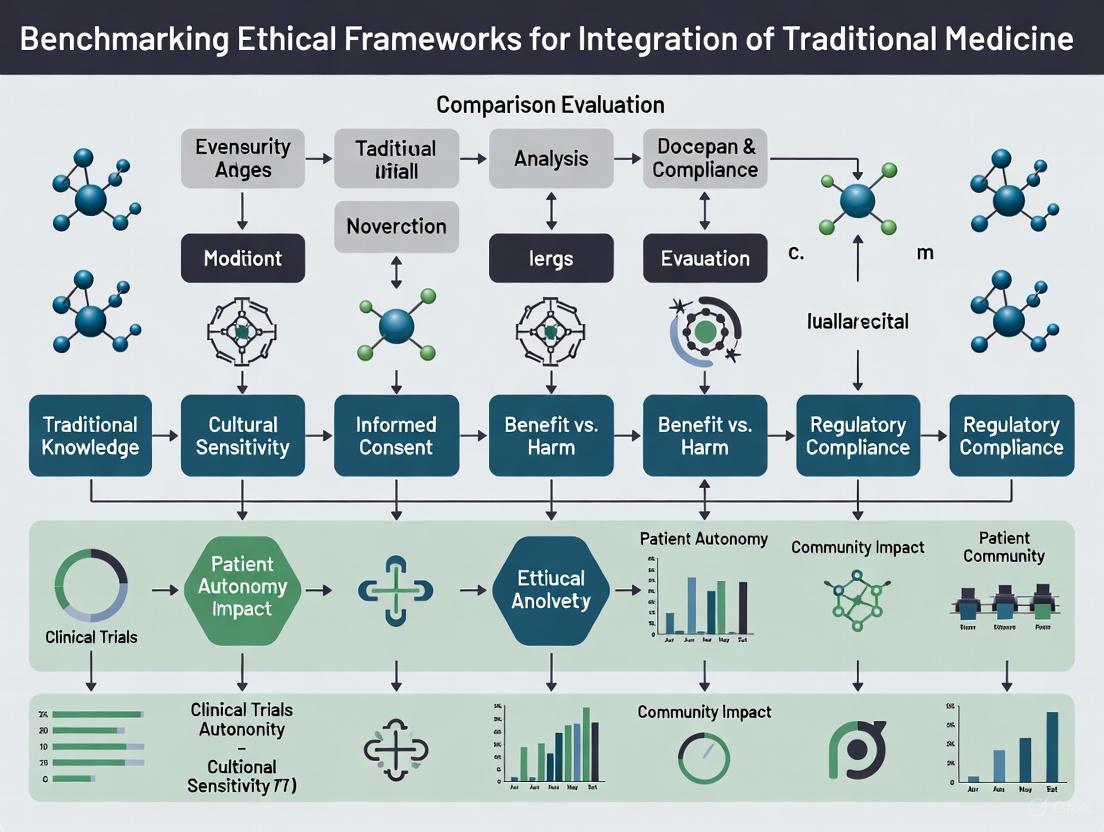
This article provides a comprehensive analysis of ethical frameworks for integrating Traditional Medicine (TM) into modern biomedical research and drug development.
Benchmarking Ethical Frameworks for Traditional Medicine Integration: A Roadmap for Research and Drug Development
Abstract
This article provides a comprehensive analysis of ethical frameworks for integrating Traditional Medicine (TM) into modern biomedical research and drug development. It explores foundational ethical principles, including intellectual property rights, equitable benefit-sharing, and cultural respect, as informed by recent global policy developments like the 2024 WIPO Treaty. The content examines practical methodological tools, such as the EU's regulatory model for herbal medicines and the Rainbow Model of Integrated Care, for implementing ethical integration. It further addresses common challenges—including scientific validity in clinical research, practitioner trust, and policy-practice gaps—and proposes optimization strategies. Finally, it reviews emerging validation technologies, notably Generative AI, for evidence generation and ethical knowledge management. Designed for researchers, scientists, and drug development professionals, this article serves as a strategic guide for navigating the complex ethical landscape of TM integration.
Navigating the Core Ethical Principles and Global Policy Landscape
The integration of traditional medicine into contemporary research and drug development presents a complex landscape of ethical challenges. As pharmaceutical and biotechnology companies increasingly look to natural products and indigenous knowledge for novel compounds, the line between bioprospecting (the search for valuable chemical products in natural biological resources) and biopiracy (the unauthorized appropriation of knowledge and genetic resources) becomes critically important [1] [2]. Nearly one-third of all small-molecule drugs approved by the U.S. Food and Drug Administration (FDA) between 1981 and 2014 were either natural products or derived from natural products, highlighting the significant commercial interest in these resources [1]. This guide objectively compares the ethical frameworks governing this field, providing researchers, scientists, and drug development professionals with evidence-based approaches to navigate these challenges while respecting the rights and contributions of indigenous communities and source countries.
Defining the Ethical Landscape
Biopiracy: Historical Context and Contemporary Manifestations
Biopiracy represents the unauthorized appropriation of biological resources and associated traditional knowledge, typically from indigenous and local communities in biodiverse-rich regions of the Global South, for commercial purposes without fair compensation or benefit-sharing [3] [1]. The term was coined in the early 1990s by Pat Mooney of the ETC Group to describe situations where "researchers or research organizations take biological resources without official sanction, largely from less affluent countries or marginalized people" [1]. This practice is deeply intertwined with historical power imbalances, echoing colonial patterns of resource extraction where biological resources and knowledge flowed from developing to industrialized nations without appropriate compensation [3].
The ethical concerns surrounding biopiracy extend beyond simple resource theft to encompass issues of justice, equity, sovereignty, and the fundamental rights of communities to control their own heritage and resources [3]. When biological resources and traditional knowledge are taken from indigenous or marginalized groups, the commercialization can harm communities by making suddenly valuable species unaffordable for native people, or through patents that prohibit use or sale by the originating communities [1].
Equitable Benefit-Sharing: Principles and Implementation
Equitable Benefit-Sharing (EBS) serves as the primary ethical and legal counterbalance to biopiracy. At its core, EBS refers to the fair distribution of advantages arising from the utilization of genetic resources, ensuring reciprocity and justice for providers [4]. This concept represents a shift away from purely extractive models toward frameworks based on reciprocity and partnership [4].
The operationalization of EBS relies on several key principles:
- Prior Informed Consent (PIC): The requirement that provider countries or communities must give their informed consent before access to genetic resources is granted [4].
- Mutually Agreed Terms (MAT): Access to genetic resources should be based on terms negotiated and agreed upon by both users and providers [4].
- Fair and Equitable Benefit-Sharing: The central tenet that benefits—both monetary and non-monetary—should be shared justly and proportionately with resource providers [4].
Table 1: Types of Benefits in Equitable Benefit-Sharing Agreements
| Benefit Category | Specific Examples | Typical Applications |
|---|---|---|
| Monetary Benefits | Royalties, license fees, research funding, upfront payments | Direct financial compensation, research infrastructure development |
| Non-Monetary Benefits | Technology transfer, capacity building, joint research, contributions to conservation | Strengthening local research capabilities, environmental protection |
| Cultural Benefits | Recognition of traditional knowledge, protection of cultural heritage, community development | Respect for indigenous worldviews, support for cultural preservation |
Comparative Analysis of Ethical Frameworks
International Regulatory Frameworks
Multiple international agreements attempt to address the ethical challenges of traditional medicine research through regulatory approaches. The following table compares the key frameworks governing this field:
Table 2: International Regulatory Frameworks Governing Bioprospecting and Benefit-Sharing
| Framework | Key Principles | Strengths | Limitations | Effectiveness Rating |
|---|---|---|---|---|
| Convention on Biological Diversity (1992) | National sovereignty over genetic resources, conservation, sustainable use, benefit-sharing | Recognizes nation-state rights over biological resources | Limited enforcement mechanisms, variable national implementation | Moderate |
| Nagoya Protocol (2014) | Access and Benefit-Sharing (ABS), Prior Informed Consent, Mutually Agreed Terms | Creates specific legal requirements for benefit-sharing | Limited coverage of digital sequence information, reliance on national implementation | Moderate-High |
| WTO TRIPS Agreement | Intellectual Property Rights, minimum IP standards for member states | Creates global IP standards | Can conflict with ABS principles, favors corporate interests | Low-Moderate |
| WIPO GRATK Treaty (2024) | Patent disclosure requirements for genetic resources and traditional knowledge | Specifically addresses biopiracy in patent system | Very recent implementation, untested effectiveness | Unknown |
The Nagoya Protocol represents the most comprehensive international attempt to regulate this field, establishing rules for how nations access and share biodiversity benefits [5]. It introduces specific components of resource sharing by establishing a framework for norms that member states must implement, including designated checkpoints to monitor compliance and the issuance of internationally recognized certificates [5]. However, critics note it lacks a dedicated forum for indigenous peoples to adjudicate biopiracy claims, has weak penalties for non-compliance, and doesn't adequately ensure indigenous access to developed drugs [5].
Indigenous-Led Ethical Frameworks
In response to limitations in state-based regulatory approaches, indigenous communities have developed their own ethical frameworks grounded in relational worldviews. These frameworks often prioritize respect, responsibility, and reciprocity over purely transactional relationships [6].
The Eight R's Framework developed through a global Indigenous consensus process presents a comprehensive approach specifically for traditional medicine research [6]:
- Reverence: Recognizing the sacred positioning of traditional medicines within indigenous communities and cultures
- Respect: Honoring indigenous protocols, knowledge systems, and governance structures
- Responsibility: Acknowledging ethical duties to protect traditional knowledge and resources
- Relevance: Ensuring research addresses community-identified priorities and needs
- Regulation: Implementing community-based oversight and approval processes
- Reparation: Addressing historical harms and injustices through concrete actions
- Restoration: Working to restore ecological and cultural relationships damaged by exploitation
- Reconciliation: Building new relationships based on mutual understanding and respect [6]
This framework emerged from concerns about the cultural appropriation of traditional medicines, exclusionary practices in research, and the patenting of indigenous knowledge without consent or benefit [6]. The relational system underlying indigenous worldviews understands that "human lives are interdependent with and contingent on living in ethical relations with other people, with our ancestors, with plants and animals, and with the natural world overall" [6].
Experimental Evidence: Case Studies in Ethical Practice
The Hoodia Case: From Biopiracy to Benefit-Sharing
The Hoodia case represents a classic example of biopiracy with a subsequent transition toward benefit-sharing arrangements. For millennia, the San people of southern Africa used native plants of the Hoodia genus as appetite suppressants [2]. Their traditional knowledge was documented by colonial botanists and later investigated by the South African Council for Scientific and Industrial Research (CSIR), which isolated active ingredients and applied for a patent in 1995 [2]. The CSIR subsequently signed a licensing agreement with Phytopharm, who partnered with Pfizer for commercialization of Hoodia products for the Western weight loss market [2].
Experimental Protocol:
- Traditional Knowledge Documentation: Colonial botanists recorded San use of Hoodia as appetite suppressant
- Scientific Validation: CSIR conducted nine years of research to isolate active components (1995 patent)
- Commercial Development: Phytopharm and Pfizer invested in product development for weight loss market
- Ethical Failure: All research and development proceeded without San knowledge or consent
- Remediation: Only in 2001, following press exposure, did CSIR enter benefit-sharing negotiations with San representatives [2]
This case demonstrates the ethical gaps in conventional research approaches, where traditional knowledge was used without consent or benefit, and highlights how public pressure can lead to course correction through belated benefit-sharing agreements.
Ethical Genomic Research with Indigenous Communities
Recent frameworks for ethical genomic research with indigenous communities provide experimental protocols for responsible engagement. The Summer internship for INdigenous peoples in Genomics (SING) Consortium developed a comprehensive framework based on six principles [7]:
- Understand Tribal Sovereignty and Regulation: Recognizing tribal governance structures and research review processes
- Engage and Collaborate: Building genuine research partnerships with indigenous communities
- Build Cultural Competency: Developing understanding of indigenous worldviews and values
- Improve Research Transparency: Ensuring open communication about research goals and processes
- Support Capacity Building: Investing in community research capabilities and infrastructure
- Disseminate Research Findings: Sharing results with communities in accessible formats [7]
Experimental Protocol:
- Preliminary Phase: Identify relevant tribal sovereignty structures and research regulations
- Planning Phase: Establish tribal advisory council and collaborative research design
- Implementation Phase: Conduct research with ongoing community engagement and cultural protocols
- Analysis Phase: Interpret findings through both scientific and indigenous knowledge lenses
- Dissemination Phase: Share results with academic and community audiences through appropriate channels
This framework successfully repositions indigenous communities from research subjects to research partners, acknowledging their expertise and rights throughout the research process [7].
Table 3: Research Reagent Solutions for Ethical Traditional Medicine Research
| Tool Category | Specific Tools | Function | Ethical Considerations |
|---|---|---|---|
| Legal Compliance Tools | Nagoya Protocol Implementation Guides, ABS Clearing-House | Ensure regulatory compliance with international agreements | Must be supplemented with ethical practices beyond legal minimums |
| Community Engagement Tools | Prior Informed Consent protocols, Community IRB guidelines | Facilitate genuine partnership with knowledge holders | Requires adaptation to specific cultural contexts and governance structures |
| Knowledge Documentation Tools | Traditional Knowledge Digital Library, Cultural Heritage Protocols | Record traditional knowledge with appropriate protections | Must balance preservation with protection against misappropriation |
| Benefit-Sharing Mechanisms | Trust funds, Royalty distribution systems, Capacity building programs | Implement fair distribution of research benefits | Should include both monetary and non-monetary benefits tailored to community needs |
| Ethical Assessment Tools | Biopiracy screening protocols, Ethical impact assessments | Evaluate potential ethical concerns in research planning | Should be applied throughout research lifecycle, not just initially |
Comparative Performance Analysis
Effectiveness Metrics Across Ethical Frameworks
The performance of different ethical frameworks can be evaluated through multiple metrics, including protection of indigenous rights, promotion of benefit-sharing, prevention of biopiracy, and facilitation of ethical research. The following diagram illustrates the comparative effectiveness of major approaches based on documented outcomes:
Quantitative Analysis of Framework Implementation
Table 4: Performance Metrics of Ethical Frameworks in Traditional Medicine Research
| Framework | Indigenous Rights Protection Score (1-10) | Benefit-Sharing Implementation Rate | Biopiracy Prevention Effectiveness | Research Facilitation Capacity |
|---|---|---|---|---|
| Indigenous-Led Frameworks | 9 | High (Community-defined) | High | Variable (Community-dependent) |
| Nagoya Protocol | 7 | Moderate-High (Legal requirement) | Moderate-High | Moderate (Regulatory complexity) |
| Convention on Biological Diversity | 6 | Moderate (Voluntary implementation) | Moderate | Moderate (State-dependent) |
| WTO TRIPS Agreement | 3 | Low (Corporate-focused) | Low | High (Streamlined IP processes) |
| EU Herbal Medicines Directive | 5 | Low-Moderate (Limited TK protection) | Moderate | High (Clear regulatory pathway) |
The EU Directive 2004/24/EC on Herbal Medicinal Products represents a specialized regulatory approach that allows herbal medicinal products to be marketed through three pathways: full marketing authorization, well-established use, and traditional use registration [8]. While this creates a clear regulatory pathway for herbal medicines, it offers limited protection for traditional knowledge from indigenous communities outside Europe, particularly as it requires fifteen years of documented use within the EU [8].
The comparative analysis of ethical frameworks from biopiracy to equitable benefit-sharing reveals that regulatory approaches alone are insufficient to address the complex ethical challenges in traditional medicine research. The most effective models combine regulatory compliance with genuine partnership approaches that recognize indigenous sovereignty, knowledge systems, and rights to self-determination. The emerging benchmark for ethical practice requires moving beyond transactional benefit-sharing toward relational frameworks based on ongoing partnership, mutual respect, and shared decision-making.
For researchers and drug development professionals, this analysis indicates that successful ethical integration of traditional medicine requires adopting community-based participatory research methods, implementing culturally-grounded ethical frameworks like the Eight R's, and ensuring continuous community engagement throughout the research process. Those who embrace these approaches are likely to not only avoid the ethical pitfalls of biopiracy but also produce more sustainable, innovative, and socially beneficial research outcomes that respect the rights and contributions of traditional knowledge holders.
The 2024 WIPO Treaty and Intellectual Property Protection for Traditional Knowledge
The 2024 WIPO Treaty on Intellectual Property, Genetic Resources and Associated Traditional Knowledge (GRATK Treaty) represents a landmark development in international intellectual property law. Adopted in May 2024 after nearly twenty-five years of negotiations, this treaty establishes the first international legal instrument linking intellectual property with the protection of genetic resources and traditional knowledge associated with genetic resources [9]. For researchers, scientists, and drug development professionals working with traditional medicine, this treaty creates new disclosure requirements and ethical benchmarks that will significantly impact how research involving genetic resources and associated traditional knowledge (ATK) is conducted and documented.
The treaty aims to "enhance the efficacy, transparency and quality of the patent system" with regard to genetic resources and traditional knowledge while preventing patents from being granted erroneously for inventions that are not novel or inventive in light of existing genetic resources and ATK [10] [9]. This development comes at a critical time when global demand for traditional medicine is projected to increase significantly in value—from $213.81 billion in 2025 to $359.37 billion by 2032—highlighting the growing economic and therapeutic importance of traditional medical knowledge [11].
Treaty Provisions & Key Mechanisms
Core Disclosure Requirement
The cornerstone of the GRATK Treaty is Article 3, which mandates a mandatory patent disclosure requirement for applicants filing international applications under the Patent Cooperation Treaty [12] [9]. This requirement triggers when a claimed invention is "based on" genetic resources or associated traditional knowledge, which the treaty defines through a two-part test:
- The genetic resources and/or traditional knowledge "must have been necessary for the claimed invention" [12]
- "The claimed invention must depend on the specific properties of the genetic resources and/or on the associated traditional knowledge" [12]
When these conditions are met, patent applicants must disclose:
- The country of origin of the genetic resources, and/or
- The Indigenous Peoples or local community providing the associated traditional knowledge [10]
Where this information is unknown, applicants must disclose the source of the genetic resources or ATK. If none of this information is known, a declaration affirming this lack of knowledge must be provided [9].
Compliance and Enforcement Mechanisms
The treaty establishes a balanced approach to compliance, recognizing practical challenges while ensuring meaningful implementation:
Table: GRATK Treaty Compliance Framework
| Aspect | Requirement | Limitations |
|---|---|---|
| Disclosure Verification | Patent offices should provide guidance | No obligation to verify authenticity of disclosure [10] |
| Failure to Disclose | Subject to appropriate, effective, and proportionate measures | Opportunity to rectify unless fraudulent conduct or intent [10] |
| Fraudulent Intent | Post-grant sanctions or remedies may apply | Requires demonstration of fraudulent intent [10] |
| Non-Fraudulent Failure | Various sanctions available | Patent cannot be revoked, invalidated, or rendered unenforceable solely based on disclosure failure [10] |
Implementation Timeline and Status
The treaty was adopted on May 24, 2024, and opened for signature for one year until May 23, 2025 [12] [10]. As of December 2024, only one Member State (Malawi) had ratified or acceded to the treaty [12]. The treaty will enter into force three months after 15 eligible parties deposit their instruments of ratification or accession [10]. The treaty includes a non-retroactivity clause, meaning its obligations do not apply to patent applications filed before its entry into force [10].
Comparative Analysis: Disclosure Requirements Across International Systems
Pre-Treaty National Disclosure Regimes
Prior to the GRATK Treaty, various countries had established their own disclosure requirements for genetic resources and traditional knowledge, creating a fragmented international landscape:
Table: Comparative Analysis of Traditional Knowledge Disclosure Frameworks
| Jurisdiction/System | Disclosure Requirement | Trigger Standard | Legal Effect of Non-Compliance |
|---|---|---|---|
| 2024 WIPO GRATK Treaty | Mandatory disclosure of country of origin and/or Indigenous Peoples/local community [10] | Invention "based on" GR/ATK (necessary for invention and depends on specific properties) [12] | Proportional sanctions; no patent revocation except for fraudulent intent [10] |
| European Union | Disclosure of source (varying implementations across member states) | Varying standards | Mixed approaches across member states |
| India | Comprehensive disclosure requirements | Based on Indian biological resources and associated knowledge | Strong penalties including patent revocation |
| China | Limited disclosure mechanisms | Focus on specific genetic resources | Administrative sanctions |
| United States (Pre-Treaty) | Voluntary disclosure system | No mandatory requirement | No legal consequences for non-disclosure |
Relationship with Other International Agreements
The GRATK Treaty is designed to be implemented in a "mutually supportive manner" with other relevant international agreements, including the Convention on Biological Diversity (CBD) and its Nagoya Protocol on Access and Benefit-Sharing [10]. This creates a complementary framework that addresses both the environmental conservation aspects of genetic resources (through CBD) and the intellectual property dimensions (through the WIPO Treaty).
Research Ethics & Traditional Medicine Integration
Ethical Challenges in Traditional Medicine Research
The GRATK Treaty emerges against a backdrop of persistent ethical challenges in traditional medicine research, which include:
- Misappropriation of Traditional Knowledge: Unauthorized use and commercialization of traditional knowledge without fair benefit-sharing [11]
- Inadequate Informed Consent: Failure to obtain proper consent from traditional knowledge holders when researching and commercializing their knowledge [13]
- Limited Benefit-Sharing: Insufficient mechanisms to ensure traditional knowledge holders share in the commercial benefits derived from their knowledge [11]
- Cultural Insensitivity: Research approaches that fail to respect the cultural context and significance of traditional knowledge [13]
These challenges are particularly acute in traditional medicine research, where 80% of African populations use some form of traditional herbal medicine, and the worldwide annual market for these products approaches $60 billion [13].
Comprehensive Ethical Framework for Research
A comprehensive framework for ethical research in traditional medicine must address multiple dimensions:
Ethical Framework for Traditional Medicine Research
This ethical framework emphasizes that collaborative partnership—including bilateral representation based on mutual respect between equal partners with community advice—forms the foundation for ethical traditional medicine research [13]. This approach includes "a responsibility to invest in the scientific training and capacity-building for ongoing research in a host country where such resources are not well developed" [13].
WHO's Global Traditional Medicine Strategy 2025-2034
The GRATK Treaty aligns with the WHO Global Traditional Medicine Strategy 2025-2034, which aims to enhance the contribution of traditional, complementary, and integrative medicine to achieving universal health coverage [11]. The strategy has four strategic objectives:
- Building Evidence: Strengthening research to validate safety and effectiveness
- Strengthening Regulation: Ensuring safety and quality through regulatory mechanisms
- Promoting Integration: Integrating traditional medicine into national health systems
- Fostering Cross-Sector Collaboration: Utilizing traditional medicine's broader health benefits [11]
Experimental Protocols & Research Methodologies
Standardized Research Protocols for Traditional Knowledge
Research involving traditional knowledge requires specialized methodological approaches that respect both scientific rigor and cultural context:
Protocol for Ethnopharmacological Research:
- Prior Informed Consent: Obtain consent from traditional knowledge holders and relevant communities
- Documentation: Record traditional uses, preparation methods, and dosage information
- Collection and Identification: Properly identify and voucher plant specimens
- Extraction and Fractionation: Prepare extracts using traditional methods when possible
- Bioactivity Screening: Test for relevant pharmacological activities
- Compound Isolation: Isolate and characterize active compounds
- Mechanistic Studies: Elucidate mechanisms of action
- Preclinical Development: Conduct safety and efficacy studies in relevant models
- Benefit-Sharing Implementation: Establish agreements for sharing benefits with knowledge holders
Protocol for Clinical Evaluation of Traditional Medicines:
- Research Question Formulation: Develop questions relevant to both traditional use and modern medicine
- Study Design: Adapt randomized controlled trials to account for holistic traditional approaches
- Outcome Measures: Include both biomedical endpoints and patient-reported outcomes
- Safety Monitoring: Implement robust pharmacovigilance for traditional preparations
- Data Analysis: Employ appropriate statistical methods for complex interventions
- Knowledge Translation: Share results with traditional knowledge holders in accessible formats
Table: Research Reagent Solutions for Traditional Medicine Studies
| Research Tool | Function | Application Example |
|---|---|---|
| DNA Barcoding | Authenticates medicinal plants using genetic markers [11] | Verification of botanical identity in multi-component herbal formulations [11] |
| Metabolomics Platforms | Comprehensive analysis of small molecule metabolites [11] | Standardization and quality control of herbal medicines [11] |
| AI-Powered Databases | Predictive modeling of herb-drug interactions [11] [14] | Identification of potential interactions between traditional medicines and pharmaceuticals [11] |
| Electronic Health Records (EHR) | Integration of traditional medicine use into patient records [11] | Monitoring safety and effectiveness in real-world settings [11] |
| Digital Authentication Systems | Traceability of raw materials [11] | Reducing risks associated with misidentified herbal components [11] |
Implementation Challenges & Research Implications
Practical Implementation Challenges
The implementation of the GRATK Treaty presents several significant challenges for researchers and patent applicants:
Determining When Disclosure is Required: The treaty's trigger for disclosure—when genetic resources or traditional knowledge is "necessary" for the invention and the invention "depends on" the specific properties of the GR/ATK—requires careful case-by-case analysis [12]. This determination may be particularly challenging for inventions that are merely inspired by traditional knowledge rather than directly dependent on it.
Identifying the Correct Source: In cases where traditional knowledge has been documented in historical texts or disseminated broadly, identifying the specific Indigenous Peoples or local community that provided the knowledge may be difficult. The treaty addresses this by allowing applicants to declare when such information is unknown [10] [9].
Administrative Burden: The disclosure requirement adds another administrative step to the patent application process, potentially increasing costs and complexity for researchers and applicants.
Research Methodology Adaptations
The treaty necessitates adaptations to research methodologies involving traditional knowledge:
Traditional Knowledge Research Workflow
Future Directions & Evolving Framework
The GRATK Treaty includes a built-in review mechanism that will assess certain issues four years after the treaty enters into force [10]. This review will consider:
- Possible Extension to Other IP Areas: Whether the disclosure requirement should extend beyond patents to other forms of intellectual property
- Inclusion of Derivatives: Whether the treaty should cover derivatives of genetic resources
- New and Emerging Technologies: How to address issues arising from technologies relevant to the application of the treaty [10]
This evolving nature of the treaty means researchers and drug development professionals must stay informed about potential future expansions of the disclosure requirements. The treaty also suggests the establishment of information systems (such as databases) of genetic resources and associated traditional knowledge, which could significantly impact how researchers access and document traditional knowledge in the future [10].
For the research community, the GRATK Treaty represents both a challenge and an opportunity—it creates additional administrative requirements but also establishes a clearer pathway for ethically engaging with traditional knowledge while ensuring that Indigenous Peoples and local communities receive appropriate recognition for their contributions to drug discovery and development.
Analyzing WHO Policy and Its Impact on National Integration Strategies
The World Health Organization (WHO) has established a comprehensive policy framework to guide the integration of Traditional, Complementary, and Integrative Medicine (TCIM) into national health systems worldwide. The WHO Global Traditional Medicine Strategy 2025–2034, adopted at the 78th World Health Assembly in May 2025, represents a landmark policy directing national integration efforts [15] [16]. This strategy aims to enhance the contribution of TCIM to achieving universal health coverage (UHC) by strengthening evidence-based practices and supporting their appropriate integration into national health systems [11]. The policy emerges against a backdrop of growing global demand for traditional medicine, with market value projected to increase from $213.81 billion in 2025 to $359.37 billion by 2032, reflecting a compound annual growth rate of 7.7% [11].
The strategy's implementation occurs alongside significant reforms to global health governance, including amendments to the International Health Regulations (IHR) that took effect in September 2025 [17]. These amendments introduce requirements for national IHR authorities to coordinate implementation at the national level, creating parallel structures that could support or complicate TCIM integration efforts. This analysis examines how WHO's policy framework is shaping national integration strategies, comparing institutional approaches, regulatory mechanisms, and implementation challenges across different countries and regions.
Comparative Analysis of National Integration Models
Diverse National Approaches to TCIM Integration
Countries worldwide have adopted distinct approaches to integrating traditional medicine into their national health systems, reflecting varying historical, cultural, and governance contexts. These integration models range from full assimilation into mainstream healthcare to parallel systems with limited interconnection.
Table 1: Comparative Analysis of National TCIM Integration Models
| Country/Region | Integration Model | Key Characteristics | Regulatory Framework | Research Infrastructure |
|---|---|---|---|---|
| China | Full Integration | Traditional Chinese Medicine fully incorporated at all care levels | National Administration of Traditional Chinese Medicine | Strong government-funded research institutions |
| India | Parallel System with Increasing Integration | AYUSH ministry (Ayurveda, Yoga, Unani, Siddha, Homeopathy) coexists with biomedical system | Ministry of AYUSH with established education standards | Growing research capacity with WHO support |
| European Union | Cautious, Evidence-Based | Limited integration pending scientific validation | Emphasis on safety, quality standards, and pharmacovigilance | Research focused on evidence generation and safety |
| African Region | Pragmatic Recognition | Widespread use despite limited regulation | Developing regulatory frameworks | Limited research capacity; relying on WHO guidance |
The integration models reflect different historical pathways and policy priorities. China has established the most comprehensive integration, with Traditional Chinese Medicine fully incorporated into its healthcare system and supported by a dedicated National Administration of Traditional Chinese Medicine [16]. This model includes formal education programs, licensed practitioners, and insurance coverage. Similarly, India has created a parallel system through its Ministry of AYUSH, which oversees Ayurveda, Yoga, Unani, Siddha, and Homeopathy, though integration with allopathic medicine remains limited [18] [16].
In contrast, European Union countries maintain a more cautious approach, emphasizing the need for scientific validation and safety monitoring before integration [18]. The EU has voiced concerns about quality and safety, urging WHO to "be firm and vocal against harmful and or inefficient practices that may be disguised as alternative medicines" [18]. This evidence-based stance reflects different cultural attitudes toward traditional medicine and stronger regulatory traditions.
African nations like Comoros and Togo acknowledge widespread TCIM use while reporting that the sector "remains unregulated and training the providers remains a challenge" [18]. Many African countries are developing regulatory frameworks to harness traditional medicine's potential while ensuring patient safety.
Quantitative Assessment of Global Integration Progress
The WHO has documented steady progress in traditional medicine integration globally through its periodic surveys of member states. The Third WHO Global Survey on TCIM reveals significant advances in policy adoption and regulatory development across member states.
Table 2: Global Progress in TCIM Integration (1999-2025)
| Integration Indicator | 1999 Baseline | 2025 Status | Change | Number of Countries |
|---|---|---|---|---|
| National TCIM Policies | 25 countries | 90 countries | +260% | 106 reporting countries |
| Regulations for Herbal Medicines | 65 countries | 116 countries | +78% | 116 reporting countries |
| National TCIM Offices | 49 countries | 100 countries | +104% | 106 reporting countries |
| University-Level TCIM Courses | 41 countries (2012) | 58 countries | +41% | 106 reporting countries |
The data demonstrates substantial advancement in formal recognition of TCIM, with the number of countries implementing national TCIM policies increasing more than threefold since 1999 [11]. Similarly, frameworks regulating herbal medicines have expanded significantly, now present in 116 member states [11]. This reflects growing governmental commitment to creating structured approaches to traditional medicine rather than allowing unregulated practice.
The establishment of national TCIM offices has more than doubled, indicating increased institutionalization within health ministries [11]. Academic integration has also progressed, with 58 countries now offering university-level TCIM courses, up from 41 in 2012 [11]. This professionalization of TCIM practitioners supports quality assurance and standardized practice.
Experimental and Methodological Approaches
Research Protocols for Evidence Generation
WHO's strategy emphasizes building a robust evidence base for TCIM through appropriate research methodologies. The complex, holistic nature of many traditional medicine practices requires adaptation of conventional clinical research methods.
The evidence generation framework begins with documentation and standardization of traditional knowledge and practices [11]. This is followed by pre-clinical research utilizing omics technologies (such as metabolomics for standardization and quality control, and genomics for personalized medicine) and DNA barcoding to authenticate medicinal plants [11]. These methods address key challenges in traditional medicine research, including product standardization and quality control of multi-component formulations.
Clinical research phases employ adaptive trial designs that accommodate the holistic, individualized nature of traditional practices while maintaining scientific rigor [11]. This approach represents a methodological innovation specific to traditional medicine research, as conventional clinical trial methods may not adequately capture the benefits of personalized, whole-system traditional interventions. Health systems research then evaluates integration models, cost-effectiveness, and real-world implementation challenges.
Digital databases play a crucial role in evidence generation, with resources like the Traditional Chinese Medicine Integrated Database and the Herb-Drug Interaction Database facilitating predictive modeling and evidence synthesis [11]. The recently launched WHO TCIM Dashboards provide dynamic platforms for managing national TCIM data and monitoring global progress [16].
Table 3: Essential Research Reagents and Resources for TCIM Integration Studies
| Research Tool Category | Specific Examples | Primary Function | Application in TCIM Research |
|---|---|---|---|
| Omics Technologies | Metabolomics, Genomics | Comprehensive analysis of biological systems | Standardization and quality control of herbal medicines; personalized medicine approaches |
| Digital Authentication | DNA barcoding | Botanical identification and authentication | Verifying botanical identity of ingredients; detecting adulterants in herbal formulations |
| Data Resources | WHO TCIM Dashboards, TCM Integrated Database | Global and traditional medicine-specific data | Evidence synthesis, policy planning, and traditional knowledge documentation |
| Clinical Research Tools | Adaptive trial designs, holistic outcome measures | Clinical evaluation of complex interventions | Evaluating traditional medicine effectiveness within appropriate methodological frameworks |
| Regulatory Tools | Pharmacovigilance systems, quality control protocols | Safety monitoring and quality assurance | Monitoring adverse events; ensuring product quality and consistency |
The research toolkit for TCIM integration studies combines advanced scientific technologies with specialized methodologies adapted to traditional medicine characteristics [11]. Omics technologies enable comprehensive analysis of complex herbal formulations, addressing challenges in standardization and quality control [11]. These high-throughput approaches provide mechanistic insights that help bridge traditional knowledge systems with contemporary scientific understanding.
DNA barcoding has emerged as a critical tool for authenticating medicinal plants, supporting quality control of multi-component herbal formulations by verifying botanical identity and detecting adulterants [11]. This technology addresses a fundamental challenge in traditional medicine research—ensuring that studied materials correspond to traditional use.
Digital resources like the WHO TCIM Dashboards provide unprecedented access to global data on traditional medicine policies, regulations, and integration progress [16]. These platforms support evidence-based policy development and facilitate cross-country learning.
Policy Implementation and Governance Structures
Institutional Coordination Frameworks
The implementation of WHO's traditional medicine strategy intersects with broader global health governance reforms, particularly the 2024 amendments to the International Health Regulations (IHR) that took effect in September 2025 [17]. These amendments introduce requirements for "national IHR authorities" to coordinate implementation of the Regulations at the national level, creating potential synergies with TCIM integration efforts.
The governance structure for TCIM integration involves multiple international organizations with complementary mandates. The World Intellectual Property Organization (WIPO) contributes through its Treaty on intellectual property, genetic resources and associated traditional knowledge, which promotes transparency and fair benefit-sharing [11]. Similarly, UNESCO recognizes traditional medicine practices as part of humanity's intangible cultural heritage, including Indonesia's jamu wellness culture, yoga from India, and traditional Chinese acupuncture and moxibustion on its lists [11].
At the national level, implementation requires coordination between the newly established or designated national IHR authorities and existing national TCIM offices [17] [11]. This coordination is essential to ensure that traditional medicine integration supports broader health security objectives while respecting cultural traditions and indigenous knowledge.
The amended IHR provide flexibility, allowing states to "choose between setting up one or two entities to fulfil the functions of the national authority and national focal point" [17]. This flexibility accommodates different constitutional arrangements and health system structures while pursuing common integration objectives.
Ethical Framework and Indigenous Knowledge Protection
A critical dimension of TCIM integration involves ethical considerations regarding the protection of indigenous knowledge and equitable benefit-sharing. The WHO strategy explicitly recognizes "the role of traditional knowledge of indigenous peoples" and "the importance of upholding their rights" [16]. This ethical framework responds to concerns about misappropriation of traditional knowledge without appropriate recognition or compensation.
The implementation of this framework faces several challenges, including establishing mechanisms for equitable benefit-sharing when traditional knowledge leads to commercial products [18]. As noted in discussions during the World Health Assembly, Thailand emphasized the importance of "uphold[ing] the rights of indigenous people and ensur[ing] that any profit made from using local biodiversity and indigenous knowledge ought to be shared with them" [18]. This position potentially conflicts with pharmaceutical industry perspectives that "paying for access to resources would hinder innovation" [18].
Additional ethical challenges include protecting traditional knowledge while generating scientific evidence, avoiding over-commercialization that might compromise cultural integrity, and ensuring that integration policies respect the cultural context of traditional practices. As expressed by the Medicus Mundi International Network, "Centering 'evidence-based' validation risks displacing practices rooted in land, culture, and spirituality" [18]. This tension between scientific validation and cultural preservation represents a central ethical dilemma in TCIM integration.
The implementation of WHO's Traditional Medicine Strategy 2025-2034 represents a significant evolution in global health policy, recognizing the importance of traditional knowledge systems while emphasizing evidence-based integration. The policy's impact on national integration strategies manifests through several key developments: the establishment of stronger regulatory frameworks for traditional medicines, increased governmental commitment through dedicated offices and policies, growing research capacity, and enhanced international cooperation through mechanisms like the Group of Friends of Traditional Medicine.
Critical challenges remain, including significant research gaps with 95% of WHO Member States citing "a lack of research data as a key barrier to the development of traditional, complementary and integrative medicine" [11]. Additionally, tensions persist between scientific validation and cultural preservation, between commercial development and equitable benefit-sharing, and between universal standards and contextual adaptation. The limited funding for traditional medicine research, particularly within WHO's overall budget constraints, further challenges implementation [18].
The upcoming second WHO Global Traditional Medicine Summit in New Delhi in December 2025 will provide an important opportunity to assess progress and align stakeholder actions [16]. Future research should focus on developing context-sensitive methodologies for evaluating traditional practices, establishing equitable models for benefit-sharing, documenting integration outcomes across different health systems, and analyzing the interplay between traditional medicine integration and global health security frameworks. Through addressing these challenges, WHO's policy can potentially transform traditional medicine's role in global health, contributing to more inclusive, culturally responsive health systems worldwide.
The integration of traditional medicine (TM) into contemporary healthcare and research represents a critical frontier for global health, demanding a careful balance between respecting cultural heritage and pursuing scientific innovation. Traditional medicine, encompassing diverse systems such as Ayurveda, Traditional Chinese Medicine (TCM), and various Indigenous knowledge systems, is not merely a historical artifact but a living, evolving body of knowledge used by billions worldwide [19] [20]. For researchers, scientists, and drug development professionals, the central challenge lies in developing ethical frameworks that do not simply extract knowledge but foster equitable collaboration, ensuring that innovation enhances rather than erodes cultural integrity.
This guide objectively compares emerging models and protocols for this integration, with a specific focus on benchmarking their operational, ethical, and scientific performance. The urgency of this balance is underscored by World Health Organization initiatives, including its new Global Traditional Medicine Strategy (2025-2034) and the development of a chapter on traditional medicine in the International Classification of Diseases (ICD-11), which aims to enable the coding of traditional medicine disorders alongside biomedical diagnoses [19] [21]. This guide provides a comparative analysis of the methodological and ethical frameworks shaping this dynamic field.
Comparative Analysis of Integration Models
The approach to integrating traditional medicine with scientific research is not monolithic. Different models have emerged, each with distinct operational paradigms, advantages, and limitations. The following table provides a structured comparison of these dominant frameworks.
Table 1: Benchmarking Models for Integrating Traditional Medicine and Scientific Research
| Integration Model | Core Methodology | Key Performance Advantages | Documented Limitations & Risks |
|---|---|---|---|
| Ethnopharmacology & Reverse Pharmacology | Systematic study of bioactive compounds based on traditional use; "reverse" path from clinical validation to drug discovery [20]. | Accelerated Discovery: Landmark drugs like artemisinin (malaria) derived from TCM [20]. Higher Hit Rates: Leverages time-tested human use to guide screening. | Reductionist Approach: Can isolate compounds, ignoring holistic synergy of traditional formulas [14]. Biopiracy Risk: Potential exploitation without equitable benefit-sharing [19]. |
| Data-Driven AI Integration | Application of Machine Learning (ML), Deep Learning (DL), and Large Language Models (LLMs) to digitize and analyze traditional medical knowledge [14] [22]. | Pattern Recognition: Identifies complex interactions in polyherbal formulations [14]. Knowledge Preservation: Digitizes fragile oral traditions and manuscripts [14]. Predictive Modeling: Predicts herb-drug interactions and accelerates molecular discovery [14]. | Data Bias: Models trained on incomplete or poor-quality data produce flawed outputs [22]. Automated Biopiracy: AI could systematically mine traditional knowledge without consent [19]. Epistemic Conflict: May distort knowledge to fit computational models [14]. |
| Whole Systems & Person-Centered Research | Evaluates traditional medicine practices (e.g., yoga, acupuncture) as complex interventions within a person-centered model of care [21]. | Clinical Relevance: Assesses interventions as actually practiced. Holistic Evidence: Generates evidence for non-pharmacological treatments (e.g., evidence for yoga in chronic back pain) [20]. | Methodological Complexity: Difficult to design blinded, controlled trials. Standardization Challenges: High variability in practitioner skill and treatment individualization. |
| Integrative Healthcare Policy | National and international policy efforts to formally regulate and integrate TM into primary healthcare and achieve Universal Health Coverage (UHC) [21]. | Structural Support: Creates frameworks for training, practice, and product safety (e.g., WHO benchmarks) [21]. Increased Access: Makes TM services part of formal healthcare. | Uneven Implementation: Only 13 countries reported having a national plan for integration as of 2018 [21]. Regulatory Dilution: Standards may oversimplify or misrepresent traditional knowledge. |
Quantitative Benchmarking of Current Research Efforts
A critical component of benchmarking is quantifying the current global research landscape. This reveals significant disparities between the widespread use of traditional medicine and the resources allocated to its scientific study. The following tables summarize key quantitative data.
Table 2: Global Research Funding and Output for Traditional Medicine
| Metric | Value | Context & Implication |
|---|---|---|
| Global Research Funding | <1% of global health research funding [19] | Significant underinvestment relative to its widespread use and potential, creating a major evidence gap. |
| Clinical Trial Volume | >26,000 clinical trials on complementary therapies in Cochrane Central database [21] | Indicates a substantial and growing body of clinical research, though it remains fragmented. |
| National Research Capacity | 75 countries have national research institutes for T&CM [21] | Demonstrates significant institutional capacity, though concentrated in specific regions. |
Table 3: Global Utilization and Regulation of Traditional Medicine
| Aspect | Metric | Significance |
|---|---|---|
| Utilization | Used by billions worldwide; primary or preferred care for many [19] | Highlights the immense practical relevance and demand, justifying the need for rigorous research. |
| Regulation (Products) | 124 countries have laws/regulations on herbal medicines [21] | Shows progress on product safety, but regulations for other TCIH products are less common. |
| Regulation (Practitioners) | 78 countries regulate T&CM providers [21] | Indicates a move towards professional standardization and quality assurance. |
Experimental Protocols for Ethical and Evidence-Based Research
To ensure that research is both scientifically valid and ethically sound, specific experimental protocols are being developed and refined. Below are detailed methodologies for key approaches cited in this field.
Protocol: Ethnopharmacological Drug Discovery via Reverse Pharmacology
This protocol, exemplified by the discovery of artemisinin, provides a pathway from traditional knowledge to validated pharmaceutical product [20].
- Ethnobotanical Selection: Identify candidate plants through rigorous ethnobotanical surveys, documented use by traditional healers, and historical textual analysis (e.g., TCM literature for Artemisia annua).
- Bioactivity-Guided Fractionation:
- Prepare a crude extract of the plant material.
- Subject the extract to in vitro or in vivo bioassays (e.g., anti-malarial activity assay).
- Iteratively fractionate the active extract using techniques like chromatography, testing each fraction for activity until the active compound is isolated.
- Structural Elucidation: Employ spectroscopic methods (NMR, Mass Spectrometry) to determine the precise chemical structure of the active molecule (e.g., artemisinin).
- Preclinical & Clinical Development: Proceed with standard drug development processes, including pharmacokinetic (ADMET) studies, toxicology, formulation, and phased clinical trials.
Protocol: A Five-Phase Ethical Framework for Generative AI in Ethnopharmacology
This framework is designed to guide the use of Generative AI in a manner that respects and protects traditional knowledge [14].
- Phase 1: Ethical Digitization & Data Sovereignty
- Methodology: Digitize traditional knowledge (oral histories, manuscripts) using OCR and NLP, with prior informed consent from knowledge holders. Data must be structured according to the FAIR (Findable, Accessible, Interoperable, Reusable) principles and the CARE (Collective Benefit, Authority to Control, Responsibility, Ethics) principles for Indigenous data governance.
- Phase 2: Knowledge Graph Construction
- Methodology: Build a structured knowledge graph that links entities such as medicinal plants, their traditional uses, bioactive compounds, molecular targets, and associated diseases. This creates a computable network of traditional knowledge.
- Phase 3: AI-Driven Predictive Modeling
- Methodology: Use Graph Neural Networks (GNNs) and LLMs with Retrieval-Augmented Generation (RAG) to explore the knowledge graph. This can predict novel herb-drug interactions, de novo molecular structures, and optimize polyherbal formulations based on traditional rationale.
- Phase 4: Experimental Validation
- Methodology: Validate AI-generated hypotheses using in vitro assays, in vivo models, and eventually, clinical trials. Techniques like molecular docking and QSAR modeling can provide initial computational validation.
- Phase 5: Equitable Translation & Benefit-Sharing
- Methodology: Ensure commercial or clinical applications are governed by agreements that guarantee equitable benefit-sharing with source communities. This includes respecting intellectual property through frameworks like the 2024 WIPO treaty and ensuring access to final products [19].
Protocol: Clinical Evaluation of Complex Traditional Interventions (e.g., Yoga for Chronic Pain)
This protocol addresses the challenge of testing holistic, non-pharmacological therapies [20].
- Intervention Standardization: Define the complex intervention (e.g., a specific yoga sequence) in a manual, while allowing for limited, justified individualization.
- Study Design: Implement a randomized controlled trial (RCT) design. A three-arm design is often optimal: (1) the TM intervention group (e.g., yoga classes), (2) a standard care or wait-list control group, and (3) an active control group (e.g., another form of exercise) to control for non-specific effects.
- Blinding: While participant blinding is often impossible, outcome assessors and data analysts should be blinded to group allocation.
- Outcome Measures: Utilize validated, patient-centered primary and secondary outcomes (e.g., pain scale and back-related function questionnaire for chronic lower back pain). Biomarkers like functional MRI (fMRI) can be used to study mechanistic correlates like relaxation responses [20].
Visualization of Workflows and Ethical Frameworks
The following diagrams, generated using Graphviz DOT language, illustrate the core logical relationships and workflows described in this guide.
Ethical AI-Driven Drug Discovery Workflow
This diagram outlines the integrated, cyclical workflow for ethically leveraging AI in traditional medicine research.
Balancing Competing Values in Research
This diagram maps the critical tensions and balancing points between the values of cultural heritage and scientific innovation.
The Scientist's Toolkit: Essential Reagents and Materials
Successful research in this field relies on a specific set of reagents, tools, and methodologies. The following table details key solutions for conducting rigorous and ethical research.
Table 4: Essential Research Reagent Solutions for Traditional Medicine Integration
| Research Reagent / Tool | Primary Function | Application in TM Research |
|---|---|---|
| Large Language Models (LLMs) & NLP | Natural language processing of unstructured text [14]. | Digitizing and extracting information from historical manuscripts, clinical notes, and ethnobotanical records in multiple languages. |
| Knowledge Graph Platforms (e.g., Neo4j) | Creating structured, interconnected networks of data [14]. | Mapping relationships between medicinal plants, their compounds, molecular targets, and traditional uses to generate testable hypotheses. |
| AI Molecular Generation Algorithms | De novo design of molecular structures with desired properties [14]. | Accelerating the discovery of novel drug candidates inspired by the chemical space of traditional medicinal plants. |
| ADMET Prediction Software | In silico prediction of Absorption, Distribution, Metabolism, Excretion, and Toxicity [14]. | Providing early-stage, computational safety and pharmacokinetic profiling for compounds derived from traditional medicine. |
| Functional MRI (fMRI) | Non-invasive imaging of brain activity [20]. | Studying the neural correlates and mechanisms of action of traditional practices like meditation and acupuncture. |
| High-Resolution Mass Spectrometry | Precise identification and quantification of chemical compounds [14]. | Standardizing and quality-controlling complex herbal formulations; identifying active constituents in bioactivity-guided fractionation. |
| International Classification of Diseases (ICD-11), Chapter 26 | Standardized terminology for diseases and health conditions [19]. | Enabling the coding of traditional medicine diagnoses and patterns in health information systems, facilitating data collection and research. |
Benchmarking the integration of cultural heritage and scientific innovation reveals a field at a critical inflection point. The data demonstrates that while traditional medicine enjoys widespread use and growing political support, it suffers from a significant research funding gap—receiving less than 1% of global health research investment [19]. This inequity undermines efforts to build the robust evidence base required for safe and effective integration.
The most promising frameworks are those that move beyond mere extraction and embrace ethical collaboration. The five-phase framework for Generative AI and the principles of reverse pharmacology provide tangible protocols for achieving this. Success is no longer measured solely by the discovery of a new drug compound, but by the triad of scientific validity, clinical applicability, and ethical integrity. This includes equitable benefit-sharing, respect for data sovereignty, and the protection of Indigenous knowledge from biopiracy, particularly in the face of emerging threats like "automated biopiracy" via AI [19].
For researchers and drug development professionals, the path forward requires a commitment to transdisciplinary work. The benchmarks and toolkits presented here provide a starting point for designing studies that are not only methodologically sound but also culturally respectful, ensuring that the pursuit of scientific innovation becomes a force for preserving and enhancing humanity's diverse medical heritage.
Implementing Ethical Integration: Regulatory Models and Operational Frameworks
- Regulatory Context: Introduction to the historical background and need for herbal medicine regulation. Uses a table to compare pre-directive national approaches.
- Directive Analysis: Examines the three regulatory pathways established by the directive. Uses a table to compare authorization routes.
- Ethical Framework: Analyzes ethical principles including autonomy, beneficence, and justice.
- Global Benchmark: Compares the EU approach with international frameworks and research status.
- Research Implications: Outlines methodological requirements and knowledge gaps. Includes tables on experimental metrics and reagent solutions.
The EU Directive 2004/24/EC: A Benchmark for Regulating Herbal Medicinal Products
The European Directive 2004/24/EC represents a pivotal regulatory development in the realm of traditional and herbal medicines, establishing a harmonized framework across European Union member states for the evaluation, authorization, and monitoring of herbal medicinal products. Prior to its implementation in 2004, the regulatory landscape for herbal medicines across Europe was characterized by significant disparities, with individual member states maintaining differing procedures and provisions that created obstacles to trade within the Community and resulted in varying levels of consumer protection [23] [24]. This fragmentation led to both discrimination and distortion of competition between manufacturers of these products while simultaneously impacting public health protection, as the necessary guarantees of quality, safety, and efficacy were not consistently provided [23]. The directive emerged as a response to these challenges, amending Directive 2001/83/EC to create a simplified registration procedure specifically designed for traditional herbal medicinal products, thereby acknowledging their particular characteristics while maintaining appropriate regulatory oversight.
The historical context preceding the directive reveals a pressing need for regulatory harmonization. Herbal medicinal products had occupied a unique position in healthcare systems across Europe, with a significant number of these products, despite their long tradition, failing to fulfill the requirements for a well-established medicinal use with recognized efficacy and an acceptable level of safety that would make them eligible for a standard marketing authorization [23]. Member states had consequently developed national approaches to regulate these products, resulting in a patchwork of regulations that hindered trade in traditional medicinal products within the Community [24]. The fundamental objective of Directive 2004/24/EC was therefore to reconcile the need for public health protection with the desire to maintain the availability of traditional herbal medicines that had demonstrated a history of safe use, while simultaneously securing the free movement of these products within the EU [25].
Table 1: Historical Context and Need for Directive 2004/24/EC
| Aspect | Pre-Directive Situation | Post-Directive Implementation |
|---|---|---|
| Regulatory Approach | Differing procedures across member states [23] | Harmonized simplified registration procedure [24] |
| Evidence Requirements | Inconsistent safety and efficacy requirements [23] | Established traditional use criteria with bibliographic evidence [26] |
| Market Access | Barriers to trade within Community [23] | Secured free movement of authorized products [25] |
| Consumer Protection | Variable quality and safety guarantees [23] | Established quality standards and safety monitoring [27] |
The EU Regulatory Framework: Directive 2004/24/EC Analysis
Core Provisions and Regulatory Pathways
Directive 2004/24/EC established a comprehensive framework for the regulation of herbal medicinal products within the European Union, creating three distinct pathways for market authorization. These pathways include the full marketing authorization requiring comprehensive clinical evidence, the well-established use authorization based on scientific literature demonstrating at least ten years of safe and effective use within the EU, and the traditional use registration specifically designed for products with long-standing medicinal application [26] [25]. This tiered approach represents a sophisticated regulatory model that calibrates evidence requirements according to the nature of the product and its historical usage, allowing for the integration of traditional knowledge alongside scientific evidence in regulatory decision-making. The directive specifically defines herbal medicinal products as those "exclusively containing as active ingredients one or more herbal substances or one or more herbal preparations, or one or more such herbal substances in combination with one or more such herbal preparations" [23], providing precise legal categorization for these products.
The traditional use registration pathway, as the most distinctive element of the directive, applies specifically to herbal medicinal products that fulfill strict criteria, including indications exclusively appropriate to traditional herbal medicinal products designed for use without medical supervision, specific administration routes (oral, external, or inhalation), and a documented history of traditional use [23]. Crucially, products seeking registration through this pathway must demonstrate at least 30 years of medicinal use, including at least 15 years within the European Union [24] [26]. This temporal requirement acknowledges the value of long-standing traditional use as evidence of safety, while also recognizing the importance of relevant usage within the European context. The directive further establishes that even with a long tradition of use, competent authorities retain the entitlement to request all data necessary for assessing safety, emphasizing that safety considerations remain paramount in the evaluation process [23].
Table 2: Authorization Pathways for Herbal Medicinal Products under EU Framework
| Pathway | Evidence Requirements | Intended Use | Applicable Products |
|---|---|---|---|
| Traditional Use Registration | 30 years of medicinal use (15 in EU); bibliographic safety data; plausible efficacy [25] | Use without medical supervision; not administered by injection [24] | Traditional herbal medicinal products with long-standing use [26] |
| Well-Established Use Authorization | Scientific literature establishing 10 years of use in EU; recognized efficacy and acceptable safety [25] | Medical supervision possible; various administration routes | Herbal products with established medicinal use [26] |
| Full Marketing Authorization | Complete dossier with clinical trials; safety data; toxicology testing; pharmaceutical studies [26] | All use contexts; various administration routes | New herbal medicinal products [26] |
Institutional Implementation and Quality Assurance
The implementation of Directive 2004/24/EC involved the establishment of specialized regulatory institutions to support its application across member states. Most notably, the Committee on Herbal Medicinal Products (HMPC) was created within the European Medicines Agency to carry out tasks concerning the simplified registration and authorization of herbal medicinal products [23] [25]. This committee, composed of experts in herbal medicinal products, plays a crucial role in establishing EU herbal monographs covering the therapeutic uses and safe conditions of well-established and traditional use for herbal substances and preparations, as well as drafting an EU list of herbal substances, preparations, and combinations thereof for use in traditional herbal medicinal products [25]. These monographs and list entries provide standardized references for companies seeking authorization and national competent authorities evaluating applications, thereby promoting harmonization across the regulatory landscape.
Quality assurance represents another fundamental pillar of the regulatory framework established by Directive 2004/24/EC. The directive mandates that all herbal medicinal products must be manufactured under Good Manufacturing Practice (GMP) standards to ensure the quality of the finished product [24]. Importantly, the directive establishes that no derogation should be made with regard to the necessary physico-chemical, biological, and microbiological tests required to demonstrate quality, stating that "products should comply with quality standards in relevant European Pharmacopoeia monographs or those in the pharmacopoeia of a Member State" [23]. This emphasis on pharmaceutical quality distinguishes properly regulated herbal medicines from unregulated herbal products, providing assurance to consumers and healthcare professionals regarding the standardized quality, purity, and composition of authorized traditional herbal medicinal products.
Ethical Framework Analysis: Balancing Competing Principles
Core Ethical Tensions and Considerations
The regulatory approach established by Directive 2004/24/EC embodies a sophisticated ethical framework that navigates complex tensions between autonomy, beneficence, and justice in healthcare. The directive acknowledges the ethical imperative of respecting patient autonomy and cultural traditions by maintaining access to traditional herbal medicines, while simultaneously fulfilling the regulatory duty of beneficence through establishing appropriate safeguards for public health [26]. This balancing act is particularly evident in the directive's approach to evidence requirements, where it incorporates traditional knowledge alongside scientific evidence, creating a graduated system where "the greater the claims made regarding medicinal benefits, the more evidence is required to substantiate its efficacy and safety" [26]. This ethical framework thus recognizes the value of traditional knowledge systems while maintaining scientific rigor in therapeutic claims assessment, addressing concerns about both under-regulation and over-regulation of these culturally significant healthcare products.
The ethical justification for the directive's approach becomes particularly evident when examining the stakeholder perspectives involved in the herbal medicine market. Consumers increasingly seek autonomy in healthcare decisions, with many opting for herbal medicines based on "a deductive approach based on anecdotal information" or "personal beliefs or intuition rather than scientific reasoning" [26]. Simultaneously, the pharmaceutical industry has recognized the growing market for herbal medicines, investing significant resources in marketing campaigns that appeal to diverse consumer groups [26]. In this context, Directive 2004/24/EC establishes a crucial protective framework that mitigates potential exploitation while preserving access, requiring that even traditionally used products meet defined safety standards and that marketing claims are appropriately substantiated. This approach navigates the ethical "grey areas" that emerge when cultural traditions, commercial interests, and public health considerations intersect in complex healthcare markets.
Consumer Protection and Access Considerations
A central ethical achievement of Directive 2004/24/EC lies in its reconciliation of consumer protection with maintained access to traditional medicines. The directive emerged against a backdrop of increasing reports of adverse reactions to herbal products, highlighting the very real safety concerns associated with unregulated herbal medicines [26]. By establishing a structured authorization process that requires demonstration of safety and quality while acknowledging traditional use patterns, the directive creates what has been characterized as a "moral imagination and courage" in regulatory design [26]. This approach avoids the ethical pitfalls of either complete deregulation, which would expose consumers to potential harm, or prohibitive regulation, which would unjustly limit access to culturally important healthcare options, particularly for populations who rely on traditional medicines as their primary or only affordable treatment alternative.
The access considerations embedded within the directive's ethical framework extend beyond mere availability to encompass informational justice through appropriate labeling requirements. The directive permits medicinal claims to be made on the label of traditional herbal medicinal products, albeit with restrictions on the precise wording used [24]. This approach enables informed consumer choice by allowing communication of traditional uses while preventing misleading claims that might overstate efficacy beyond what traditional evidence supports. By requiring that products registered through the traditional use scheme are "intended and designed for use without the supervision of a medical practitioner" [23], the directive additionally establishes appropriate boundaries for self-care while reserving more potent products for contexts with professional oversight, creating an ethical distribution of regulatory stringency according to potential risk.
Global Benchmarking: Comparative Analysis with International Frameworks
EU Framework as an International Reference
The regulatory model established by Directive 2004/24/EC provides a valuable benchmark for international comparisons in traditional medicine regulation, particularly when examined alongside the approaches taken by other jurisdictions and global bodies. The World Health Organization has acknowledged the importance of traditional and complementary medicine systems in healthcare, launching initiatives such as the WHO Traditional Medicine Strategy 2014-2023 and establishing the WHO Global Centre for Traditional Medicine in Jamnagar, India [28] [29]. These developments signal growing global recognition of the need to integrate traditional medicine into comprehensive healthcare systems, with the EU's regulatory approach offering a structured model for doing so while maintaining appropriate scientific and quality standards. The directive's calibrated evidence requirements and quality standards provide a template that could be adapted across diverse regulatory contexts, from highly developed to resource-constrained settings.
When evaluated against the global research landscape for traditional medicine systems, the EU framework demonstrates both alignments and divergences with international approaches. Recent research has revealed significant disparities in research status among different traditional medicine systems, with Traditional Chinese Medicine (TCM) and Acupuncture demonstrating stronger research outputs compared to many other systems [28]. Quantitative analysis shows TCM recording the highest citation count (n=2238) among traditional medicine systems, the most dedicated journals (n=20), and the highest number of COVID-19 related clinical studies (n=335), followed by Ayurveda (n=112) [28]. These research disparities highlight the differential evidence bases supporting various traditional medicine systems, with implications for their regulatory treatment across jurisdictions. The EU framework's approach of requiring traditional use evidence rather than demanding clinical trial data for all products makes it particularly suitable for systems with less developed research infrastructure while still incentivizing evidence generation.
Table 3: Research Status Comparison of Major Traditional Medicine Systems
| Medicine System | Scientific Documents (SCOPUS) | Dedicated Journals | Cochrane Reviews | COVID-19 Clinical Studies |
|---|---|---|---|---|
| Traditional Chinese Medicine | Highest volume | 20 | Not specified | 335 [28] |
| Ayurveda | Moderate volume | Not specified | Not specified | 112 [28] |
| Acupuncture | High volume | Not specified | 142 reviews; 33 protocols | Not specified [28] |
| Homeopathy | Not specified | Not specified | Not specified | Not specified |
| Unani Medicine | Lower volume | Not specified | Not specified | Not specified |
Methodological Implications for Research and Development
The EU regulatory framework establishes specific methodological requirements for research on traditional herbal medicines that serve as important benchmarks for study design and evidence generation in the field. The directive's emphasis on bibliographic evidence of traditional use, rather than requiring new clinical trials for traditional herbal medicinal products, creates a distinctive evidence paradigm that values long-standing traditional knowledge alongside contemporary scientific research [23] [27]. This approach has important implications for research methodologies in the field, encouraging the systematic documentation and assessment of traditional use patterns while still requiring modern pharmacological and toxicological evaluation of safety. For the assessment of herbal medicinal products with well-established use, the directive accepts bibliographic references containing "a detailed and referenced review of the literature, should be provided" [23], establishing a standard for evidence synthesis in this domain.
The implementation of Directive 2004/24/EC has additionally stimulated advances in research infrastructure for traditional herbal medicines, particularly through the activities of the Committee on Herbal Medicinal Products (HMPC) in developing community herbal monographs [23] [25]. These monographs represent systematic assessments of the available data on specific herbal substances and preparations, evaluating both traditional use and scientific evidence to reach conclusions on recommended uses and safe conditions. The development of these monographs requires sophisticated methodological approaches to evidence assessment, particularly given the need to evaluate diverse data sources ranging from historical traditional use documentation to contemporary clinical studies and pharmacological research. This methodological framework provides a valuable template for evidence evaluation in traditional medicine research more broadly, supporting the development of robust, transparent, and scientifically-grounded assessments of traditional healthcare products.
Research Implications and Methodological Considerations
Experimental Protocols and Evidence Requirements
The implementation of Directive 2004/24/EC has established distinctive experimental protocols and evidence requirements for traditional herbal medicinal products that differ significantly from those applied to conventional pharmaceuticals. While conventional pharmaceuticals typically require extensive pre-clinical and clinical testing, the directive acknowledges that "the long tradition of the medicinal product makes it possible to reduce the need for clinical trials, in so far as the efficacy of the medicinal product is plausible on the basis of long-standing use and experience" [23]. This evidence paradigm creates a methodological framework where historical use data serves as a partial substitute for prospective clinical trials, while maintaining requirements for comprehensive quality testing and pharmacovigilance monitoring. The directive specifically notes that "pre-clinical tests do not seem necessary, where the medicinal product on the basis of the information on its traditional use proves not to be harmful in specified conditions of use" [23], establishing a risk-based approach to testing requirements.
For products seeking authorization under the traditional use registration scheme, the experimental focus shifts from establishing efficacy through clinical trials to demonstrating quality and safety through comprehensive testing. The directive explicitly states that "no derogation should be made with regard to the necessary physico-chemical, biological and microbiological tests" [23], emphasizing that quality standards must be equivalent to those required for conventional medicines. This approach necessitates sophisticated analytical methodologies for the characterization of complex herbal mixtures, including techniques such as chromatography, spectroscopic analysis, and microbiological testing to ensure batch-to-batch consistency and absence of contaminants. Additionally, the directive requires that "even a long tradition does not exclude the possibility that there may be concerns with regard to the product's safety, and therefore the competent authorities should be entitled to ask for all data necessary for assessing the safety" [23], establishing a precautionary principle in safety evaluation that may require targeted toxicological studies even for traditionally used products.
Table 4: Key Experimental Metrics for Traditional Herbal Medicinal Products
| Parameter | Standard Methodologies | Regulatory Standards | Evidence Requirements |
|---|---|---|---|
| Quality Testing | Chromatography (HPLC, TLC), spectroscopic analysis, microbiological testing [24] | European Pharmacopoeia or Member State pharmacopoeia standards [23] | Full quality dossier required for all herbal medicinal products [25] |
| Safety Assessment | Bibliographic review of traditional use, toxicological studies, adverse event monitoring [27] | Acceptable safety based on long-standing use; additional data upon request [23] | 30 years of medicinal use (15 in EU); pharmacovigilance reporting [26] |
| Efficacy Evaluation | Plausibility assessment based on traditional knowledge, literature review [23] | Traditional use for specific indications; plausible efficacy [27] | Bibliographic evidence of traditional use; no clinical trials required [25] |
Knowledge Gaps and Research Opportunities
Despite the comprehensive framework established by Directive 2004/24/EC, significant knowledge gaps remain in the scientific understanding and methodological approaches to traditional herbal medicines, presenting important opportunities for future research. The directive itself acknowledged these limitations by including a requirement for the Commission to "present a report on the application of the chapter on traditional herbal medicinal products to the European Parliament and to the Council including an assessment on the possible extension of traditional-use registration to other categories of medicinal products" [23]. This provision highlights the evolutionary nature of the regulatory framework and the need for ongoing research to address persistent evidence gaps, particularly regarding the mechanistic understanding of herbal medicines, standardization of complex mixtures, and validation of traditional use claims through contemporary research methodologies.
The research landscape analysis of traditional medicine systems reveals substantial disparities in evidence generation, with some systems demonstrating significantly more robust research output than others [28]. These disparities represent both a challenge and opportunity for methodological development in traditional medicine research. Promising avenues for future investigation include the development of novel methodological approaches specifically designed to address the unique challenges presented by complex herbal mixtures, such as systems biology approaches for mechanism elucidation, advanced analytics for quality standardization, and innovative clinical trial designs appropriate for evaluating traditional herbal interventions. Additionally, the directive's emphasis on quality standards creates opportunities for research on analytical method development specifically tailored to the characterization of complex herbal products, including techniques for marker compound analysis, metabolomic profiling, and stability testing of multi-component mixtures.
Diagram 1: EU Regulatory Pathways for Herbal Medicinal Products. This diagram illustrates the three authorization routes established by Directive 2004/24/EC, showing their distinct evidence requirements and the shared quality standards that apply across all pathways.
Research Reagent Solutions for Traditional Medicine Studies
The implementation of robust research programs to address knowledge gaps in traditional medicine requires specialized reagent solutions and methodological tools. The following table outlines key research reagents and their applications in generating evidence for traditional herbal medicines consistent with regulatory standards. These methodological resources enable researchers to address the distinctive challenges presented by complex herbal products, from quality standardization to mechanism elucidation and safety assessment. The development and validation of these research tools represents a critical foundation for advancing the evidence base supporting traditional herbal medicines and facilitating their appropriate integration into contemporary healthcare systems.
Table 5: Essential Research Reagent Solutions for Traditional Medicine Studies
| Reagent Category | Specific Examples | Research Applications | Regulatory Relevance |
|---|---|---|---|
| Reference Standards | Chemical marker compounds, authenticated botanical reference materials [30] | Quality control, analytical method validation, product standardization | Essential for quality dossier requirements [25] |
| Bioanalytical Tools | Cell-based assays, enzyme inhibition assays, receptor binding assays [27] | Mechanism of action studies, safety screening, bioactivity assessment | Supporting evidence for safety and efficacy claims [26] |
| Molecular Biology Reagents | PCR primers for species authentication, cytokine detection assays, protein arrays [31] | Species identification, immunomodulatory effects, systems biology approaches | Addressing concerns about adulteration and mechanism [27] |
| Toxicological Screening Tools | Hepatotoxicity assays (e.g., CYP450 inhibition), genotoxicity tests, organ-specific toxicity models [27] | Safety profiling, herb-drug interaction studies, risk assessment | Required for safety evaluation, especially new combinations [23] |
Directive 2004/24/EC represents a pioneering regulatory model that successfully balances the preservation of traditional knowledge with contemporary scientific and public health standards. By establishing a tiered evidence framework that calibrates requirements according to product characteristics and historical usage, the directive creates a pragmatic pathway for the integration of traditional herbal medicines into modern healthcare systems while maintaining appropriate safeguards. The directive's emphasis on quality standardization, safety monitoring, and plausible efficacy based on traditional use provides a template that could inform regulatory development in other jurisdictions seeking to appropriately recognize traditional medicines. Furthermore, the directive's implementation through the Committee on Herbal Medicinal Products and the development of community monographs has advanced the scientific foundation for traditional herbal medicines, creating structured processes for evidence evaluation that acknowledge both traditional knowledge and contemporary scientific research.
Looking forward, the continued evolution of traditional medicine regulation will require addressing persistent research challenges, particularly regarding the development of appropriate methodologies for evaluating complex herbal mixtures, standardizing multi-component products, and validating traditional use claims through contemporary scientific approaches. The significant disparities in research status among different traditional medicine systems highlighted in recent analyses [28] additionally underscore the need for coordinated global efforts to strengthen the evidence base for traditional medicines, potentially through initiatives such as the WHO Global Traditional Medicine Centre [28]. As research in this field advances, the regulatory framework established by Directive 2004/24/EC provides a robust foundation for the continued integration of traditional herbal medicines into comprehensive healthcare systems, offering a model that respects cultural traditions while upholding the fundamental principles of public health protection, scientific rigor, and ethical healthcare practice.
Applying the Rainbow Model of Integrated Care (RMIC) across Macro, Meso, and Micro Levels
The Rainbow Model of Integrated Care (RMIC) is a comprehensive conceptual framework developed to address the challenges of fragmented health systems by providing a unified structure for understanding and implementing integrated care. Conceived by Dr. Pim Valentijn in 2013, the RMIC was designed to bridge the theoretical and practical gaps in integrated care delivery, particularly from a primary care perspective [32] [33]. The model offers conceptual clarity by combining elements of primary care and integrated care into a coherent structure that captures the multi-dimensional nature of integrating health services [34] [35]. Its development involved extensive literature reviews, Delphi panels in the Netherlands, and validation by international expert panels, establishing it as a robust framework for both research and practical application [34] [33].
The primary purpose of the RMIC is to provide a detailed description of integrated care that can be applied across various healthcare settings and contexts. The model achieves this by conceptualizing integration across multiple levels and domains, recognizing that successful integrated care requires coordinated efforts from clinical, professional, organizational, and system perspectives [34] [35]. The RMIC is particularly valuable for understanding the complex interplay between different integration dimensions and for providing a common language and taxonomy that facilitates communication, policy formulation, program development, and evaluation across different healthcare settings [34] [35]. Its relevance has been demonstrated through applications in diverse international contexts, including the Netherlands, Singapore, China, and others, making it a versatile tool for global healthcare improvement initiatives [34] [36] [37].
Conceptual Framework of the RMIC
Core Dimensions and Levels
The Rainbow Model of Integrated Care organizes integration into a coherent structure of interconnected dimensions operating at different levels of the healthcare system. The model's namesake "rainbow" visualization represents these dimensions as interconnected arcs, symbolizing their continuous interaction and mutual influence [34] [32]. At its foundation, the RMIC distinguishes three primary categories of integration: scope, type, and enablers, which together provide a comprehensive framework for understanding and implementing integrated care initiatives [33].
The scope of integration encompasses two guiding principles that define the approach to care delivery. Person-centered care places the individual patient at the center of the care process, ensuring services are tailored to each person's unique needs, preferences, and values [34] [32]. Complementing this, population-based care addresses health issues at a community or population level, focusing on preventive strategies and health promotion that benefit broader demographic groups [34] [33]. These two principles operate at both micro and meso-macro levels, ensuring that integrated care addresses both individual patient needs and broader public health objectives [36].
The type of integration describes four distinct domains where integration occurs, corresponding to different levels of the healthcare system:
- Clinical integration (micro level): Focuses on coordinating care processes for individuals across different professionals and settings, ensuring continuity and comprehensiveness of care at the patient level [34] [35].
- Professional integration (meso level): Concerns the development of shared accountability and collaborative practices between different healthcare professionals within partnerships or networks [34] [35].
- Organizational integration (meso level): Addresses the collaborative governance mechanisms and structures between different healthcare organizations [34] [35].
- System integration (macro level): Involves creating linkages with the broader external environment, including policy alignment and resource coordination across the healthcare system [34] [35].
The enablers of integration comprise two cross-cutting domains that facilitate connectivity across all levels:
- Functional integration: Refers to the essential support functions and activities, including financial systems, information management, and technological infrastructure that enable coordination [34] [35].
- Normative integration: Concerns the social and cultural factors within partnerships, including shared values, vision, and collaborative culture that align stakeholders [34] [35].
These domains are visualized in the following conceptual diagram of the RMIC framework:
Underlying Principles and Value Proposition
The RMIC is guided by several fundamental principles that collectively define its approach to integrated care. The principle of person-centered care ensures that services are organized around the unique needs, preferences, and values of individual patients, rather than the convenience of healthcare providers or systems [32]. This requires actively engaging patients in care decisions and designing care pathways that address their holistic needs over time [34]. The principle of coordinated care emphasizes the importance of seamless service delivery across multiple healthcare settings and providers, reducing fragmentation and improving continuity [32]. This is achieved through collaborative care models where healthcare professionals from different disciplines work together in multidisciplinary teams to ensure patients receive comprehensive care [32]. Finally, the principle of integrated care itself represents the culmination of these approaches, creating a system where caregivers from different disciplines provide a seamless and unified care experience [32].
The value proposition of the RMIC framework lies in its ability to generate what is termed "value-driven care" [32]. By aligning the various dimensions of integration, the model seeks to optimize health system performance against the Triple Aim outcomes: better health, better care, and lower costs [33] [38]. This value creation occurs through several mechanisms. First, the model's comprehensive nature helps reduce service duplication and gaps in care, improving efficiency [34]. Second, by emphasizing both person-centered and population-based approaches, it addresses both individual health needs and broader public health objectives [33]. Third, the explicit inclusion of functional and normative enablers ensures that both the "hard" technical components (like information systems and funding models) and "soft" cultural components (like shared values and trust) receive adequate attention [32] [33]. This balanced approach is essential for sustainable integration, as over-reliance on structural changes without corresponding cultural development often undermines integration efforts [33].
Experimental Validation and Measurement Protocols
Validation Studies and Psychometric Properties
The Rainbow Model of Integrated Care Measurement Tool (RMIC-MT) has undergone rigorous validation across multiple international contexts to establish its psychometric properties. The following table summarizes key validation studies and their findings:
Table 1: Validation Studies of the Rainbow Model of Integrated Care Measurement Tool
| Study Context | Sample Characteristics | Methodology | Key Findings | Reference |
|---|---|---|---|---|
| Netherlands (Elderly Care) | 323 healthcare professionals (GPs, community nurses, practice nurses, case managers) | Confirmatory Factor Analysis (CFA) with maximum likelihood estimation | Nine-factor model with 36 items confirmed; Moderate to good model fit (CFI/TLI >0.9, RMSEA close to 0.06) | [36] |
| Singapore Regional Health System | Representatives from regional health system planning offices | Face and content validity assessment; Psychometric property evaluation | Initial validation supporting measure's relevance in Singapore context; Provided insights for improving Regional Health System | [34] |
| China (Patient Version) | 386 patients with diabetes across 20 community health stations | Exploratory and Confirmatory Factor Analysis; Cross-sectional validation | Five-factor structure with 15 items; Good internal consistency (Cronbach's alpha=0.890); 53.51% total variance explained | [37] |
| International Delphi Study | Experts from multiple countries | Literature review and Delphi consensus approach | Developed taxonomy of 59 key features across RMIC dimensions; 21 key features organized into three categories | [35] [33] |
The validation studies consistently demonstrate that the RMIC-MT exhibits satisfactory psychometric properties for measuring integrated care across diverse settings. The Dutch study with elderly care professionals confirmed the hypothesized nine-factor structure corresponding to the RMIC domains, with good model fit indices [36]. The Chinese patient version validation yielded a slightly different factor structure with five domains but maintained strong internal consistency and construct validity [37]. These variations highlight the importance of contextual adaptation while maintaining core theoretical constructs.
Standardized Measurement Protocols
Implementation of the RMIC-MT follows standardized protocols to ensure reliability and comparability across different contexts. The measurement tool typically employs a survey methodology with 5-point Likert scales for response options, though the specific anchors vary between versions (e.g., "never" to "all the time" for provider versions; "don't agree at all" to "fully agree" for some patient versions) [34] [36] [37]. Most versions include an "I don't know" option to account for varying levels of familiarity with different integration aspects [36]. The standard administration protocol involves:
- Sampling Approach: Convenience or purposive sampling of healthcare professionals and/or patients within integrated care networks [36] [37]
- Sample Size Determination: Following the rule of thumb of 10 subjects per questionnaire item to ensure adequate power for factor analysis [36] [37]
- Data Collection: Web-based survey platforms with reminder systems after one and two weeks to improve response rates [36]
- Translation and Adaptation: For cross-cultural application, a rigorous process including forward translation, back-translation, expert review, and pre-testing is recommended [37]
The following diagram illustrates the standardized validation workflow for adapting and implementing the RMIC-MT:
For the provider version, the original instrument consists of 44 items grouped into eight dimensions corresponding to the RMIC domains, while refined versions have utilized 36 items [34] [36]. The patient version typically contains fewer items (24 in the original, 15 in the adapted Chinese version) focusing on person-centeredness, service integration, professional integration, and organizational integration [37]. Scoring involves summing responses across items, with higher scores indicating higher levels of perceived integration [37]. The validation process includes comprehensive assessment of content validity, construct validity (through factor analysis), and reliability (through internal consistency measures) [34] [36] [37].
Research Reagents and Toolkit
Essential Measurement Instruments
Implementation of the RMIC framework in research contexts requires specific measurement tools and instruments designed to capture the multi-dimensional nature of integrated care. The following table details the core components of the RMIC research toolkit:
Table 2: Research Reagent Solutions for RMIC Implementation
| Tool/Instrument | Purpose/Function | Target Population | Key Characteristics | Validation Status |
|---|---|---|---|---|
| RMIC-MT Provider Version | Measures level of integrated care from healthcare providers' and managerial perspectives | Healthcare professionals, managers, organizational leaders | 36-44 items covering all RMIC domains; 5-point Likert scale; 15-minute completion time | Validated in Netherlands, Singapore; Good psychometric properties [34] [36] |
| RMIC-MT Patient Version | Assesses patient experiences and perceptions of care integration | Patients, particularly those with chronic conditions requiring multi-provider care | 15-24 items focusing on person-centeredness, clinical, professional integration; 5-point Likert scale | Validated in China, Netherlands; Satisfactory reliability [36] [37] |
| Taxonomy of Key Features | Classifies and describes specific elements of integrated care for program design and evaluation | Researchers, policymakers, program designers | 59 key features distributed across six integration dimensions; Consensus-based definitions | Developed through literature review and Delphi studies; International expert validation [35] [33] |
| Development Model for Integrated Care (DMIC) | Provides a framework for tracking development of integrated care services over time | Healthcare networks, organizations implementing integrated care | 89 elements grouped into nine thematic clusters; Four development phases | Validated in 84 integrated health care services; International application [39] |
The RMIC-MT represents the core measurement instrument, with separate versions optimized for different stakeholders. The provider version comprehensively assesses all RMIC domains, including the enablers (functional and normative integration) that are typically less visible to patients [34] [36]. The patient version focuses on dimensions directly experienced by patients, particularly person-centeredness and clinical integration [37]. The taxonomy of key features provides researchers with a common language and classification system for describing integrated care initiatives, facilitating comparison and knowledge transfer across different contexts and settings [35] [33].
Implementation and Data Collection Tools
Beyond the core measurement instruments, several implementation tools support the application of the RMIC in research and practice. The IntegratedCare Monitor is a practical tool that enables real-time monitoring and analysis of critical network performance indicators, allowing healthcare providers to track the development of their collaborative networks over time [32]. This tool operationalizes the RMIC framework by providing specific metrics and dashboards that reflect the different integration domains. For developmental assessment, the DMIC self-assessment module enables integrated care services to evaluate their current state of development across the nine thematic clusters and identify areas for improvement [39].
Data collection for RMIC implementation typically employs web-based survey platforms to facilitate efficient distribution and data management [36]. For comprehensive evaluations, mixed-methods approaches combining quantitative RMIC-MT data with qualitative interviews or focus groups provide richer insights into the mechanisms underlying integration scores [35] [40]. The implementation process also benefits from network-specific coding systems that allow researchers to analyze data at both individual and network levels, capturing the multi-level nature of integration [36]. For longitudinal assessments, the RMIC can be administered at multiple time points to track changes in integration levels, with a recommended minimum interval of 12-18 months to allow for detectable development in integration processes [39] [40].
Comparative Analysis and Application Guidelines
Performance Across Contexts and Systems
The RMIC framework has demonstrated versatility across diverse healthcare contexts, though with variations in implementation and emphasis. The following table compares its application across different settings:
Table 3: Comparative Application of RMIC Across Healthcare Contexts
| Application Context | Primary Focus Areas | Adaptations Required | Effectiveness Evidence | Implementation Challenges |
|---|---|---|---|---|
| Dutch Primary Elderly Care | Professional coordination, multidisciplinary teamwork, relational capital | Translation to Dutch; Emphasis on trust-based collaboration processes | Strong association between united integration perspectives and perceived effectiveness; Trust-based processes more important than control-based | Resistance to change; Aligning disunited integration mindsets [36] [33] |
| Singapore Regional Health System | System integration, organizational partnerships, population-based approaches | Contextualization to regional health system structure; Focus on macro-level integration | Provided insights for improving Regional Health System; Supported international comparison | Functional and system integration features considered less appropriate by some experts [34] [35] |
| Chinese Primary Care | Person-centeredness, clinical integration, professional coordination | Significant reduction to 15 items; Focus on patient-experienced dimensions | Good reliability and validity for patient version; Identified gaps between provider and patient perceptions | Translating Western concepts to Chinese primary care context; Different factor structure emerged [37] |
| Canadian Community-Based Primary Care | Developmental milestones, strategic relational processes, inter-organizational structures | Timeline analysis of milestone events; Focus on developmental processes | Identified 5 milestone categories accelerating integrated care achievement; Strategic relational milestones most crucial | Complexity of developmental processes; Context-specific implementation strategies [40] |
The comparative analysis reveals several important patterns. First, the RMIC demonstrates sufficient flexibility to accommodate different healthcare system priorities while maintaining core theoretical constructs. In the Netherlands, the emphasis was on trust-based collaboration processes and relational capital, with research showing that "mutual gains" and "process management" were prerequisites for successful development of integrated care projects [33]. In Singapore, the focus shifted toward system integration and population health approaches aligned with the Regional Health System strategy [34]. Second, cultural and systemic factors influence which dimensions are prioritized, with Western contexts often emphasizing clinical and professional integration, while Asian applications have placed greater emphasis on person-centeredness within hierarchical systems [37] [33]. Third, the framework consistently reveals gaps between different stakeholder perspectives, particularly between providers and patients, highlighting the importance of multi-stakeholder assessment in integrated care initiatives [37] [33].
Implementation Framework and Best Practices
Successful implementation of the RMIC framework follows several key principles and best practices derived from its application across diverse contexts. Stakeholder alignment emerges as a critical factor, with research showing that projects characterized by "United Integration Perspectives" significantly outperformed those with "Disunited Integration Perspectives" in both collaboration processes and effectiveness outcomes [33]. This highlights the importance of ensuring shared understanding and commitment across clinical, professional, organizational, and system stakeholders before embarking on integration initiatives.
A balanced approach addressing both "hard" functional enablers and "soft" normative enablers proves essential for sustainable integration. Research indicates that over-reliance on structural changes without corresponding development of relational capital and shared values undermines integration efforts [33]. Conversely, focusing exclusively on trust-based approaches without supporting technical infrastructure represents an equally limited strategy. The most successful implementations address both dimensions simultaneously, creating a reinforcing cycle where technical supports enable collaboration, which in turn strengthens relationships and shared purpose [32] [33].
The developmental nature of integrated care requires long-term perspective and appropriate pacing. The DMIC research identifies four development phases—initiative and design, experimental and execution, expansion and monitoring, and consolidation and transformation—each with different characteristics and requirements [39]. Similarly, milestone-based research suggests that integrated care develops through a predictable sequence of achievements across strategic relational, strategic process change, internal structural, inter-organizational structural, and external categories [40]. Successful implementations recognize this developmental trajectory and avoid skipping essential milestones in pursuit of rapid results.
Contextual adaptation while maintaining fidelity to core principles represents another critical success factor. As demonstrated by the variations in factor structure across different cultural contexts, successful implementation requires balancing adherence to the theoretical model with appropriate adaptation to local circumstances [36] [37]. This involves not just linguistic translation but conceptual and cultural adaptation to ensure the framework resonates with local values and healthcare system structures.
Finally, continuous measurement and feedback mechanisms ensure that integration efforts remain on track and adapt to changing circumstances. The use of the RMIC-MT at regular intervals allows organizations to monitor progress, identify emerging challenges, and make evidence-based adjustments to their integration strategies [34] [36] [37]. This data-driven approach moves integrated care from ideological commitment to systematic improvement based on measurable progress across the multiple dimensions of the RMIC framework.
The landscape of clinical research is undergoing a significant transformation, moving from the highly controlled environment of traditional Randomized Controlled Trials (RCTs) to the more inclusive and practical setting of Real-World Studies (RWS). This evolution is critical for ensuring that clinical evidence is not only scientifically rigorous but also applicable to diverse patient populations in real-world clinical practice. The fundamental distinction between these approaches lies in their core objectives: RCTs primarily demonstrate efficacy under ideal conditions, while RWS investigates effectiveness in routine clinical settings [41].
This shift is particularly important within the context of benchmarking ethical frameworks for traditional medicine integration research. Without adequate inclusion of diverse research participants, it becomes challenging to understand how study findings will translate into the real world [42]. Under-served groups—often defined by demographic, social, economic, or health factors—have historically been underrepresented in clinical research, limiting the generalizability of results and potentially exacerbating health disparities [42]. Designing culturally appropriate clinical trials is therefore both a methodological and an ethical imperative, ensuring that generated evidence truly represents the populations who will ultimately use the treatments.
Comparative Analysis: RCTs and Real-World Studies
Fundamental Design and Purpose Differences
Traditional RCTs and RWS differ fundamentally in their design, execution, and overarching goals. The table below summarizes these key distinctions:
Table 1: Core Design Characteristics of RCTs vs. Real-World Studies
| Variable | Randomized Controlled Trials (RCTs) | Real-World Studies (RWS) |
|---|---|---|
| Primary Purpose | Establish efficacy under ideal conditions [41] | Determine effectiveness in routine practice [41] |
| Setting | Experimental, highly controlled [41] | Real-world clinical settings [43] [41] |
| Patient Population | Homogeneous, selective via strict criteria [44] [41] | Heterogeneous, reflects clinical practice [44] [41] |
| Treatment Protocol | Fixed, according to protocol [41] | Variable, based on physician discretion [41] |
| Comparator | Placebo or selective active comparator [41] | Various alternative interventions used in practice [41] |
| Patient Monitoring | Continuous and per protocol [41] | Variable, as part of routine care [41] |
Quantitative Comparison of Output and Coverage
An analysis of publications in head and neck cancer from 2010 to 2020 provides quantitative insight into how these study types differ in output. The following table compares their characteristics and evidence generation rates:
Table 2: Comparative Analysis of RCT and RWE Publications in Head and Neck Cancer (2010-2020) [43]
| Characteristic | *Comparative Effectiveness Research (CER) | Traditional RCT |
|---|---|---|
| Number of Publications | 256 | 164 |
| Evidence Generation Rate | 78.2% | 54.1% |
| Median Sample Size | 1,241 (IQR: 255–4,068) | 176 (IQR: 84–345) |
| Studies with >1 Endpoint | 32.0% | 68.3% |
| Inclusion of Overall Survival (OS) | 67.0% | 53.0% |
| Mean Follow-up Time | 4.9 ± 2.3 years | 4.0 ± 2.7 years |
CER is a primary type of RWS that focuses on comparing interventions in real-world settings [43].
Multivariate analysis revealed that the study type itself was an independent factor influencing evidence generation. Compared to traditional RCTs, CER studies were significantly more likely to generate evidence (adjusted OR = 7.088, 95% CI: 2.511–20.009, P < 0.001) [43]. The number of endpoints and the inclusion of overall survival as an endpoint were also significant factors [43].
Methodological Frameworks for Culturally Appropriate Research
Foundational Ethical Principles
The ethical integration of cultural considerations in clinical research can be guided by principles adapted from the Belmont Report, which are also highly applicable to AI-assisted research [45]:
- Beneficence: The responsibility to design and implement research that actively promotes the well-being of participants and their communities.
- Justice: Ensuring the fair distribution of both the benefits and burdens of research, requiring special attention to include historically underrepresented groups.
- Respect for Autonomy: Acknowledging and upholding the right of individuals to make informed decisions about research participation.
Operationalizing Cultural Considerations
Moving from principle to practice requires concrete operational frameworks:
- Cultural Awareness: Recognizing that different experiences and influences contribute to what makes a unique individual, including differences in attitudes and values that could influence research awareness, recruitment, and retention [46].
- Cultural Competence: The ability to deliver research-related services that meet the multifaceted needs of participants, encompassing not only an understanding of the study participants but also the implementation of this awareness in research design, conduct, and interpretation [46].
- Cultural Humility: A lifelong process of self-reflection, openness, and acknowledgment of one’s own cultural biases, emphasizing the building of equitable relationships with participants [47].
These concepts are complementary. While cultural competence provides essential foundational knowledge, cultural humility ensures this knowledge is applied through a lens of continuous learning and partnership, preventing the application of cultural knowledge as a static checklist [47].
Figure 1: Logic Model Linking Ethical Principles to Research Outcomes. This diagram visualizes how foundational principles and operational frameworks interact to produce ethically sound and scientifically valid research outcomes.
Experimental Protocols and Evidence-Based Strategies
Protocol for Culturally Tailoring Recruitment Materials
A study developed and pilot-tested evidence-based guidelines for creating culturally tailored recruitment materials for African Americans and Latinos [48]. The methodology involved:
- Phase 1: Literature Review - A systematic search of articles indexed in PubMed, CINAHL, and Web of Science to identify effective cultural tailoring strategies.
- Phase 2: Focus Groups - Six in-person focus groups (three African American, three Latino) were conducted in community-based settings. A purposive sampling method was used, and groups were moderated by race/ethnicity-concordant, qualitatively trained researchers [48].
- Phase 3: Guideline Development - The guidelines were iteratively developed by a team of investigators, research staff, and community leaders using literature synthesis, focus group themes, and team expertise.
- Phase 4: Pilot Testing - The guidelines' effectiveness was tested via a Facebook banner ad campaign for the "ADAPTABLE" study, comparing click-through rates and enrollment outcomes between institutions using tailored versus non-tailored ads [48].
Key Findings from Focus Groups: Thematic analysis revealed several critical themes for effective recruitment: employing diversity and inclusion; accessing multiple recruitment channels; increasing "footwork" in the community; personalizing outreach to specific groups' beliefs and values; aligning messaging with language preferences; and specifying incentives [48].
Pilot Implementation Results: The pilot study demonstrated a significantly higher clicks-per-impression ratio for tailored ads (0.47 vs. 0.03). Furthermore, the percentage of African American enrollment was significantly higher in the group using tailored ads (12.8% vs. 8.3%) [48].
Addressing Common Barriers to Inclusion
A rapid review of the literature identified predominant barriers to inclusion and evidence-based strategies to overcome them [42]. The most effective approaches are multi-faceted, as no single strategy is universally effective.
Table 3: Common Barriers to Inclusion and Evidence-Based Mitigation Strategies [42]
| Barrier Category | Specific Barriers | Evidence-Based Strategies |
|---|---|---|
| Communication | Language differences, Low health literacy, Poor communication [42] | Multilingual materials and staff, Cultural competency training, Communication-specific strategies [42] |
| Trust & Attitudes | Lack of trust in research/doctors, Fear, Beliefs about research [42] | Community partnerships, Building understanding and trust, Patient navigators [42] |
| Access & Logistics | Lack of trial information, Inability to access sites, Transportation, Time constraints [42] | Tackling logistical barriers (e.g., travel vouchers, flexible hours), Use of community clinics, Remote visits [42] |
| Trial Design | Restrictive eligibility criteria [42] | Use of broader, more pragmatic criteria, Study designs that accommodate participant needs [42] |
The Researcher's Toolkit for Culturally Appropriate Trials
Implementing culturally competent research requires specific tools and approaches. The following table details key resources and their functions.
Table 4: Essential Research Reagents and Resources for Culturally Appropriate Clinical Trials
| Tool/Resource | Function | Application Example |
|---|---|---|
| Community Advisory Board (CAB) | Provides ongoing community input into the research process, ensuring cultural relevance and building trust [42]. | A CAB reviews and provides feedback on study protocols, consent forms, and recruitment strategies before implementation. |
| Culturally Tailored Recruitment Guidelines | Offers evidence-based recommendations for creating recruitment materials that resonate with specific cultural groups [48]. | Using guidelines to select inclusive imagery and culturally resonant messaging for social media ads targeting a specific population. |
| Cultural Competency Training | Equips research staff with the knowledge, skills, and attitudes to interact effectively with individuals from diverse cultural backgrounds [42] [47]. | Mandatory training for all study staff on the historical context of medical mistrust in certain communities and effective communication techniques. |
| Multilingual Materials & Staff | Ensures that potential and enrolled participants can access information and communicate in their preferred language [42]. | Translating consent forms and study materials into relevant languages and employing bilingual coordinators. |
| Data Diversity Assessment Framework | A tool to regularly monitor and assess the diversity of the enrolled study population against relevant benchmarks. | Tracking recruitment demographics by race, ethnicity, age, and gender to identify and address gaps in representation mid-trial. |
The journey from traditional RCTs to inclusive Real-World Studies represents a necessary evolution in clinical research. While RCTs remain the gold standard for establishing efficacy under controlled conditions, RWS provides indispensable complementary evidence on how interventions perform in the diverse and complex environment of real-world clinical practice [44] [41]. The integration of cultural competence and humility into every stage of research—from initial design to final interpretation—is not merely an ethical obligation but a methodological requirement for generating evidence that is both scientifically valid and broadly applicable.
Success in this endeavor requires a multi-faceted approach. As the evidence shows, there is "no one-size-fits-all" strategy [42]. Success hinges on community partnership, proactive and tailored recruitment, flexible study protocols, and an ongoing commitment to self-reflection and learning within the research team. By embracing these principles and methodologies, researchers can design clinical trials that not only advance scientific knowledge but also promote health equity and ensure that the benefits of research reach all segments of the population.
Developing Ethical Documentation and Digital Repositories for Traditional Knowledge
The integration of Traditional Medicine (TM) into modern healthcare and research represents a frontier rich with potential for drug discovery and holistic patient care. However, this integration is fraught with challenges, primarily concerning the ethical documentation of knowledge and the development of digital repositories that respect the cultural origins of the information. Traditional knowledge is not merely data; it is a living, cultural asset often passed down orally through generations. The process of digitization, if not handled with extreme care, risks eroding the context of this knowledge or facilitating its exploitation without fair benefit to source communities [14]. This guide objectively compares current frameworks and methodologies for ethically benchmarking traditional medicine integration, providing researchers with a structured approach to evaluate their practices against emerging global and technological standards.
Comparative Analysis of Ethical Documentation Frameworks
A critical first step for researchers is understanding the landscape of ethical frameworks. These frameworks provide the foundational principles for any engagement with traditional knowledge. The table below compares the core principles and primary applications of three major approaches.
Table 1: Comparison of Core Ethical Frameworks for Traditional Knowledge Documentation
| Framework Approach | Core Principles | Primary Application | Key Strengths | Notable Limitations |
|---|---|---|---|---|
| Community-Led Archiving [49] [50] | Free, Prior, and Informed Consent (FPIC); Community control over access/use; Respect for sacred knowledge. | Digital archiving of elders' sustainability knowledge; Creating culturally sensitive repositories. | Ensures community sovereignty; Prevents misuse of sensitive cultural information. | Can be resource-intensive; Requires long-term trust-building. |
| The Five-Phase GenAI Framework [14] | Collective Benefit, Authority to Control, Responsibility, Ethics (CARE); FAIR data principles. | Applying Generative AI to digitize oral traditions and decode polyherbal formulations. | Bridges traditional knowledge with cutting-edge technology; Promotes inclusive, data-driven innovation. | Complex to implement; Requires cross-disciplinary expertise. |
| WHO-Global Traditional Medicine Centre (GTMC) Policy [21] | Integration into national health systems; Evidence-based practice; Person-centred holistic care. | National-level policy development; Mainstreaming Traditional, Complementary, and Integrative Healthcare (TCIH). | Provides high-level legitimacy and structure; Focuses on universal health coverage. | Less granular guidance on community-level ethics and digital protocols. |
Quantitative Benchmarking of Research Status and Integration
Beyond ethical principles, benchmarking requires a quantitative assessment of the current research landscape and the operational efficiency of traditional medicine systems. This data reveals disparities and helps target areas needing development.
Table 2: Quantitative Research and Integration Metrics Across Traditional Medicine Systems
| Medicine System | Cochrane Systematic Reviews (n) [28] | Registered COVID-19 Clinical Trials (n) [28] | Research Documents in SCOPUS (n, approx.) [28] | Hospital Operational Efficiency (TE Score) [51] |
|---|---|---|---|---|
| Traditional Chinese Medicine (TCM) | 142 (Acupuncture) | 335 | High (Highest citation count: 2238) | 0.766 - 1.000 (Varies by hospital level) |
| Ayurveda | Data Not Specified | 112 | Moderate | Data Not Available |
| Acupuncture | 142 | Data Not Specified | High | Data Not Available |
| Other Systems (e.g., Unani, Siddha) | 0 (Many systems) | Minimal | Low | Data Not Available |
The data shows a significant disparity in research output and evidence base among different traditional medicine systems. TCM and Acupuncture have a more substantial presence in international scientific databases and systematic reviews, whereas other systems like Unani and Siddha have minimal representation [28]. This indicates an urgent need for increased, targeted research funding and capacity building to create a more level playing field. From an operational perspective, studies on TCM hospitals in China reveal varying levels of technical efficiency, with half of the sampled hospitals exhibiting inefficient management, highlighting a need for internal reforms alongside research advancement [51].
Experimental Protocols for Benchmarking AI in Traditional Medicine
With the advent of Artificial Intelligence (AI), new protocols are needed to benchmark the performance of these technologies in the traditional medicine domain. The MTCMB (Multi-Task Benchmark) framework provides a robust, multi-faceted methodology for evaluating Large Language Models (LLMs) [31].
Protocol 1: The MTCMB Benchmarking Workflow
This protocol evaluates LLMs across knowledge, reasoning, and safety tasks specific to TM.
1. Problem Formulation: Define the need to evaluate LLMs' competence in TCM, focusing on their ability to handle implicit reasoning, diverse textual forms, and critical safety protocols [31]. 2. Dataset Curation: Construct a benchmark comprising 12 sub-datasets from authoritative sources, including national licensing exams, classical TCM texts, real-world patient records, and safety guidelines [31]. 3. Task Categorization: Organize evaluation tasks into five major categories: - Factual QA: Testing knowledge recall from standardized sources. - Textual Comprehension: Evaluating entity extraction and classical text parsing. - Diagnostic Reasoning: Assessing skill in multi-turn dialogues and case analysis. - Prescription Generation: Testing herb selection and dosage adjustment. - Safety Evaluation: Evaluating contraindication detection and risk mitigation [31]. 4. Model Selection & Evaluation: Test a diverse set of LLMs, including general models (e.g., GPT-4), medically-tuned models (e.g., HuatuoGPT), and reasoning-optimized models (e.g., Deepseek-R1). Use a mix of zero-shot, few-shot, and chain-of-thought prompting techniques [31]. 5. Metric Application: Employ domain-aware metrics for evaluation: accuracy for QA, BLEU/ROUGE-L for text generation, BERTScore for semantic alignment, and expert-derived criteria for safety compliance [31].
Protocol 2: Ethical GenAI Implementation for Ethnopharmacology
This protocol outlines a phased approach for using Generative AI (GenAI) in ethnopharmacology research while adhering to ethical guidelines [14].
1. Community Engagement & FPIC: Prior to any digitization, secure Free, Prior, and Informed Consent (FPIC) from knowledge-holding communities. This is a continuous process, not a one-time event [14] [50]. 2. Data Acquisition & Digitization: Collect data from diverse sources, including oral traditions (using audio/video), classical texts (using OCR), and clinical records. This should be community-led and culturally sensitive [49] [14]. 3. Knowledge Graph Construction: Process the digitized text using Natural Language Processing (NLP) to extract entities (herbs, symptoms, formulations) and build a structured knowledge graph that represents relationships within the traditional knowledge [14]. 4. AI Model Training & Validation: Train and fine-tune GenAI models (e.g., LLMs, molecular generators) on the structured knowledge. Validate predictions for herb-drug interactions or phytochemical properties with laboratory experiments and expert TCM practitioners [14]. 5. Benefit-Sharing & Dissemination: Establish formal agreements for sharing any commercial or academic benefits derived from the knowledge with the source communities. Ensure research findings are accessible to both the scientific community and the knowledge holders [14] [50].
The Scientist's Toolkit: Essential Research Reagents and Solutions
For researchers embarking on experimental work in this field, the following tools and resources are essential.
Table 3: Key Research Reagent Solutions for Traditional Medicine Research
| Tool Category | Specific Tool/Resource | Function & Application in TM Research |
|---|---|---|
| Benchmarking Datasets | MTCMB Benchmark [31] | Provides a comprehensive testbed for evaluating AI models on TCM-specific knowledge, reasoning, and safety. |
| Computational Models | Generative Pretrained Transformers (GPT) [14] | Digitizes oral traditions and decodes complex, polyherbal formulations from text data. |
| Molecular Modeling Tools | Graph Neural Networks (GNNs) [14] | Models the complex relationships between herbs, compounds, and biological targets for drug discovery. |
| Evaluation Metrics | BERTScore [31] | Assesses the semantic similarity between AI-generated text and expert-written references, beyond simple keyword matching. |
| Ethical Framework | CARE (Collective Benefit, Authority to Control, Responsibility, Ethics) [14] | Guides the ethical application of AI in ethnopharmacology, ensuring community rights and benefits are central. |
| Data Management | FAIR (Findable, Accessible, Interoperable, Reusable) Principles [14] | Ensures that digitized traditional knowledge data is managed to maximize its utility for the global research community. |
The ethical development of digital repositories for traditional knowledge sits at the crossroads of cultural preservation, scientific innovation, and global health equity. A successful approach is not monolithic but rather a composite of community-led ethical principles, rigorous and multi-faceted benchmarking, and the responsible application of advanced AI tools. The comparative data reveals a stark disparity in research status among different medicine systems, underscoring the need for united global efforts, such as those spearheaded by the WHO Global Traditional Medicine Centre [28] [21]. Moving forward, stakeholders must prioritize establishing strong evidence bases, creating culturally attuned regulatory pathways, and fostering inclusive, data-driven innovation that respects the sovereignty of traditional knowledge holders. By adhering to the frameworks and protocols detailed in this guide, researchers and drug development professionals can contribute to a future where traditional medicine is integrated respectfully, effectively, and ethically into the fabric of global healthcare.
Overcoming Implementation Hurdles and Bridging System Gaps
Addressing Scientific Validity and Quality Control in Traditional Medicine Research
The global traditional medicine market, currently valued at approximately $175 billion, is projected to double by 2031, signaling unprecedented growth and demand [52]. This expansion necessitates rigorous scientific validation and quality control frameworks to ensure safety, efficacy, and reliability of traditional medicine products. Despite centuries of empirical use, integration into mainstream healthcare systems remains challenging due to variable regulatory landscapes, standardization difficulties, and methodological limitations in research design [52]. This guide objectively compares current validation methodologies, analyzes their performance against conventional research benchmarks, and provides experimental protocols to address persistent quality challenges. By establishing clear benchmarking criteria, this analysis provides researchers and drug development professionals with evidence-based frameworks for evaluating traditional medicine research quality across diverse methodological approaches.
The fundamental challenge begins with definitional ambiguity. As Professor Ikhlas Khan, director of the National Center for Natural Products Research, emphasizes: "Everyone talks about the benefits of different medicines, but no one defines them. You can say 'ginseng is good,' but which ginseng? What part of the plant? What preparation? What dose? Lack of clear definitions hinders evaluation and impedes standardization" [52]. This definitional uncertainty permeates every aspect of traditional medicine research, from study design to outcome measurement, requiring specialized methodological approaches distinct from conventional pharmaceutical research.
Methodological Frameworks for Traditional Medicine Research
Syndrome Differentiation and Diagnostic Standardization
Traditional Chinese Medicine (TCM) employs "Bianzheng Lunzhi" (Syndrome Differentiation and Treatment) as its core diagnostic framework, representing a personalized approach that comprehensively analyzes disease presentation, patient constitution, and environmental factors [53]. This complex diagnostic process has been systematically decomposed into research-operable components through the TCMEval-SDT benchmark dataset, which breaks down syndrome differentiation into four validated steps:
- Clinical Information Extraction: Emulating TCM clinicians in obtaining clinical information from patient medical data
- Pathogenesis Reasoning: Inferring TCM pathogenesis from relevant clinical information
- Syndrome Reasoning: Inferring TCM syndromes from relevant TCM pathogenesis
- Explanatory Summary: Summarizing clinical experiences and insights from TCM clinicians [53]
This structured approach enables standardized evaluation of diagnostic accuracy and treatment selection in TCM research settings. The annotation guidelines require that clinical information be classified as either relevant or irrelevant to the diagnostic process, with only clinically significant information included in research analyses [53]. Furthermore, the methodology mandates comprehensive entity annotation where entire phrases with independent clinical significance must be annotated as complete units to prevent information loss [53].
Evidence Mapping and Systematic Review Methodologies
Comprehensive evidence mapping has emerged as a critical methodology for assessing the scope and quality of traditional medicine research. A recent analysis of 2,719 systematic reviews published between 2018-2022 revealed significant patterns in research focus and methodological quality [54]. The following table summarizes key findings from this extensive evidence mapping exercise:
Table 1: Evidence Mapping of Traditional Medicine Systematic Reviews (2018-2022)
| Analysis Category | Research Focus | Volume | Quality Assessment (AMSTAR 2) |
|---|---|---|---|
| Most Researched Conditions | Diseases of digestive system | High | Variable quality |
| Diseases of circulatory system | High | Variable quality | |
| Diseases of genitourinary system | High | Variable quality | |
| Most Studied Modalities | Herbal medicine | 1,867 reviews | Considerably low methodology quality |
| Acupuncture | 471 reviews | Considerably low methodology quality | |
| Population Focus | Adult populations | 2,591 reviews | - |
| Pediatric populations | 128 reviews | - |
This evidence mapping reveals significant disparities in research distribution and methodological rigor across traditional medicine domains. The considerably low methodological quality according to AMSTAR 2 criteria highlights an urgent need for improved research standards in systematic reviews of traditional medicine [54].
Biomarker Validation and Preclinical Testing Models
The chick chorioallantoic membrane (CAM) model has emerged as a validated alternative to conventional mammalian testing for biomaterial compatibility assessment. Recent research demonstrates that this model provides comparable tissue response data to subcutaneous implantation models in rats, while adhering to the 3R principles (Replacement, Reduction, Refinement) in animal research [55]. The experimental protocol for CAM validation involves:
Implantation Procedure: Fertilized specific pathogen-free chicken eggs are incubated at 37°C and 70-80% humidity. On embryonic development day 8, a window is introduced in the eggshell, followed by separation and removal of the shell membrane from the CAM using Dulbecco's phosphate-buffered saline solution. Test materials are implanted on day 9, with tissue harvesting on day 10 [55].
Histopathological Analysis: Harvested CAM tissue with implanted biomaterials is fixed with 4% buffered formaldehyde, followed by dehydration through increasing alcohol concentrations and xylol exposure. Tissue blocks are embedded in polymer medium, sectioned at 4μm thickness, and stained with hematoxylin and eosin for evaluation [55].
Scoring System: Histopathological evaluation follows ISO 10993-6 Annex E guidelines, assessing polymorphonuclear cells, lymphocytes, plasma cells, macrophages, giant cells, necrosis, neovascularization, fibrosis, and fatty infiltrate. Irritancy scores are calculated using a standardized formula: (Inflammatory Cell Parameters) × 2 + (Tissue Response Parameters) [55].
Statistical analysis comparing CAM model results with conventional rat subcutaneous implantation models showed no significant differences in tissue response scores, validating the CAM model as an effective screening tool for biomaterial compatibility [55].
Comparative Analysis of Research Validation Strategies
Data Integration and Blockchain Frameworks
The integration of traditional medicine research with modern data management frameworks represents a transformative approach to validation. The PrecisionChain platform demonstrates how blockchain technology can create immutable audit trails for clinical and genetic data, addressing critical challenges in data integrity and transparency [56]. This framework employs a multi-level indexing system:
Clinical Data Level: Utilizes the Observational Medical Outcomes Partnership (OMOP) Common Data Model format with Domain View (indexed by concept type) and Person View (organized by patient ID) [56]
Genetic Data Level: Incorporates five sub-indexing schemes: Variant View (binning variants by genomic coordinate), Person View (all variants for a patient in one stream), Gene View (variant biological information), Minor Allele Frequency Counter (dynamic frequency updating), and Analysis View (sequencing metadata) [56]
Access Logs Level: Creates immutable records of all data queries and analyses with timestamps and user identifiers, enabling complete audit trails for regulatory compliance [56]
This integrated approach enables multimodal querying capabilities, including domain queries (patients with specific diagnoses), patient queries (all data for single patients), clinical cohort creation (based on concept combinations), genetic variant queries (patients with specific variants), and combined genotype-phenotype analysis [56].
Quality Control Metrics and Performance Benchmarks
Robust quality assessment requires standardized metrics comparable across research domains. The FAIRMODE framework, while developed for environmental modeling, provides a transferable methodology for establishing modeling quality objectives (MQO) and performance indicators in traditional medicine research [57]. Key transferable metrics include:
Table 2: Transferable Model Quality Assessment Metrics for Traditional Medicine Research
| Performance Indicator | Application in Traditional Medicine | Benchmark Threshold |
|---|---|---|
| Normalized Mean Bias (NMB) | Measures systematic over/under-prediction in outcome models | Within ±15% for established outcomes |
| Normalized Mean Error (NME) | Quantifies average deviation between predicted and observed outcomes | ≤25% for high-quality models |
| Temporal Correlation | Assesses model performance across time-dependent variables | Domain-specific thresholds |
| Spatial Gradient Indicators | Evaluates geographical variations in treatment response | Context-dependent criteria |
For traditional medicine compounds with established efficacy, such as Artemisinin for polycystic ovarian syndrome, NMB should fall within ±15% and NME within ≤25% of expected outcomes based on conventional treatment benchmarks [53]. These thresholds ensure model accuracy while accommodating natural product variability.
Experimental Protocols for Validation Studies
Phytochemical Characterization Protocols
Comprehensive phytochemical analysis forms the foundation of traditional medicine validation. The characterization of Phela, a traditional Sotho and Tswana restorative medicine, demonstrates a robust methodological approach:
Plant Material Authentication: The four constituent plants (Clerodendrum glabrum, Gladiolus dalenii, Senna occidentalis, and Rotheca myricoides) must be botanically authenticated by qualified taxonomists with voucher specimens deposited in recognized herbariums [52].
Extraction and Fractionation: Sequential extraction using solvents of increasing polarity (hexane, dichloromethane, ethyl acetate, ethanol, water) followed by bioactivity-guided fractionation to isolate active compounds [52].
Compound Identification: Structural elucidation of isolated compounds using mass spectrometry, nuclear magnetic resonance spectroscopy, and X-ray crystallography where applicable [52].
Quality Control Markers: Identification of chemical markers for quality control using high-performance liquid chromatography or gas chromatography with established reference standards [52].
Clinical Validation Frameworks
Clinical validation of traditional medicines requires specialized methodologies that accommodate complex formulations while maintaining scientific rigor. The WHO Global Traditional Medicine Centre advocates for fit-for-purpose clinical trial designs that respect traditional use patterns while generating conclusive efficacy data [52]. Key methodological considerations include:
Whole System Research Designs: Evaluating complex traditional medicine interventions as complete systems rather than isolating single components, using pragmatic trial designs that reflect real-world practice [52].
Qualitative-Quantitative Mixed Methods: Integrating patient-reported outcomes, practitioner perspectives, and biomarker data to comprehensively assess treatment effects [52].
Expert Consensus Methodologies: Incorporating structured expert judgment using Delphi methods or nominal group techniques to establish diagnostic and treatment consensus for syndrome-based approaches [53].
Visualization of Research Workflows
Traditional Medicine Validation Pipeline
The following diagram illustrates the comprehensive validation pipeline for traditional medicine research, integrating multiple methodological approaches from initial characterization to clinical application:
Syndrome Differentiation Thought Process
For Traditional Chinese Medicine research, the thought process underlying syndrome differentiation can be visualized as a structured diagnostic workflow:
Research Reagent Solutions for Traditional Medicine Studies
Table 3: Essential Research Reagents for Traditional Medicine Validation
| Reagent Category | Specific Examples | Research Application | Quality Standards |
|---|---|---|---|
| Reference Standards | Certified chemical markers (e.g., curcuminoids, ginsenosides, artemisinin) | Quantitative analysis, method validation, quality control | USP, EP, CP reference standards with Certificate of Analysis |
| Cell-Based Assay Systems | Primary human hepatocytes, immune cells, specialized cell lines (Caco-2, HepG2) | Bioactivity screening, metabolic studies, toxicity assessment | Cell authentication, mycoplasma testing, early passage use |
| Molecular Biology Tools | PCR arrays for inflammatory markers, apoptosis pathways, metabolic enzymes | Mechanistic studies, pathway analysis, target identification | RNase-free conditions, validated primers, replicate experiments |
| Animal Model Alternatives | Chick Chorioallantoic Membrane (CAM) model, 3D tissue constructs | Preclinical safety assessment, biocompatibility testing | ISO 10993-6 compliance, histopathological validation [55] |
| Analytical Instrumentation | HPLC-MS, GC-MS, NMR spectroscopy | Chemical fingerprinting, metabolite identification, impurity profiling | System suitability testing, validated methods, reference standards |
The integration of traditional medicines into contemporary healthcare requires robust, scientifically valid validation frameworks that respect traditional knowledge while meeting modern evidentiary standards. The methodologies, metrics, and experimental protocols outlined provide researchers with comprehensive tools for addressing persistent challenges in quality control and scientific validation. By adopting these standardized approaches, the research community can generate comparable, reproducible evidence to support the appropriate integration of traditional medicines into global healthcare systems, ultimately expanding therapeutic options while ensuring patient safety and treatment efficacy.
The continued development of fit-for-purpose regulatory standards, coupled with advanced data management systems like blockchain-based audit platforms, will further enhance transparency and reliability in traditional medicine research. As WHO's McDougall notes, several countries including Brazil have successfully integrated traditional medicine through policy-driven approaches, providing valuable models for evidence-based integration [52]. Through collaborative efforts between traditional knowledge holders and scientific researchers, and with appropriate methodological adaptations, traditional medicine can fulfill its potential as a safe, effective, and accessible component of global healthcare.
Building Trust and Collaboration Between Traditional Healers and Biomedical Professionals
The global landscape of healthcare is inherently pluralistic. Patients across the world routinely utilize multiple systems of care, often consulting traditional health practitioners (THPs) alongside mainstream, allopathic, or biomedical health practitioners (BHPs) [58]. This practice is driven by the fact that THPs are often more accessible, available, affordable, and culturally acceptable for holistic care [58]. A recent World Health Organization (WHO) global survey found that in most countries (93 of 133), traditional medicine services are highly utilized [58].
This reality creates an urgent need for functional, ethical, and effective collaboration between these two systems. Such collaboration is envisioned as a cooperative venture based on shared power and authority, which is non-hierarchical and assumes power based on knowledge or expertise as opposed to power based on role or function [58]. Framing this within the context of ethical benchmarking—the systematic process of comparing an organization's ethical practices, policies, and performance against those of leading organizations or established standards—provides a structured pathway for evaluating and improving these collaborative efforts [59]. This guide objectively compares the current state of collaborative efforts, analyzes the evidence, and provides a framework for researchers and drug development professionals to advance this critical integration.
Global Comparison of Collaborative Models and Outcomes
Current collaborative attempts between traditional and biomedical health systems vary significantly in their structure, focus, and outcomes. The following table synthesizes quantitative and qualitative findings from global research, providing a basis for comparison.
Table 1: Global Comparison of Collaborative Models between Traditional and Biomedical Practitioners
| Region/Country | Nature of Collaboration | Health Focus Area(s) | Reported Outcomes & Key Findings |
|---|---|---|---|
| Africa (Regional) | Primarily one-sided referrals; some training programs for THPs [58] [60] | HIV/AIDS, Tuberculosis, Mental Health [58] [60] [61] | Mixed effectiveness; significant barriers include lack of trust, unstandardized practices, and absence of legal frameworks [61] [62]. |
| United States | Traditional medicine products categorized as nutritional supplements, not integrated into healthcare [52] | General wellness, chronic conditions [52] | Lacks mandatory regulatory approval, leading to quality and safety concerns (e.g., turmeric vs. isolated curcumin supplements) [52]. |
| China | Policy-driven integration of Traditional Chinese Medicine (TCM) into the national healthcare system [63] | Disease prevention, COVID-19 treatment, chronic disease management [63] | TCM policies (1980-2022) show robust structure; TCM was widely applied in COVID-19 treatment with reported efficacy [63]. |
| Brazil | Policy-driven approach via the National Policy of Integrative and Complementary Practices [52] | Primary care for various conditions [52] | Supports 29 modalities (e.g., acupuncture, yoga) mainly dispensed at the primary care level [52]. |
| New Zealand | Bidirectional collaboration programs [58] | Not specified in review | One of the few identified cases of bidirectional collaboration [58]. |
A scoping review mapping global evidence from 1978 to 2023 underscores the scarcity of such efforts, finding only 12 articles describing 10 specific collaboration studies worldwide [58]. These collaborations were geographically distributed across America (5), Africa (2), China (2), and New Zealand (1) [58]. The same review found that collaboration often entails specific activities, which can be benchmarked for effectiveness:
Table 2: Collaborative Activities and Their Implementation
| Collaborative Activity | Description | Presence in Reviewed Models |
|---|---|---|
| Relationship Building | Initial efforts to establish contact and mutual respect between practitioner groups [58]. | Widespread |
| Cross-Referrals | Formal or informal systems for patients to be referred between THPs and BHPs [58]. | Common, but often one-sided (THP to BHP) [60] |
| Joint Training | Educational sessions where both practitioner groups learn from each other [58]. | Occasional |
| Coordinated Meetings | Regular forums for discussion of patient cases, treatment plans, and collaborative goals [58] [61]. | Occasional |
| Joint Health Promotion | Cooperative public health campaigns and community outreach [58]. | Rare |
Experimental and Case Study Protocols in Collaboration Research
Understanding the evidence base for collaboration requires an examination of the methodologies used in key studies. The following section details the experimental protocols and frameworks that have been applied to study, implement, and evaluate collaborative models.
The Consolidated Framework for Collaboration Research (CFCR)
*Objective:* To synthesize collaboration constructs from 95 articles into a comprehensive framework for planning, evaluating, and researching cross-sector collaborations [64].
*Methodology:*
- Systematic Literature Review: A systematic search was conducted in PubMed, Embase, and EBSCO for peer-reviewed publications describing theories, models, frameworks, and principles for cross-sector collaboration [64].
- Data Abstraction and Coding: Text was abstracted from included articles and analyzed using content analysis. An initial codebook was developed based on existing models and refined through pilot testing [64].
- Framework Development: Constructs were grouped into seven domains:
- Community Context: The environment in which the collaboration functions (political, economic, social) [64].
- Group Composition: The members and sectors represented in the collaboration [64].
- Structure & Internal Processes: The formal rules, roles, and procedures governing the collaboration [64].
- Group Dynamics: The psychological and interpersonal processes within the group (e.g., trust, leadership, communication) [64].
- Social Capital: The networks, norms, and social trust that facilitate coordination and cooperation [64].
- Collaboration-Level Activities: Actions that influence or take place within the collaboration itself [64].
- Community-Level Activities: Actions that influence or take place within the broader community [64].
*Application:* Researchers can use the CFCR to articulate collaboration components, select relevant constructs for their context, and diagnose or explain variations in collaboration processes and outcomes [64].
Qualitative Analysis of Healthcare Professional Perspectives
*Objective:* To explore the experiences and perspectives of biomedical healthcare professionals (HCPs) regarding collaboration with traditional medical practitioners (TMPs) in HIV and TB care in rural Ethiopia [61].
*Methodology:*
- Study Design: A descriptive qualitative design was employed [61].
- Participant Selection: 25 HCPs (physicians, pharmacists, nurses, health officers) working directly in HIV and TB clinics in five health facilities were purposively included as key informants [61].
- Data Collection: In-depth interviews were conducted using semi-structured questionnaires between March 5 and April 30, 2022. Interviews were audio-recorded and transcribed verbatim [61].
- Data Analysis: Inductive coding and thematic analysis were performed using MAXQDA 2020 software [61].
*Key Findings:* The study revealed that HCPs had mixed experiences, ranging from no interaction to informal social interactions and rare informal referrals. While some were skeptical, most acknowledged potential benefits if TMPs were limited to managing minor conditions. Major reported challenges included unstandardized herbal practices, secrecy of TMPs, differing treatment philosophies, and the absence of legal frameworks [61].
The Policy Modeling Consistency (PMC) Index Model
*Objective:* To quantitatively evaluate the quality of Traditional Chinese Medicine Development Policies (TCMDPs) issued by the Chinese central government over 42 years (1980-2022) [63].
*Methodology:*
- Policy Selection: Identification and collection of TCMDPs released over the target period.
- Evaluation System Construction: A comprehensive evaluation system was built, including 10 first-level and 40 second-level indicators [63].
- Index Calculation and Rating: Policies were scored based on the PMC index model, which allows for multi-dimensional inspection of policy quality, individual scoring performance, and indicator distribution characteristics [63].
*Key Findings:* The study found that of the policies evaluated, four were rated as "perfect," 35 as "superb," 50 as "excellent," 28 as "good," and four as "acceptable." This quantitative evaluation helped identify strengths and potential weaknesses in policy design, such as room for improvement in policy areas, guarantees and incentives, and the scope of issuing agencies [63].
Visualizing the Collaborative Ecosystem and Workflows
Conceptualizing the complex, multi-level nature of collaboration is crucial for research and implementation. The following diagram illustrates the key domains of interaction and their interrelationships, as synthesized from the Consolidated Framework for Collaboration Research (CFCR) and other reviewed models.
For researchers embarking on the study or implementation of collaborative models, a specific set of methodological tools and resources is essential. The following table details key "research reagent solutions" for this field.
Table 3: Essential Research Reagents and Tools for Collaboration Studies
| Tool/Resource | Function/Application | Exemplar Use Case |
|---|---|---|
| Consolidated Framework for Collaboration Research (CFCR) | Provides a comprehensive set of constructs and domains to guide the planning, implementation, and evaluation of cross-sector collaborations [64]. | Serves as a foundational theory for designing a study on a new healer-BHP collaborative network, ensuring key domains like group dynamics and social capital are measured. |
| D'Amour et al. Collaboration Typology | A framework defining four common types of collaboration by degree of integration: sharing, partnership, interdependence, and full collaboration [58] [60]. | Used in a systematic review to categorize and analyze the depth of existing collaborative interventions between healers and professionals [60]. |
| Policy Modeling Consistency (PMC) Index Model | A quantitative method for evaluating the structural quality and consistency of policy design based on the content of policy texts [63]. | Applied to evaluate and score a suite of national policies aimed at integrating traditional medicine, identifying strengths and weaknesses in policy architecture [63]. |
| Qualitative Interview Guides (Semi-Structured) | To collect in-depth, contextual data on the perceptions, experiences, and barriers faced by both BHPs and THPs [61]. | Used in a qualitative study in Ethiopia to explore healthcare professionals' perspectives on collaboration with traditional healers, revealing critical barriers like lack of trust [61]. |
| WHO Traditional Medicine Strategy 2025-2034 | A global strategic document outlining core objectives and principles for integrating traditional medicine into health systems, emphasizing evidence, regulation, and equity [15]. | Provides an ethical and strategic benchmark against which national-level integration efforts can be assessed and guided. |
The comparative analysis presented in this guide demonstrates that while the political and scientific will to integrate traditional and biomedical health systems is growing, as evidenced by the WHO's Traditional Medicine Strategy 2025-2034 and national policies in countries like China and Brazil, truly bidirectional, equitable collaboration remains rare [58] [52] [15]. The most significant barriers—lack of trust, divergent philosophical foundations, and inadequate regulatory frameworks—are consistently identified across diverse contexts [61] [62].
Future progress hinges on a concerted, multi-pronged research agenda. Key areas for development include:
- Robust Evidence Generation: Conducting rigorous scientific evaluation of traditional medicines, like the pharmacological profiling of Phela in South Africa, to build a shared foundation of evidence [52].
- Fit-for-Purpose Regulation: Developing regulatory mechanisms that accommodate the complexity of traditional remedies while ensuring public safety, moving beyond the supplement model used in the United States [52].
- Structural and Legal Frameworks: Establishing clear national policies and legal frameworks that define the roles, responsibilities, and intellectual property rights of traditional healers, as called for by healthcare professionals in Ethiopia [61].
- Ethical Benchmarking: Systematically applying ethical benchmarking principles to compare collaborative models, identify best practices, and set achievable goals for improvement, thereby building credibility and driving internal alignment among stakeholders [59].
By adopting structured frameworks like the CFCR, employing mixed-methodologies, and committing to an ethic of mutual respect and shared power, researchers, drug development professionals, and policymakers can meaningfully advance the integration of these two worlds. The ultimate goal is a synergistic healthcare ecosystem that leverages the strengths of both systems to achieve the highest attainable standard of health for all.
This comparison guide analyzes Ghana's pilot integration of Traditional Medicine (TM) into its formal health system as a model for global TM research. The guide objectively compares the intended policy objectives against implementation outcomes, supported by qualitative and quantitative data on system performance. Framed within the critical need for ethical frameworks in TM integration research, the analysis reveals a "good" overall performance rating (78.9%) yet identifies significant disparities between policy design and ground-level execution. Key findings highlight the critical roles of interprofessional collaboration, financial architecture, and regulatory coordination as determinants of successful integration, providing a benchmark for researchers and drug development professionals engaged in similar integrative health initiatives.
The global movement to integrate Traditional, Complementary, and Integrative Healthcare (TCIH) into national health systems represents a profound shift toward person-centred, culturally responsive care [21]. The World Health Organization recognizes TCIH as beneficial and essential for achieving universal health coverage when adequately integrated into the health system [65]. Ghana's experience with TM integration presents a critical case study in the complexities of aligning ambitious national policies with practical implementation realities.
Ghana operates an inclusive health system, where TM is officially recognized as a medical practice but not fully incorporated into all healthcare spheres [66]. The country has established a sophisticated policy framework including the Traditional Medicine Practice Council (TMPC), the Ghana Food and Drug Authority (FDA) for regulating TM products, a Centre for Scientific Research into Plant Medicine, and TM departments within university settings [66]. These structural innovations position Ghana as a leader in Africa's TM integration landscape.
However, despite comprehensive policies, Ghana's health system currently operates a consumer-led, tolerant model with parallel healthcare delivery between orthodox and TM practitioners [66]. This analysis examines the implementation gaps that have prevented Ghana from achieving a fully integrated model and extracts actionable insights for researchers and policy-makers working at the intersection of traditional medicine and evidence-based drug development.
Comparative Analysis: Policy Objectives vs. Implementation Outcomes
Table 1: Performance Assessment of Ghana's Traditional Medicine Integration Framework
| Thematic Area | Policy Objectives | Implementation Outcomes | Performance Gap Analysis |
|---|---|---|---|
| Regulatory Framework | Establish comprehensive oversight via TMPC and FDA [66] | Shortage of approved TM products; poor regulatory coordination [66] | Regulatory infrastructure exists but delivery chain fragmented |
| Interprofessional Collaboration | Create collaborative care models between TM and orthodox practitioners [66] | Poor relational coordination; power struggles between practitioner groups [66] | Systemic barriers prevent effective teamwork and referral systems |
| Research & Evidence Generation | Build knowledge base through national research institutions [66] [21] | Research output not commensurate with TM use; insufficient research data [21] | 75 countries have national TCIH research institutes, but only 12 provide public funding [21] |
| Financial Architecture | Integrate TM into national health financing [66] | Limited financial support for TM practitioners; lack of incentives [66] | Absence of financial mechanisms undermines policy objectives |
| Public Awareness & Visibility | Promote TM through improved publicity and awareness [66] | Poor visibility of TM integration achievements [66] | Communication gaps limit consumer awareness and utilization |
Table 2: Quantitative Assessment of Integration Performance
| Performance Indicator | Target | Actual Achievement | Success Rate |
|---|---|---|---|
| National Coordination | Fully established mechanisms [66] | Completely achieved [66] | 100% |
| Practitioner Training | Comprehensive health worker training [66] | Completely achieved [66] | 100% |
| Policy Development | Established TM policy framework [66] | Fully implemented [66] | 100% |
| Financial Systems | Adequate funding and incentives [66] | Not achieved [66] | 0% |
| Logistics & Supply Chain | Effective product distribution [66] | Partially achieved [66] | 50% |
Experimental Protocols and Methodological Frameworks
Qualitative Assessment Methodology
The foundational research on Ghana's TM integration employed a phenomenological qualitative study design to explore TM practitioners' lived experiences [66]. The protocol implementation followed these specific phases:
Participant Recruitment: Seventeen (17) TM practitioners from both urban (Kumasi metropolis) and rural (Offinso North District) settings in Ghana's Ashanti Region were selected through purposive and snowball sampling techniques [66].
Data Collection: Researchers conducted in-depth individual interviews using semi-structured guides to explore perceptions, experiences, and recommendations regarding TM integration [66].
Data Analysis: Employed thematic analysis within the conceptual framework for integrating TM into national health systems, focusing specifically on health governance/financing and health architecture components [66].
Validation: Incorporated triangulation through cross-setting comparison (urban vs. rural) and used the conceptual framework to ensure comprehensive coverage of integration dimensions [66].
Quantitative Performance Evaluation Protocol
Complementing the qualitative assessment, a quantitative evaluation framework was developed to measure implementation effectiveness:
Assessment Tool: Adapted from the WHO New Vaccine Introduction checklist, creating a modified evaluation instrument specific to TM integration components [67].
Scoring System: Employed an 'all or none' grading system where planning or execution of a key activity attracted a score of 1, and non-performance received 0 [67].
Composite Rating: Generated overall performance percentage based on combined planning and implementation scores, interpreted on a Likert scale: ≥90% (comprehensive), 70-89% (good), 50-69% (fair), and <50% (poor) [67].
Stakeholder Validation: Shared country score sheets with key stakeholders involved in the implementation for validation, with disagreements resolved by referring to source documents [67].
Signaling Pathways for Effective Integration
The research identified critical signaling pathways that determine the success or failure of TM integration policies. These pathways represent the functional connections between policy intent and implementation reality.
The Scientist's Toolkit: Research Reagent Solutions for TM Integration Studies
Table 3: Essential Research Tools for Traditional Medicine Integration Studies
| Research Tool | Function | Application in Ghana Study |
|---|---|---|
| Phenomenological Interview Protocols | Capture lived experiences and perceptions of stakeholders | Explored TM practitioners' experiences with integration process [66] |
| Conceptual Framework for TM Integration | Provide structured analysis of integration components | Analyzed health governance/financing and health architecture [66] |
| WHO NVI Checklist Adaptation | Quantitatively assess implementation performance | Modified for TM-specific evaluation metrics [67] |
| Composite Scoring System | Generate standardized performance ratings | Created overall implementation rating (78.9% - "good") [67] |
| Stakeholder Validation Mechanism | Ensure findings align with ground realities | Shared score sheets with implementation stakeholders for verification [67] |
| Urban-Rural Comparative Design | Identify contextual implementation variations | Compared Kumasi metropolis (urban) with Offinso North (rural) [66] |
Discussion: Ethical Framework Benchmarking and Research Implications
Bridging the Policy-Implementation Divide
The Ghana case study demonstrates that technically sound policies alone are insufficient to achieve successful TM integration. The country's performance rating of 78.9% ("good") masks significant variations across different implementation domains [67]. While coordination mechanisms, training, and policy development scored perfectly, financial systems completely failed, and logistics management only achieved partial success [67]. This pattern mirrors challenges observed in other sectors in Ghana, such as renewable energy, where comprehensive policy frameworks coexist with persistent implementation barriers [68].
The ethical implications of this divide are substantial. When TM integration policies are poorly implemented, it can create false expectations among both practitioners and patients, potentially undermining trust in both traditional and orthodox health systems. Researchers must therefore develop ethical frameworks that account not only for validation of TM efficacy but also for the implementation capacities of health systems.
Toward a New Benchmarking Framework
Based on Ghana's experience, an ethical benchmarking framework for TM integration research should incorporate:
Implementation Readiness Assessment: Evaluating systemic capacity before policy rollout, including financial mechanisms, regulatory enforcement capabilities, and interprofessional relationship building.
Stakeholder Power Balancing: Actively addressing the power disparities between orthodox and TM practitioners that manifest as "power struggles" and resistance to collaborative care models [66].
Context-Adaptive Validation Methodologies: Developing evidence generation methods that respect traditional knowledge systems while meeting scientific standards for safety and efficacy [21] [69].
Equity-Centered Integration: Ensuring that integration policies do not inadvertently reduce access by formalizing and increasing costs of traditionally accessible TM services [70].
The Ghana case study further reveals that successful integration requires moving beyond a tolerant model to genuinely collaborative care. Future research should explore the specific mechanisms through which relational coordination between practitioner groups can be enhanced, particularly through structured communication platforms and shared training experiences.
Ghana's pilot integration of traditional medicine into its formal health system offers invaluable insights for global researchers and drug development professionals. The alignment of national policies with ground-level implementation requires addressing critical gaps in financial architecture, interprofessional collaboration, and regulatory coordination. The experimental protocols and assessment frameworks developed through this analysis provide actionable tools for benchmarking TM integration initiatives across different contexts.
Future research priorities should include: (1) developing standardized implementation readiness assessment tools; (2) creating ethical frameworks for validating traditional knowledge without dispossessing traditional practitioners; (3) establishing monitoring systems that track both health outcomes and implementation fidelity; and (4) generating comparative data across multiple countries to identify transferable success factors. Through such methodologically rigorous and ethically grounded approaches, researchers can contribute to realizing the full potential of traditional medicine as a component of comprehensive, person-centered healthcare systems worldwide.
Ensuring Financial Sustainability and Insurance Coverage for Integrated Services
The integration of traditional, complementary, and integrative healthcare (TCIH) with conventional biomedical systems represents a transformative shift toward person-centered care. However, this integration faces significant financial sustainability and insurance coverage challenges that must be addressed through ethical and standardized frameworks. The WHO Traditional Medicine Strategy: 2014–2023 has highlighted the essential role of TCIH in achieving universal health coverage (UHC), emphasizing the need for respectful collaboration between different healthcare systems [21].
Financial sustainability remains a critical barrier, as many integrated models rely on time-limited grant funding without secure pathways to long-term reimbursement through stable insurance mechanisms. The fragmented nature of health care payment systems and the dominance of fee-for-service (FFS) reimbursement create particular challenges for integrating services that include non-face-to-face components or non-medical providers [71]. This comparative guide examines financial models, reimbursement mechanisms, and ethical considerations to provide researchers and drug development professionals with evidence-based frameworks for advancing integrated service models.
Comparative Analysis of Integrated Service Models
Financial Structures and Reimbursement Mechanisms
Table 1: Comparison of Integrated Service Model Components and Financial Structures
| Model Component | Collaborative Care Model (CoCM) | Primary Care Behavioral Health (PCBH) | Certified Community Behavioral Health Clinic (CCBHC) |
|---|---|---|---|
| Core Components | Structured team: primary care provider, behavioral health care manager, psychiatric consultant; measurement-based care; systematic follow-up; patient registry [71] [72] | Behavioral health consultants embedded in primary care; brief, focused interventions; warm handoffs; same-day consultations [72] | Comprehensive behavioral health services; crisis services; care coordination; integration with physical health care [71] |
| Billing/Reimbursement Approach | Specific Medicare billing codes (99492-99494); services billed "incident to" physician services [72] | Traditional psychotherapy codes; health and behavior codes; general behavioral health integration codes [72] | Previously non-billable services covered through demonstration programs; prospective payment systems [71] |
| Key Financial Sustainability Challenges | Initial lack of billing codes for key components; non-billable consultation time; registry maintenance [71] | Same-day billing restrictions; dependency on high utilization rates [72] | Inclusion of services not typically reimbursable in FFS systems; requires stable funding streams [71] |
| Evidence Base | Strong evidence from 79 RCTs showing significant improvement in depression and anxiety [71] | Research demonstrates effectiveness but financial viability depends on operational efficiency [72] | Appears to be diffusing more successfully than other innovations due to funder approach [71] |
Quantitative Outcomes and Financial Impact
Table 2: Financial and Operational Outcomes of Integration Models
| Outcome Metric | Collaborative Care Model | Primary Care Behavioral Health | Traditional Fee-for-Service Limitations |
|---|---|---|---|
| Implementation Timeline | Slow dissemination due to initial lack of billing codes [71] | Faster implementation but operational challenges | Standard approach but incompatible with many integrated services |
| Reimbursement Level | Dedicated Medicare codes now available (99492-99494) [72] | Variable based on payer policies and utilization rates [72] | Limited to face-to-face visits; excludes care coordination |
| Patient Population Impact | Over 40% of primary care patients have behavioral health conditions [72] | Suitable for broad population with mild-moderate needs [72] | Fragmented care for complex patients |
| Research Funding | Initially NIMH and AHRQ grants; limited SAMHSA targeting [71] | Varied sources including private funding [72] | Not applicable |
| Code Development Timeline | 11.2 years average from research to provisional CPT III code [71] | Uses existing code sets [72] | Established codes but limited scope |
Ethical Framework for Traditional Medicine Integration Research
Comprehensive Ethical Requirements
International research on traditional herbal medicines should be subject to the same ethical requirements as all research involving human subjects. A comprehensive framework outlines eight ethical requirements that must be adapted to specific social contexts [13]:
Table 3: Ethical Framework for Traditional Medicine Research
| Ethical Requirement | Definition | Application to TCIH Research |
|---|---|---|
| Collaborative Partnership | Research leadership includes bilateral representation with community advice; investment in scientific training and capacity-building [13] | Ensures mutual respect between conventional and traditional medicine practitioners |
| Social Value | Knowledge should lead to improvements in health; specification of benefit recipients [13] | Addresses varying perceptions of value across stakeholders (public health, commercial, cultural) |
| Scientific Validity | Design to produce beneficial, generalizable knowledge; feasible implementation [13] | Balances internal validity (controlled conditions) with external validity (real-world practice) |
| Fair Subject Selection | Selection based on scientific importance, not convenience or vulnerability [13] | Considers appropriate diagnostic categories across medical systems |
| Favourable Risk-Benefit Ratio | Potential benefits should outweigh risks for individuals and communities [13] | Addresses unknown safety profiles of some traditional interventions |
| Independent Review | Review by bodies not tied to investigators to assess risk-benefit justification [13] | Ensures appropriate oversight despite different evidence traditions |
| Informed Consent | Valid permission sensitive to cultural context [13] | Adapts to different health belief models and literacy levels |
| Respect for Subjects | Plan for results dissemination; right to withdraw; adverse event monitoring [13] | acknowledges indigenous knowledge and community rights |
Implementation Methodology for Ethical Research
The following diagram illustrates the ethical deliberation process for international traditional medicine research:
Experimental Protocols and Assessment Methodologies
Research Protocol for Traditional Medicine Financial Integration
Objective: To evaluate the financial sustainability and health outcomes of integrated traditional medicine services within conventional healthcare systems.
Methodology:
- Stakeholder Mapping: Identify key stakeholders including traditional medicine practitioners, conventional healthcare providers, policymakers, insurers, and patient representatives [21] [13].
- Intervention Design: Co-design integrated service models that incorporate evidence-based traditional medicine interventions for specific health conditions [21].
- Payment Model Development: Create alternative payment models that accommodate traditional medicine services, including:
- Implementation Framework: Establish implementation protocols with clear metrics for:
- Clinical outcomes specific to condition being treated
- Patient-reported experience measures
- Financial sustainability indicators
- Cultural safety assessments [21]
Data Collection:
- Quantitative: Service utilization, cost data, health outcomes, reimbursement rates
- Qualitative: Stakeholder interviews, focus groups with practitioners and patients
- Mixed Methods: Integration of financial and clinical data to assess cost-effectiveness [71] [13]
Analysis:
- Comparative cost-effectiveness analysis across different integration models
- Return on investment calculations from health system and societal perspectives
- Assessment of barriers and facilitators to financial sustainability [71] [72]
Logical Framework for Sustainable Integration
The following diagram illustrates the critical pathway from research to sustainable integration of traditional medicine services:
Research Reagent Solutions for Integration Studies
Table 4: Essential Research Materials and Tools for Integration Studies
| Tool/Resource | Function | Application Context |
|---|---|---|
| WHO Benchmark Documents | Provides minimum standards for training, practice, and safety of traditional medicine practitioners [21] [73] | Quality assurance in research involving traditional medicine interventions |
| CPT Code Development Framework | Pathway for establishing billing codes for new services and procedures [71] | Financial sustainability research for integrated service models |
| Stakeholder Engagement Platform | Structured approach for inclusive participation of all relevant parties [13] | Ethical research design and implementation |
| Health Services Research Methods | Mixed-methods approaches combining quantitative and qualitative data [71] [72] | Comprehensive evaluation of integration outcomes |
| Alternative Payment Model Templates | Frameworks for designing non-FFS reimbursement systems [71] [72] | Development of sustainable financing mechanisms |
| Traditional Medicine Clinical Research Guidelines | WHO-developed protocols for researching traditional medicine interventions [21] | Methodologically sound investigation of traditional therapies |
The financial sustainability and insurance coverage of integrated services depends on systematically addressing evidence generation, reimbursement mechanisms, and ethical implementation. The comparative analysis presented demonstrates that successful models like the Collaborative Care Model have overcome initial barriers through dedicated billing codes and adapted payment structures, though the process can take more than a decade [71]. The CCBHC model shows promise through its approach to funding previously non-billable services [71].
For researchers and drug development professionals, the critical imperative is to incorporate payment considerations early in intervention design and to adhere to comprehensive ethical frameworks that respect traditional knowledge systems while ensuring scientific validity [13]. Future success will require continued development of alternative payment models that move beyond fee-for-service limitations, coupled with policy frameworks that support the respectful integration of traditional and conventional medicine approaches to achieve truly person-centered healthcare [21].
Assessing Efficacy and Validating Integration Through Technology and Comparative Analysis
The Role of Generative AI in Ethnopharmacology and Drug Discovery
Ethnopharmacology, the study of biologically active compounds derived from traditional medical knowledge systems, holds immense promise for drug discovery, cultural preservation, and healthcare innovation [74]. However, this field has historically faced significant barriers including fragmented documentation, minimal digitization, and limited integration with biomedical frameworks [74]. The advent of generative artificial intelligence (GenAI) offers transformative solutions to these challenges by providing advanced computational tools to digitize traditional knowledge, decode polyherbal formulations, predict herb-drug interactions, and accelerate phytopharmaceutical discovery [74].
Generative AI represents a paradigm shift from traditional predictive models to systems capable of creating entirely novel molecular structures with desired therapeutic properties [75]. This capability is particularly valuable for drug discovery, where bringing a new drug to market typically costs approximately $2.5 billion and requires extensive time investments [75]. GenAI models can generate novel chemical entities with optimized drug-like properties, potentially reducing both costs and development timelines dramatically—as demonstrated by Insilico Medicine's development of novel kinase inhibitors in just 21 days [75].
The integration of GenAI into ethnopharmacology occurs within a complex ethical landscape concerning traditional medicine integration. The World Health Organization has advocated for more inclusive healthcare systems that integrate traditional medicines with biomedicine [76], while scholars debate the potential for such integration to replicate colonial attitudes toward indigenous practices [76]. This article examines the technical capabilities, performance metrics, and ethical considerations of applying generative AI to ethnopharmacology and drug discovery, providing researchers with a comprehensive analysis of this emerging field.
Generative AI Frameworks and Models in Drug Discovery
Fundamental Architectures and Mechanisms
Generative AI models for drug discovery employ several distinct architectural frameworks, each with unique mechanisms and applications. The primary models include Generative Adversarial Networks (GANs), Variational Autoencoders (VAEs), and Transformer-based architectures [77]. These systems understand patterns and complexity from training data and then generate novel molecular structures with therapeutic potential [75].
GANs operate through a competitive framework with two neural networks: a generator that creates molecular structures and a discriminator that evaluates their authenticity against real molecular data [75]. This adversarial process continues until the generator produces outputs that the discriminator can no longer distinguish from authentic compounds. VAEs employ an encoder-decoder structure where the encoder compresses input data into a latent space representation, and the decoder reconstructs molecules from this compressed representation while introducing variations [75]. Transformer-based architectures utilize self-attention mechanisms to process sequential data, making them particularly effective for molecular string representations like SMILES (Simplified Molecular-Input Line-Entry System) [75].
Table 1: Key Generative AI Models in Drug Discovery
| Model Type | Mechanism | Strengths | Common Applications |
|---|---|---|---|
| Generative Adversarial Networks (GANs) | Two neural networks (generator and discriminator) compete | High-quality, diverse molecular generation | De novo molecular design, scaffold hopping |
| Variational Autoencoders (VAEs) | Encoder-decoder structure with latent space | Smooth latent space interpolation, controlled generation | Molecular optimization, property-based design |
| Transformer-based Models | Self-attention mechanisms for sequential data | Excellent with SMILES notation, transfer learning | Large-scale molecular generation, multi-property optimization |
| Reinforcement Learning (RL) | Agent learns through rewards/punishments | Target-specific optimization, multi-parameter optimization | Generating compounds with specific binding affinity |
Advanced Integrated Frameworks
Recent advances have moved beyond basic architectures to integrated frameworks that combine multiple AI approaches. The ReLeaSE (Reinforcement Learning for Structural Evolution) framework integrates generative and predictive deep neural networks, enabling the generation of novel molecules with specified physicochemical and biological characteristics [75]. Similarly, GENTRL (Generative Tensorial Reinforcement Learning), developed by Insilico Medicine, combines deep generative models with reinforcement learning to rapidly design novel chemical structures validated through biological testing [75].
These advanced systems can be trained on specialized datasets, including indigenous medicinal plants and traditional knowledge, to create customized frameworks for ethnopharmacological research [77]. For instance, research in Nigeria has demonstrated how local medicinal knowledge can be incorporated with global molecular databases to discover candidate molecules with improved drug-likeness, reduced toxicity, and enhanced binding affinity to target proteins [77].
Performance Benchmarking: Generative AI vs Traditional Methods
Quantitative Metrics and Experimental Outcomes
Evaluating the performance of generative AI models requires multiple metrics that assess both molecular optimization and efficiency gains compared to traditional drug discovery approaches. Key performance indicators include quantitative structure-activity relationship (QSAR) predictions, synthetic accessibility, structural novelty, and clinical candidate progression rates.
Table 2: Performance Comparison: Generative AI vs Traditional Methods
| Performance Metric | Traditional Drug Discovery | Generative AI Approach | Experimental Evidence |
|---|---|---|---|
| Timeline for Lead Identification | 2-4 years | 21 days to 6 months | Insilico Medicine: DDR1 inhibitors in 21 days [75] |
| Success Rate | High attrition (>96% failure) | Improved early-stage filtering | Molecular property prediction with >80% accuracy [75] |
| Structural Novelty | Limited by existing compound libraries | High novelty with unique scaffolds | GENTRL-generated molecules structurally distinct from known compounds [75] |
| Multi-parameter Optimization | Sequential, resource-intensive | Concurrent optimization | ReLeaSE integrates property prediction during generation [75] |
| Cost Efficiency | ~$2.5 billion per approved drug | Significant reduction in preclinical costs | AI-driven prioritization reduces synthetic experimentation [75] |
Experimental Protocols and Validation
Rigorous experimental validation is crucial for establishing the efficacy of GenAI-generated compounds. The following protocols represent methodologies cited in key studies:
Protocol 1: In Vitro Validation of AI-Generated Kinase Inhibitors
- Molecular Generation: GENTRL system trained on known kinase inhibitors using generative tensorial reinforcement learning [75]
- Property Prediction: Deep neural networks predict binding affinity, selectivity, and pharmacokinetic properties [75]
- Chemical Synthesis: Top-ranked candidates synthesized via feasible routes identified by retrosynthetic analysis [75]
- Biological Testing: In vitro assays measuring IC50 values against target kinases (DDR1) and counter-screens against related kinases for selectivity [75]
- Cellular Assays: Evaluation of cellular efficacy, toxicity, and mechanism of action in disease-relevant cell lines [75]
Protocol 2: Natural Product-Inspired Compound Discovery
- Dataset Curation: Compile database of natural products and traditional medicinal plants with associated ethnopharmacological uses [77]
- Model Training: Train generative models on curated dataset using transfer learning from general chemical space [77]
- Molecular Generation: Generate novel compounds inspired by natural product scaffolds with optimized properties [77]
- Virtual Screening: Evaluate generated compounds for drug-likeness, toxicity, and target complementarity [78]
- Experimental Validation: Test top candidates in disease-specific assays (e.g., antimalarial, antimicrobial activity) [77]
Ethical Frameworks for Traditional Medicine Integration
Comprehensive Ethical Requirements
The application of GenAI to ethnopharmacology must operate within robust ethical frameworks that address the unique challenges of traditional medicine research. Emanuel et al.'s eight-point framework provides a comprehensive foundation for evaluating ethical considerations [13].
Table 3: Benchmarking Ethical Frameworks for Traditional Medicine Research
| Ethical Requirement | Definition | Application to GenAI in Ethnopharmacology |
|---|---|---|
| Collaborative Partnership | Research leadership includes bilateral representation with community advice | Include indigenous communities in dataset curation and model development [13] |
| Social Value | Research should potentially lead to improvements in health | Ensure benefits extend to source communities, not just commercial interests [13] |
| Scientific Validity | Research designed to produce beneficial, generalizable knowledge | Balance internal validity (controlled trials) with external validity (real-world usage) [13] |
| Fair Subject Selection | Subjects selected based on scientific importance, not vulnerability | Avoid exploitation of indigenous knowledge without appropriate benefit-sharing [13] |
| Favourable Risk-Benefit Ratio | Potential benefits should outweigh risks | Consider cultural harm alongside physical risks in traditional knowledge digitization [19] |
| Independent Review | Independent bodies must review research ethics | Establish review boards with traditional knowledge experts alongside scientists [13] |
| Informed Consent | Obtain valid permission sensitive to cultural context | Develop culturally appropriate consent processes for traditional knowledge use [13] |
| Respect for Subjects | Plan for results dissemination and monitor adverse events | Ensure knowledge circulation back to source communities [13] |
Implementation Challenges and Political Dimensions
The practical implementation of ethical frameworks faces significant challenges. The WHO's advocacy for integrating traditional medicines with biomedicine [76] encounters political and ontological barriers. Deep ontological divides often make traditional medical practices incommensurable with biomedical paradigms, complicating integration efforts [76]. Furthermore, integration risks replicating colonial attitudes toward indigenous practices, potentially repeating forms of epistemic injustice rather than remedying them [76].
Terminology itself presents challenges, with labels like "traditional," "ethnic," and "complementary" often reflecting power dynamics rather than scientific distinctions [76]. These categorical ambiguities can lead to "No True Scotsman" fallacies where the legitimacy of medical traditions becomes a political question rather than a scientific one [76].
Technical Implementation and Research Toolkit
Essential Research Reagent Solutions
Implementing GenAI approaches in ethnopharmacology requires specialized computational and experimental resources. The following table details key research reagents and their applications:
Table 4: Research Reagent Solutions for AI-Driven Ethnopharmacology
| Research Reagent | Function | Application Examples |
|---|---|---|
| Generative AI Platforms (GENTRL, ReLeaSE) | De novo molecular generation | Designing novel compounds inspired by traditional medicines [75] |
| Natural Product Databases | Training data for AI models | Curated datasets of plant-derived compounds with traditional uses [77] |
| Virtual Screening Suites | In silico prediction of bioactivity | Prioritizing AI-generated compounds for experimental testing [78] |
| Plant Metabolomics Platforms | Phytochemical profiling of medicinal plants | Validating traditional preparations and identifying active constituents [78] |
| Traditional Knowledge Repositories | Digitized ethnopharmacological data | Training AI models on documented traditional uses [74] |
Workflow Visualization
The application of generative AI to ethnopharmacology follows a structured workflow that integrates traditional knowledge with modern computational approaches:
AI-Driven Ethnopharmacology Workflow
Ethical Implementation Framework
Successful implementation of GenAI in ethnopharmacology requires careful attention to ethical considerations throughout the research pipeline:
Ethical AI Implementation Framework
Generative AI presents transformative potential for ethnopharmacology and drug discovery, offering solutions to longstanding challenges in digitizing traditional knowledge, decoding complex formulations, and accelerating phytopharmaceutical development [74]. The performance metrics demonstrate significant advantages over traditional methods, particularly in reducing discovery timelines from years to weeks while maintaining or improving success rates [75].
However, the technical promise of these approaches must be balanced with thoughtful ethical implementation. The framework for traditional medicine research must emphasize collaborative partnerships, equitable benefit-sharing, and respect for indigenous knowledge systems [13]. Recent policy developments, including the WHO's Global Traditional Medicine Strategy 2025–2034 [19] and the 2024 World Intellectual Property Organization treaty on intellectual property and genetic resources [19], provide important guidance for navigating these complex issues.
Future research should focus on developing standardized benchmarking protocols for GenAI in ethnopharmacology, expanding culturally appropriate ethical review processes, and establishing international frameworks for benefit-sharing with traditional knowledge holders. Through careful attention to both technical capabilities and ethical implications, generative AI can fulfill its potential to revolutionize drug discovery while respecting and preserving the traditional medical knowledge systems that have served human health for millennia.
The global integration of traditional medicine (TM) into mainstream healthcare necessitates robust clinical research, yet this endeavor faces unique ethical challenges. The ethical review processes for TM clinical research vary significantly across jurisdictions and often struggle to reconcile the paradigmatic differences between traditional healing systems and conventional biomedical research frameworks [79]. This comparative analysis examines the international landscape of ethical review protocols, highlighting key variations in regulatory requirements, approval timelines, and methodological adaptations needed for rigorous yet culturally appropriate TM research. Understanding these differences is crucial for researchers, ethics committee members, and drug development professionals working to advance ethically sound TM research that respects both scientific rigor and traditional healing paradigms.
International Variations in Ethical Review Processes
Global Disparities in Regulatory Oversight
Substantial heterogeneity exists in ethical review requirements for traditional medicine research across different countries and regions. A recent survey of ethical approval processes across 17 countries revealed significant variations in regulatory stringency, review timelines, and documentation requirements [80]. All surveyed countries have established decision-making committees tasked with overseeing the ethics of human subject research, but their functioning and requirements differ markedly.
In Europe, the majority of countries require formal ethical approval for all study types, though exceptions exist. The United Kingdom requires local audit department registration for audits but mandates formal ethical review for other study types [80]. Montenegro subjects all studies to an initial formal review by the National Scientific Council to determine whether they qualify as research or audit, while Slovakia limits formal research ethics committee (REC) approval requirements to interventional studies only [80]. The organizational level of RECs also varies, functioning primarily at the local hospital level in most European countries, with exceptions like Italy, Montenegro, and Germany where assessments occur regionally or nationally [80].
Asian countries demonstrate different patterns, with India and Indonesia requiring formal ethical review for all study types, while Hong Kong and Vietnam have more flexible approaches for audit studies [80]. Indonesia imposes additional authorization requirements for all studies involving international collaboration, necessitating a foreign research permit application to Indonesia's National Research and Innovation Agency (BRIN) [80]. Vietnam requires ethical approvals for interventional studies and clinical trials to be submitted to a National Ethics Council rather than local ethics committees [80].
Document Requirements and Approval Timelines
The documentation required for ethical review exhibits both commonalities and variations across jurisdictions. Applications typically require the study protocol, allowing RECs to assess and classify the study, with additional documentation potentially including conflict-of-interest statements, consent forms, or data transfer agreements [80]. Certain institutions charge fees for ethical approval submissions, particularly for profit-oriented studies and randomized controlled trials (RCTs) [80].
Approval timelines present significant challenges for international collaborative research. European countries like Belgium and the United Kingdom appear to have the most arduous processes in terms of timeline duration (>6 months) for gaining ethical approval for interventional studies [80]. Review processes for observational studies and audits in Belgium, Ethiopia, and India may extend beyond 3-6 months [80]. These delays can create barriers to research, particularly for low-risk studies, potentially curtailing medical research efforts [80].
Table 1: International Comparison of Ethical Review Requirements for Traditional Medicine Research
| Country/Region | Formal Ethical Review Required For | REC Level | Additional Authorization | Typical Approval Timeline |
|---|---|---|---|---|
| United Kingdom | All except audits | Local | Required for research studies | >6 months for interventional |
| Belgium | All study types | Local | Required for all studies | >6 months for interventional |
| Germany | All study types | Regional | Not specified | 1-3 months |
| Italy | All study types | Regional | Not specified | 1-3 months |
| Montenegro | Determined by National Scientific Council | National | Not specified | 1-3 months |
| India | All study types | Local | Not specified | 3-6 months for observational |
| Indonesia | All study types | Local | Foreign research permit required | Not specified |
| Hong Kong | All except audits (with waiver possible) | Regional | Not specified | Shorter lead times |
| Vietnam | All except audits | Local/National | Not specified | Shorter lead times |
Methodological Challenges in Traditional Medicine Research
Paradigmatic Conflicts Between TM and Biomedical Research
Traditional medicine research faces fundamental methodological challenges stemming from paradigmatic differences between TM systems and conventional biomedical research approaches. TM systems, while diverse, tend to be based on worldviews of "holism" (the whole is greater than the sum of its parts), "vitalism" (a "vital" principle distinguishes living organisms), and/or "eco-centrism" (planet/nature as central) [79]. These contrast with biomedical paradigms historically structured around "scientific materialism" that mechanistically reduces living systems to constituent physical parts [79].
These paradigmatic differences create significant tensions in research design, particularly concerning the gold standard of clinical research—randomized controlled trials (RCTs). The principles of "Treatment Tailored to Individual" and "Treatment Based on Syndrome Differentiation" in Traditional Chinese Medicine (TCM), which emphasize personalized treatment according to a patient's constitution, age, gender, and lifestyle, conflict with RCTs' standardized intervention approaches [81]. TCM diagnostics utilize categories such as "liver qi stagnation" or "kidney yin deficiency" that do not align with biomedical diagnostic categories, creating challenges for establishing standardized inclusion criteria and outcome measures [81] [79].
Additional challenges arise from the multicomponent and multimodal nature of many TM interventions. Herbal formulations typically contain multiple ingredients with understood synergistic, additive, and antagonistic effects on multiple targets—directly contradicting the biomedical "single active ingredient" model [79]. When treatments are modified over the course of therapeutic processes based on changing bodily conditions, maintaining standardized interventions for research becomes particularly challenging [81].
Innovative Methodological Adaptations
Researchers have developed various methodological adaptations to address these challenges while maintaining scientific rigor. Pragmatic RCT designs that measure intervention effectiveness in real-world clinical practice through real-world evidence have emerged as promising alternatives to classic RCTs [81]. These designs aim to retain holistic concepts, syndrome differentiation, and flexible treatment adjustments characteristic of TM while generating credible evidence.
Preference-based randomization represents another innovative adaptation, where patients willing to be randomized are assigned to intervention or control groups, while those with clear preferences are included in non-randomized groups [81]. This approach respects patient autonomy and reflects real-world practice while maintaining elements of experimental control.
Efforts to standardize TM diagnostic approaches have led to the development of multidimensional core information sets for standardized diagnosis of TM syndromes [81]. By integrating disease and syndrome data, these frameworks enhance diagnostic scientificity while respecting TM theoretical frameworks, potentially increasing the credibility and international acceptance of TM clinical trials.
Table 2: Methodological Adaptations for Traditional Medicine Clinical Research
| Methodological Challenge | Standard Biomedical Approach | TM-Adapted Approach | Key Features |
|---|---|---|---|
| Individualized treatments | Standardized interventions | Pragmatic RCTs | Real-world evidence; flexible treatment adjustments |
| Complex interventions | Single-component interventions | Whole systems research | Evaluates multicomponent, multimodal interventions |
| Diagnostic categorization | Biomedical diagnoses | Syndrome differentiation standards | Multidimensional core information sets; integrates TM and biomedical diagnoses |
| Patient preferences | Full randomization | Preference-based randomization | Respects patient preferences while maintaining study validity |
| Blinding challenges | Conventional placebo controls | Modified control groups | Active controls; sham procedures with demonstrated physiological effects |
Ethical Framework Analysis for Traditional Medicine Research
Applying Comprehensive Ethical Frameworks
A comprehensive ethical framework for clinical research provides a valuable structure for analyzing ethical challenges in traditional medicine research. This framework includes eight key requirements: collaborative partnership, social value, scientific validity, fair subject selection, favorable risk-benefit ratio, independent review, informed consent, and respect for enrolled subjects [13]. Several of these requirements present particular challenges in TM research contexts.
The principle of collaborative partnership requires bilateral representation based on mutual respect between equal partners with community advice, including responsibility to invest in scientific training and capacity-building [13]. This is especially important in international TM research to avoid exploitation of traditional knowledge without appropriate benefit-sharing [13] [79].
Social value determinations may differ significantly among stakeholders in TM research. Public-health officials often seek to define safety and effectiveness of herbal medicines, while entrepreneurs may hope for immediate returns from sales or novel chemical compounds [13]. Indigenous communities and traditional knowledge holders may prioritize preservation of indigenous medical knowledge and cultural practices [13]. Without basic agreement on the primary source of social value, judging the research's ultimate impact becomes difficult [13].
Scientific validity in TM research must balance internal validity (reliably testing hypothesized relationships under controlled conditions) and external validity (applicability to real-world target populations) [13]. This tension is illustrated by clinical trials of Echinacea, where null results prompted questions about whether the medicine was truly ineffective or whether experimental conditions didn't reflect real-world usage [13].
TM-Specific Ethical Challenges
Traditional medicine research raises unique ethical concerns that require special consideration in ethical review processes. The widespread assumption that herbal products are safe because they are "natural" creates particular challenges for informed consent processes, as patients may underestimate potential risks [82]. Many herbal medicines have pharmacological effects, with associated risks of adverse drug reactions, drug/herb interactions, allergic reactions, and contamination [82].
Unlike pharmaceutical drugs, most herbal medicines have not undergone phased development before market release, having been used for hundreds or thousands of years before clinical study [82]. When products are removed from their cultural and traditional roots and applied in different environments and formats, the consequences become unpredictable [82]. This creates significant challenges for risk-benefit assessments in ethical review.
Environmental sustainability represents another ethical dimension unique to TM research. The growing demand for standardized herbal products pressures high-demand species, with some plants facing extinction due to demand [82]. Unsustainable harvesting threatens both medicinal plant species and the communities that depend upon them [82]. Biopiracy, where traditional herbal medicines are patented without consent or compensation to knowledge holders, presents additional ethical concerns [79] [82].
Visualization of Ethical Review Workflow
Traditional Medicine Research Ethical Review Process
The following diagram illustrates the key stages and decision points in the ethical review process for traditional medicine clinical research:
Traditional Medicine Ethics Review Workflow
This workflow highlights the complex pathway for ethical approval of traditional medicine research, emphasizing the additional considerations for international collaborations and culturally appropriate review.
Essential Research Reagent Solutions for TM Clinical Trials
Standardized Methodological Tools
Conducting rigorous traditional medicine clinical trials requires specialized methodological tools and frameworks adapted to TM's unique characteristics. The following table outlines essential "research reagent solutions" for addressing key methodological challenges in TM research:
Table 3: Essential Methodological Tools for Traditional Medicine Clinical Research
| Research Tool Category | Specific Instrument/Framework | Primary Function | Key Applications |
|---|---|---|---|
| Study Design Adaptations | Pragmatic RCT framework | Measures effectiveness in real-world practice | Evaluating individualized TM treatments in clinical settings |
| Preference-based randomization design | Respects patient preferences while maintaining validity | Recruitment for trials where patients have strong treatment preferences | |
| Diagnostic Standardization | CONSORT Extension for CHM Formulas (2017) | Standardized reporting for Chinese herbal medicine trials | Improving quality and transparency of herbal formula trial reporting |
| STRICTA (Standards for Reporting Interventions in Clinical Trials of Acupuncture) | Guidelines for reporting acupuncture interventions | Standardizing acupuncture trial methodology and reporting | |
| Multidimensional core information sets for TM syndromes | Standardized diagnosis of TM syndromes | Enhancing diagnostic reliability and reproducibility in TM research | |
| Ethical Review Tools | Emanuel et al. ethical framework for international research | Comprehensive ethical analysis | Ensuring all ethical dimensions of TM research are addressed |
| Two-Eyed Seeing (Etuaptmumk) principle | Equitable coexistence of Indigenous/traditional and biomedical knowledges | Research involving Indigenous traditional medicines and knowledge | |
| Data Collection & Management | Traditional medicine case report forms (CRFs) | Capturing TM-specific diagnostic and treatment data | Documenting individualized treatments and outcomes in TM practice |
| TM-specific outcome measures | Assessing outcomes relevant to TM theoretical frameworks | Evaluating treatment success according to TM paradigms |
The ethical review processes for traditional medicine clinical research present unique challenges stemming from fundamental paradigmatic differences between traditional healing systems and conventional biomedical research frameworks. Significant international variations in regulatory requirements, approval timelines, and documentation create additional complexity for researchers engaged in global TM research. Successfully navigating these challenges requires methodological innovations that respect TM's theoretical foundations while maintaining scientific rigor, coupled with ethical frameworks that address TM-specific concerns including benefit-sharing, environmental sustainability, and cultural appropriateness. As TM continues to integrate into global healthcare systems, developing more standardized yet flexible ethical review processes that accommodate TM's distinctive characteristics while ensuring participant protection remains an essential priority for researchers, ethics committees, and regulatory authorities worldwide.
The integration of Traditional Medicine (TM) into modern healthcare and research paradigms represents a critical frontier for global health. This process, however, extends beyond scientific validation to encompass complex ethical, legal, and regulatory dimensions. As global interest in TM grows, driven by its potential for drug discovery and its widespread use in primary healthcare, establishing robust ethical frameworks for integration research has become paramount. This guide objectively benchmarks integration success across three distinct regions—Asia, Africa, and the European Union—by comparing their regulatory performance, implementation methodologies, and the supporting data generated by their respective approaches. The analysis is structured to provide researchers, scientists, and drug development professionals with a comparative toolkit for evaluating and designing ethically-grounded TM research initiatives.
Global Context and Ethical Imperatives
The World Health Organization estimates that 80% of people in developing countries rely on herbal medicine for their primary healthcare needs [83]. This widespread use underscores the practical importance of TM while highlighting the urgent need for effective governance to ensure safety, efficacy, and quality. The recent 2024 WIPO Treaty on Intellectual Property, Genetic Resources, and Associated Traditional Knowledge marks a significant milestone in this landscape, introducing mandatory patent disclosure requirements for inventions based on genetic resources and associated traditional knowledge [84]. This treaty aims to prevent biopiracy—the commercialization of traditional remedies without free, prior, and informed consent from knowledge holders or fair benefit-sharing arrangements.
Ethnopharmacology, which explores bioactive compounds from traditional medical systems, faces significant barriers including fragmented documentation, minimal digitization, and limited integration with biomedical frameworks [14]. The emergence of advanced technologies like artificial intelligence (AI) has amplified both opportunities and risks, enabling large-scale data analysis while potentially facilitating automated biopiracy through digital sequencing information and AI-driven bioinnovation [84]. These developments complicate traditional knowledge protection and create new ethical-legal challenges for intellectual property governance.
Table 1: Key International Frameworks Governing Traditional Knowledge
| Framework/Initiative | Key Focus | Relevance to TM Integration |
|---|---|---|
| WIPO Treaty (2024) | Mandatory patent disclosure for genetic resources & associated TK | Prevents biopiracy; ensures transparency in patent systems [84] |
| Convention on Biological Diversity & Nagoya Protocol | Access and benefit-sharing (ABS) | Establishes legal framework for sharing benefits from genetic resource utilization [84] |
| WHO Global Traditional Medicine Centre | International policy harmonization | Addresses AI governance, TK databases, and ethical integration into healthcare [84] |
| EU Global Gateway Strategy | Infrastructure investment & partnership | Includes digital health components and supports sustainable development alignment [85] |
Regional Case Studies: Benchmarking Integration Performance
Asia: Digitization and Defensive Protection
Asian approaches to TM integration are characterized by advanced digitization initiatives and robust defensive protection mechanisms. These have been developed in response to the region's extensive and well-documented traditional medical systems.
India's Traditional Knowledge Digital Library (TKDL) represents a pioneering defensive protection strategy. This digital repository compiles knowledge from Ayurveda, Unani, Siddha, Sowa Rigpa, and yoga systems, making it accessible to patent offices worldwide to prevent the erroneous granting of patents for existing traditional knowledge [84]. By establishing prior art in internationally recognizable formats, the TKDL has successfully prevented hundreds of inappropriate patents, addressing the critical challenge of documenting oral traditions for modern intellectual property systems.
China's traditional Chinese medicine database integrates pharmacopeial data directly into patent examination processes, ensuring traditional knowledge is respected when assessing innovation claims [84]. This systematic integration has facilitated greater international recognition of TCM while protecting China's medicinal heritage from misappropriation.
Generative AI applications across Asian medical systems are demonstrating transformative potential. AI tools are being deployed to digitize oral traditions, decode polyherbal formulations, predict herb-drug interactions, and accelerate phytopharmaceutical discovery [14]. These applications utilize natural language processing (NLP), knowledge graph construction, and molecular modeling to bridge traditional knowledge systems with contemporary scientific research methodologies.
Table 2: Benchmarking Asian TM Integration Frameworks
| Country | Regulatory Framework | Key Integration Performance Metrics | Technological Adoption |
|---|---|---|---|
| India | Drugs & Cosmetics Act (Ayurveda, Siddha, Unani drugs provision); TKDL | Prevention of erroneous patents; documentation of multiple medical systems [84] | Traditional Knowledge Digital Library (TKDL); AI in ethnopharmacology research [14] [84] |
| China | Traditional Chinese Medicine database integrated with patent system | Pharmacopeial data incorporated into patent examination [84] | Generative AI for formula analysis and drug discovery [14] |
| Thailand | Sui generis legal frameworks for TM | Specialized legal protection beyond conventional IP [84] | Research on AI for traditional medicine integration [14] |
Africa: Developing Frameworks and Capacity Building
African nations present a varied landscape of TM integration, characterized by ongoing development of regulatory frameworks and significant capacity-building challenges. The continent's approach reflects both its rich biodiversity and the healthcare realities where traditional medicine remains a primary resource for many communities.
Ethiopia's regulatory landscape illustrates both progress and challenges in TM integration. A 2022 cross-sectional study with 237 regulatory personnel found that while 79.7% were aware of TM-related content in current legislation, 82.3% had received no formal training on TM regulations [83]. Implementation practices were rated unsatisfactory by 49.8% of respondents regarding quality, safety, efficacy, rational use, and storage conditions. Performance assessments identified 70.2% weak performance at the federal level and 41.7% at the regional level in implementing TM regulatory activities [83]. Key barriers included lack of research on herbal medicines (90.3%) and insufficient regulatory mechanisms (87.8%).
The African Union's collaborative initiatives with the European Union through the Global Gateway Africa-Europe Investment Package represent significant capacity-building investments. This partnership, celebrating 25 years in 2025, has mobilized substantial resources for sustainable development, including a €100 million Africa-EU Space Partnership Programme [86]. This program focuses on leveraging space technologies for environmental monitoring, climate resilience, and economic development—capabilities that can indirectly support TM integration through better monitoring of medicinal plant resources and ecosystems.
Regional disparities in regulatory maturity are evident across Africa. While countries like Kenya and South Africa are developing more advanced frameworks, the African Regional Intellectual Property Organization's Swakopmund Protocol (2010) provides a regional mechanism for TM protection [84]. However, implementation challenges persist, with studies across Nigeria, South Africa, Ghana, and Uganda revealing significant gaps in policy implementation and design [83].
European Union: Partnership Models and Ethical Governance
The European Union's approach to TM integration is characterized by partnership models, ethical governance frameworks, and strategic international engagement. Rather than focusing solely on internal integration, the EU has established mechanisms that support global TM development while protecting its own regulatory standards.
The EU's Global Gateway Strategy represents a comprehensive external investment approach, mobilizing up to €300 billion for global infrastructure investments [85]. With €150 billion dedicated to Africa, this strategy focuses on digital, energy, and transport sectors while strengthening health and education systems [87] [88]. Although not exclusively focused on TM, this initiative creates enabling infrastructures for TM research and integration through improved connectivity, data systems, and healthcare capacities.
Trade and investment figures underscore the scale of EU-Africa collaboration. The EU is Africa's largest trading partner, with 2024 trade flows reaching €355 billion, accounting for approximately one-third of Africa's total trade [88]. EU foreign direct investment stock in Africa stood at €239 billion in 2023 [88], creating economic relationships that can support TM research and development when coupled with appropriate ethical safeguards.
Regulatory frameworks within EU member states demonstrate sophisticated approaches to TM governance. The Traditional Herbal Medicinal Products Directive (THMPD Directive 2004/24/EC) provides a dedicated registration pathway for traditional herbal medicines, allowing them to be marketed with specified combinations of minerals and vitamins [83]. Germany's regulatory system, operating through the European Medicines Agency (EMA), exemplifies this comprehensive approach where herbal medicines are regulated with standards comparable to conventional pharmaceuticals [83].
Table 3: Comparative Analysis of Regional Integration Performance
| Parameter | Asia | Africa | European Union |
|---|---|---|---|
| Regulatory Rigor | Advanced sui generis systems with digital integration | Developing frameworks with implementation gaps | Sophisticated EU-wide directives (e.g., THMPD) [83] |
| Research Investment | Significant national funding for TM research | Heavy reliance on international partnerships (e.g., Global Gateway) [88] [86] | Combined public and private investment with global partnerships |
| Technological Innovation | High (AI, digital libraries, knowledge graphs) [14] | Emerging (space technology applications, database development) [84] [86] | Advanced (AI ethics frameworks, digital infrastructure) [14] [84] |
| Ethical Safeguards | Established prior art mechanisms (TKDL) [84] | Evolving within access and benefit-sharing frameworks | Strong IP protections with emerging AI governance [84] |
| Implementation Evidence | Documented patent prevention success [84] | Documented regulatory capacity challenges (e.g., Ethiopia) [83] | Documented trade and investment flows [88] |
Experimental Protocols and Methodological Frameworks
Generative AI in Ethnopharmacology: A Five-Phase Framework
Recent research has proposed a structured, five-phase ethical framework for implementing generative AI in ethnopharmacology [14]. This protocol offers a reproducible methodology for integrating AI technologies while addressing ethical considerations:
Phase 1: Knowledge Digitization and Curation
- Objective: Convert fragmented traditional knowledge into structured, machine-readable formats while respecting cultural protocols.
- Methodology: Employ Natural Language Processing (NLP) and Optical Character Recognition (OCR) to digitize textual sources, complemented by ethical recording of oral traditions with free, prior, and informed consent.
- Quality Control: Implement FAIR (Findable, Accessible, Interoperable, Reusable) data principles and Traditional Knowledge labels to indicate cultural specificity and use conditions.
Phase 2: Knowledge Graph Construction and Analysis
- Objective: Create interconnected representations of traditional medicine concepts, ingredients, preparations, and uses.
- Methodology: Utilize Graph Neural Networks (GNN) to establish relationships between medicinal plants, their bioactive compounds, therapeutic applications, and safety profiles.
- Output Validation: Cross-reference knowledge graph outputs with established pharmacological databases and expert validation from traditional practitioners.
Phase 3: Predictive Modeling and Compound Discovery
- Objective: Identify promising candidate compounds and formulations for further investigation.
- Methodology: Apply molecular generation algorithms and Quantitative Structure-Activity Relationship (QSAR) modeling to predict bioactivity, toxicity, and herb-drug interactions.
- Experimental Validation: Compare AI-generated candidates with known active compounds through in vitro and in vivo studies where available.
Phase 4: Clinical Translation and Integration
- Objective: Facilitate the responsible translation of AI-identified leads into clinical applications.
- Methodology: Implement Retrieval-Augmented Generation (RAG) to ground AI outputs in evidence-based literature, combined with electronic health record (EHR) analysis for real-world safety monitoring.
- Ethical Oversight: Apply CARE (Collective Benefit, Authority to Control, Responsibility, Ethics) principles throughout the development process.
Phase 5: Benefit-Sharing and Knowledge Feedback
- Objective: Ensure equitable distribution of benefits and continuous improvement of AI systems.
- Methodology: Establish transparent benefit-sharing mechanisms and create feedback loops to return research findings to source communities in culturally appropriate formats.
Diagram 1: Five-Phase Ethical AI Framework for Ethnopharmacology - illustrates the sequential workflow for implementing generative AI in traditional medicine research, from initial knowledge digitization to equitable benefit-sharing. Source: Adapted from "Reimagining ethnopharmacology with generative AI" [14].
Regulatory Gap Analysis Methodology
The regulatory landscape analysis presented in the African case study employed a reproducible cross-sectional and archival review methodology [83]:
Study Design and Duration: Cross-sectional study combined with archival review conducted from November 2021 to March 2022.
Participant Recruitment: 237 regulatory personnel participated through self-administered questionnaires, representing regulatory authorities at federal and regional levels.
Data Collection Instruments:
- Structured questionnaires assessing awareness, training, implementation practices, and perceived barriers.
- Archival assessment checklists for documentary analysis of existing legal frameworks.
- Literature search protocols for comparative analysis with international models.
Analytical Methods:
- Quantitative data analysis using Statistical Package for the Social Sciences (SPSS) software version 26.
- Descriptive statistics (frequencies, percentages) for awareness levels, training status, and implementation ratings.
- Comparative analysis against benchmark countries (India, China, Germany, United States).
Quality Assurance Measures:
- Pilot testing of data collection instruments.
- Cross-validation between questionnaire responses and archival findings.
- Triangulation of quantitative data with qualitative insights from open-ended questions.
This methodology provides a template for reproducible regulatory gap analysis in other jurisdictions seeking to evaluate and strengthen their TM governance frameworks.
Ethical Framework Implementation Roadmap
The WIPO Treaty establishes critical disclosure requirements for patent applications based on genetic resources and associated traditional knowledge [84]. Successful implementation requires addressing several interconnected dimensions:
Diagram 2: Multidimensional Ethical Framework for Traditional Medicine Integration - illustrates the key components required for ethically-grounded traditional medicine research and integration, spanning legal, technological, capacity building, and ethical partnership dimensions. Source: Synthesized from WIPO Treaty analysis and AI governance frameworks [14] [84].
Legal Implementation Requirements:
- National Legislation: Enacting domestic laws to enforce WIPO Treaty disclosure mandates, including verification mechanisms and sanctions for non-compliance [84].
- Patent Office Capabilities: Strengthening examination capacities to verify disclosure statements and assess traditional knowledge prior art, particularly in regions with limited resources [84].
- International Harmonization: Ensuring consistent application across jurisdictions to prevent forum shopping and regulatory arbitrage [84].
Technology Governance Mechanisms:
- Secure Traditional Knowledge Databases: Developing interoperable databases with appropriate access controls, developed in consultation with Indigenous Peoples and local communities [84].
- AI Governance Frameworks: Establishing specialized protocols for AI applications in TM research, including prevention of automated biopiracy through data mining [14] [84].
- Digital Sovereignty: Ensuring partner countries maintain control over digital infrastructures, technologies, and data, reducing dependence on foreign entities [86].
Capacity Building Initiatives:
- Regulatory Training: Addressing identified gaps in TM regulation knowledge, as evidenced by the 82.3% of regulatory personnel receiving no formal training in Ethiopia [83].
- Research Funding: Directing resources toward safety, efficacy, and quality studies of traditional medicines, addressing the identified research gap affecting 90.3% of regulatory challenges [83].
- Stakeholder Education: Building bridges between traditional healers, scientific communities, and regulatory bodies to overcome reported reluctance to engage (56.5%) [83].
Ethical Partnership Models:
- Free, Prior, and Informed Consent: Establishing robust protocols for engaging traditional knowledge holders in research and commercialization activities [84].
- Equitable Benefit-Sharing: Developing mechanisms to ensure fair distribution of benefits arising from TM commercialization, addressing historical inequities [84].
- Cultural Respect Protocols: Recognizing that some traditional knowledge, particularly sacred or ceremonial elements, may not be appropriate for documentation or commercialization [84].
The Scientist's Toolkit: Research Reagent Solutions
Table 4: Essential Research Reagents and Resources for Traditional Medicine Integration Studies
| Tool/Resource | Function | Application Context |
|---|---|---|
| Generative AI Models (LLMs) | Digitization of oral traditions; pattern recognition in traditional formulations [14] | Ethnopharmacology data mining; hypothesis generation |
| Traditional Knowledge Digital Libraries | Defensive protection against erroneous patents; prior art establishment [84] | Patent examination; research prior art searches |
| Knowledge Graph Systems | Mapping relationships between plants, compounds, uses, and safety profiles [14] | Research planning; safety prediction; formula analysis |
| Molecular Generation Algorithms | de novo design of candidate compounds; prediction of bioactive structures [14] | Drug discovery; chemical space exploration |
| QSAR Modeling Tools | Predicting bioactivity, toxicity, and ADMET properties [14] | Compound prioritization; safety assessment |
| Natural Language Processing | Extracting information from historical texts; processing ethnobotanical data [14] | Data digitization; literature analysis |
| Retrieval-Augmented Generation | Grounding AI outputs in evidence-based sources [14] | Clinical decision support; research validation |
| Cultural Respect Protocols | Ensuring ethical engagement with traditional knowledge holders [84] | Community-based research; benefit-sharing |
Benchmarking global integration success reveals distinct regional patterns in traditional medicine research and implementation. Asia demonstrates advanced capabilities in digital protection and AI applications, with India's Traditional Knowledge Digital Library representing a globally significant defensive protection mechanism. Africa shows promising partnership models through initiatives like the EU's Global Gateway, while facing documented regulatory capacity challenges that require targeted investment. The European Union contributes sophisticated regulatory frameworks and international partnership models that emphasize ethical governance and digital sovereignty.
The recent WIPO Treaty establishes a critical international framework for protecting traditional knowledge, while emerging technologies like generative AI offer transformative potential for ethnopharmacology research. Successful integration across all regions depends on implementing multidimensional ethical frameworks that address legal, technological, capacity building, and partnership dimensions. This comparative analysis provides researchers, regulators, and drug development professionals with evidence-based benchmarks for designing ethically-grounded traditional medicine research programs that respect cultural heritage while advancing scientific discovery.
The global integration of Traditional, Complementary, and Integrative (TCI) Medicine into mainstream healthcare systems represents a significant shift toward holistic, accessible, and culturally relevant care [89] [90]. With approximately 80% of the global population relying on TCI medicine at least occasionally, and 170 out of 194 World Health Organization (WHO) member states acknowledging its use, the imperative for robust evaluation frameworks has never been greater [90]. This integration occurs within a complex landscape of diverse traditional systems—including Ayurveda, Traditional Chinese Medicine (TCM), Siddha, Unani, and various Indigenous practices—each with distinct philosophical underpinnings and therapeutic approaches [90] [79].
Benchmarking, defined as "a management approach for implementing best practices at best cost," provides a critical methodology for continuous quality improvement in this context [91]. However, evaluating integration success extends beyond conventional clinical metrics to encompass paradigmatic alignment, ethical considerations, and system-level interoperability [79]. The WHO's Traditional Medicine Strategy (2014-2023, extended to 2034) emphasizes evidence-informed integration, yet significant methodological challenges persist in developing appropriate evaluation frameworks that respect the epistemological diversity of TCI systems while ensuring patient safety, therapeutic efficacy, and ethical practice [89] [90] [79].
This article establishes a comprehensive framework for evaluating integration outcomes across clinical, professional, and system dimensions, providing researchers and policymakers with validated metrics, methodological protocols, and visualization tools to assess integration initiatives effectively.
Comparative Outcome Metrics Framework
Clinical and Patient-Reported Outcome Measures
Successful integration of TCI medicine requires rigorous assessment of clinical effectiveness, safety, and patient-centered outcomes. The metrics outlined in Table 1 enable standardized evaluation across diverse therapeutic contexts and healthcare settings.
Table 1: Clinical and Patient-Reported Outcome Metrics for TCI Medicine Integration
| Metric Category | Specific Metric | Measurement Method | Benchmark Target | Data Source |
|---|---|---|---|---|
| Clinical Effectiveness | Chronic Condition Management Compliance | Percentage of eligible patients receiving guideline-based TCI care [92] | >90% compliance [92] | Electronic Health Records (EHR), Clinical audits |
| 30-Day Readmission Rate | Percentage of patients readmitted within 30 days of TCI treatment [92] | <10% [92] | Hospital readmission records, Follow-up surveys | |
| Herb-Drug Interaction Incidence | Documented adverse events from concurrent use [89] | Minimal reportable events | Pharmacovigilance systems, Adverse event reporting | |
| Patient-Reported Outcomes | Patient Satisfaction Score (NPS) | Net Promoter Score: % Promoters - % Detractors [92] | NPS >45 [92] | Structured patient surveys (e.g., CG-CAHPS) |
| First Contact Resolution Rate | Percentage of issues resolved during initial consultation [92] | Maximize rate | Patient feedback systems, Clinical encounter data | |
| Symptom-Specific Quality of Life | Validated instruments (e.g., PROMIS, WHOQOL) | Statistically significant improvement | Pre-post intervention assessments |
Operational and Health System Metrics
Beyond clinical outcomes, successful integration requires assessment of operational efficiency, financial sustainability, and system-level impact, as detailed in Table 2.
Table 2: Operational and Health System Integration Metrics
| Metric Domain | Key Performance Indicator | Calculation Formula | Benchmark Standard | Application Context |
|---|---|---|---|---|
| Financial Sustainability | Net Collection Rate | (Payments Collected ÷ (Total Charges - Contractual Adjustments)) × 100 [92] | >90% [92] | Practice financial management |
| Average Reimbursement per Encounter | Total Reimbursements ÷ Number of Patient Encounters [92] | Specialty-dependent | Revenue cycle analysis | |
| Operational Efficiency | Patient No-Show Rate | (No-Show Appointments ÷ Total Scheduled Appointments) × 100 [92] | <5% [92] | Clinic scheduling systems |
| Average Wait Time to Appointment | Total Days Waited ÷ Number of Appointments [92] | Minimize based on urgency | Access to care assessment | |
| Provider Utilization Rate | (Hours on Patient Care ÷ Total Available Hours) × 100 [92] | ~75% (healthy range) [92] | Workforce optimization | |
| System Integration | Cross-Referral Rates | Number of shared patients between conventional and TCI providers | Increasing trend | Integrated health networks |
| Guideline Adherence | Compliance with integrated clinical pathways | High adherence rate | Protocol implementation studies |
Experimental Protocols for Outcome Assessment
Randomized Controlled Trial (RCT) Design for Complex TCI Interventions
Conducting rigorous clinical trials for TCI medicine requires specialized methodologies that account for intervention complexity, individualized treatments, and paradigm-specific diagnostic frameworks [79].
Protocol Overview: The "Whole Systems Research" RCT design evaluates multicomponent, individualized TCI interventions while maintaining methodological rigor [79]. This approach addresses key challenges such as lack of appropriate placebo controls for therapies like acupuncture and meditation, and the incompatibility of standard blinding procedures when conscious patient engagement is therapeutic [79].
Methodological Steps:
- Stratified Recruitment: Recruit participants based on both biomedical diagnoses and TCI diagnostic patterns (e.g., "liver qi stagnation" in TCM or "vata imbalance" in Ayurveda) [79].
- Individualized Treatment Protocol: Allow TCI practitioners to customize treatments within established practice guidelines while documenting all modifications.
- Outcome Assessment: Employ both biomedical endpoints and TCI-specific outcome measures (e.g., pattern differentiation tool scores) at baseline, midpoint, and post-intervention.
- Process Evaluation: Document treatment fidelity, practitioner expertise, and patient-practitioner relationships as potential effect modifiers.
- Statistical Analysis: Use mixed-effects models to account for treatment individualization while maintaining group comparisons.
Validation Measures: Establish content validity of TCI-specific instruments through expert consensus panels comprising both biomedical and TCI practitioners. Assess construct validity through correlation with established biomedical measures [79].
Mixed-Methods Evaluation for Integration Initiatives
Comprehensive assessment of integration initiatives requires combining quantitative metrics with qualitative insights regarding implementation barriers, contextual factors, and stakeholder experiences.
Protocol Overview: This sequential explanatory design quantifies integration outcomes while exploring implementation determinants through qualitative methods [90] [79].
Methodological Sequence:
- Quantitative Phase (Months 1-6):
- Collect clinical outcome data (from Table 1) and operational metrics (from Table 2) across participating sites.
- Administer structured surveys assessing patient experience, provider attitudes, and organizational readiness for integration.
- Conduct preliminary analysis to identify high-performing and low-performing sites for targeted qualitative investigation.
Qualitative Phase (Months 7-9):
- Conduct semi-structured interviews with key stakeholders (patients, TCI practitioners, biomedical providers, administrators).
- Facilitate focus group discussions to explore collective experiences and perceived barriers.
- Observe clinical interactions and team meetings to understand workflow integration.
Integration Phase (Months 10-12):
- Use qualitative findings to explain and contextualize quantitative results.
- Develop implementation frameworks addressing identified barriers and leveraging facilitating factors.
- Create case studies illustrating successful integration models across different contexts.
Analytical Approach: Employ convergent mixed-methods analysis, statistically comparing quantitative outcomes across sites while thematically analyzing qualitative data. Joint displays visually present how qualitative findings explain quantitative results [79].
Visualization of Research Workflows
TCI Research Evaluation Framework
The following diagram illustrates the comprehensive workflow for developing and validating outcome metrics in TCI integration research, emphasizing iterative refinement and paradigmatic alignment:
Mixed-Methods Assessment Protocol
This diagram outlines the sequential mixed-methods approach for comprehensive evaluation of TCI integration initiatives:
Essential Research Reagent Solutions
The following table details key methodological tools and approaches required for rigorous TCI integration research:
Table 3: Research Reagent Solutions for TCI Integration Studies
| Research Domain | Essential Tool/Method | Function & Application | Implementation Considerations |
|---|---|---|---|
| Paradigmatic Alignment | Two-Eyed Seeing (Etuaptmumk) | Enables equitable coexistence of Indigenous/traditional and biomedical knowledges [79] | Requires respectful engagement with knowledge holders and ethical review processes |
| Whole Systems Research Methods | Evaluates multicomponent, individualized TCI interventions with methodological appropriateness [79] | Adapts conventional trial designs to accommodate treatment individualization and complex interventions | |
| Outcome Measurement | Pattern Differentiation Tools | Assesses TCI-specific diagnostic categories and treatment responses [79] | Requires validation across different populations and practitioner training standardization |
| Biopsychosocial Assessment Batteries | Measures comprehensive health outcomes beyond disease-specific parameters [79] | Should include culturally appropriate quality of life and well-being measures | |
| Implementation Science | Integrated Clinical Pathway Mapping | Visualizes patient journeys across conventional and TCI care systems [90] | Identifies integration points, handoff barriers, and care coordination challenges |
| Stakeholder Engagement Frameworks | Facilitates collaborative research with TCI practitioners and communities [79] | Addresses power imbalances and ensures equitable participation in research processes | |
| Data Integration | Mixed-Methods Convergence Analysis | Combines quantitative outcomes with qualitative contextual understanding [79] | Requires interdisciplinary team with both methodological and TCI content expertise |
Discussion and Future Directions
The evolving landscape of TCI medicine integration demands sophisticated evaluation frameworks that balance methodological rigor with cultural sensitivity and paradigmatic respect [79]. The metrics, protocols, and visualization tools presented in this article provide researchers with a comprehensive toolkit for assessing integration outcomes across multiple dimensions. Future research priorities identified through WHO-led expert consensus exercises include chronic disease management, geriatric safety (particularly herb-drug interactions), mental health applications, and health system integration models [89].
The successful evaluation of TCI integration requires ongoing methodological innovation, particularly in developing validated assessment tools that capture the holistic outcomes valued by traditional systems while meeting evidentiary standards for biomedical integration [79]. Furthermore, ethical benchmarking must guide this research agenda, ensuring appropriate protection of traditional knowledge and equitable benefit-sharing with source communities [79]. As global interest in TCI medicine continues to grow, these evaluation frameworks will prove essential for policymakers, researchers, and healthcare administrators seeking to implement integrated care models that are safe, effective, equitable, and culturally appropriate.
Conclusion
The integration of traditional medicine into biomedical research and practice is not merely a technical challenge but a profound ethical undertaking. A successful framework must balance innovation with respect, ensuring robust scientific validation while safeguarding the intellectual property and cultural rights of indigenous communities and local knowledge holders. The future of this field hinges on multi-stakeholder collaboration—among researchers, policymakers, traditional practitioners, and industry—guided by adaptable, culturally sensitive, and legally sound ethical benchmarks. Key implications for biomedical research include the need for innovative trial designs that accommodate holistic principles, the critical role of AI and other technologies in ethical documentation and discovery, and the urgency of establishing global standards for benefit-sharing. By championing a person-centred, equitable, and integrated approach, the scientific community can unlock the vast potential of traditional knowledge for global health, driving drug discovery and clinical innovation in an ethically responsible manner.
References
- 1. Biopiracy [https://en.wikipedia.org/wiki/Biopiracy]
- 2. How should the benefits of bioprospecting be shared? - PMC [https://pmc.ncbi.nlm.nih.gov/articles/PMC4714751/]
- 3. What Are Ethical Considerations of Biopiracy? → Question [https://climate.sustainability-directory.com/question/what-are-ethical-considerations-of-biopiracy/]
- 4. Equitable Benefit Sharing → Term [https://climate.sustainability-directory.com/term/equitable-benefit-sharing/]
- 5. Integrating Biodiversity Management and Indigenous ... [https://pmc.ncbi.nlm.nih.gov/articles/PMC3483946/]
- 6. Ethical principles of traditional Indigenous medicine to ... [https://pmc.ncbi.nlm.nih.gov/articles/PMC9950658/]
- 7. A framework for enhancing ethical genomic research with ... [https://www.nature.com/articles/s41467-018-05188-3]
- 8. Ethical considerations in the regulation and use of herbal ... [https://www.frontiersin.org/journals/medical-technology/articles/10.3389/fmedt.2024.1358956/full]
- 9. WIPO Adopts Treaty on Intellectual Property Genetic ... [https://www.wilmerhale.com/en/insights/client-alerts/20240826-wipo-adopts-treaty-on-intellectual-property-genetic-resources-and-associated-traditional-knowledge]
- 10. Summary of the WIPO Treaty on Intellectual Property, ... [https://www.wipo.int/en/web/treaties/ip/gratk/summary_gratk]
- 11. Policy implications of WHO's Global traditional medicine ... [https://pmc.ncbi.nlm.nih.gov/articles/PMC12578523/]
- 12. WIPO Treaty on Intellectual Property, Genetic Resources, ... [https://www.uspto.gov/ip-policy/patent-policy/wipo/wipo-treaty-intellectual-property-genetic-resources-and-associated]
- 13. Herbal medicine research and global health: an ethical ... [https://pmc.ncbi.nlm.nih.gov/articles/PMC2649468/]
- 14. Reimagining Ethnopharmacology with Generative AI [https://www.sciencedirect.com/science/article/pii/S104366182500427X]
- 15. Traditional, Complementary and Integrative Medicine [https://www.who.int/health-topics/traditional-complementary-and-integrative-medicine]
- 16. WHA78: Traditional medicine takes centre stage [https://www.who.int/news/item/02-06-2025-wha78--traditional-medicine-takes-centre-stage]
- 17. National IHR authorities in the 2024 amendments to WHO's ... [https://pmc.ncbi.nlm.nih.gov/articles/PMC12434747/]
- 18. WHO's Big Push To Integrate Traditional Medicine Into ... [https://healthpolicy-watch.news/whos-big-push-to-integrate-traditional-medicine-into-global-healthcare-framework/]
- 19. Traditional medicine and its contributions to science, health ... [https://pmc.ncbi.nlm.nih.gov/articles/PMC12578528/]
- 20. Traditional medicine has a long history of contributing to ... [https://www.who.int/news-room/feature-stories/detail/traditional-medicine-has-a-long-history-of-contributing-to-conventional-medicine-and-continues-to-hold-promise]
- 21. Traditional, complementary and integrative healthcare: global ... [https://pmc.ncbi.nlm.nih.gov/articles/PMC10693890/]
- 22. A review of recent artificial intelligence for traditional ... [https://www.sciencedirect.com/science/article/pii/S2225411025000197]
- 23. Directive - 2004/24 - EN - EUR-Lex [https://eur-lex.europa.eu/eli/dir/2004/24/oj/eng]
- 24. European Directive on Traditional Herbal Medicinal Products [https://en.wikipedia.org/wiki/European_Directive_on_Traditional_Herbal_Medicinal_Products]
- 25. Herbal medicinal products | European Medicines Agency (EMA) [https://www.ema.europa.eu/en/human-regulatory-overview/herbal-medicinal-products]
- 26. Ethical considerations in the regulation and use of herbal ... [https://pmc.ncbi.nlm.nih.gov/articles/PMC11211540/]
- 27. European legislation on herbal medicines: a look into the ... [https://pubmed.ncbi.nlm.nih.gov/18422385/]
- 28. Research status of traditional & complementary medicine ... [https://pmc.ncbi.nlm.nih.gov/articles/PMC12169296/]
- 29. Strategy for Integration [https://integrmed.org/journal/view.php?number=7]
- 30. European regulation of herbal medicinal products on the ... [https://www.sciencedirect.com/science/article/abs/pii/S0944711311004909]
- 31. A Multi-Task Benchmark Framework for Evaluating LLMs ... [https://arxiv.org/html/2506.01252v1]
- 32. Rainbow model for integrated care | Care innovations [https://www.essenburgh.com/en/lp-care-innovation-the-rainbow-model-for-integrated-care/]
- 33. Rainbow of Chaos: A study into the Theory and Practice ... [https://ijic.org/articles/10.5334/ijic.2465]
- 34. A Prospective Validation Study of a Rainbow Model ... [https://pmc.ncbi.nlm.nih.gov/articles/PMC5015548/]
- 35. Towards a taxonomy for integrated care: a mixed-methods ... [https://pmc.ncbi.nlm.nih.gov/articles/PMC4353214/]
- 36. Construct Validation of the Rainbow Model of Integrated ... [https://pmc.ncbi.nlm.nih.gov/articles/PMC9936912/]
- 37. A Validation Study of the Rainbow Model of Integrated Care [https://ijic.org/articles/10.5334/ijic.5603]
- 38. Rainbow model for integrated care [https://www.integratedcareevaluation.org/rainbow-model-for-integrated-care/]
- 39. The renewed Development Model for Integrated Care [https://bmchealthservres.biomedcentral.com/articles/10.1186/s12913-025-12610-2]
- 40. Shifting paradigms: Developmental milestones for ... [https://www.sciencedirect.com/science/article/pii/S0277953622002817]
- 41. Real-world Evidence versus Randomized Controlled Trial [https://pmc.ncbi.nlm.nih.gov/articles/PMC6097073/]
- 42. Promoting inclusion in clinical trials—a rapid review of the ... [https://pmc.ncbi.nlm.nih.gov/articles/PMC8643184/]
- 43. Comparative role of real-world study and traditional ... [https://pmc.ncbi.nlm.nih.gov/articles/PMC7909328/]
- 44. Rationale, Strengths, and Limitations of Real-World Evidence ... [https://pmc.ncbi.nlm.nih.gov/articles/PMC9438907/]
- 45. AI Ethical Guidelines [https://library.educause.edu/resources/2025/6/ai-ethical-guidelines]
- 46. Cultural Considerations - Health Literacy in Clinical Research [https://mrctcenter.org/health-literacy/tools/overview/cultural-considerations/]
- 47. Cultural Competence and Cultural Humility in Clinical Trials [https://signanthealth.com/resources/blog/cultural-competence-and-cultural-humility-in-clinical-trials-1]
- 48. Development and pilot implementation of guidelines for ... [https://bmcmedresmethodol.biomedcentral.com/articles/10.1186/s12874-022-01724-4]
- 49. What Are the Best Practices for Digitally Archiving Elders ... [https://lifestyle.sustainability-directory.com/learn/what-are-the-best-practices-for-digitally-archiving-elders-sustainability-knowledge/]
- 50. What Are the Ethical Guidelines for Digitizing and Sharing ... [https://lifestyle.sustainability-directory.com/learn/what-are-the-ethical-guidelines-for-digitizing-and-sharing-culturally-sensitive-traditional-knowledge/]
- 51. The efficiency evaluation of traditional Chinese medicine ... [https://www.frontiersin.org/journals/public-health/articles/10.3389/fpubh.2024.1445766/full]
- 52. Integrating traditional medicines into health systems - PMC [https://pmc.ncbi.nlm.nih.gov/articles/PMC12579966/]
- 53. TCMEval-SDT: a benchmark dataset for syndrome ... [https://www.nature.com/articles/s41597-025-04772-9]
- 54. An evidence map on traditional medicine across health ... [https://www.sciencedirect.com/science/article/pii/S2213422024000507]
- 55. Validation of the Chick Chorioallantoic Membrane (CAM) ... [https://pmc.ncbi.nlm.nih.gov/articles/PMC12041968/]
- 56. A framework for sharing of clinical and genetic data ... [https://www.nature.com/articles/s41591-024-03239-5]
- 57. A new set of indicators for model evaluation complementing ... [https://gmd.copernicus.org/articles/18/4231/2025/]
- 58. Collaboration between traditional health practitioners and ... [https://pmc.ncbi.nlm.nih.gov/articles/PMC11304181/]
- 59. Ethical Benchmarking → Term [https://prism.sustainability-directory.com/term/ethical-benchmarking/]
- 60. Exploring the possibility of collaboration for biomedical ... [https://www.medrxiv.org/content/10.1101/2023.11.21.23298620v1.full-text]
- 61. Healthcare professionals' perspective on collaboration with ... [https://www.nature.com/articles/s41598-025-04223-w]
- 62. Utilization of traditional medicine and its integration into the ... [https://www.sciencedirect.com/science/article/pii/S1744388121000852]
- 63. Quantitative evaluation of traditional Chinese medicine ... [https://www.frontiersin.org/journals/public-health/articles/10.3389/fpubh.2022.1041528/full]
- 64. Consolidated Framework for Collaboration Research ... [https://pmc.ncbi.nlm.nih.gov/articles/PMC7781480/]
- 65. Data on the use of traditional and complementary medicine ... [https://pmc.ncbi.nlm.nih.gov/articles/PMC12578536/]
- 66. Integrating traditional medicine into the Ghanaian health system [https://pmc.ncbi.nlm.nih.gov/articles/PMC10318977/]
- 67. An assessment of Ghana's pilot of the RTS,S malaria vaccine ... [https://pmc.ncbi.nlm.nih.gov/articles/PMC11438052/]
- 68. Addressing Policy Implementation Challenges | Voices [https://www.sylff.org/news_voices/32997/]
- 69. Medicine in motion: Opportunities, challenges and data ... [https://www.sciencedirect.com/science/article/pii/S0378874120333638]
- 70. Traditional medicine in contemporary Ghana: A public ... [https://www.sciencedirect.com/science/article/abs/pii/S0277953697000348]
- 71. Financial sustainability of novel delivery models in behavioral ... [https://pmc.ncbi.nlm.nih.gov/articles/PMC10752219/]
- 72. Building Financially Sustainable Integrated Care Models [https://simitreehc.com/simitree-blog/building-financially-sustainable-integrated-care-models-in-behavioral-health/]
- 73. WHO benchmarks for the practice of Unani medicine [https://www.who.int/publications/i/item/9789240042698]
- 74. Reimagining ethnopharmacology with generative AI [https://pubmed.ncbi.nlm.nih.gov/41120019/?utm_source=FeedFetcher&utm_medium=rss&utm_campaign=None&utm_content=1n9QFWGRy9iTcWip2dW1GbdzFjAa7dJLYnwHSf4uSgwOSYXk-&fc=None&ff=20251023232306&v=2.18.0.post22+67771e2]
- 75. Generative artificial intelligence in drug discovery [https://www.frontiersin.org/journals/pharmacology/articles/10.3389/fphar.2024.1331062/full]
- 76. Easier Said than Done: The Politics of Medical Integration [https://link.springer.com/article/10.1007/s41649-024-00341-1]
- 77. Generative AI for drug discovery: Accelerating molecular ... [https://sphinxsp.org/journal/index.php/icds/article/view/28]
- 78. Advancing Medicinal Plant Research with Artificial ... [https://www.nrfhh.com/Advancing-Medicinal-Plant-Research-with-Artificial-Intelligence-Key-Applications,206025,0,2.html]
- 79. Protocol for a scoping review of traditional medicine ... [https://www.frontiersin.org/journals/medicine/articles/10.3389/fmed.2024.1409392/full]
- 80. Global comparison of research ethical review protocols [https://pmc.ncbi.nlm.nih.gov/articles/PMC11975204/]
- 81. Challenges in Traditional Chinese Medicine Clinical Trials [https://pmc.ncbi.nlm.nih.gov/articles/PMC12262083/]
- 82. Applying an Ethical Framework to Herbal Medicine - PMC [https://pmc.ncbi.nlm.nih.gov/articles/PMC6169226/]
- 83. Traditional herbal medicine legislative and regulatory ... [https://www.frontiersin.org/journals/pharmacology/articles/10.3389/fphar.2025.1475297/full]
- 84. Traditional knowledge on health: balancing innovation ... [https://pmc.ncbi.nlm.nih.gov/articles/PMC12578522/]
- 85. Global Gateway - International Partnerships - European Union [https://international-partnerships.ec.europa.eu/policies/global-gateway_en]
- 86. Africa-EU Partnership: 25 Years of Collaboration and the ... [https://spaceinafrica.com/2025/04/30/africa-eu-partnership-25-years-of-collaboration-and-the-future-of-space-cooperation/]
- 87. The second scramble for Africa: The EU's Global Gateway ... [https://aumf.au.int/newspublicview/32]
- 88. Driving change together: the EU's partnership with Africa ... [https://mo.ibrahim.foundation/news/2025/driving-change-together-eus-partnership-africa-towards-sustainable-prosperity]
- 89. WHO global research priorities for traditional ... [https://pmc.ncbi.nlm.nih.gov/articles/PMC12615007/]
- 90. Global Integration of Traditional and Modern Medicine [https://www.xiahepublishing.com/2835-6357/FIM-2025-00033]
- 91. Benchmarking: A Method for Continuous Quality ... [https://pmc.ncbi.nlm.nih.gov/articles/PMC3359088/]
- 92. Clinic KPI Benchmarks 2025: Metrics Top Practices Swear By [https://omnimd.com/blog/clinic-kpi-benchmarks/]